
Add ₹999 more to unlock FREE SHIPPING!
Your sacred cart is currently empty.
Shop Photo FramesSaturn, the second-largest planet in the solar system after Jupiter, has been worshipped as a deity since ancient times. People worship other gods so that they may stand by their side and support them. Saturn is the only deity whom people worship specifically to keep him away from their zodiac sign, as Saturn is a fierce deity. Devotees believe that he makes life miserable for those who neglect him. Just like in Maharashtra, there are temples of Shani in villages across the country. One such magnificent Shani temple is located in Nerul, Navi Mumbai.
Although the greatness or worship of Shani is not mentioned in the Veda Samhitas or the great epics of the Ramayana and Mahabharata, it appears in later texts. The glory of Shani is described in the Markandeya Purana, which was written between the third and fifth centuries. Similarly, he is also mentioned in the later Agni Purana. The volume titled ‘Shani Mahatmya’ in Marathi is read in many households. It also describes the glory of Shani. This volume was written by the poet Tatyaji Mahipati, who lived between the thirteenth and sixteenth centuries of the Common Era. The greatness of Shani is told in many texts of astrology. According to these texts, there is a story that because Shani began to cause distress to common people, Lord Shankara made him the lord of the Capricorn and Aquarius zodiac signs to appease him. He is considered exalted in the Libra zodiac sign and debilitated in the Aries zodiac sign.
In the Skanda Purana, there is a legend regarding Shani Deva which states that Shani is the son of Surya Deva. Sanjna, the daughter of Daksha, was the wife of Surya. Unable to bear the intense radiance of Surya, she left him and went away. Before departing, through the power of her penance, she gave her shadow a human form. Her name was Chhaya. Sanjna entrusted her children, Vaivasvata Manu, Yama, and Yamuna, to the care of Chhaya. Later, Chhaya bore two sons and one daughter from Surya. Their names are Manu, Shani, and the daughter Bhadra. According to another legend, Chhaya was a devotee of Shiva. While Shani was in her womb, she was performing penance. She was so absorbed in it that she did not even care for food. The intense prayers she offered at that time affected the child in her womb, causing his complexion to turn black. Seeing his son with such a dark complexion, Surya became suspicious of Chhaya and insulted her. Shani could not bear the insult to his mother. He looked at Surya with such an angry gaze that Surya’s body was scorched black and the horses of Surya’s chariot came to a halt. Seeing the impact this was having on the universe, the gods called upon Shankara. Shankara advised Surya to seek forgiveness from Shani. Accordingly, after Surya apologized, Shani restored his original form and the strength of his horses.
The word Shani means one who moves slowly. ‘Shanaye kramatisah’ means he who moves at a slow pace, hence he is Shanaishwara. It takes him approximately 30 years to complete one revolution around the Sun. Therefore, he is also called Manda. Furthermore, in the Dasharathakrita ‘Shanaishwara Stotra’, names such as Konantaka, Raudra, Babhru, Krishna, Pingala, and Sauri have been given to Shani. Shani’s vehicle is a horse, and it is sometimes said that a kite and a pigeon are also his vehicles. Everyone fears his Sade Sati.
Sadesati is a concept in Vedic astrology. Shani typically stays in one zodiac sign for approximately two and a half years. When a person is under the influence of Sadesati, it means that Shani exerts its influence for a total of seven and a half years: two and a half years in the sign preceding the person’s natal moon sign, two and a half years in the person’s own sign, and two and a half years in the sign following it. Once it appears in a horoscope, it does not take long for a person to face misfortune. Regarding this, a legend is told that the mighty demon king Ravana was slain precisely because he was under the influence of Sadesati. ‘Shani In the Mahatmya, Tatyaji Mahipati has narrated the story of King Vikramaditya of Ujjayini. Due to the influence of Sade Sati, he had to endure great suffering. Tatyaji Mahipati has noted that this story originally belongs to Gujarat. In the Shani Mahatmya, he has clearly stated, “The story is in the Gujarati language, concerning the principles of the Navagrahas.”
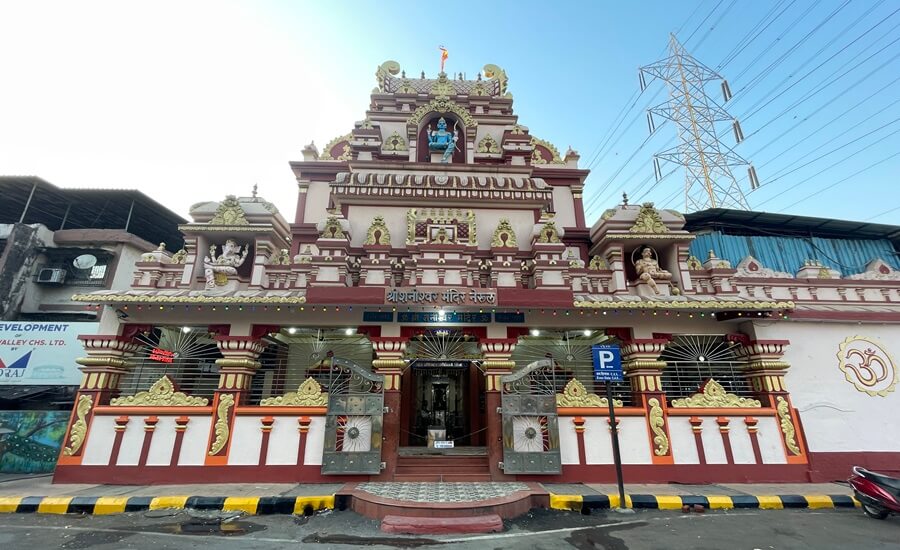
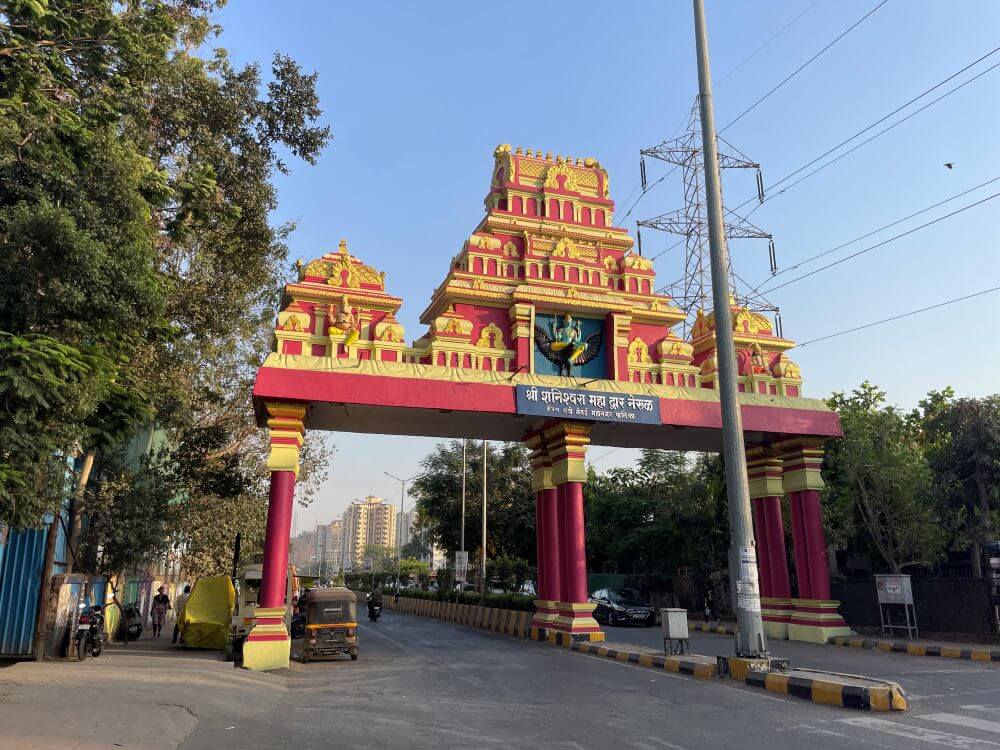
The temple of such Shani Dev is located in Nerul. Nerul is a suburb of Navi Mumbai. CIDCO, the organization that established this city, has provided plots of land here to various religious communities for their temples. Consequently, in specific wards of Nerul, there are temples of various deities established by devotees from different regions. This temple was established in 1992 through the ‘Shri Shanaishwar Seva Samiti’, which was formed by devotees originally from the Mangaluru region of Karnataka. Subsequently, in February 2015, on the occasion of the temple’s 22nd anniversary, the Ashtabandha Brahmakalashotsava was conducted. At that time, the Rajagopuram here was inaugurated by Dr. D. Veerendra Heggade, the Dharmadhikari of Shri Kshetra Dharmasthala.
This temple of Lord Shanishwara is situated on a large plot of land. The temple is constructed in the Dravidian architectural style. The structure of the temple consists of an Ovary (veranda), a Sabhamandapa (assembly hall), and a Garbhagriha (sanctum sanctorum). There is a circumambulatory path leading from the Sabhamandapa. The Ovary here is semi-open from the front. The Ovary has windows with steel bars at the front and a wide entrance in the center. Above it stands a Gopura adorned with attractive carvings. On the lower horizontal level of this, there is an idol of Lord Ganesha in the niche on the left, and an idol of Lord Hanuman in the niche on the right. In the niche on the upper part of the Gopura, there is an idol of Lord Shanishwara in a blessing posture. This idol is blue in color. The four-armed idol is seated on a high pedestal with the sole of the left foot resting on the knee of the right leg. One of its hands holds an arrow and another holds a bow. A large Kirtimukha is carved above the niche here.
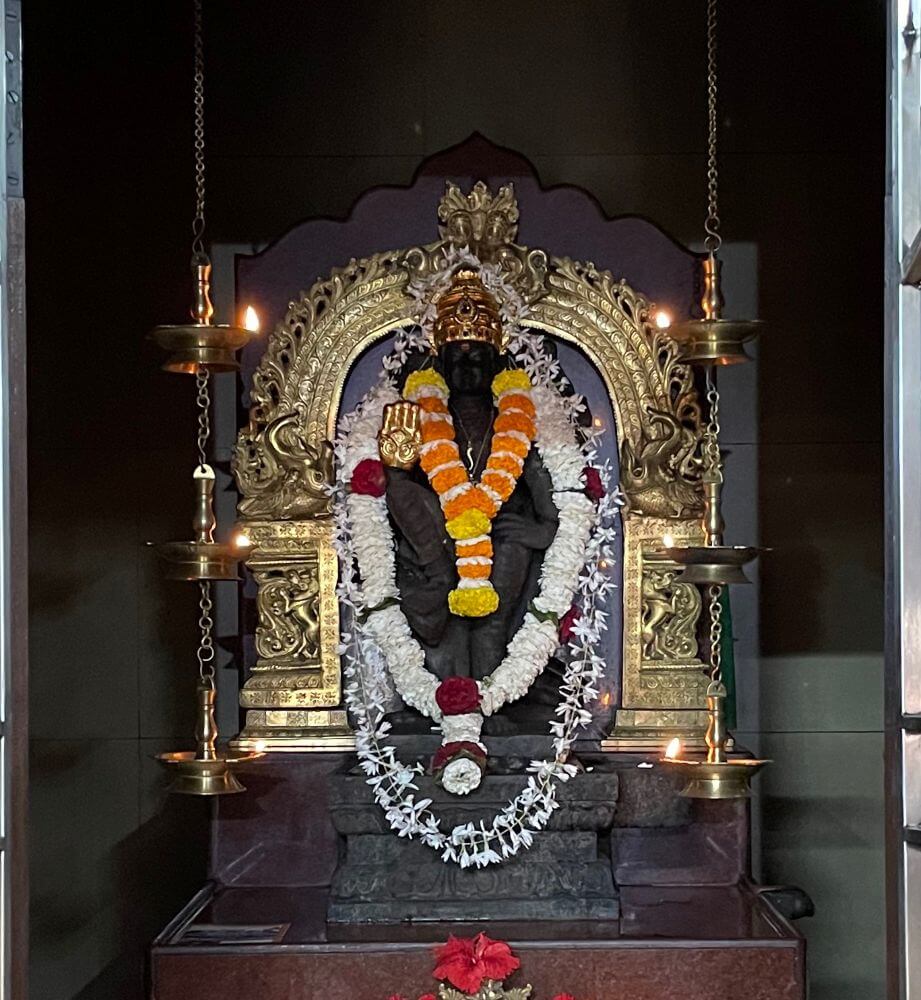
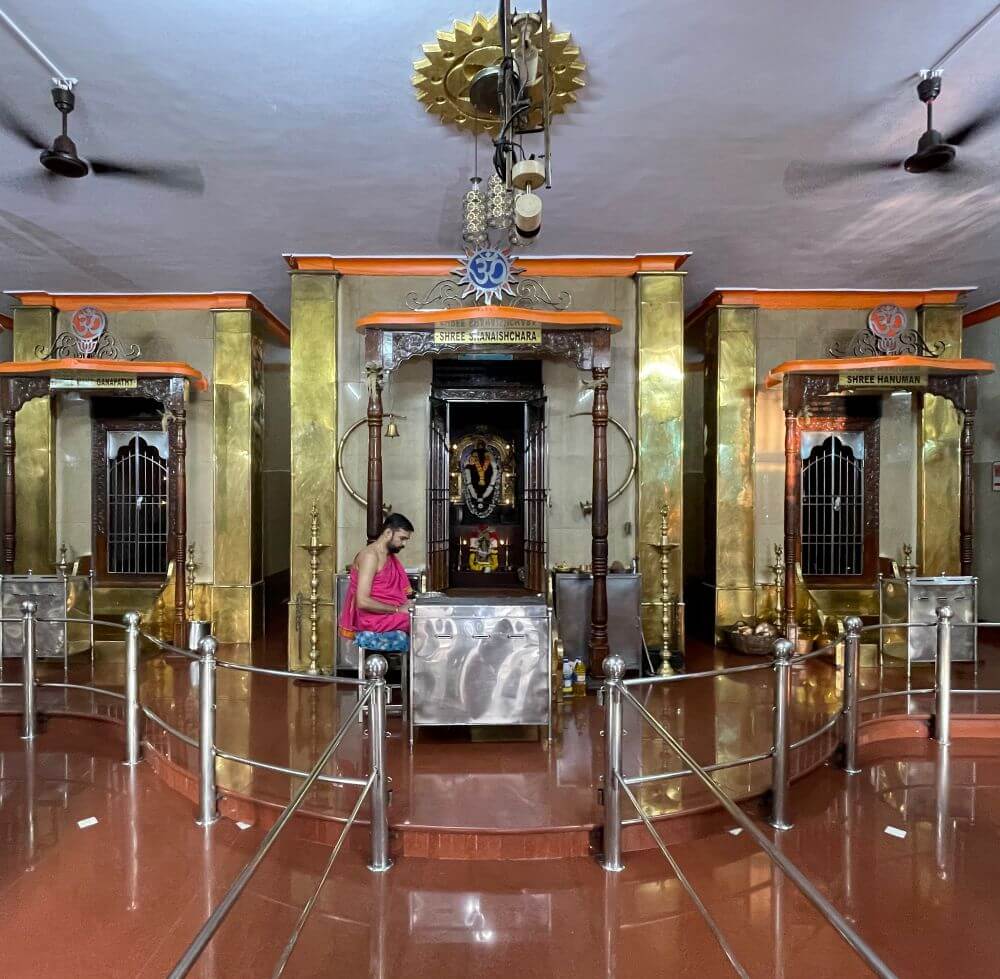
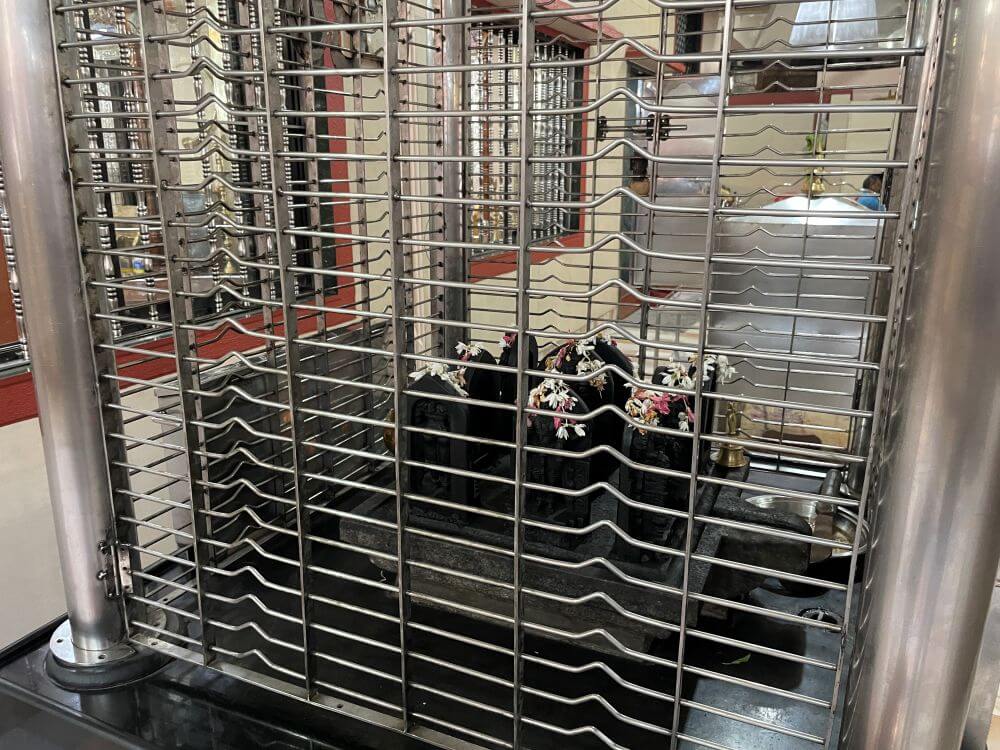
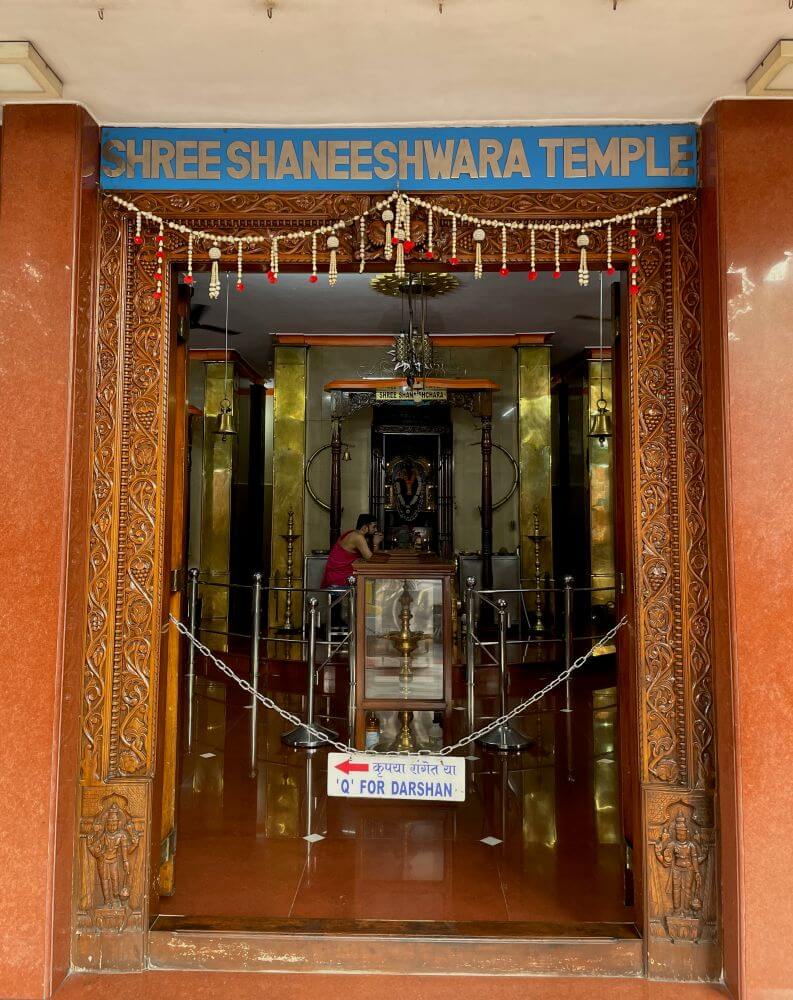
In the portico, there is a large oil lamp stand and a Tulsi Vrindavan. From here, one enters the main hall of the temple. Directly ahead is the sanctum sanctorum of Shani. Following the Dravidian architectural style, its structure consists of a small staircase with three steps, a front pavilion with wooden pillars, and the sanctum. Inside this sanctum, on a large pedestal, the idol of Shani, carved from black stone, is enshrined within a golden arch. Below the pedestal, there is also a smaller metal idol of Shani. The entrance to the sanctum is adorned with silver plating featuring intricate carvings. In the adjacent sanctums, the idol of Maha Ganapati is installed on the left, and the idol of Hanuman is installed on the right. To the right of the temple, there is another large portico where the idols of the Navagrahas are enshrined on a high platform. The temple office is also located here. Adjacent to this, at a slightly lower level, is a grand pavilion. Various religious festivals and cultural programs are celebrated in this space. Although the Shani temple has an entrance through the Rajagopuram, it is kept open only on special occasions. Therefore, entry to the temple is primarily through this side pavilion.
Every Saturday, this temple sees a large gathering of both South Indian devotees and Marathi devotees from the Nerul area. Major festivals like Shani Jayanti and Mahashivratri are celebrated here with great fervor. For the past twenty-five years, a chariot festival has been organized here every year in the month of February. This is considered one of the major chariot festivals in Navi Mumbai. Thousands of devotees from various walks of life in Navi Mumbai come to seek the blessings of Lord Shani on this occasion. During this time, the entire temple premises are decorated with vibrant lighting. The festival begins at six in the morning with religious rituals such as Kavata Udghatana and Navaka Pradana Havan. At eleven in the morning, programs like Ratharohana, Mahapuja, and Annasantarpana take place. This is followed by the Bali Utsava in the evening, and Avabhruta Snana, Mahapuja, and Annaprasada at night. A palanquin procession of the deity is carried out within the temple premises with traditional music and in accordance with South Indian religious customs. Folk arts from Karnataka are also performed during this festival, drawing thousands of citizens to witness them. Various rituals such as Yellu Deepa, Archana, Karpura Arati, Kesar Rice Puja, Ashtottara Puja, and Navagraha Puja are also performed in this temple. Many devotees bring their new two-wheelers or four-wheelers here for blessings. A special puja is conducted for them by the temple priests. This puja is available for a fee.
This sacred temple stands as a testament to deep spiritual devotion, ancient architectural grandeur, and rich local cultural traditions.
The sanctum sanctorum houses the divine idol consecrated according to ancient Vedic traditions, surrounded by serene courtyards and traditional temple architecture.
Navratri, Maha Shivratri, Annual Temple Jatra & Deepotsav
Compare and book flights, secure top-rated local hotels near the temple, hire reliable guides, and rent cars instantly.
Extend your pilgrimage by visiting other highly sacred temples located nearby.


Add ₹999 more to unlock FREE SHIPPING!
Your sacred cart is currently empty.
Shop Photo FramesFill in your delivery details below to place your order.
Add comment