
Add ₹999 more to unlock FREE SHIPPING!
Your sacred cart is currently empty.
Shop Photo FramesWherever the Yadava dynasty held power, Shiva temples are invariably found on the forts of those regions. These were places of deep reverence for kings, chieftains, administrative officials, royal gurus, and royal priests. Although the former glory of these state-patronized temples gradually faded over time, the existence of these temples has been preserved through the unwavering faith of the people. One such ancient temple is located on the Vilasgad fort near Yedenipani village in the Walwa taluka of Sangli district. This temple of Mallikarjuna, situated within a mountain cave on the fort, continues to maintain its existence even after hundreds of years, solely due to the devotion of the people.
The legend of Mallikarjuna is narrated in the 15th chapter of the Shri Kotirudra Samhita of the ‘Shiva Purana’, which states that once, Shiva and Parvati asked their two sons, Ganesha and Kartikeya, to circumambulate the Earth. While Kartikeya was returning from his circumambulation, he met Narada on the way. Narada told him that by sending you on the circumambulation, your parents have, behind your back You have performed the marriage of your younger brother. Hearing this, Kartikeya became enraged. He arrived at Mount Kailash, argued with his parents, and departed for Mount Krauncha. When Shiva and Parvati went there to persuade him, Kartikeya left that place as well. Saddened, Shiva and Parvati remained there, assuming a luminous form. That sacred Linga came to be known by the combined names of Mallika (Parvati) and Arjuna (Shiva).
Regarding the site of Mallikarjuna at Vilasgad, the legend states that thousands of years ago, Sage Agastya resided in the caves here along with his family. It was during that time that he consecrated this Shiva Linga. The stone construction of the temple’s assembly hall (sabhamandapa), built in the Hemadpanti architectural style, is said to date back to the thirteenth century (the Yadava period). In recent times, a three-hundred-year-old inscription was discovered near the entrance gate within the temple fortifications. It records the renovation of the temple walls. The Vilasgad fort, where this temple is located, is one thousand years old. Later, this fort It was under the control of Adil Shah. In the year 1717, this fort came under the possession of Chhatrapati Sambhaji II of Kolhapur. References are found regarding a resolution passed in the year 1798 to renovate the fort. In ancient times, this fort was used for surveillance.
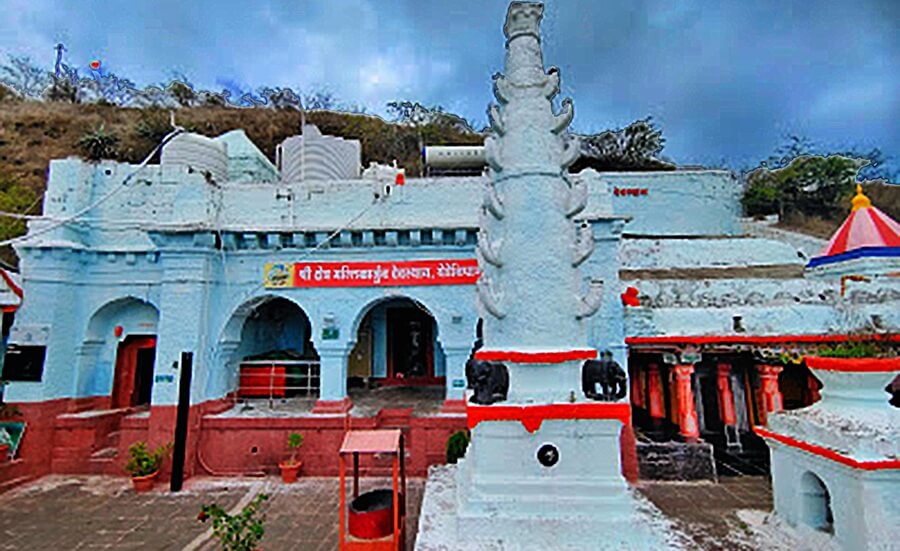
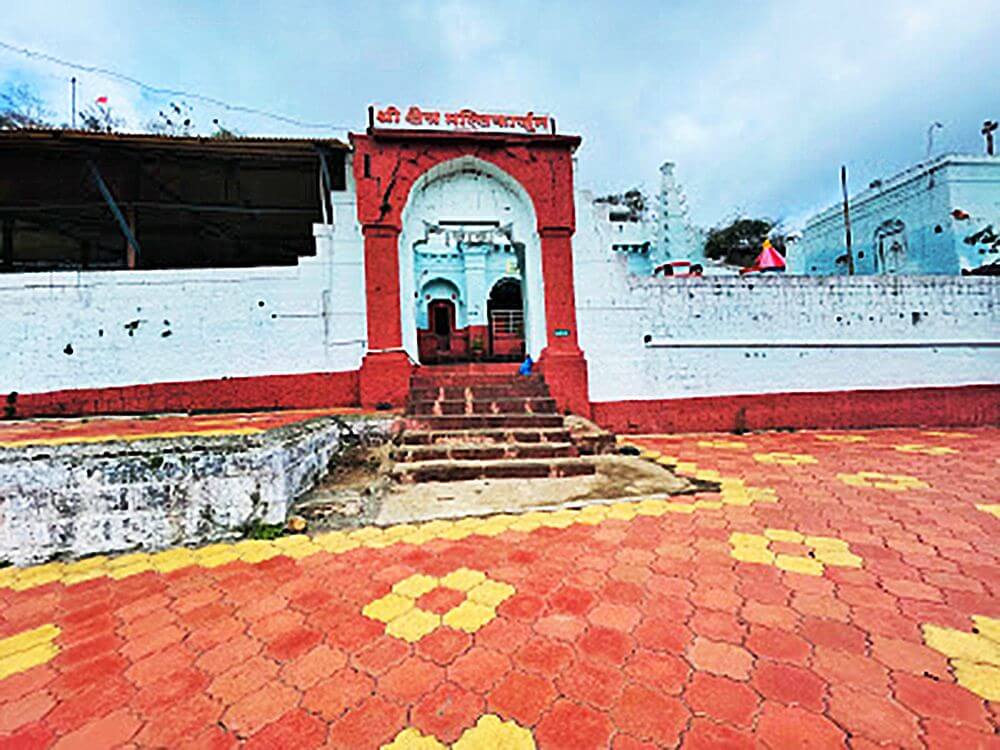
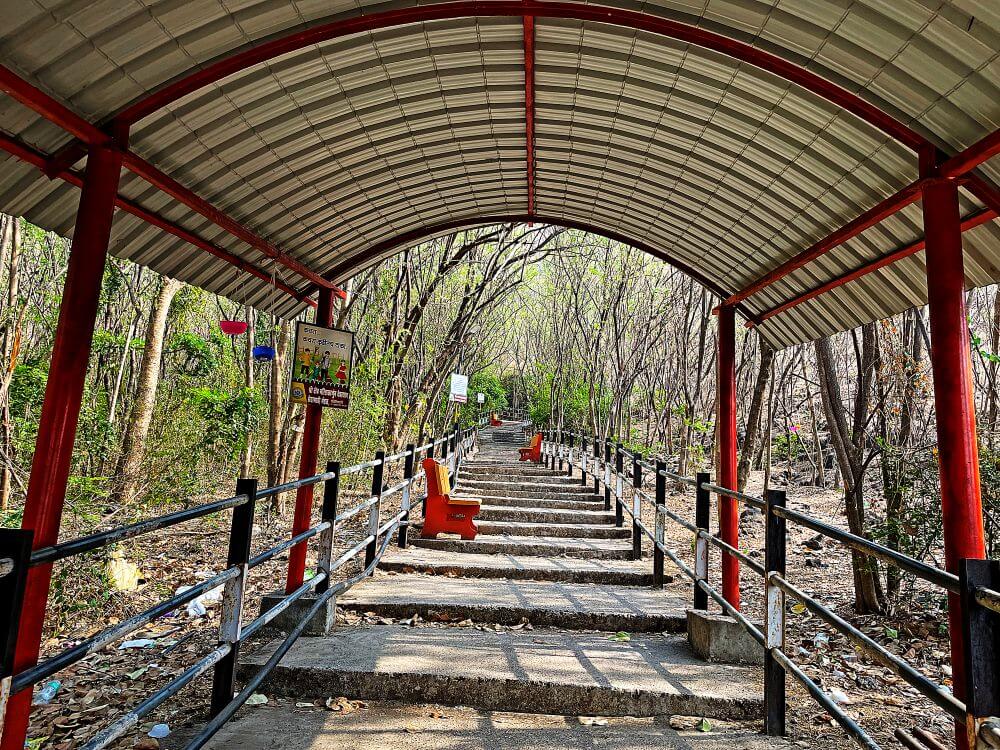
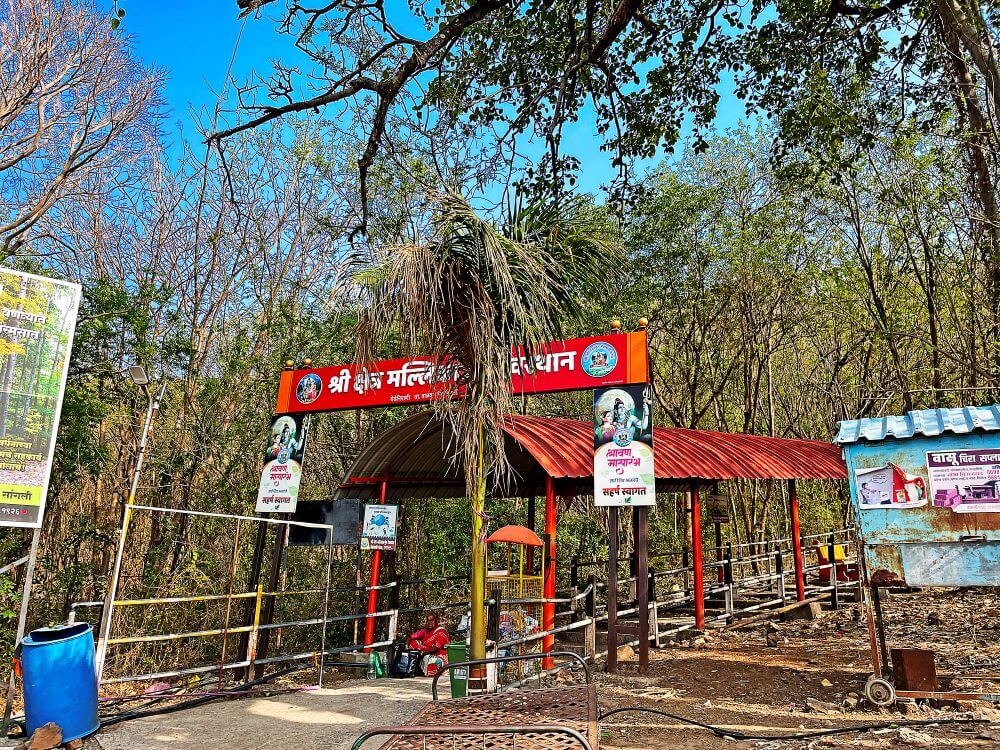
To reach the fort, there are steps built from carved stone leading from the foothills to the temple, with safety railings on both sides. There are seats provided along this path for the convenience of devotees. It is said that these new steps have been constructed directly over the ancient rock-cut staircase. Both sides of this path are covered in dense forest on the mountain. Upon reaching the top of the path, there is a flat ground paved with paver blocks. On one side of this ground stands the fortification wall of the temple. Except for the caves here, the entire structure of the temple is built in the Hemadpanti architectural style.
There are seven steps at the entrance of the temple. From here onwards, the temple is paved. There is a courtyard. In the courtyard, facing the entrance, there is a raised platform with a stone pillar upon it. To the side is a Tulsi Vrindavan. Next to the Tulsi Vrindavan, on another platform, stands a two-tiered circular Deepmala (lamp tower). On the four sides of the square base of the Deepmala are four elephant sculptures, and there are 24 separate hands for lighting lamps. Lamps are lit on this Deepmala only once a year, on Mahashivratri. Further ahead are the two front pavilions (Mukhamandapas) of the temple.
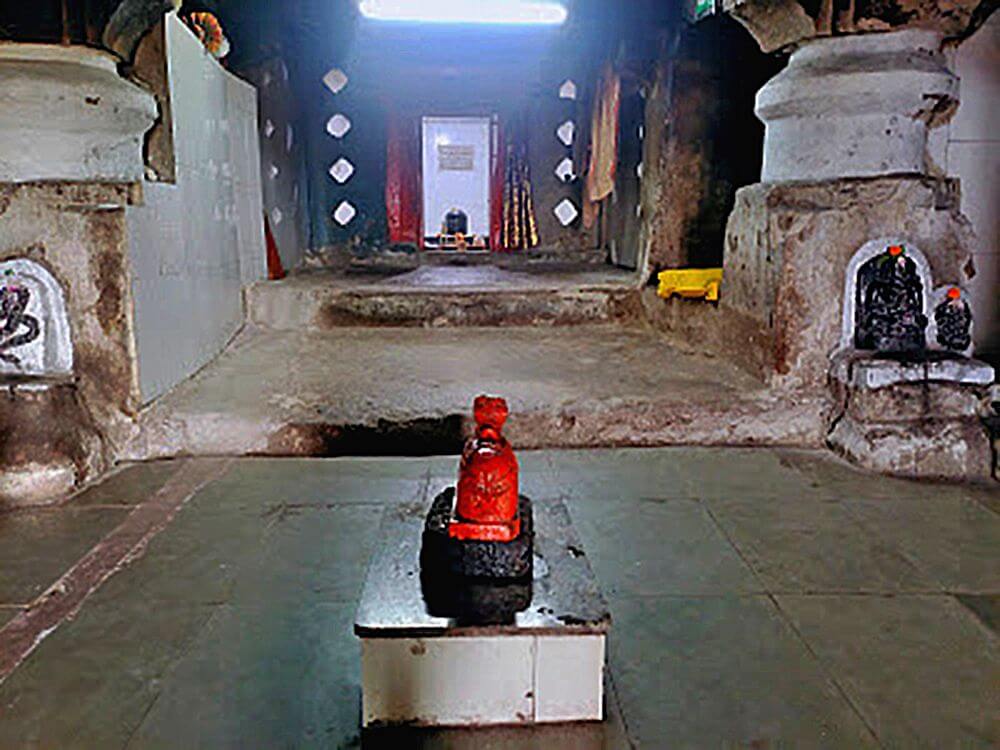
In the assembly hall (Sabhamandap), on the left side against the wall, there is a sculpture of a married woman visiting her parental home (Sasurwashin) in a niche, which resembles a Sati stone. It is said that a devout woman who was visiting her parental home disappeared at this very spot. Next to this sculpture, in another niche, is the Kotling (Shivling). It is said that there are ten million miniature lingas on this Shivling. In the next niche, there are two stone lingas known as Bhimashankar and Uma Shankar, with a trident (Trishul) placed in front of them. In front of the niche, there is a sculpture of a five-hooded serpent carved in black stone, and a Nandi smeared with vermilion on a pedestal. It is a small idol. Devotees believe that if one lifts this idol using the palm of one hand and three fingers of the other, the wishes in their heart are fulfilled. Further ahead, near the pillar, is the idol of Rishikesh, and to the side, in the sanctum, is the idol of Kartikeya Swami. Outside the chamber of Kartikeya Swami, there is a large stone slab (sahan) on the ground, upon which rests a large log of sandalwood. Every morning at dawn, sandalwood is ground on this slab and applied as a sacred paste (chandan-uti) to all the deities.
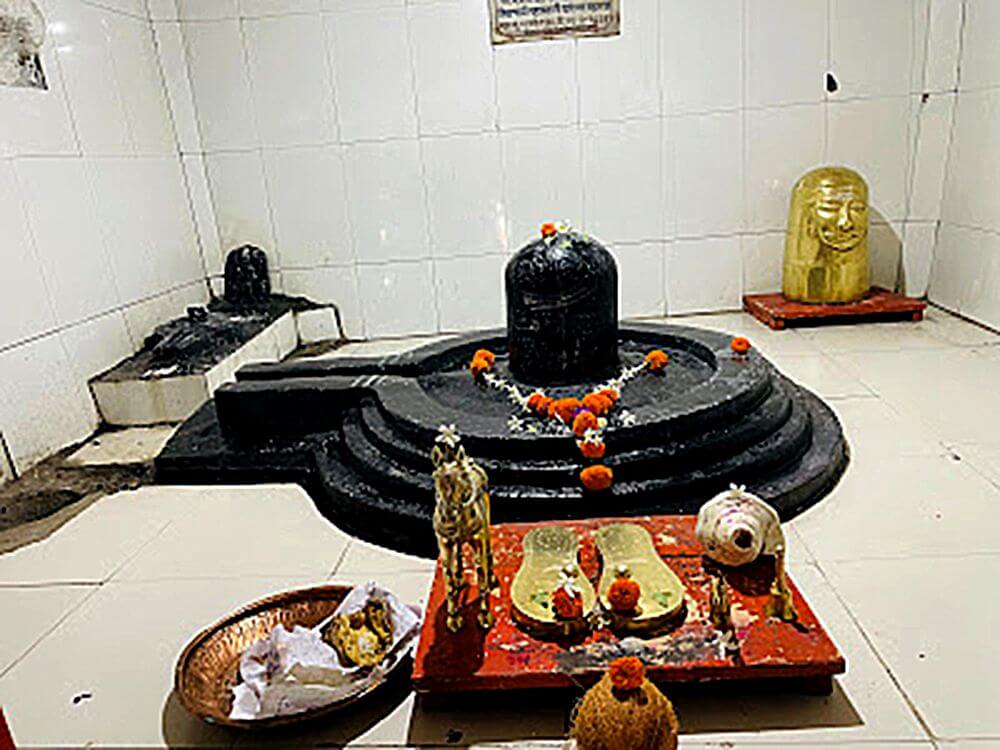
Ahead lies the intricately carved entrance to the sanctum sanctorum (Garbhagriha). The door frame and the lintel are adorned with floral and leaf motifs, with an image of Lord Ganesha carved on the central panel (Lalatbimba). The frame of the entrance is smeared with vermilion (Shendur). In the center of the sanctum, on the floor, resides the Swayambhu (self-manifested) Shiva Linga of Somnath. It is said that beneath this Linga, there is a stone tortoise embedded in the ground. Nearby, on a Vajrapitha, are the stone idols of other deities.
In front of this sanctum sanctorum is the main sanctum of Mallikarjuna. The door frames of the sanctum are adorned with floral carvings, and the lintel features a sculpture of Lord Ganesha. In front of the entrance, there are ancient idols of Ganesha and a five-hooded serpent (Panchaphani Naga) housed within a decorative arch (Makhar). Inside the sanctum, the Mallikarjuna Shiva Linga is installed upon a Vajrapitha. It is believed that this Shiva Linga was consecrated by Sage Agastya. In the chamber adjacent to the sanctum, there is an idol of Nandi carved from black stone, depicted with its head turned, resting on a Vajrapitha. On the wall behind Nandi, the Saptamatrika panel is carved. One can enter the cave chamber through a doorway located in the center of the assembly hall (Sabha Mandapa). The Mallikarjuna Linga is present in this chamber. Beside the temple, in the Basaveshwara temple, there is an idol of Nandi. The kitchen is located here as well, where the daily offering (Prasad) for the deity is prepared. It is believed that once the fragrance of the Prasad reaches this Nandi, the offering is considered accepted by all the deities.
To the left of the temple is a small shrine dedicated to Kalbhairavnath. On the lalatbimba (lintel) of the entrance, there is a sculpture of Lord Ganesha, and on both sides of the entrance, there are two horse-faced figures. Inside the temple, on a vajrapitha (sacred pedestal), are the black stone idols of the deities Bhairavnath, Kalbhairav, Jugai, and Janai.
At a short distance from the temple lies the Patalganga Cave Well, which is enclosed by a railing. The water from this well is used for drinking purposes. There are steps carved into the rock to descend into the well. A short distance from this well is a small temple containing three Shiva Lingas and some ancient stone relics. The stone-constructed temple features a shikhara and a kalash. In front of the temple stands a black stone idol of Nandi. Mahashivratri is the main annual festival celebrated at the temple. Throughout the month of Shravan, there is a large influx of devotees seeking the darshan of the deity. During the annual festivals, bhajans, kirtans, pravachans, music programs, and Mahaprasad are organized at the temple.
This sacred temple stands as a testament to deep spiritual devotion, ancient architectural grandeur, and rich local cultural traditions.
The sanctum sanctorum houses the divine idol consecrated according to ancient Vedic traditions, surrounded by serene courtyards and traditional temple architecture.
Navratri, Maha Shivratri, Annual Temple Jatra & Deepotsav
Compare and book flights, secure top-rated local hotels near the temple, hire reliable guides, and rent cars instantly.
Extend your pilgrimage by visiting other highly sacred temples located nearby.


Add ₹999 more to unlock FREE SHIPPING!
Your sacred cart is currently empty.
Shop Photo FramesFill in your delivery details below to place your order.
Add comment