
Add ₹999 more to unlock FREE SHIPPING!
Your sacred cart is currently empty.
Shop Photo FramesThe self-manifested shrine of Shri Biroba at Ashta is renowned as the revered deity of the Dhangar community and the object of faith for people from all eighteen traditional castes. The spacious temple of Shri Biroba, the guardian deity of Ashta town, is unique in many respects. It is said that the non-vegetarian food offering, which takes place once a month, never falls short, no matter how many devotees arrive. During festivals, tons of non-vegetarian food are prepared for the surging crowds. A special feature here is that Shri Biroba visits devotees’ homes in the form of His masks. He is always on tour for auspicious ceremonies and festivals.
The tale of Shri Biroba is recounted thus: In ancient times, Padmanā and Sidrāmā, sons of Hanagū Jagadāḷyā, were tilling their fields. As they ploughed, they also guided their plough over a large anthill in the field. At that moment, they noticed some sheep and a golden casket within the anthill. Upon opening the casket, they beheld a young girl inside. The two of them, along with the casket and the girl, She was entrusted to the king. The king named her Suravanti and raised her as his own daughter. When Suravanti came of age, the king wished to arrange her marriage. However, she conveyed to the king that she would never marry.
One day, Suravanti chanced upon a calf suckling its mother. Witnessing this sight, her maternal instincts awakened, and she yearned deeply for a child of her own. Yet, her resolve to remain unmarried was unwavering. She commenced a vow to attain motherhood without a husband. Pleased by her devotion, Lord Shankara and Devi Parvati instructed her to partake of a lamp as prasada, made from the essence of grain without clouds, fruit without blossoms, and ghee from the milk of wild cows. With the assistance of Garuda, she procured all these ingredients and consumed them as prasada. At that very moment, a divine spark of Lord Shankara entered Suravanti’s womb. After some time, Suravanti gave birth to a son, who was none other than Biroba. Though Biroba is the family deity of the Dhangar community, in Maharashtra, He is also revered as a fierce deity. It is known.
The legend of the temple states that the region was plagued by evil forces, causing great distress to the citizens. At that time, a devotee had a dream vision of a Kāśī Liṅga in the forest. Following this vision, he searched and was blessed with the darśan of Birobā in the form of a Liṅga. He then built the temple at the very spot where he was commanded to do so in his dream. This temple later became renowned as the Kāśīliṅga Birobā Mandir. According to another legend, a great ascetic performed severe penance to free this region from evil forces. Pleased by his devotion, Mahādev appeared before him and commanded him to establish a Śivaliṅga at that very spot.
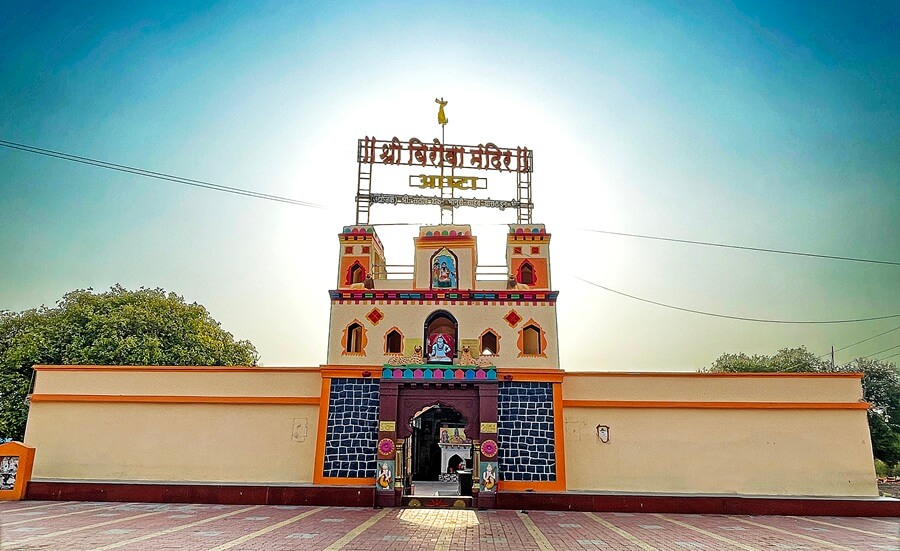
This spacious temple of Shri Biroba stands in the heart of Ashta city, right alongside the highway. The large courtyard in front of the temple is paved with paver blocks, which makes the area appear clean and beautiful. Beyond this lies the temple’s rampart, approximately १२ feet high, featuring a distinctive three-storied entrance. On both sides of the arch-shaped entrance are sculptures of Dvarapalas and lotus flowers in high relief. Above the entrance is a Bashingi parapet, with sculptures of two tigers on either side and a murti of Bhagavan Shankara in the centre. Inside the entrance are guardrooms. On the temple-facing rear side of the entrance, there are paintings depicting various individuals from society. Additionally, there are paintings of a cow suckling its calf, a lion, a horse, and a donkey. Adjacent to the entrance, there is a staircase leading to the rampart.
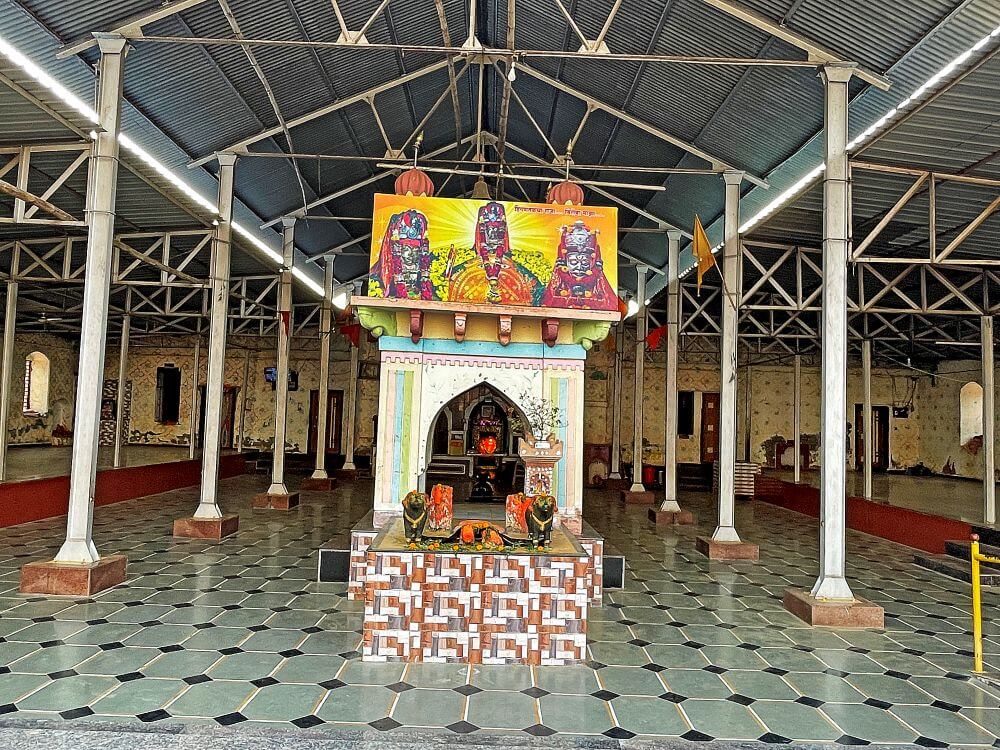
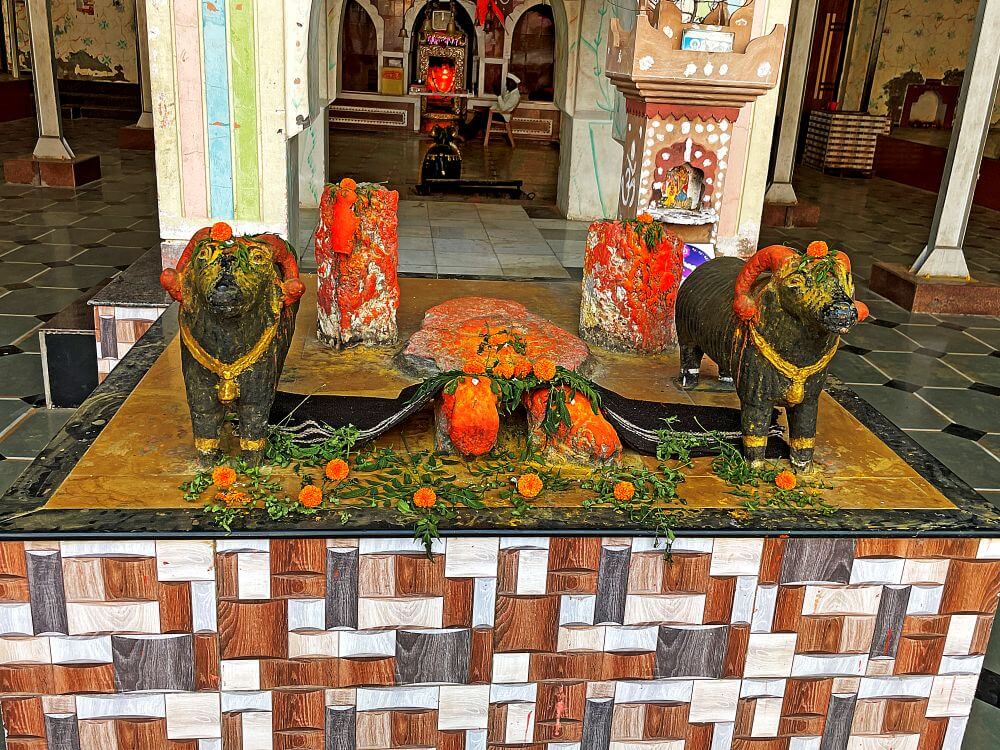
In front of the Mandir, upon a large platform, stands a distinctive Deepamaal. This hexagonal Deepamaal, with its lower platform and upper finial, takes the form of a lotus blossom. Further ahead is the open Sabhamandap of the Mandir. For the convenience of the devotees, a tin shed has been erected over this Mandap. As Biroba is a manifestation of Bhagwan Shankar, Nandi has been consecrated within this Mandap. Behind Nandi, on the platform, are stone sheep on both sides. Two similar sheep are also present on the platform outside the Mandir.
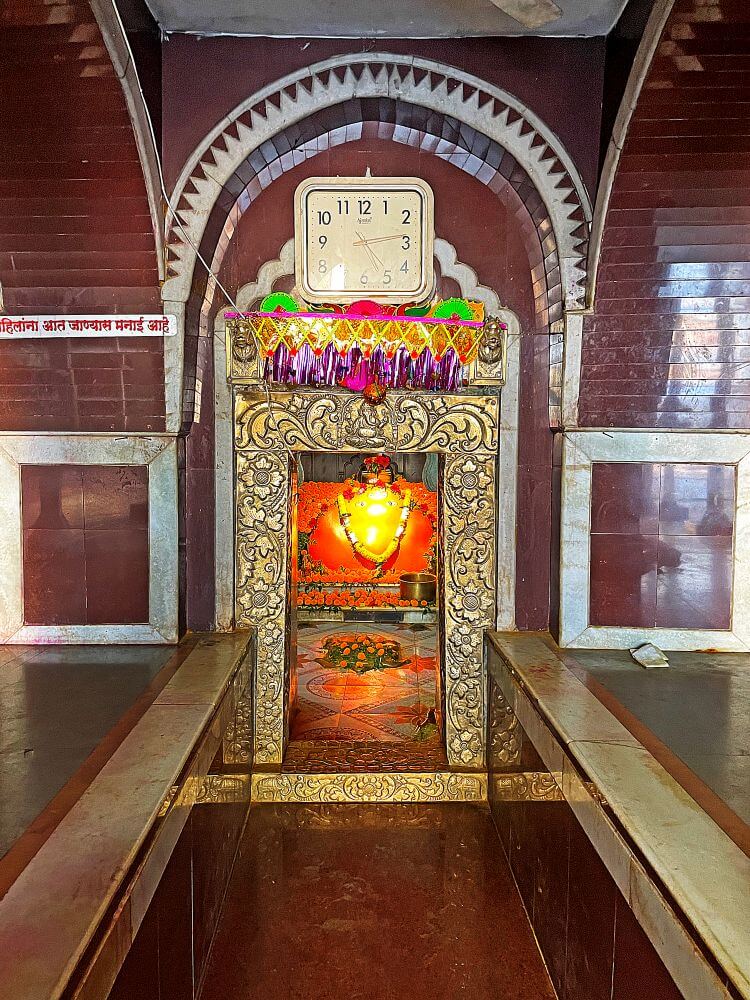
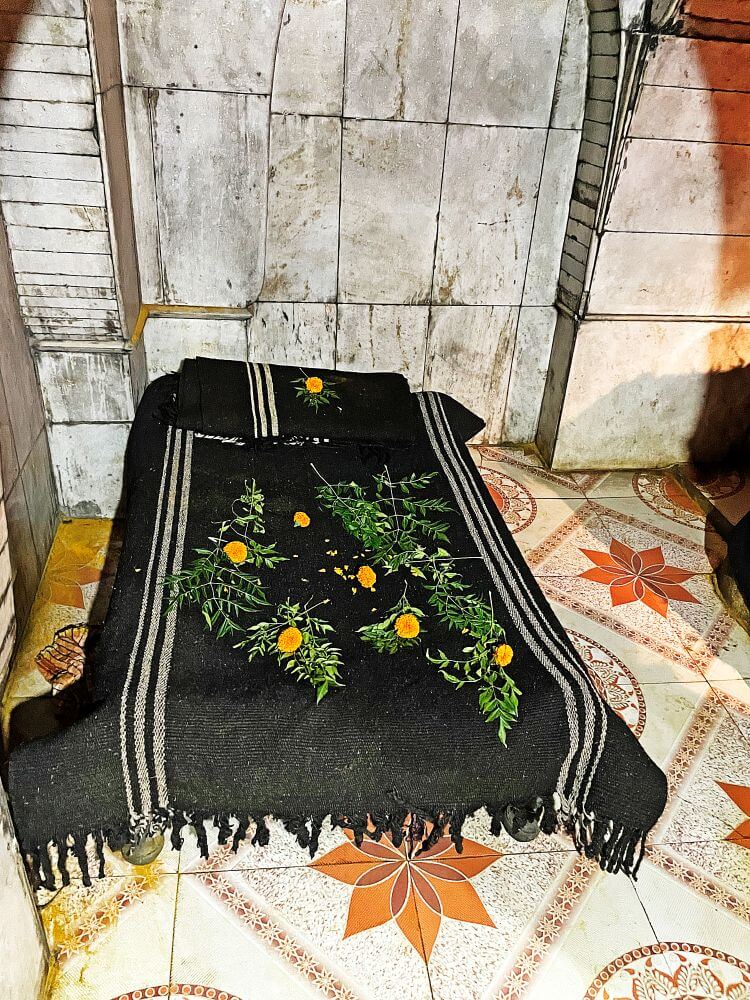
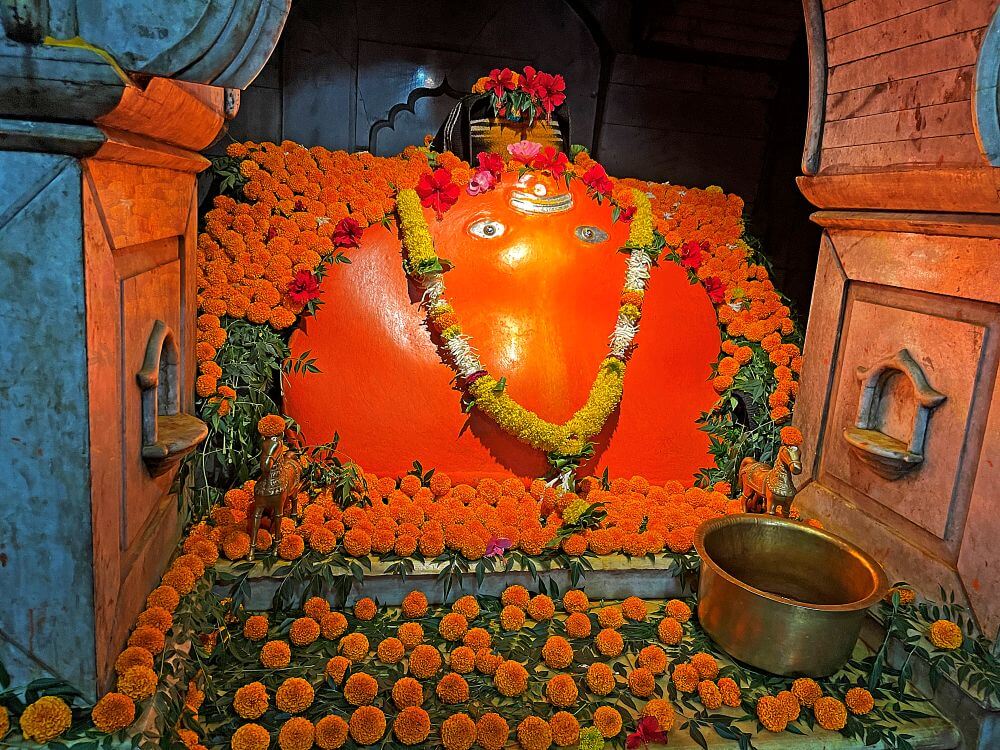
In front of the sacred Nandi murti, there is an antarala adorned with three arches. Around these arches, one can behold sculptures of two sheep. Above these arches, on the upper level, there are three more arches. The dwarashakhas of the garbha-griha are beautifully embellished with intricate carvings. They are covered with silver plating, and at the lalata-bimba, there is a sacred murti of Shri Ganapati. Within the garbha-griha, there is a brass tortoise, and in front of it, the svayambhu stone of Birhoba. The tilak on the murti’s forehead and the eyes are crafted from silver. To the left of Birhoba, there is a bed adorned with a ghongadi (wool blanket) specially prepared for Him. At the rear of the temple, there is a goshala, and within the temple precincts, a well-equipped bhakta-nivas for pilgrims.
Every three years, there is a grand Yatra of Shri Biraba. For this triennial festival, a large throng of devotees gathers. They are offered Mahaprasad of non-vegetarian food. …we go. It is said that thousands of years ago, a Siddha Purusha initiated this tradition to avert a crisis from the village. That day was a Tuesday. Therefore, this Yatra takes place every three years on the Tuesday following Akshaya Tritiya. It is also known as the Thorali Jatra. At other times, a Yatra is held here every year on Gudi Padwa. Thousands of devotees gather here to listen to the ‘Bhaknuk,’ or prophecy, that takes place during this Yatra. During this time, the Hedam dance is performed with abandon. Dhangari Ovis are sung. There is an immense showering of Bhandara. The palanquin procession sets out amidst the resounding beats of Dhangari Dhol and Kaitala. Witnessing the enthusiasm and decorations during this festival—
My Lord, who is made of gold, resides in a golden temple.
Where nine lakh constellations descend
Such is the divine abode of my Kāśiliṅga.
Such a composition, lovingly offered by a devotee, truly seems to manifest before our very eyes…
This sacred temple stands as a testament to deep spiritual devotion, ancient architectural grandeur, and rich local cultural traditions.
The sanctum sanctorum houses the divine idol consecrated according to ancient Vedic traditions, surrounded by serene courtyards and traditional temple architecture.
Navratri, Maha Shivratri, Annual Temple Jatra & Deepotsav
Compare and book flights, secure top-rated local hotels near the temple, hire reliable guides, and rent cars instantly.
Extend your pilgrimage by visiting other highly sacred temples located nearby.


Add ₹999 more to unlock FREE SHIPPING!
Your sacred cart is currently empty.
Shop Photo FramesFill in your delivery details below to place your order.
Add comment