
Add ₹999 more to unlock FREE SHIPPING!
Your sacred cart is currently empty.
Shop Photo FramesChiranjeevi Hanuman is the source of inspiration for ascetics. To the common householder, Sankatmochan Hanuman appears as a savior who rescues them from distress. As a deity of strength, Swami Samarth, a worshipper of Shakti, established Hanuman temples in various villages. There are many such temples of Maruti, both established and Swayambhu (self-manifested), in numerous villages. One such ancient and famous Swayambhu Maruti temple is located in the village of Dongarwadi in Walwa taluka. Devotees firmly believe that the Jagrut Maruti here grants their wishes and rescues them from their troubles. It is for this reason that thousands of devotees visit this temple for darshan every Saturday.
About 900 years ago, Lord Hanuman appeared in a dream to a devotee from the village of Dongarwadi and revealed His presence at that location. Following the vision, the villagers searched the dense forest area and discovered this Swayambhu (self-manifested) stone idol. At that time, the villagers performed an abhishek of the idol and constructed a small temple. Since the installation of this Hanuman, the consumption of non-vegetarian food has been prohibited in the village. It is said that this Hanuman strictly forbids non-vegetarian food and kerosene. Consequently, no one in the village uses kerosene to light lamps, stoves, or hearths. Even when there was no electricity in the village, kerosene was not used for any purpose. To perform the last rites for the deceased, edible oil is used instead of kerosene in this village. This tradition has been followed in the village for many years.
One of the unique features of this place is that no one builds a house near this temple. Not only that, but the houses that were previously there were also moved away. Regarding this, a legend is told that when Hanuman manifested in the village of Dongarwadi, A devotee here had a divine vision: “I do not wish for worldly life around Me. The villagers should pull a bullock cart from the temple, and wherever it breaks down, that is where this village should be established.” Following this, the bullock cart broke down approximately one kilometer away from the temple. As per the divine vision, all the families residing near the temple subsequently relocated to the area where the cart had broken down. For this reason, even today, no one builds a house near this temple.
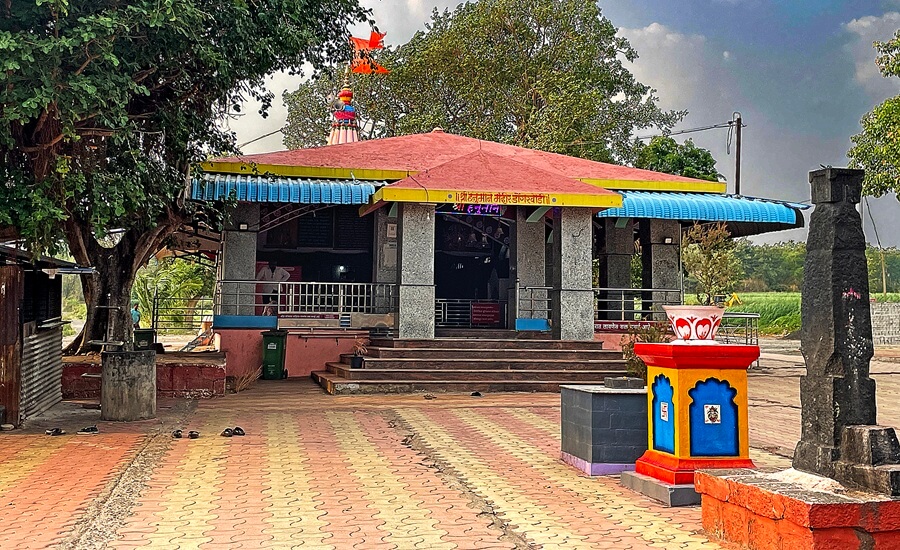
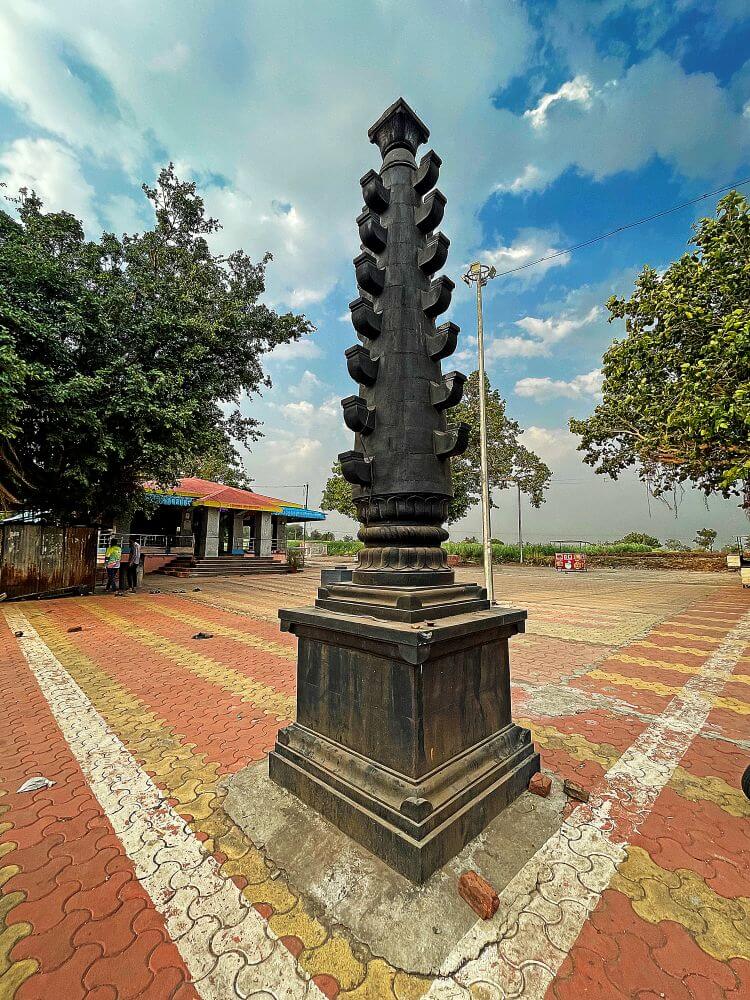
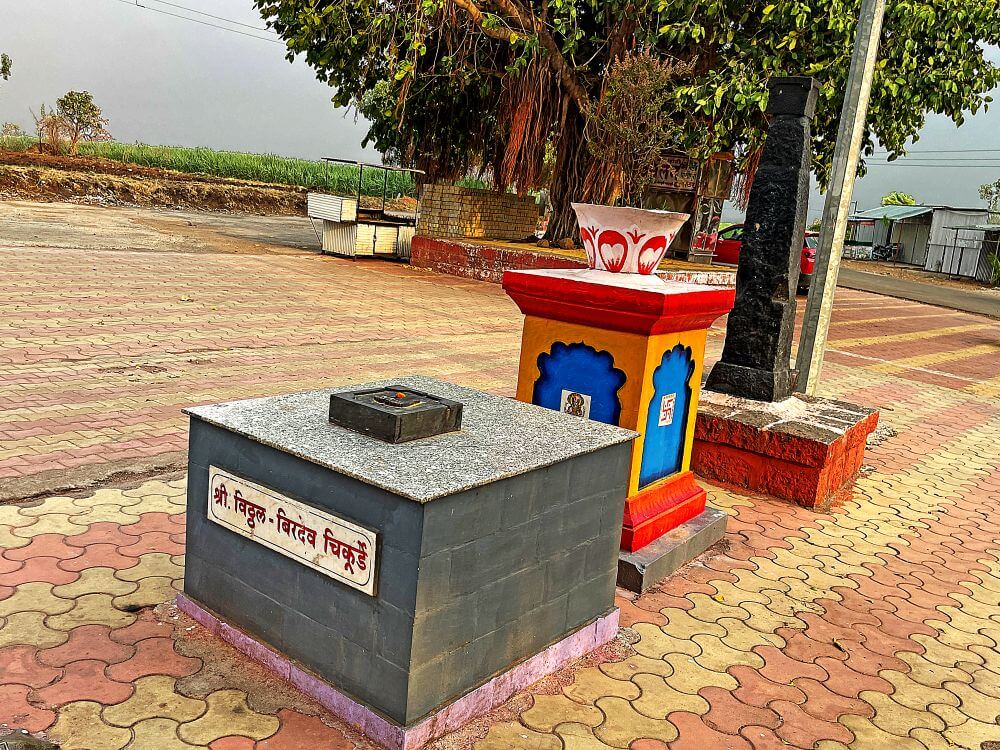
In the spacious, paver-block-covered courtyard of this temple, there is a platform (chautara) featuring a deepmala (lamp tower). The deepmala has separate arms for lighting the lamps. Beside the banyan tree in the courtyard, there is another platform with a pillar. Nearby is the Tulsi Vrindavan, and further ahead, on a platform, are the padukas (footprints) of Vitthal Birdev. The temple is situated further ahead on a high plinth (jagati).
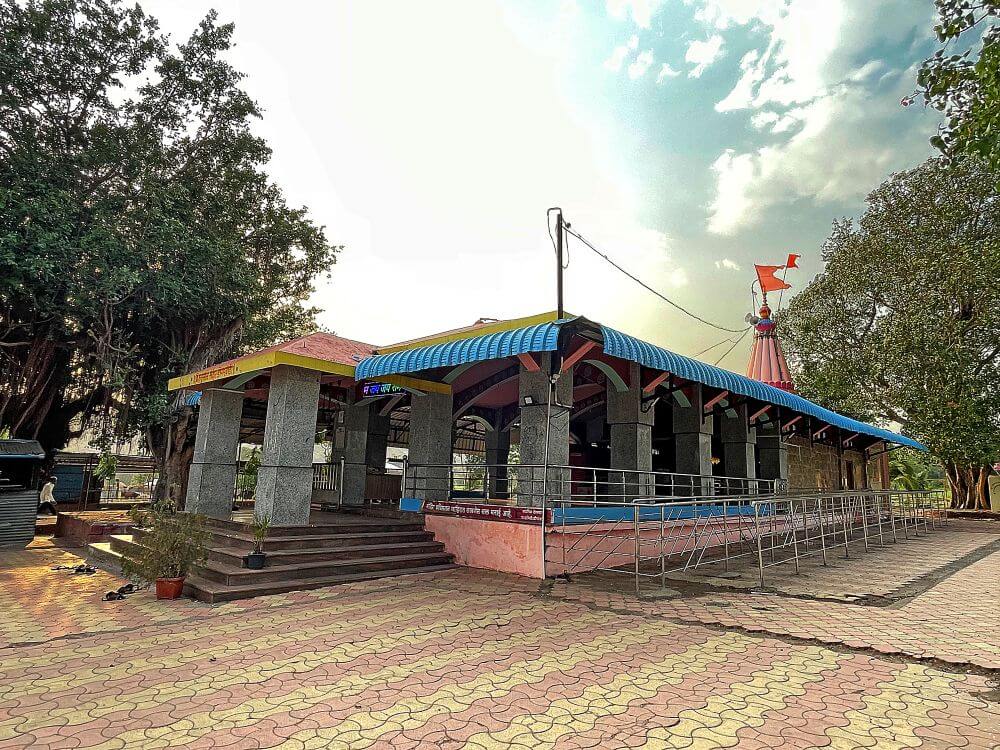
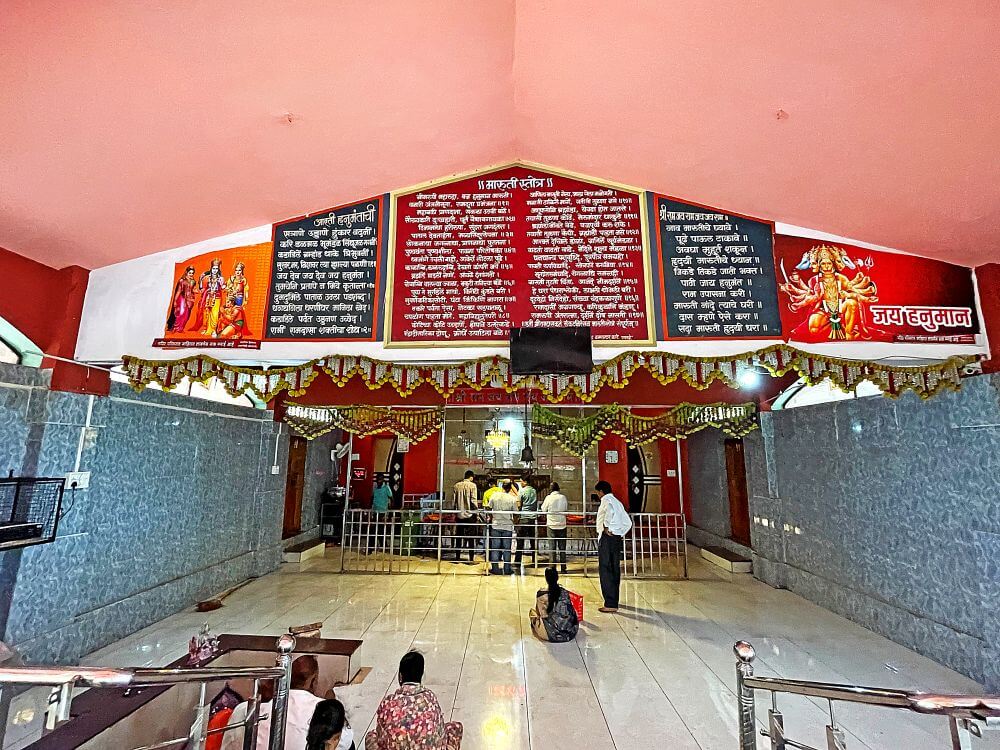
One enters the temple’s front hall (Mukhamandapa) by climbing five steps from the courtyard. The temple’s structure consists of a front hall (Mukhamandapa), a main assembly hall (Sabhamandapa), an intermediate chamber (Antarala), and the sanctum sanctorum (Garbhagriha). There are two square pillars in the front section of the Mukhamandapa. Ahead of the Mukhamandapa (entrance hall) is the Sabhamandapa (main assembly hall), which is slightly elevated. This open-style Sabhamandapa features four rows of five square pillars each. The pillars support beams, which in turn support the roof. On the exterior side of the Sabhamandapa, there is an arrangement for a queue for the convenience of devotees. The Sabhamandapa has a square roof topped with a Kalasha. Beyond this, on both sides, is the enclosed Antarala (vestibule). The Antarala has windows to ensure proper ventilation. In a square, recessed area within the Antarala, the stone idol of the deity is placed. Here, devotees perform the ‘Kaul’ ritual (seeking divine guidance). Additionally, there is a Shivlinga and a brass idol of Lord Ganesha. Along the walls of the Antarala, on a Vajrapitha (raised pedestal), are the idols of Shri Ram, Lakshman, Sita, and Hanuman.
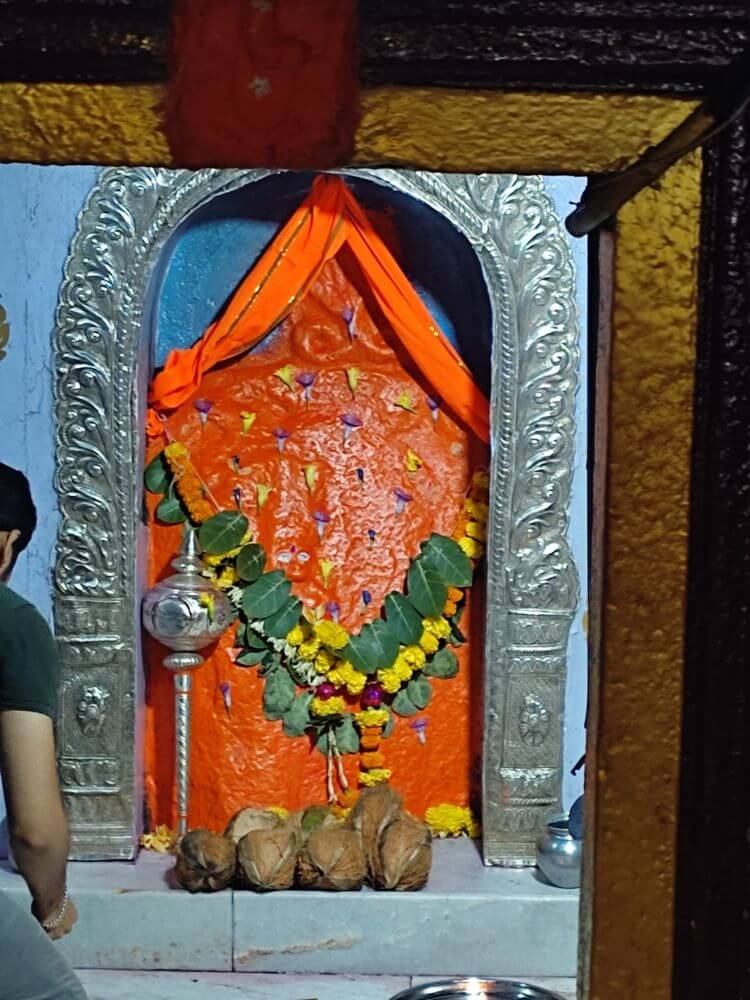
Ahead is the entrance to the sanctum sanctorum (Garbhagriha). On the lintel (Lalatbimba) is Lord Ganesha, and the door frame is adorned with floral and leaf carvings. Inside the sanctum, on a Vajrapitha, stands the vermilion-anointed Swayambhu stone idol of Lord Hanuman, with a silver mace placed beside it. Above the sanctum is a tall, two-tiered tapering Shikhara. The first tier of the Shikhara features twelve niches (Devakoshtakas) topped with miniature spires. In the center of the Shikhara is a lotus-petal ring, and the second tier above it is decorated with vertical fluted carvings. At the pinnacle of the Shikhara are two Amalakas stacked one above the other, crowned by a Kalasha and a temple flag (Dhwajapataka).
In the temple premises, there is the temple of Lord Yedoba. Outside this temple, on a raised platform (chautara), there is a Nandi, and further ahead, a tortoise (kasav). Inside the temple, on a vajrapitha, is the idol of Lord Yedoba mounted on a horse, and beside it is the idol of Dattatreya. Further from here is the temple of Goddess Dongrai. In the temple, there is an idol of Goddess Dongrai and a stone (pashan). Beside this temple is the Saptamatrika temple. Inside the temple, on a vajrapitha, are the Saptamatrika-pat and stones of other deities. In the premises, there is an Annachhatra mandap. Here, Mahaprasad is organized during all annual festivals as well as every Saturday.
A grand fair is held here on the fourth day of Gudi Padwa. On that occasion, Sasan-kathis from the surrounding villages arrive here. Apart from this, annual festivals such as Hanuman Jayanti, Chaitra Padwa, Ram Navami, and Mahashivratri are celebrated. During all these festivals, thousands of devotees come to seek the blessings of the deity and to fulfill their vows. Every Saturday, a large crowd of devotees gathers here for the darshan of the deity.
This sacred temple stands as a testament to deep spiritual devotion, ancient architectural grandeur, and rich local cultural traditions.
The sanctum sanctorum houses the divine idol consecrated according to ancient Vedic traditions, surrounded by serene courtyards and traditional temple architecture.
Navratri, Maha Shivratri, Annual Temple Jatra & Deepotsav
Compare and book flights, secure top-rated local hotels near the temple, hire reliable guides, and rent cars instantly.
Extend your pilgrimage by visiting other highly sacred temples located nearby.


Add ₹999 more to unlock FREE SHIPPING!
Your sacred cart is currently empty.
Shop Photo FramesFill in your delivery details below to place your order.
Add comment