
Add ₹999 more to unlock FREE SHIPPING!
Your sacred cart is currently empty.
Shop Photo FramesBattis Shirala is a historic village, renowned for the worship of live serpents during Nagpanchami. On the day of Nagpanchami, a grand procession of live serpents used to be taken out here. Ambabai is the presiding village deity (Gramdevata) of this village, and Her ancient temple here is famous. A month before Nagpanchami, the villagers would seek divine permission (Kaul) from Ambabai before commencing the capture of serpents, and the first Nagpuja (serpent worship) would be performed in this very temple. It is said that this Nagpuja has a tradition spanning eight to nine hundred years. However, since 2002, due to judicial restrictions on serpent worship, an idol (Nagpratima) is now worshipped instead of live serpents.
This ancient temple, built of stone, is said to date back to the thirteenth century. Adinath Bhairav, born in the village of Nighoje near Pune, composed the sacred text ‘Nathleelamrut’ in 1834 CE, in Vitakshetra, which is the village of Vite in Sangli. According to this text, the worship of live serpents began in Shirala due to Guru Gorakshanath. Guru Gorakshanath was a revolutionary Siddha who purified Indian spiritual practices by initiating a movement against Vamachari Tantra sadhanas. Due to his profound work, Sant Dnyaneshwar revered him as ‘Vishayvidhvansakaiveer,’ meaning a valiant hero who destroys worldly attachments. His period is considered to be from 1050 CE to 1150 CE. He primarily resided in the region of Tryambakeshwar. Once, he arrived at Shriyalpur, which is present-day Shirala.
In the tenth chapter of ‘Nathleelamrut,’ it is stated: ‘From there (meaning Matsyendragad), they swiftly departed. Then they arrived at Shriyalpur. There, the son of Matsyendra (Matsyendranath) descended into the town.’ That day was Nagpanchami. As per his daily routine, Gorakshanath set out for alms in the village. Approaching the door of a Brahmin’s house, he uttered the ‘Alakshashabd,’ which is ‘Alakh Niranjan.’ The Brahmin’s wife then informed him that it was Nagpuja today. She requested him to partake in a meal after the Shodashopchar Puja (sixteen-step ritual worship) of the clay serpents was completed. She also conveyed that observing this vow (Vrat) prolongs life and bestows wealth (Lakshmi). Gorakshanath then remarked, ‘You observe this vow every year, yet why do you remain in such a state of destitution? If the worship of clay fulfills your desires, then why do you not worship the mountain itself? All people are deluded by illusion.’ (Goraksha said: ‘Every year, you perform this vow. Then why this state of poverty? There is no food or clothing. If clay worship fulfills desires, then why do they not worship the mountain? People everywhere are deluded by illusion.’) He further questioned, ‘Instead of worshipping a clay Shesh (serpent deity), why do you not worship actual serpents?’ And as soon as he spoke these words, an extraordinary event occurred. ‘The Nath played his Shringi (horn). Innumerable Kadrunandan (serpents, sons of Kadru) appeared. White, yellow, and black, adorned with jewels on their heads, they shone.’ As Gorakshanath blew his Shringi, countless serpents manifested at that spot. ‘This direct experience (Prachiti) is shown to you. By destiny, deities will be realized. Worship them with utmost devotion. Honor the divine.’ Meaning, this direct manifestation has been shown to you. Gorakshanath declared that if they are worshipped with love, destiny and deities will be realized. Since then, the worship of live serpents has been performed here.
Information about this temple is also found in the ‘Karveer Mahatmya,’ a sacred text composed by Dajibha Joshirao of Kolhapur, a few years before ‘Nathleelamrut.’ It states that Garuda began to torment the serpents. Thereupon, all the serpents sought refuge with Mahalakshmi of Kolhapur. She instructed them that there is a rock (shila) to the north of Karveer, where they should reside. The people there would worship them. Thus, the serpents came to this place. Another legend recounts that in ancient times, a Brahmin used to recite the sacred text ‘Durga Saptashati’ in the Ambabai temple. A serpent would regularly come there to listen to the recitation and, upon leaving, would place a gold coin (Suvarnamudra) as an offering (Dakshina) for the Brahmin. One day, the Brahmin was overcome by greed, thinking that if he killed the serpent, he would obtain all the gold coins from its belly. The next day, as the serpent arrived to listen to the recitation, the Brahmin struck it with a stick. At that very moment, the serpent vanished, and the Brahmin became disoriented. Therefore, no one in this village harms serpents.
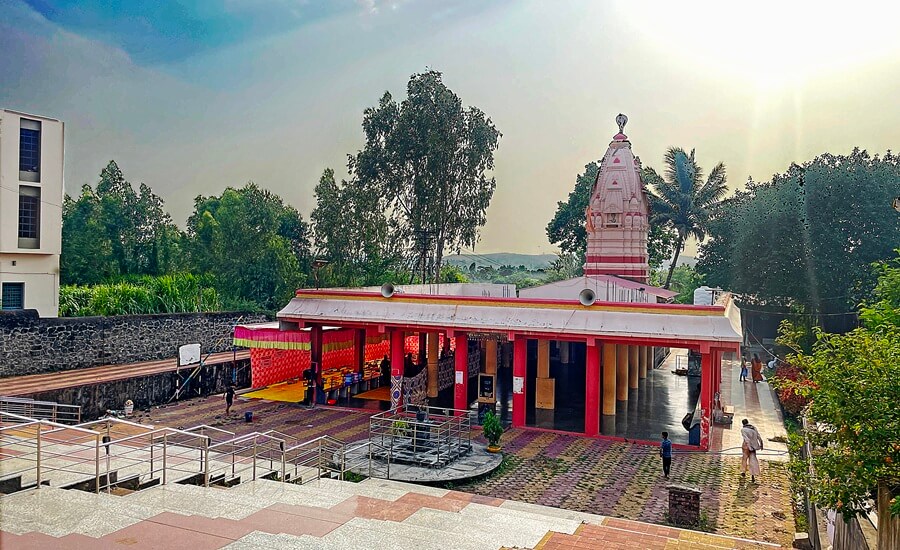
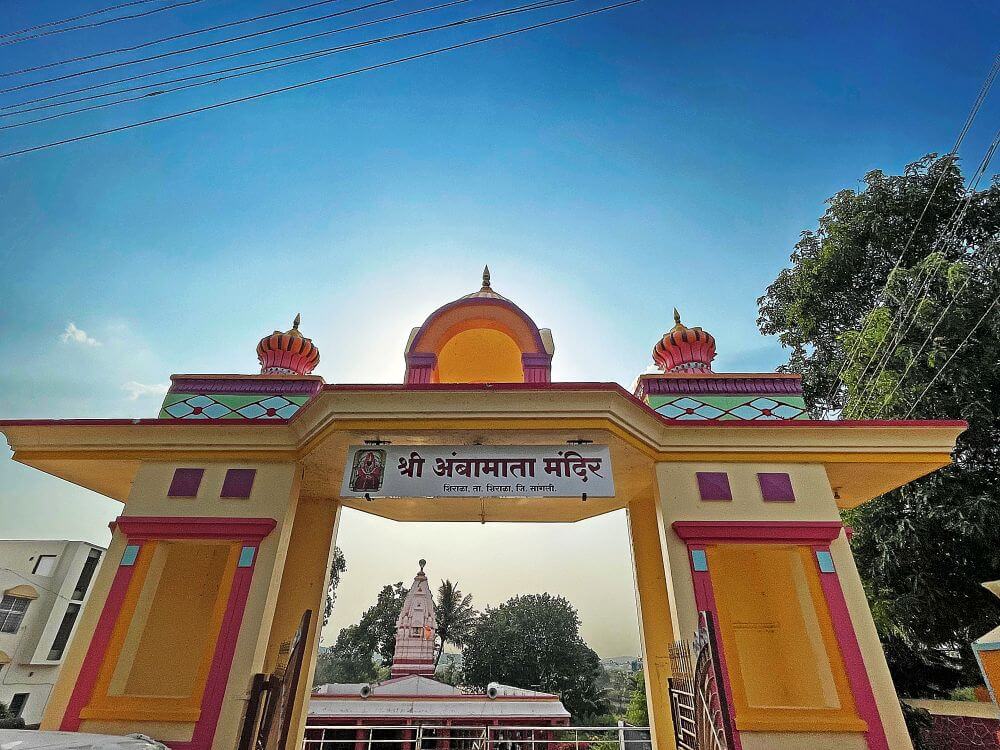
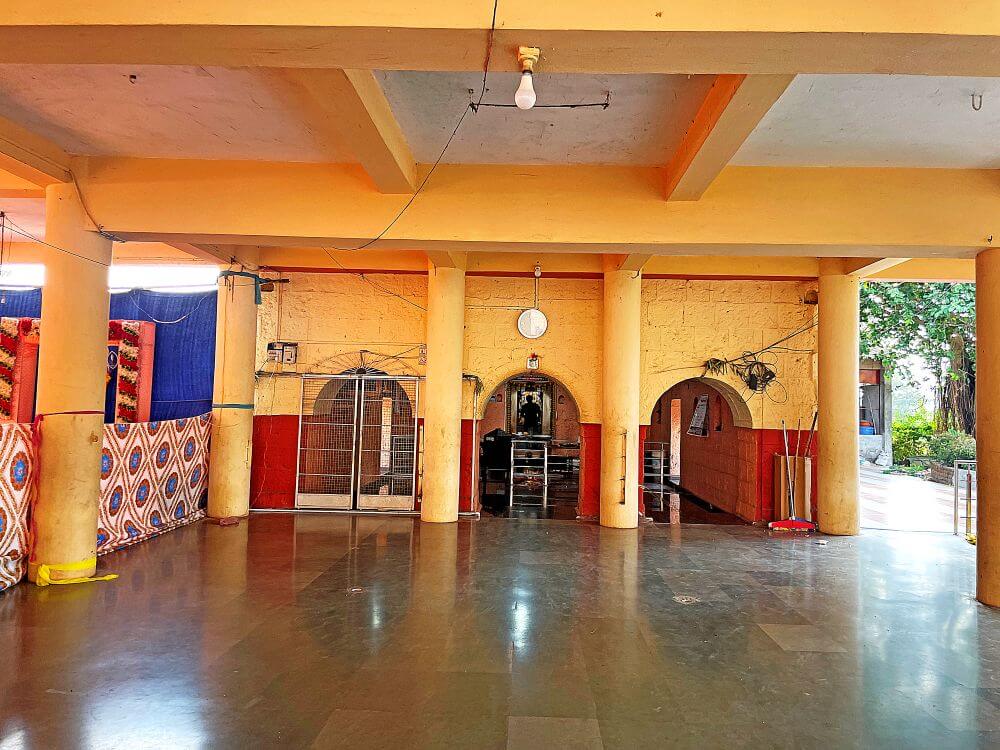
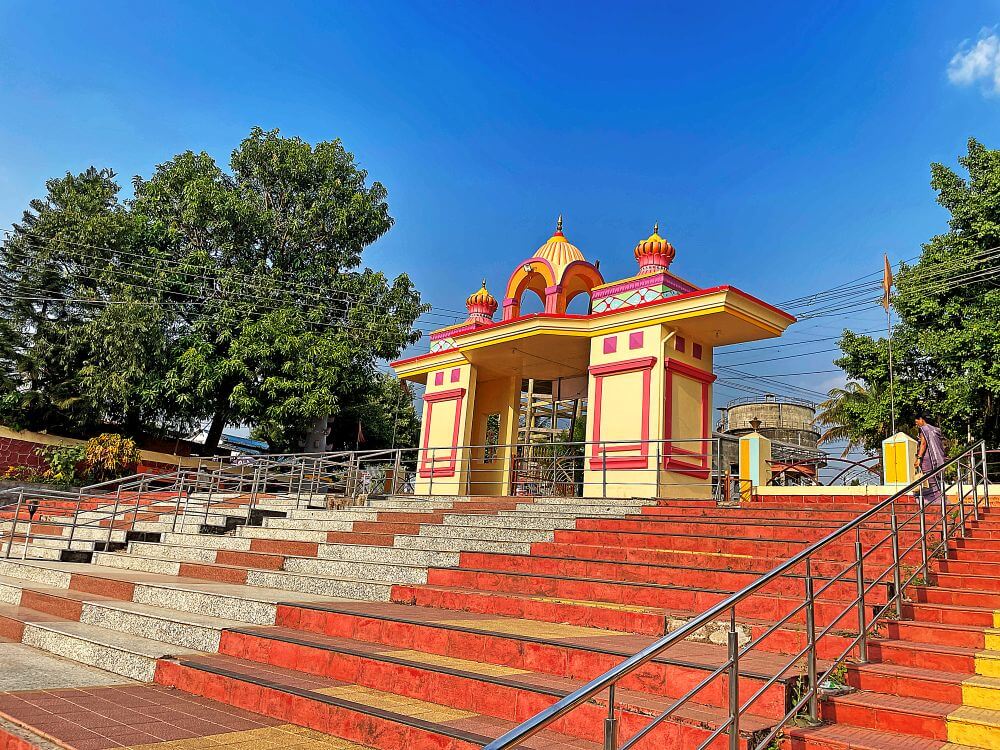
The main entrance archway (Praveshkamani) of the Ambabai temple, which is surrounded by a compound wall (Avarbhint), has two square pillars on either side, topped by a balcony (Sajja). The pillars feature niches for deities (Devkoshtake), a spire (Shikhar) at the top, an Amalak (finial) on the spire, and a Kalas (pinnacle) above it. Above the balcony, there is a Meghadambari (canopy) crowned with a Kalas. Descending 25 to 30 steps from the entrance archway, one enters the temple courtyard (Prangan), which is situated at a slightly lower level. The temple’s layout comprises a Sabhamandap (assembly hall), an Antaral (antechamber), and a Garbhagriha (sanctum sanctorum). The Sabhamandap here is open-sided. In front of the Sabhamandap’s entrance, on a raised platform (Chautara), stands a black stone idol of Nandi. On Nandi’s hump, a Shivpind (lingam) is carved, a serpent (Nag) on its back, and the sacred ‘Omkar’ symbol on its forehead. Drapery (Zhool) and garlands (Mala) are also carved on Nandi’s back.
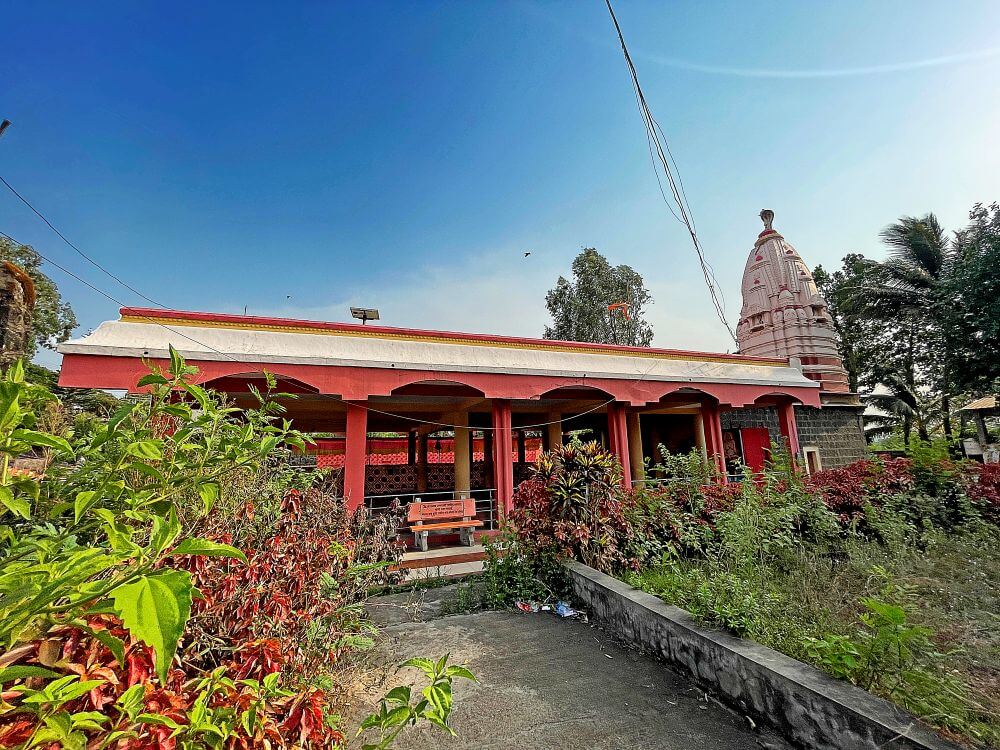
Further ahead, there is the entrance to the Antaral, featuring three arches supported by four pillars. Arrangements for a darshan queue are made in the Antaral. Within the Antaral, there is a Shivpindi, and to the left of the Garbhagriha’s entrance, on a Vajrapith (pedestal), are idols of Maruti and other deities. To the right of the entrance, there is an idol of Ganpati. The Antaral has entrances on both its left and right sides.
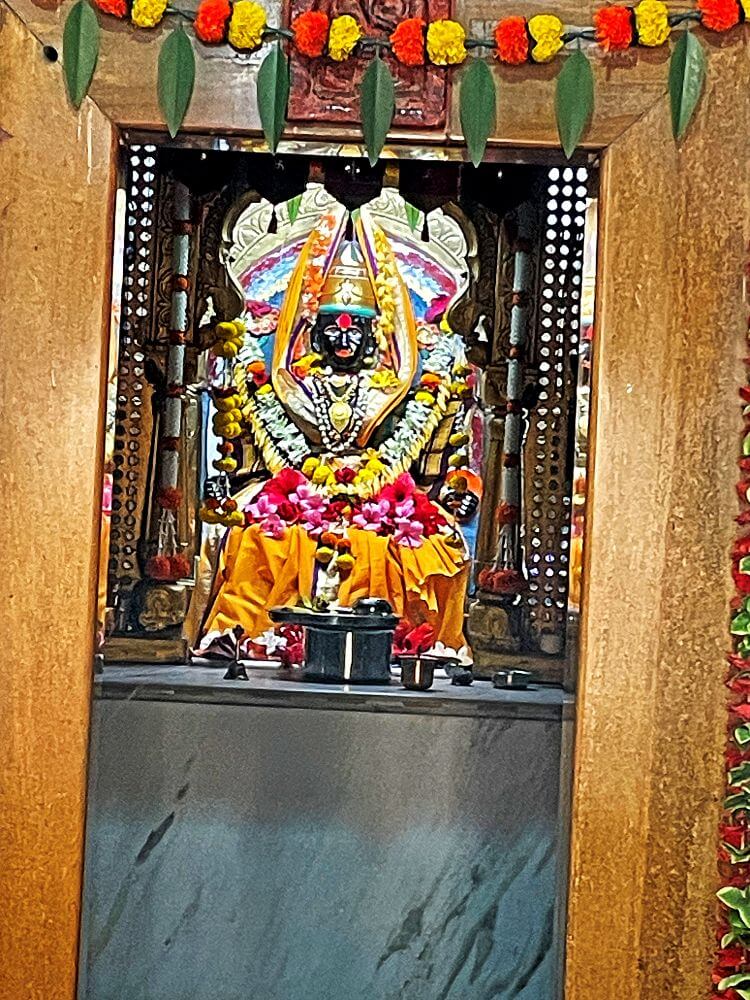
Further ahead is the entrance to the Garbhagriha. On the Lalatbimband (lintel), there is an image of Ganpati, and on the Mandarak (architrave), a lotus flower design is carved. On both sides of the entrance, there are niches for lamps (Dipkoshtake). Inside the Garbhagriha, on a Vajrapith, within an intricately carved Makhar (shrine), resides the four-armed (Chaturbhuj) black stone idol of Ambabai. The Goddess holds a Trishul (trident), sword, shield, and other weapons, and is adorned with precious garments and ornaments. On the Prabhavali (aura/halo) behind the idol, there is a Kirtimukh (glorious face) at the center, flanked by leaf and floral patterns on both sides. A square spire (Shikhar) crowns the temple’s roof. Within the spire, on all four sides, there are niches for deities (Devkoshtake) containing serpent sculptures (Nagshilpe). This spire is of the Urushrung type and has 36 sub-spires (Upshikhare). At the apex of the spire, where the Kalas would typically be, there is an idol of a serpent (Nag Pratima).
In the temple, Nag Panchami is celebrated with great enthusiasm as the main annual festival. Previously, on this sacred day, one hundred to one hundred and fifty snakes, caught from the forest by villagers, were brought to the temple and devoutly worshipped. Subsequently, after performing Nag Puja in every home, a grand procession of these revered serpents was taken out through the village in vehicles such as bullock carts and tractors. During this time, competitions were held to honor the serpents, such as for the longest snake, the thickest snake, and the snake that stood tallest. In the year 2002, after the catching of snakes and the presentation of their shows were banned under the Wildlife Protection Act, symbolic serpents are now worshipped and taken in procession. On this auspicious occasion, thousands of devotees from across the state come for the sacred Darshan of the Devi and to witness the divine fair of serpents. In the temple, revered annual festivals such as Mahashivratri, Chaitra Padwa, Sharadiya Navratri, and others are celebrated with devotion. Every Tuesday, Friday, Purnima, Amavasya, and other auspicious days, the temple witnesses a large and devout gathering of devotees.
Information about this unique serpent festival of Battis Shirala was first published in the 1954 ‘Kirloskar’ magazine. At that time, a film about it was also shown in America. Subsequently, the ‘National Geographic’ channel also gave publicity to this festival in Shirala. Furthermore, the Nag Panchami celebrations here were featured on English channels such as Discovery and Animal Planet. Consequently, many foreign tourists also make it a point to visit this temple in Shirala.
This sacred temple stands as a testament to deep spiritual devotion, ancient architectural grandeur, and rich local cultural traditions.
The sanctum sanctorum houses the divine idol consecrated according to ancient Vedic traditions, surrounded by serene courtyards and traditional temple architecture.
Navratri, Maha Shivratri, Annual Temple Jatra & Deepotsav
Compare and book flights, secure top-rated local hotels near the temple, hire reliable guides, and rent cars instantly.
Extend your pilgrimage by visiting other highly sacred temples located nearby.


Add ₹999 more to unlock FREE SHIPPING!
Your sacred cart is currently empty.
Shop Photo FramesFill in your delivery details below to place your order.
Add comment