
Add ₹999 more to unlock FREE SHIPPING!
Your sacred cart is currently empty.
Shop Photo FramesThe Nath Sampradaya holds a unique and unparalleled place in the cultural and religious history of Maharashtra. There are many temples dedicated to the Nath tradition and the Navnath (nine Naths) across the state. Shirala is one of the most significant among them. The number of Navnath temples in this taluka is remarkable. The temple of Gorakshanath at Battis Shirala is one such prominent shrine. Devotees believe that Gorakshanath still resides in this temple in a subtle form, as the site was sanctified by the touch of his holy feet. During the grand pilgrimage (Mahayatra) held every twelve years, thousands of sadhus from across the country visit this temple for darshan.
Shrishail Kardalivan in Andhra Pradesh is considered the birthplace of the Nath Sampradaya, while Andhra, Karnataka, and Maharashtra are regarded as its primary sites of divine activity (leelasthali). Guru Gorakshanath is the founder of this tradition, and Matsyendranath (Machindranath) was his guru. According to the book ‘History of the Nath Sampradaya’ by the great researcher Dr. Ra. Chi. Dhere, the period of Gorakshanath is between 1050 and 1150 AD. Gorakshanath authored several works in Sanskrit and Hindi, such as ‘Amanaska’ and ‘Amaraughaprabodha’. ‘Gorakhbodh’ is his well-known treatise on philosophical thought. According to Dhere, Gorakshanath purified Indian spiritual practice by launching a movement against the ‘Vamachari’ tantric practices like Vajrayana, Sahajayana, Shakta, and Kapalika. The temple of such a great revolutionary Siddha-purusha at Shirala is an important pilgrimage site for followers of the Nath tradition.
Many leelas (divine plays) of Gorakshanath are described in the book ‘Nathlilamrit’, composed by Adinath Bhairav. This book was written in 1834 AD in the village of Vitap-kshetra, known as Vita, located about 64 km from Battis Shirala. According to this text, Gorakshanath had visited Shirala. Not only that, but it was because of him that the tradition of worshipping live cobras began in this village. The legend goes that Gorakshanath arrived in this village on the day of Nag Panchami. He went to a Brahmin’s house to seek alms. The Brahmin’s wife told him that it was Nag Panchami, a vow that brings longevity and prosperity, and that they would eat only after performing the sixteen-step worship (shodashopachar puja) of clay snakes. Upon this, Gorakshanath said, “If you perform this vow every year, why is your condition so impoverished? If clay worship fulfills your desires, why do you not worship the mountain itself? People are deluded by ignorance. Instead of worshipping a clay representation of Shesha, why do you not worship the live serpents?” And after he said this, the impossible happened. “As the Nath played the Shringi (horn), countless serpents appeared. They were white, yellow, and black, adorned with gems on their hoods.” As soon as Gorakshanath played the Shringi, countless cobras appeared at that spot. “You have been shown this direct proof; through divine grace, deities and siddhas manifest. Worship them with great devotion, and honor the divine,” Gorakshanath said. Since then, the tradition of worshipping live cobras has been observed here.
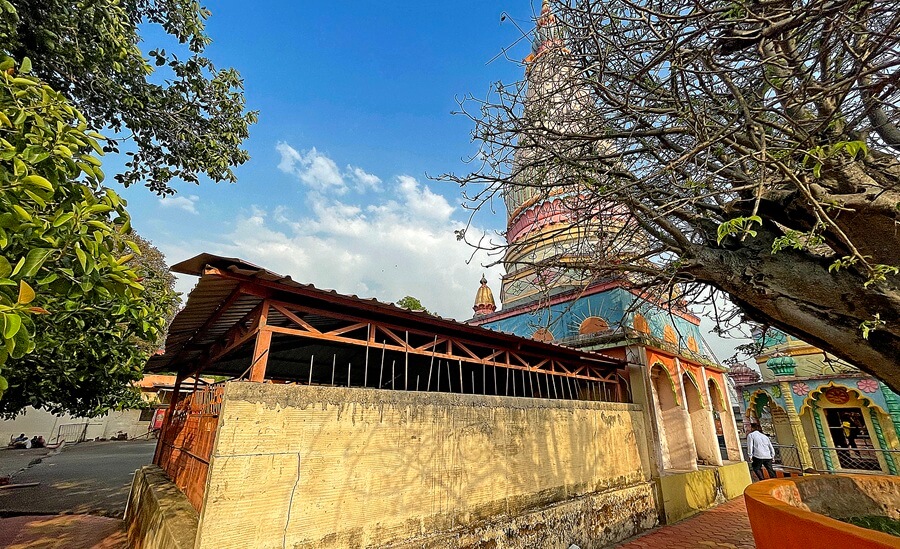
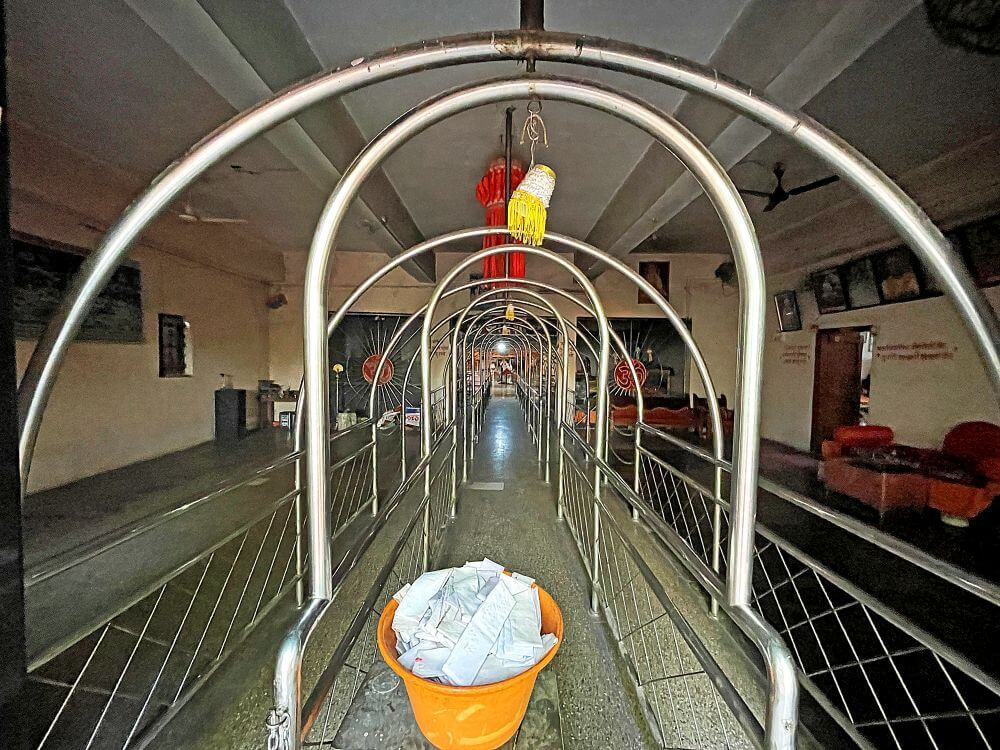
It is said that the Gorakshanath temple was built during this period, i.e., the 11th or 12th century. The structure of the Gorakshanath temple is large and built in the Hemadpanti architectural style. A sabhamandap (assembly hall) was built in recent times in front of the original ancient temple. A queue system for darshan has been arranged from the entrance of this enclosed hall to the sanctum sanctorum. At the start of the queue, many caps are kept in a basket. It is a rule here that devotees going for darshan must wear a cap on their heads. The palanquin used during festivals is kept in the sabhamandap. There are entrances on both sides of the sanctum sanctorum in the hall. On the front wall of the sanctum, there are four-armed dwarapalas (gatekeepers) in niches on both sides. In front of the sanctum entrance are the padukas (footprints) of Gorakshanath.
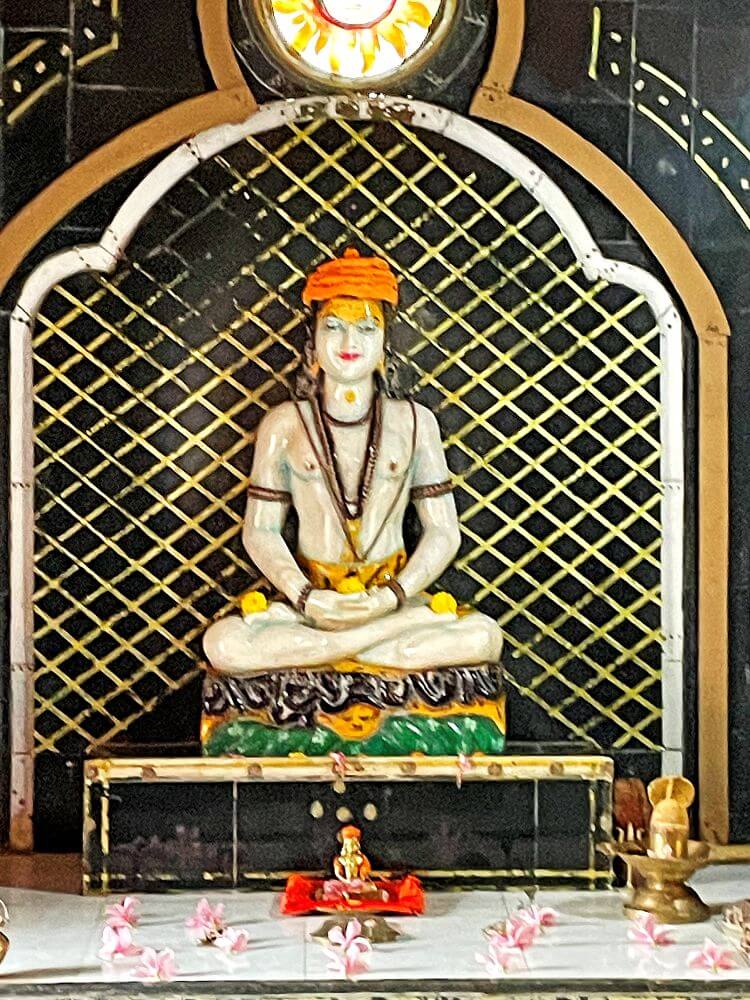
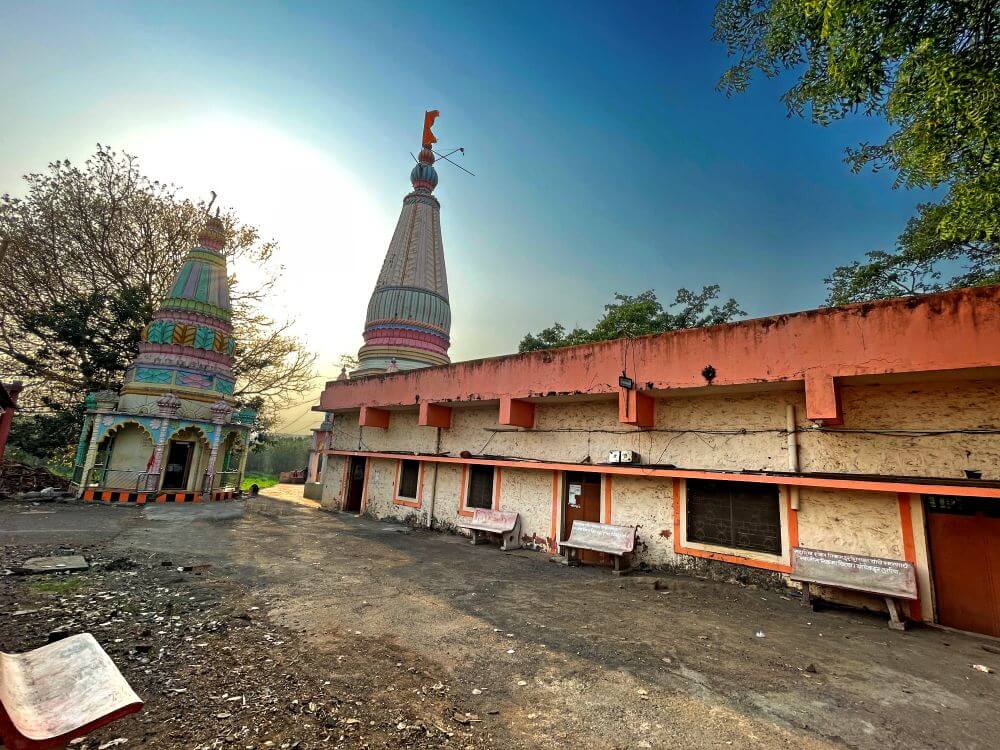
There is intricate carving on the door frames of the sanctum and an image of Lord Ganesha on the lintel. Besides the main entrance, the sanctum has side entrances on the left and right. Inside the sanctum, on a vajrapitha (diamond pedestal), is the meditative idol of Gorakshanath. On the roof of the sanctum, there are small shikhara spires at all four corners, topped with amalakas and kalashas. In the center is the main, tall, tapering shikhara. The base of the shikhara is hexagonal with square carvings. Above it is a ring of lotus petal designs, and the tapering upper part features vertical ridge carvings. At the pinnacle of the shikhara are two amalakas stacked one above the other, topped by a kalasha and a flag.
In the temple courtyard, there is a meditation temple of Matsyendranath. Matsyendranath was the guru of Gorakshanath. In this temple, there are idols of Vitthal-Rukmini on a vajrapitha and an underground chamber. There is a narrow staircase to reach this chamber. In the niches of the walls of the underground chamber, there are two samadhi-like structures. It is said that Gorakshanath performed penance in this chamber for twelve years. Behind the temple is a ‘Gorakh-chinch’ tree. The scientific name of this tree is ‘Adansonia digitata’. It is native to the African continent and was brought to India from Africa 250 to 300 years ago. This tree, which has medicinal properties, is rare in Maharashtra. According to local legend, the tree here grew from a dry branch planted by Gorakshanath. It is said that Gorakshanath gave initiation to his disciples under this very tree. Devotees believe that performing 108 circumambulations (pradakshina) around this tree fulfills one’s heart’s desires.
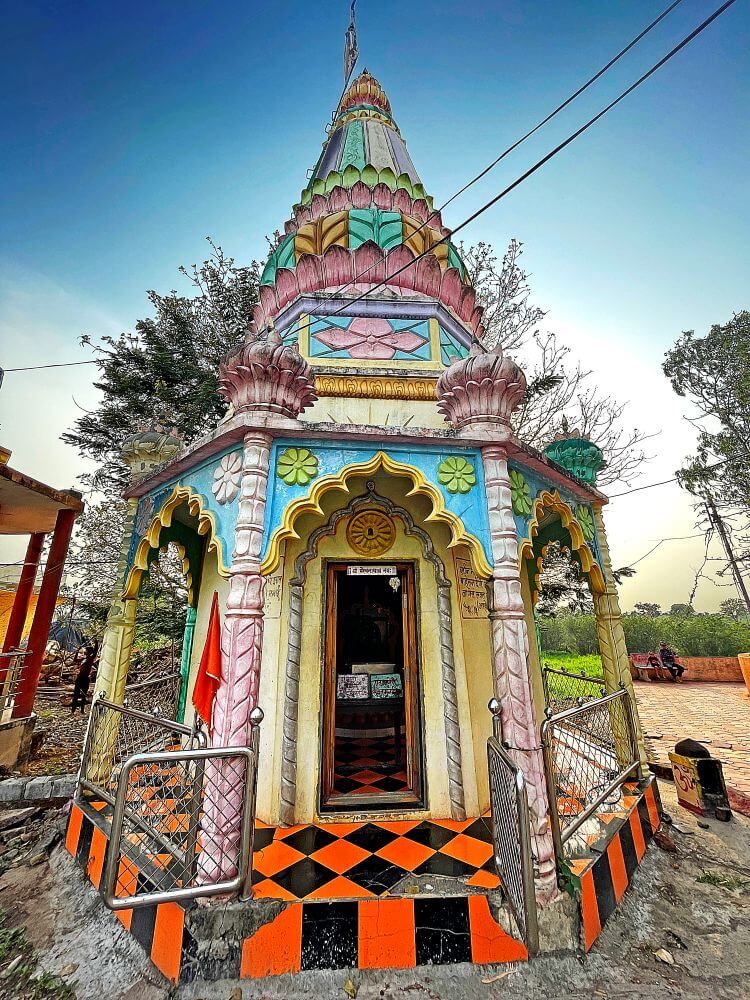
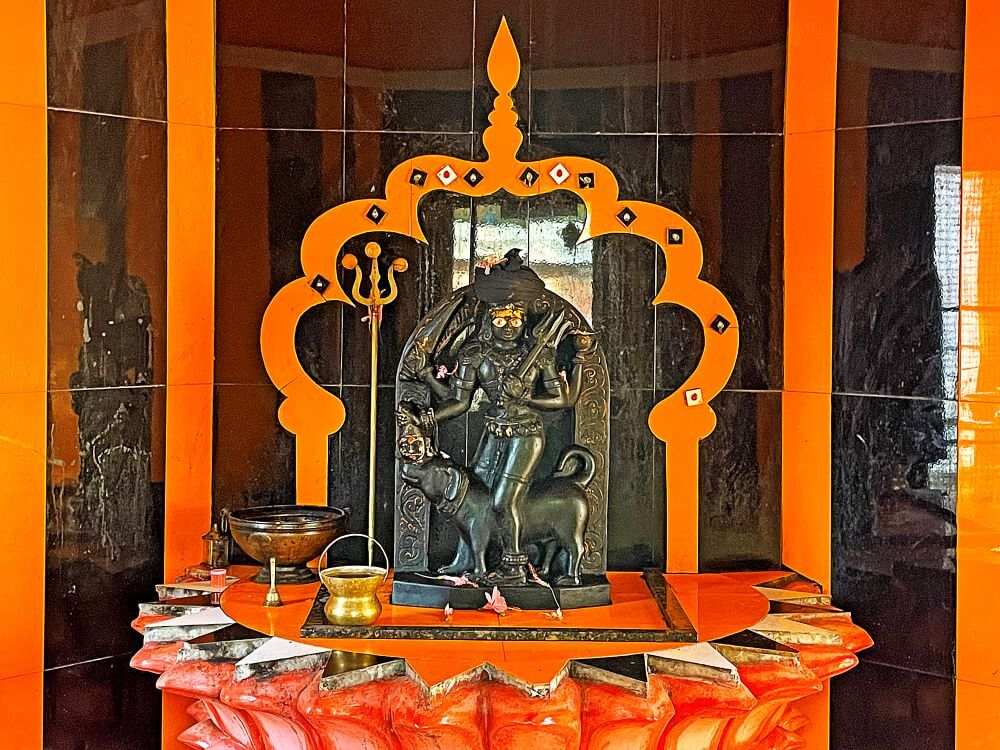
Behind the temple in the courtyard is a hexagonal temple of Kalbhairav. The entrance of the temple has an ornate door frame with a Ganesha sculpture on the lintel. Inside the temple, on a vajrapitha shaped like a lotus flower, is a four-armed idol of Kalbhairav carved in black stone. The idol holds a sword, a trident, a human skull, and a vessel of nectar. The prabhavali (halo) behind the idol is decorated with leaf and flower motifs, and in front, there is a brass trident and a kamandalu. On the roof of the temple, on the side of the entrance, there are dome-shaped small shikharas at both corners topped with kalashas. At the pinnacle, there are two amalakas stacked one above the other, topped with a kalasha.
Beside this temple is the temple of Vitthal-Rakhumai. It is said that the Warkari Sampradaya originated from the Nath Sampradaya. Saint Dnyaneshwar was a great luminary of the Nath Sampradaya. Gahininath, a disciple of Gorakshanath, was the guru of Saint Nivruttinath. Saint Nivruttinath bestowed the philosophical heritage of the Nath Sampradaya upon Saint Dnyaneshwar. Dnyaneshwar has clarified this in his Abhang:
Adinath is the guru of all Siddhas, and Machhindranath is his chief disciple.
Machhindranath imparted knowledge to Gorakshanath, and Gorakshanath passed it on to Gahininath.
By the grace of Gahininath, Nivruttinath became the bestower, who revealed the essence to Dnyandev.
He has clarified in the epilogue of the ‘Dnyaneshwari’ that this sacred text of the Warkari Sampradaya is the legacy of the Nath Sampradaya. For this reason, this abode of Gorakshanath is considered sacred in the Warkari Sampradaya.
A pilgrimage festival (Yatra Utsav) is celebrated at this temple for eight days, starting from Chaitra Krishna Ekadashi, also known as Varuthini Ekadashi. On the first day of the Yatra, lakhs of devotees from states like Maharashtra and Karnataka arrive to seek the blessings of the deity. Hundreds of Warkari Dindis set up tents and reside in the temple premises. At 11:00 AM, the Palkhi (palanquin) of Gorakshanath departs. During the Yatra period, programs such as Bhajan, Kirtan, Pravachan, Jagaran, Bharud, and Songi Bhajan are organized in the temple.
A Maha-Yatra is held here every twelve years. At that time, all Nath-panthi Sadhus and Mahants from North India come to this temple for Darshan. A report on the monastery’s administration is reviewed, and a new Mathadhipati (head of the monastery) is selected. During the Yatra, hundreds of shops selling various goods are set up, giving the area the appearance of a marketplace. Apart from this, there is a crowd of devotees at the temple on every Ekadashi. It is the firm belief of the devotees that on Ekadashi, Lord Vitthal of Pandhari comes to visit Gorakshanath.
This sacred temple stands as a testament to deep spiritual devotion, ancient architectural grandeur, and rich local cultural traditions.
The sanctum sanctorum houses the divine idol consecrated according to ancient Vedic traditions, surrounded by serene courtyards and traditional temple architecture.
Navratri, Maha Shivratri, Annual Temple Jatra & Deepotsav
Compare and book flights, secure top-rated local hotels near the temple, hire reliable guides, and rent cars instantly.
Extend your pilgrimage by visiting other highly sacred temples located nearby.


Add ₹999 more to unlock FREE SHIPPING!
Your sacred cart is currently empty.
Shop Photo FramesFill in your delivery details below to place your order.
Add comment