
Add ₹999 more to unlock FREE SHIPPING!
Your sacred cart is currently empty.
Shop Photo FramesThe Mahalakshmi Temple in Hedavade, near Vasai, is one of the most famous and spiritually awakened temples in the Palghar district. It is the firm belief of devotees that if one makes a vow (navas) to the Mahalakshmi Devi of this temple and visits for darshan on five consecutive Fridays, their heartfelt wishes are fulfilled. There is also a Navagraha temple here, which is claimed to be the only self-manifested (swayambhu) Navagraha temple in the country. Devotees also believe that by performing puja to the Navagrahas here, all difficulties are resolved and planetary afflictions are destroyed. This temple is open for darshan only on Fridays. Consequently, thousands of devotees visit here on this day to seek the blessings of the Goddess.
The legend regarding this temple is that Dadasaheb Hate, a resident of Vasai, discovered an idol of the Goddess some years ago. Hate’s ancestors had accompanied Chimaji Appa to Vasai to fight against the Portuguese. Born in Vasai, Hate had studied astrology and palmistry in Gangapur, Karnataka. Once, while traveling to his farm in a bullock cart, he stopped under a tamarind tree to rest for a few moments, as was his custom. At that time, the Goddess, surrounded by a divine aura, appeared before him in the form of a beautiful woman. Pointing to a specific spot, she commanded Hate to unearth her idol from the ground and to build a temple for her. That day was the twelfth day (Dwadashi) of the dark fortnight of the month of Chaitra, and it was a Friday. Upon digging at the spot indicated by the Goddess, he found an idol of the Goddess smeared with vermilion.
To consecrate the idol, they erected a small temple of ten by ten feet with a tiled roof and walls made of Karvi reeds. According to the original plan, the idol was placed facing the wall. However, it is said that after a few days, the Goddess appeared to Hate once again. “I wish to play Garba. The orientation of the idol facing the wall hinders me.” Saying this, the Devi commanded that the idol be placed in the center of the temple. Consequently, the temple was renovated, and the position of the idol was changed. The fame of the Devi as one who grants the wishes of her devotees spread in a short time, and many devotees began to arrive for her darshan. The temple attained its present form after the renovation that took place a few years ago.
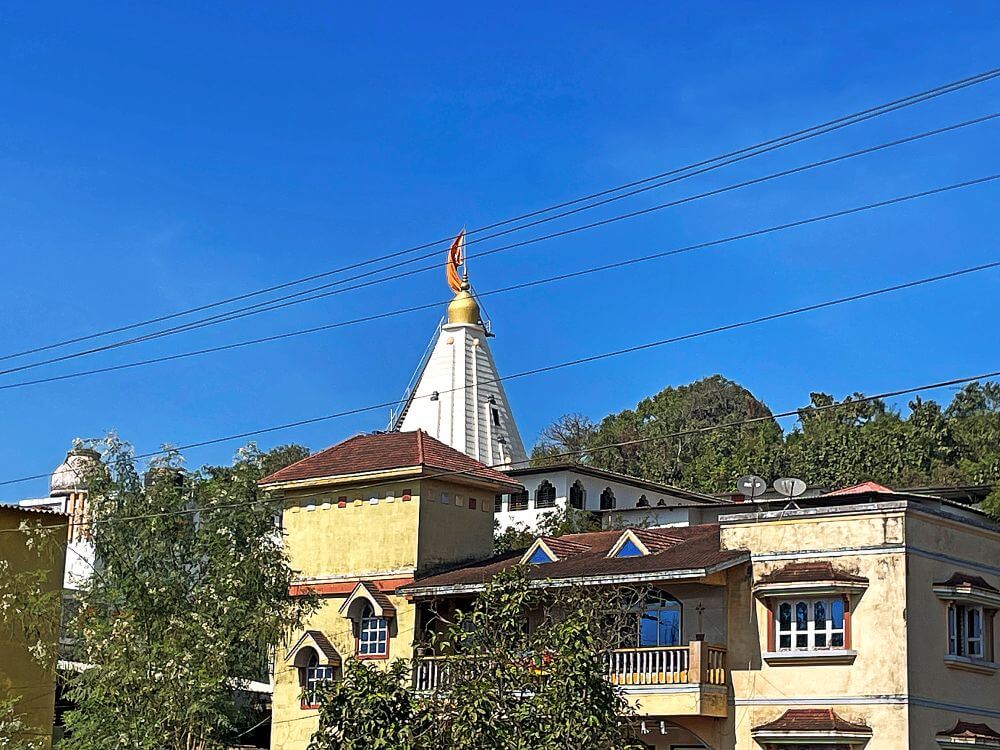
This temple is situated on the northern bank of the Tansa River at Hedavade, near the Mumbai-Ahmedabad National Highway. Located in a scenic environment, the confluence of the Tansa and Vaitarna rivers lies just a short distance from the temple. The temple structure is visible from a distance. To reach the temple, one must climb a few steps. Before entering the temple, one first encounters the Sheshnag / Nagmandala on a platform outside. There is a legend behind this site as well. The renovation work of the temple had stalled due to a lack of funds. It had become difficult for Mr. Hate to pay the contractors’ dues. When he prayed to the Goddess, she advised him to build a temple for Shri Sheshnag along with a pair of snakes. Accordingly, Mr. Hate ordered the idols of Sheshnag and the male and female serpent deities. Just as these idols were being brought to the temple, a large donation was received for the temple, and the work resumed. Devotees believe that performing regular worship of the Nagmandala here eliminates the Kaal Sarp Dosha. Special rituals are performed here on the day of Nag Panchami.
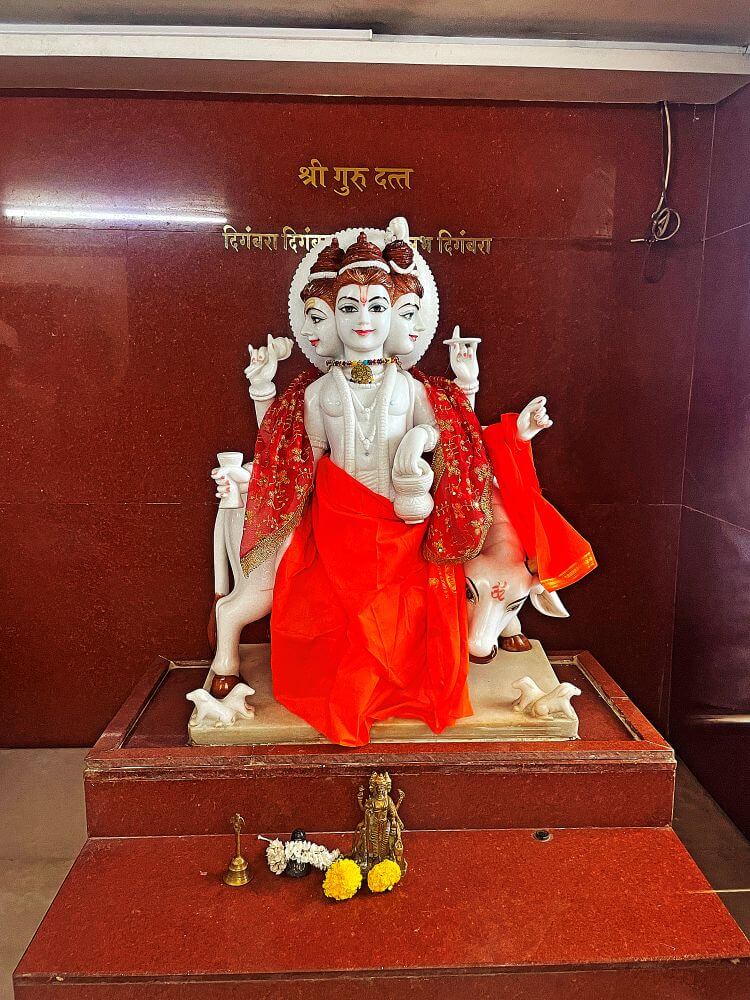
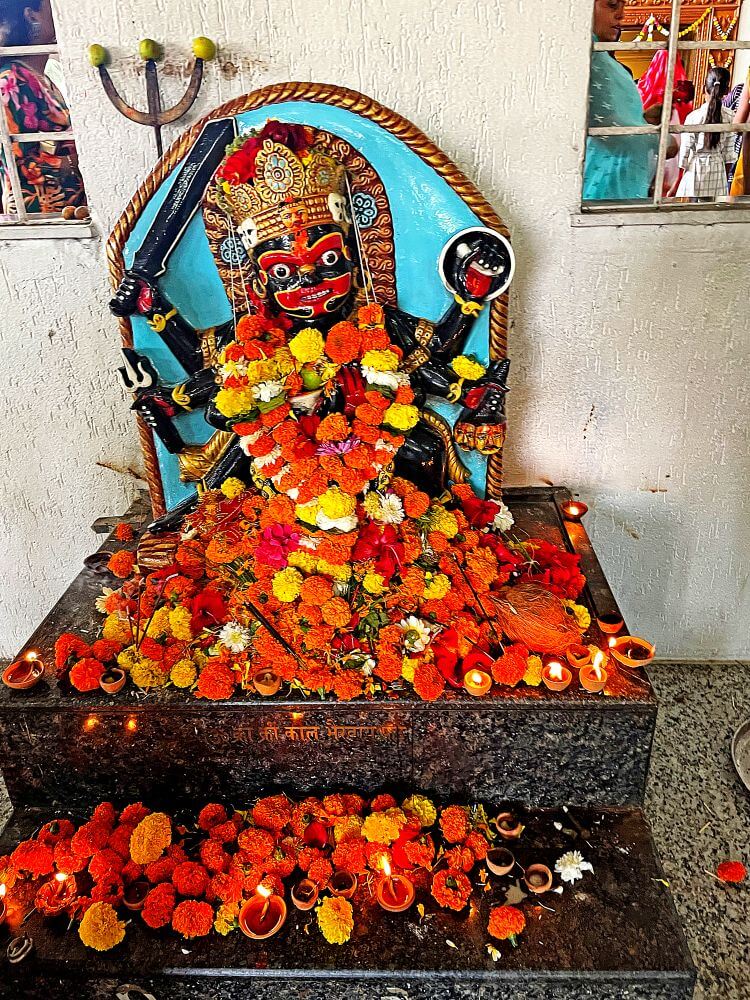
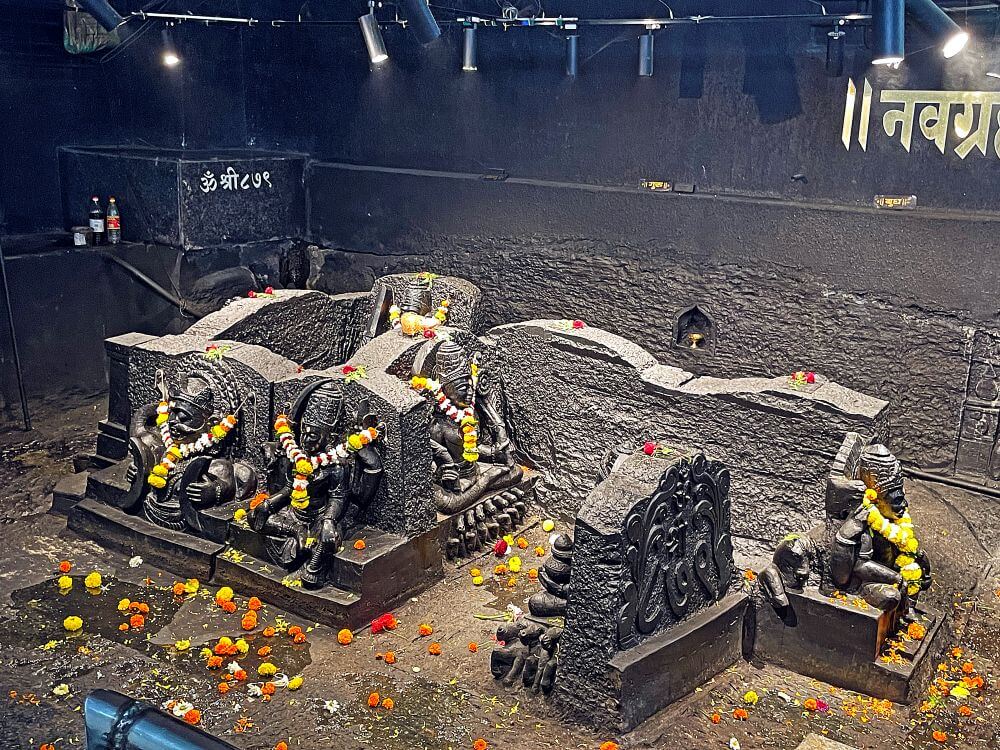
After having the darshan of the Nagamandala, one enters the large sabhamandapa (main hall) here. Just a few steps away, one gets the darshan of Panchamukhi Hanuman. This six-foot-tall idol, carved from black granite, weighs more than 伍佰 kilograms. Near the feet of the idol is the Sudarshana Chakra, in the center is Garuda, and to the left is the Shankha. To the right of the temple are the idols of the Navagrahas. These idols are made from monolithic granite stone formed from volcanic lava. These idols are situated in a single location, and their faces are oriented in various directions. All the idols are 貳拾柒 inches (approximately 貳.伍 feet) in height. When viewed from above, it is observed that the number 9 is formed over the Navagrahas. Specific mantras are inscribed on the upper portion of all the idols. All the planetary idols here are in a meditative state (with eyes closed). There is also a beautiful idol of the deity of wealth, Kubera, at the site of the Navagrahas. Nearby, there is also a Panchamukhi Shivling. The Navagraha Stotra is inscribed on the wall near these idols. In the temple premises, there are shrines dedicated to Kalbhairav, Dattaguru, Shri Saraswati, and Panchamukhi Ganesha. The Panchamukhi Ganesha here is also known as Karyasiddhi Ganesha.
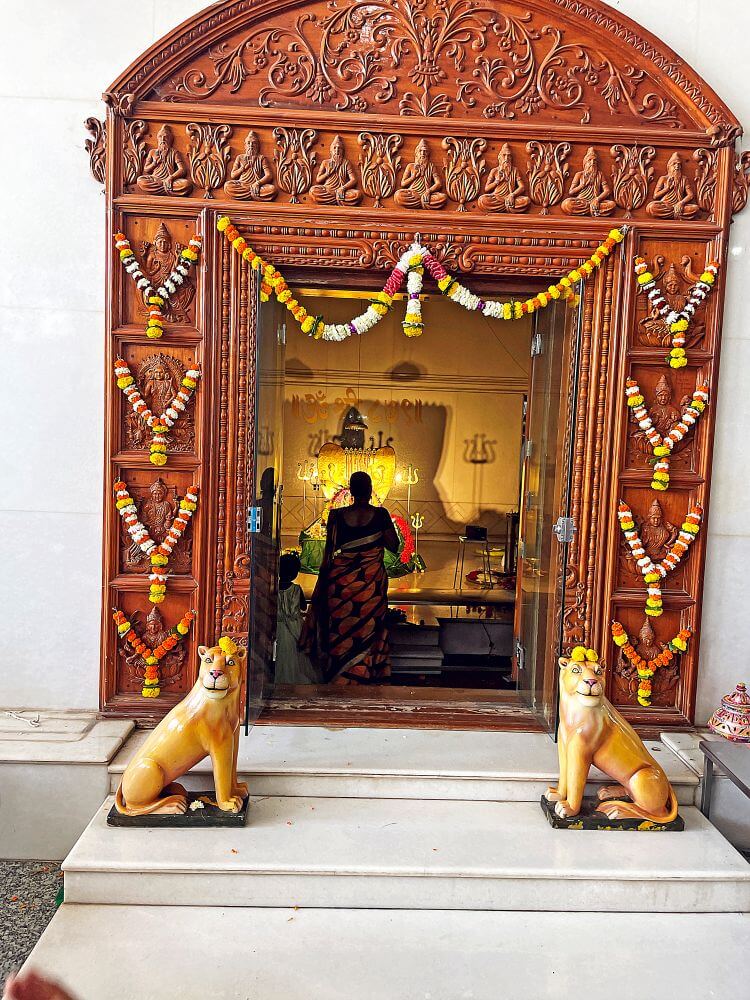
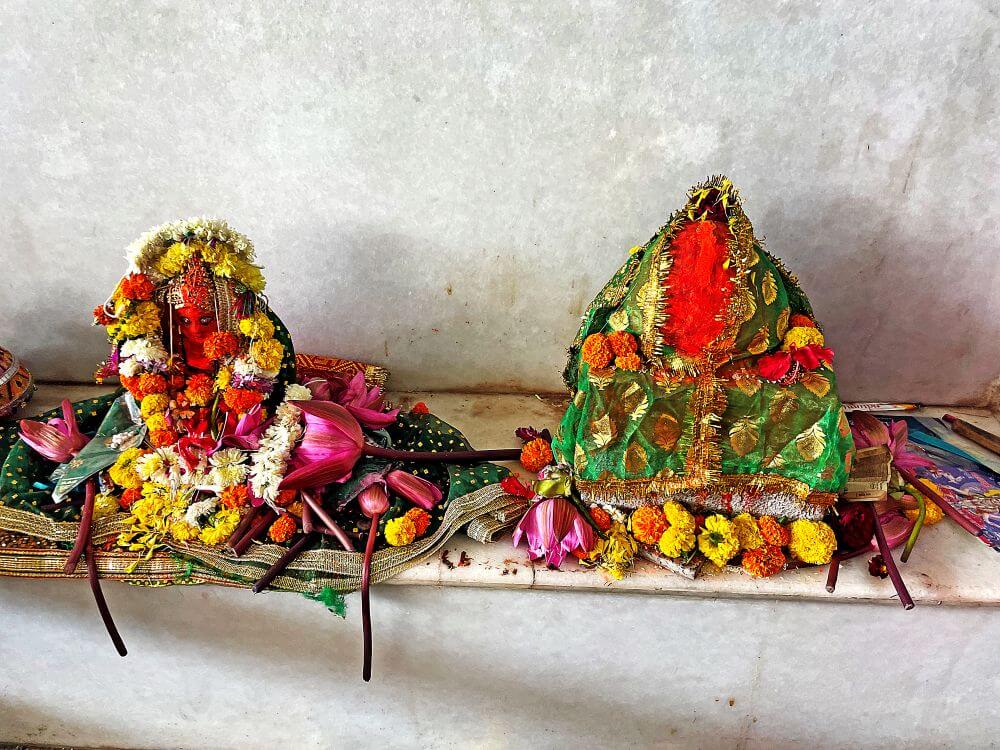
In front of the sanctum sanctorum of the Goddess, there is a tortoise, and on both sides of the entrance, there are statues of a tiger, which is the vehicle of the Goddess. The door frame of the sanctum entrance features exquisite carvings, and statues of certain sages are sculpted here. On the front walls of the sanctum entrance, the number ‘८७९’ is inscribed on both sides. According to beliefs in Hinduism, this number in its specific combination holds special significance. Here, ८ represents the Ashtavinayaka, ७ represents the Saptarishi/Saptadevata, and ९ represents the form of the Navagraha. Devotees believe that incorporating this number into daily life brings divine protection. In the center of the sanctum sanctorum, the idol of the Goddess is placed in a gold-plated shrine. In front of the idol is the Shri Yantra, and the shrine of the Goddess is adorned with attractive carvings. On the lower side, there are elephants on both sides. The Goddess wears a gold necklace around her neck.
This temple is opened for devotees to have darshan only once a week, on Friday mornings at 9:30. At 10:00 in the morning, an Abhishekam is performed on the idol. Maha-Aarti is conducted and Naivedyam is offered. Following this, a Mahabhandara is held for the devotees. The Mahabhandara continues from 11:00 in the morning until 3:30 in the afternoon. The temple doors are closed for devotees at 6:00 in the evening. Many devotees whose vows have been fulfilled perform the ‘Tulabharam’ ritual in the assembly hall, offering grains equal to their body weight. The ‘Tula’ of the devotees is performed before the afternoon Aarti. Many devotees also perform the ‘Tulabharam’ ritual for the prosperity and development of their children.
This sacred temple stands as a testament to deep spiritual devotion, ancient architectural grandeur, and rich local cultural traditions.
The sanctum sanctorum houses the divine idol consecrated according to ancient Vedic traditions, surrounded by serene courtyards and traditional temple architecture.
Navratri, Maha Shivratri, Annual Temple Jatra & Deepotsav
Compare and book flights, secure top-rated local hotels near the temple, hire reliable guides, and rent cars instantly.
Extend your pilgrimage by visiting other highly sacred temples located nearby.


Add ₹999 more to unlock FREE SHIPPING!
Your sacred cart is currently empty.
Shop Photo FramesFill in your delivery details below to place your order.
Add comment