
Add ₹999 more to unlock FREE SHIPPING!
Your sacred cart is currently empty.
Shop Photo FramesKnown as the ‘King of the Deccan’ and the Kuldevata (family deity) of various castes and communities in Maharashtra, Jotiba resides atop the hills of Wadi Ratnagiri. Originally a Kshetrapal (guardian deity of the region), this folk deity is worshipped here as Kedareshwar. A magnificent temple stands on this hill, which is known by the name of Jotiba himself. The name Jotiba has also evolved from the term ‘Jyotirlinga,’ and devotees believe him to be an incarnation of Kedarnath. Every day, thousands of devotees arrive for his darshan, chanting ‘Changbhala’ and showering gulal and grated coconut. During the Chaitra Yatra, this entire hill plateau is filled with the presence of millions of devotees.
The grandeur and legends of Jotiba are described in the text ‘Kedarvijay.’ It is said that this was originally a Sanskrit text, brought into Marathi by a devotee of Jotiba named Hari Angapurkar. This 36-chapter text was published in the year 1779 AD. The legend within this text states that at the ‘Badri’ Kedar region, the sage Pouganda and his wife Vilambuja were performing penance to be blessed with a son. On a Sunday, at sunrise, on the seventh day (Saptami) associated with the Chaitra Shukla Shashthi, a son was born to them. He became famous as ‘Kedar Ravaleshwar.’ He is considered an incarnation of Kedarnath from the Himalayas. Consequently, he received names such as Kedar,
Kedareshwar, or Kedarlinga. Since Kedarnath is one of the Jyotirlingas, people began referring to Kedarlinga simply as Jyotirlinga. The authors of ‘Kedarvijay’ state that the name Jotiba became popular from this very name. Ravaleshwar is another famous name for Jotiba. The story behind this is that he is an incarnation of the ‘Ravalagni’ (the fire of wrath) of Jamadagni. After the death of Renuka, the wrath abandoned by Jamadagni was shared among the Navnath, the ocean, the forests, and the rest of the world. Kedarnath took his incarnation by accepting and unifying the wrath that had come to the Navnath. Hence, he was named Ravaleshwar. There is a verse regarding this: “Nav Ravagnicha Avatar. Dharila Triguni Sagunakar. Mhanuni Naam Ravaleshwar. Agmottari Thevile.”
The Marathi text ‘Kedarvijay’ also recounts a legend of how Kedareshwar came from the Himalayas to the South. It states that Dakshin Kedar (the Southern Kedar) accepted the task of reinstating Goddess Lakshmi, who had been exiled from Karveer due to the havoc caused by the demon Kolhasur. Supporting Kolhasur were demons like Ratnasur, Raktabhoj, and Mahishasur, while Kedarnath was supported by the Siddhas, Bhairav, the Matrukas, as well as the powers of Charpatamba (Chopdai), Mahalakshmi, and Yamai. In this battle, Kedarnath defeated Ratnasur and the other demons. The mountain where Ratnasur was slain came to be known as Ratnagiri. The place where Kolhasur fell became Kolhapur. Mahalakshmi was established there, and at her insistence, Kedarnath made the Ratnagiri hill his permanent abode.
Jotiba’s ancient site was located on this hill, about 3100 feet above sea level. Its exact history remains unknown. However, it is said that the first renovation of this temple was carried out by Navji Sase (or Raoji Saya), the Patil of Kiwal village. Later, during the Peshwa era in 1730, Ranojirao Shinde renovated the temple again. The Ranojirao Shinde family held the Patilship of Kanherkhed in Satara. Ranojirao served in the infantry under Peshwa Balaji Vishwanath. Through his own valor, he rose to become a Shiledar in 1725. In 1728-29, Chimaji Appa, with the help of the Shinde, Pawar, and Holkar families, conquered Malwa. At that time, Chimaji Appa granted Ranojirao Shinde a share of 6.55 million rupees from the 15 million revenue collection of that province. Ranojirao was a devotee of Jotiba; he even named one of his sons Jotiba. Next to the Jotiba temple is the Kedareshwar temple. This pillarless temple was built in 1808 AD by Daulatrao Shinde. Daulatrao was on the throne from 1795 to 1827. He was the brother of the renowned general Mahadji Shinde. Between the Jotiba and Kedareshwar temples lies the temple of Chopdai. This temple was built in 1750 AD by the Jagirdar of Kolhapur, Pritirao (Bapusaheb) Chavan Himmatbahaddur. Thus, the temple complex at Jotiba holds a history dating back to the Peshwa era.
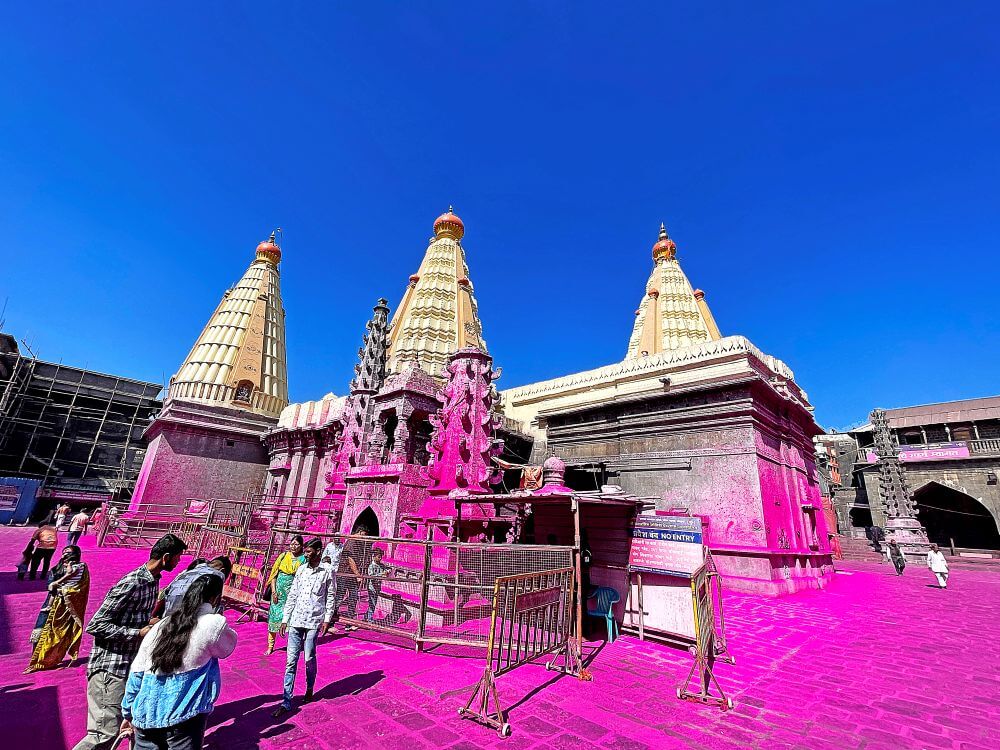
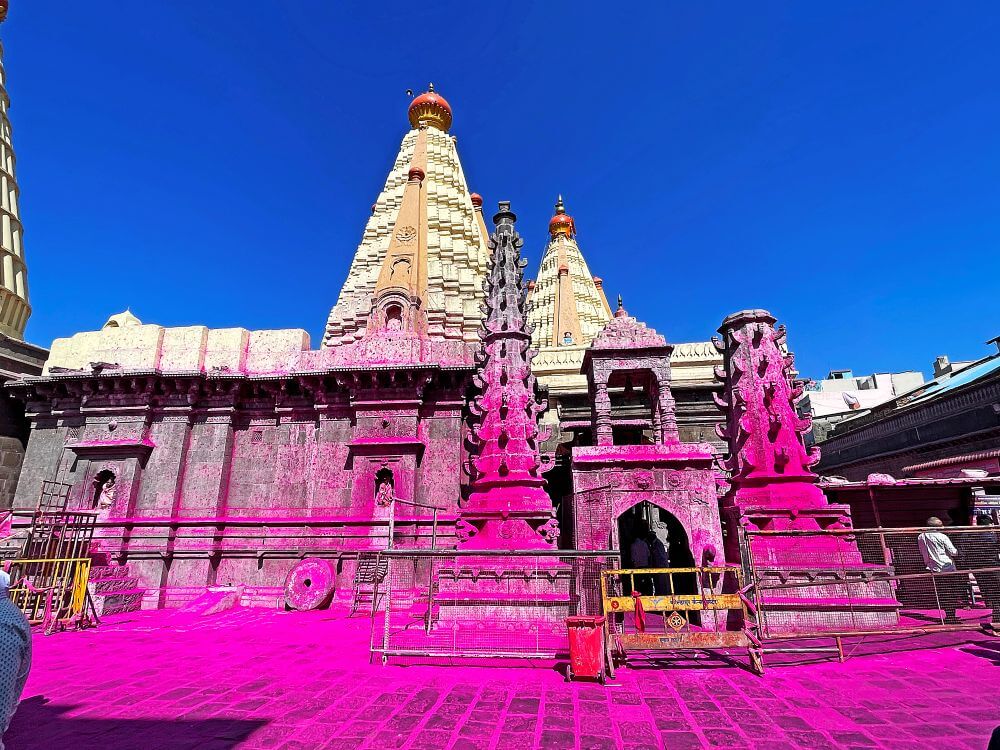
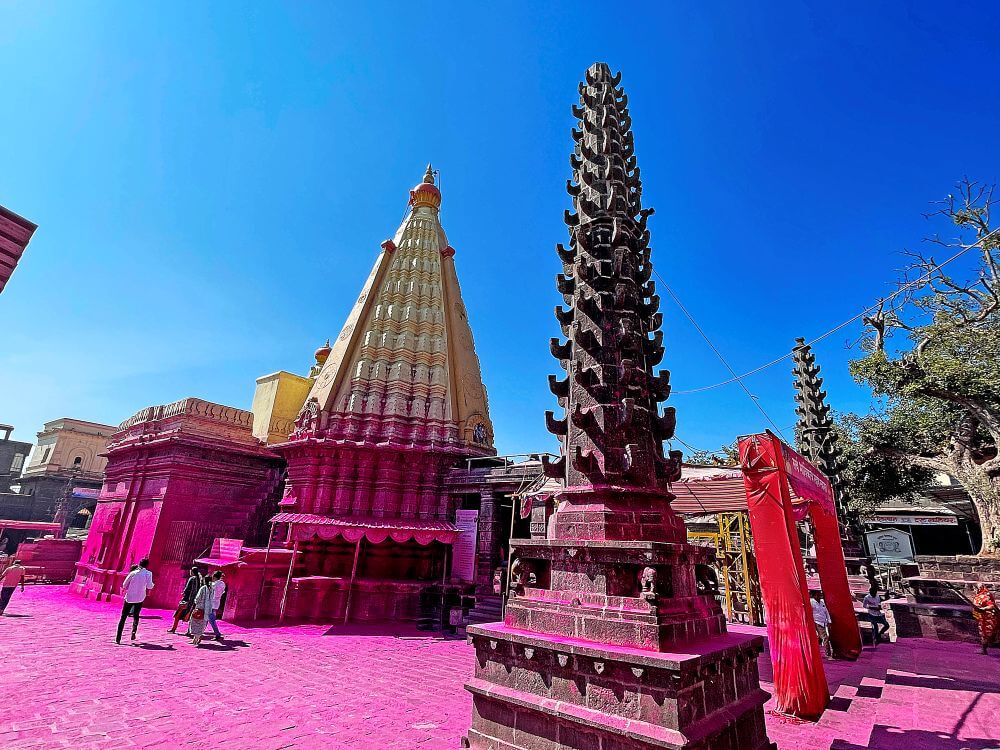
Jotiba is known as the King of the Deccan. His seat is as majestic as any mountain fortress. One enters the vast temple courtyard through grand stone gateways. Entry into the temple is generally through the northern staircase. The courtyard is paved with stone, though the black stone has taken on a pink hue due to the gulal showered by devotees. Upon entering the courtyard, the tall stone lamp pillars (Deepmalas) catch one’s attention. Among the various lamp pillars in the premises, the one directly in front of the Jotiba temple features exquisite carvings on its pedestal. It depicts the entire procession of the deity’s Chaitra Yatra, including the deity seated on a horse, Garuda, Hanuman, elephants, camels, and the Chaughada (drums). This lamp pillar also houses an idol of Goddess Annapurna. A grand festival of lights (Deepotsav) is held here on Tripurari Purnima. Additionally, on Chaitra Shukla Shashthi, the deity’s Mahaprasad is cooked in the nearby ‘Chulangana’ (cooking courtyard).
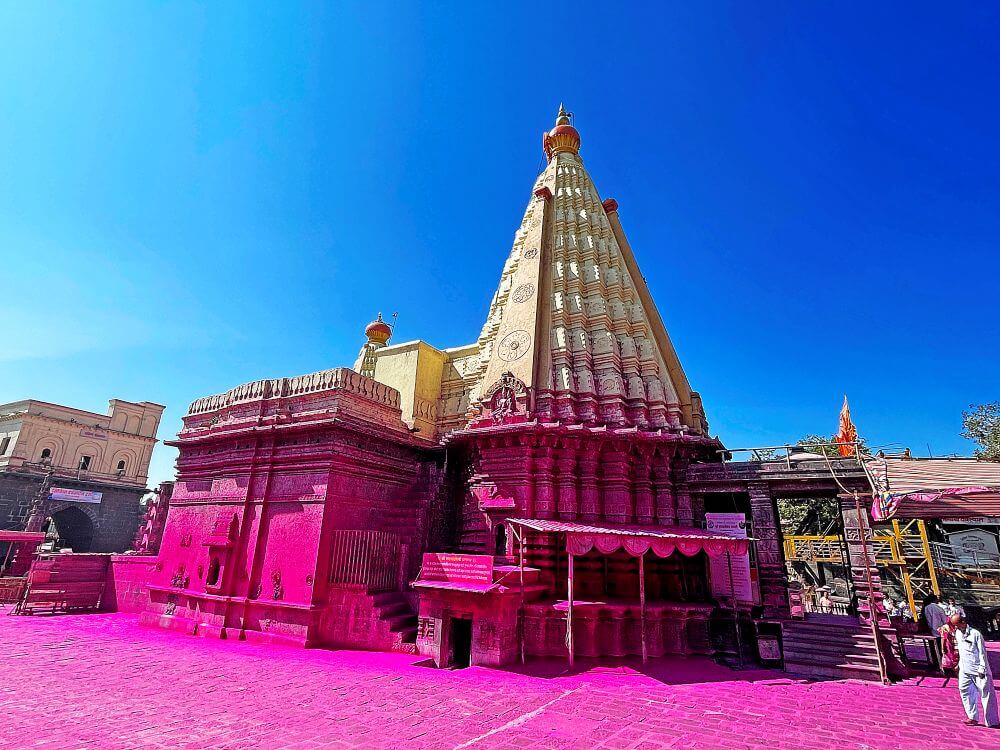
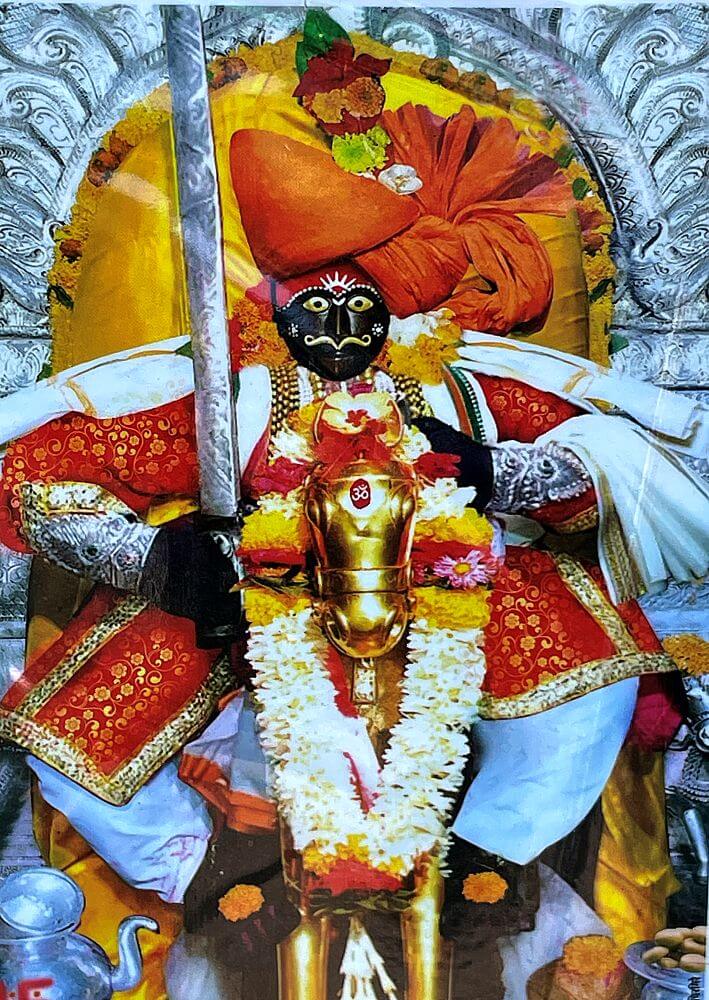
Directly ahead are the black stone temples of Jotiba, Kedareshwar, and Chopdai, each topped with a tall spire. Before entering the Jotiba temple, it is customary to first have darshan of Kalbhairav. Kalbhairav is considered an assistant to Jotiba. There is a small shrine for Kalbhairav in the temple courtyard. In this shrine, which features brass pillars, a black-colored idol of Kalbhairav sits on a high pedestal. With a turban on his head, a rich embroidered Angarkha (tunic), a dhoti, and a sword in his hand, this idol of Kalbhairav bears a striking resemblance to the idol of Jotiba. The original eternal flame burns here continuously.
In this temple, there is a designated path for darshan. A queue has been formed using steel pipes. On this path, the first stop is the place of Mahadeva’s Nandi. A unique feature here is the presence of two stone Nandi idols in one place, which are considered symbols of the Saguna (manifest) and Nirguna (unmanifest) forms of the Divine. Directly in front of them is a brass mask of Jotiba. These Nandis were installed by Daulatrao Shinde. Opposite this Nandi Mandapa is the Kedareshwar temple. The temple features large stone pillars and an arched corridor (ovari). Inside the sanctum sanctorum, there are three Lingas. One of these is the Linga form of Jotiba, and the second is the Matulinga, established by the Shinde government of Gwalior. The third is the Kashi Vishweshwar Linga, one of the twelve Jyotirlingas installed by Jotiba in the Ratnagiri hill region. At the back of this area is a large brass mask with a serpent hood raised above it. After this, one has the darshan of Chopdai Devi.
The architecture of this temple of Chopdai, also known as Charpatamba Devi, is Hemadpanti, blended with the Southern architectural style. Here, in the stone sanctum, the eight-armed (Ashtabhuja) idol of Chopdai Devi is seated facing west on a high Vajrapitha. She wears a silver crown on her head and beautiful ornaments around her neck. In one hand she holds a sword, and in the other, a flower. Since one of the idol’s feet rests on a high pedestal, the Goddess appears to be in a warrior stance. The idol is adorned with a silver-plated Makhar (shrine frame) featuring intricate carvings. At the base of the Makhar pillars are tiger sculptures, and at the top, there is a serpent hood.
Much like the Mahalaxmi temple in Kolhapur, a Kiranotsav (festival of sun rays) is celebrated annually at the Chopdai temple. On one day in February, during the evening, the sun’s rays pass through a window in the temple’s assembly hall (Sabhamandapa) and fall directly onto the lotus feet of Chopdai. On the Shravani Shashthi, the day-and-night worship of Chopdai is performed here. Following this, one enters the main temple of Jotiba. The assembly hall of the temple is adorned with magnificent arched stone pillars. Similar to the Garuda pillar in the Vitthal temple of Pandharpur, a brass pillar here holds great significance. Carved onto this pillar are Shri Ram-Lakshman-Sita, Krishna of Vrindavan, and various incarnations of Vishnu. Similarly, the event of Jotiba going hunting on Paush Purnima is depicted here. Like Jotiba, there are also carved images of Khandoba and Mhalasadevi, who are the guardian deities (Kshetrapal) of the region, on this pillar.
The entrance to the sanctum sanctorum is made of brass, featuring carvings of various deities, animals, and flowers. Beautiful sculptures of horses, which are the vehicle (vahana) of Jotiba, are also carved here. On the stone steps here, one can see several circular protrusions. It is said that in the past, devotees used to hammer silver coins into these spots. Some of those coins are still visible.
Near the sanctum, in a niche in the wall, is a black stone idol of Hanuman. This idol is in the form of ‘Chapatdan’ Hanuman, meaning that Hanuman’s hand is raised to deliver a slap. In his other hand, instead of a mace (gada), he holds tree branches. Beneath his feet lies a demoness. This idol commemorates the event when Hanuman went to the Ashoka Vatika in search of Sita. The demoness lying under his feet is from the Ashoka Vatika, and she is referred to as ‘Panauti’ or ‘Sadesati’. It is said that this Hanuman idol dates back to before 1730. There are also two vermilion-smeared idols of Ganesha here. One is the ‘Purnabrahmaswaroop’ Ganesha, as described in the Atharvashirsha, while the other is in the ‘Shivnandan’ form, representing him as the son of Shiva. This Shivnandan Ganesha holds a trident (trishul) in his hand.
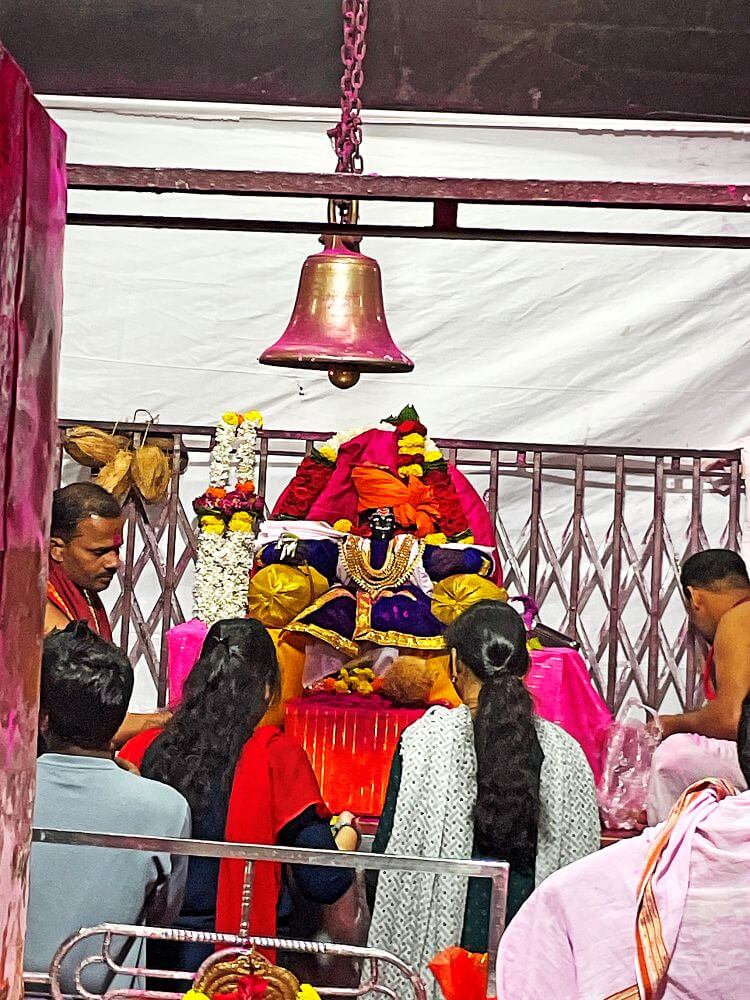
Inside the sanctum, Jotiba’s idol is seated in a brass shrine on a high pedestal. The idol is three feet tall and made of bluish-black polished stone. In most temples, idols do not face south, but the Jotiba temple is an exception. The legend behind this is that after the slaying of Ratnasura, Mahalaxmi-Ambabai requested Jotiba to keep his gaze upon her constantly; hence, the idol faces south. The idol is in the ‘Kramanpada’ form, meaning the left foot is slightly placed forward. The idol holds a sword, an elixir vessel (amritpatra), a trident, and a damaru. Behind the idol is Shesha, Jotiba’s secondary vehicle. According to iconographic scholars, the original idol of Jotiba here is in the form of the child Kedar. This leads devotees to wonder why the idol has a mustache; however, this mustache is applied later during the ritual decoration (Alankar Puja). During the decoration, a stylish turban is tied on the head, and the deity is dressed in a rich tunic (angarkha) and a dhoti. The idol’s attire is changed twice a day. The Makhar behind the idol is silver-plated, with horse sculptures mounted on its pillars. The idol of Jotiba underwent ‘Vajralep’ (a protective coating) in the years 1935, 1985, and 2006, which restored its original appearance. The temple also houses a silver processional idol of Jotiba, which is taken out in a palanquin during various festivals.
Outside the Jotiba temple, to the east lies the shrine of Satwai, and to the west is Ramling. This Ramling temple was built by Malji Nikam Panhalkar in 1780. Additionally, there is a small shrine of Dattatreya in the temple courtyard. In a pavilion on one side, a cow sculpture is installed, which devotees worship as Kamadhenu. On one side of the courtyard, there is a ‘Devbav’ or Pushkarini (stepped well) with stone stairs. It contains two sacred water sources, Jalsena and Chandrasena. The water from this well is used for the deity’s worship. Beside the steps of this well is an ancient inscription recording the donation of land in Giravali village for the worship of Karvir-Nivasini (Mahalaxmi). Next to this inscription, a large serpent image is carved. Similarly, in the stone corridors on one side of the courtyard, there are designated places for the ‘Sasankathis’ (ceremonial staffs).
Devotees believe that Jotiba is a living deity who grants their prayers. To fulfill their vows, many devotees offer gold and silver ornaments, horse figurines, metal hands, as well as sweets and coconuts to Jotiba. The temple remains crowded with devotees every day. Sunday is considered the auspicious day dedicated to Jotiba; therefore, the temple sees a larger influx of devotees on this day, as well as on every Purnima (full moon) and Shravan Shuddha Shashthi. A grand fair (yatra) is held at the temple on Chaitri Purnima, which begins as early as Ashtami. From Chaitra Shuddha Ekadashi to Purnima, a palanquin procession of Jotiba is taken out daily. At that time, the entire Wadi Ratnagiri resonates with the chant, “Jotibachya Navana Changbhala.” During this, gulal and grated coconut are showered freely. On Chaitri Purnima, the palanquin of Jotiba is taken to the Yamai Devi temple with great pomp and music. In this procession, more than fifty ‘Sasankathis’ are carried and danced. A Sasankathi is a bamboo pole about 30 to 35 feet high, wrapped in red and white turbans. At the top, black and white yak-tail whisks (chawari) or peacock feather fans (morchel) or kalash are tied. A horizontal wooden plank is fixed four to five feet from the base of the pole, upon which horse figurines or idols of the deity are placed. Devotees carry this plank on their shoulders and dance with the pole. Some of these poles hold special honor, with the first honor belonging to the village of Padali (Ninam). Devotees from across Maharashtra, Karnataka, and Andhra Pradesh attend this fair, and since Jotiba is the family deity (Kuldaivat) of the Scindia dynasty of Gwalior, many devotees also arrive from there.
This sacred temple stands as a testament to deep spiritual devotion, ancient architectural grandeur, and rich local cultural traditions.
The sanctum sanctorum houses the divine idol consecrated according to ancient Vedic traditions, surrounded by serene courtyards and traditional temple architecture.
Navratri, Maha Shivratri, Annual Temple Jatra & Deepotsav
Compare and book flights, secure top-rated local hotels near the temple, hire reliable guides, and rent cars instantly.
Extend your pilgrimage by visiting other highly sacred temples located nearby.


Add ₹999 more to unlock FREE SHIPPING!
Your sacred cart is currently empty.
Shop Photo FramesFill in your delivery details below to place your order.
Add comment