
Add ₹999 more to unlock FREE SHIPPING!
Your sacred cart is currently empty.
Shop Photo FramesMaharashtra is often described as stretching ‘from Chanda to Banda’. Here, Chanda refers to Chandrapur, and Banda is the largest marketplace on the Goa border in Sawantwadi Taluka. Bandeshwar is the village deity of this town, which boasts a rich historical heritage and has endured the ravages of many wars. A grand and beautiful temple of the Swayambhu Bandeshwar stands here. A unique feature of this temple is the presence of eleven and a half Swayambhu Lingams. This sacred site is considered a जागृत देवस्थान (awakened shrine) and is a place of deep faith for countless devotees.
Banda has an ancient history, having been an important port in the lower Konkan region in ancient times. It was known by the name Banda since the Yadav period. During the Adilshahi era, the town was renamed Adilabad. In the latter half of the sixteenth century, the region experienced great turmoil. A conflict was ongoing between the Portuguese, Ramaraya of Vijayanagara, and Nizamshah against Adilshah. On the १९th of September, १५४७, Ramaraya, Nizam, and the Portuguese entered into an agreement to fight against Adilshah. It was decided that all conquered territory would go to Vijayanagara, but the region between Banda and Cintacora would go to the Portuguese. During this war-torn period, between १५५० and १५५३, a Shiv devotee discovered Shivlingams in the forest of Banda. Later, they were consecrated here, and the place was named Bandeshwar.
There is a legend that the area where the Bandeshwar temple now stands was once a forest. A Shiv devotee farmer would bring his cattle to graze in that forest. It was then that he discovered eleven and a half Shivlingams – eleven complete and one partially broken. Another version of this legend states that this farmer would take his cattle to graze. He noticed that one of his cows would regularly go to a specific spot with dense trees and spontaneously let down her milk. He brought this to the attention of the villagers. When they inspected the spot, they found these Shivlingams. Everyone then worshipped them and built a temple on that very spot. This is the Bandeshwar temple. The farmer’s name was Nar Jog Sawant Moraya. An inscription in the sanctum sanctorum of the old temple bore the text ‘श्री देव बांदेश्वर. नार जोग सावंत मोरया’ (Shri Dev Bandeshwar. Nar Jog Sawant Moraya).
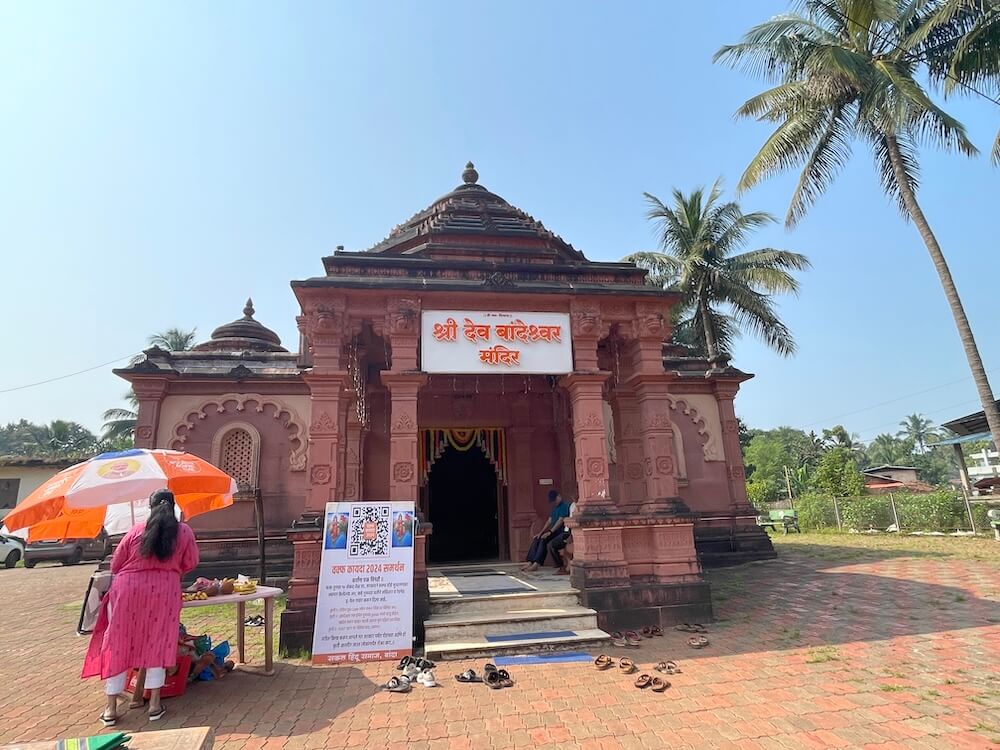
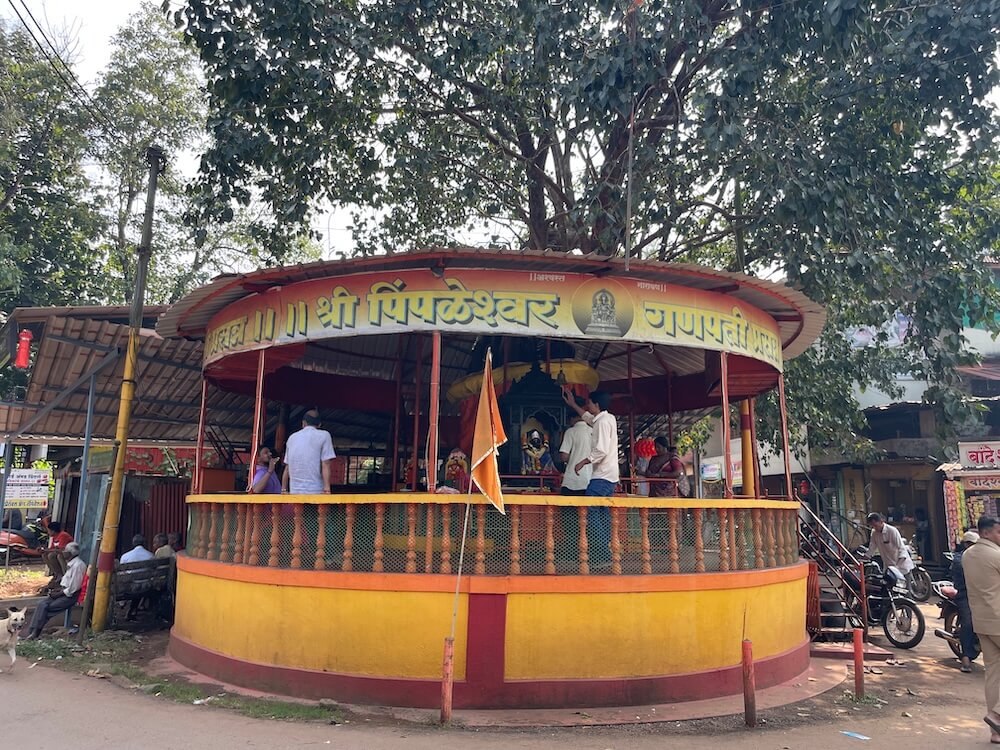
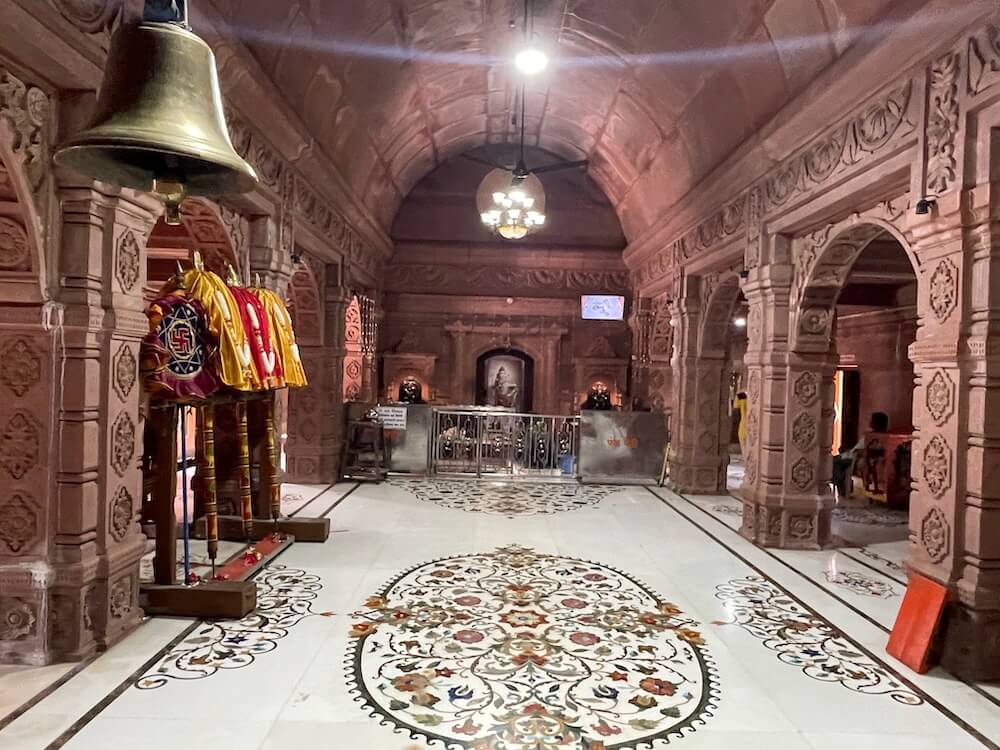
In the marketplace of Banda, near the Pimpaleshwar Ganapati Para, by the road in a spacious courtyard, stands the exceedingly grand and beautiful Bandeshwar temple. The temple courtyard is several feet elevated from the road. One enters the courtyard by ascending seven steps. Immediately upon entering, to the left, is a tall Deepstambha (lamp pillar) with the shape of a temple shikhara at its top. Special arrangements have been made on the Amalaka of this Deepstambha for lighting lamps. Nearby is a Tulsi Vrindavan. In front of the courtyard is the temple’s Mukhamandapa (front pavilion) made of pink stone. There are seating arrangements here. A large dome rests on four substantial pillars here. It is topped with a squat Amalaka and a Kalasha (finial). The entire temple structure is built of Rajasthani Dholpuri stone, while Makrana marble has been used for the temple’s floor. The temple’s layout comprises a Mukhamandapa, Sabhamandapa (assembly hall), Antarala (vestibule), and Garbhagriha (sanctum sanctorum).
A Kirtimukha (glorious face) is carved above the entrance to the enclosed Sabhamandapa. Makrana marble tiles have been used in the Sabhamandapa in such a way that the floor appears to be covered with a Kashmiri carpet. Carved arched and latticed windows, as well as entrances at intervals, ensure ample sunlight and fresh air in the Sabhamandapa. The exquisitely carved pillars can be considered a defining feature of this temple. Each pillar is intricately carved from base to top. Although the Antarala is slightly smaller than the Sabhamandapa, it is a replica of it. The roofs of the Sabhamandapa and Antarala are Gajaprishtakara (elephant-back shaped).
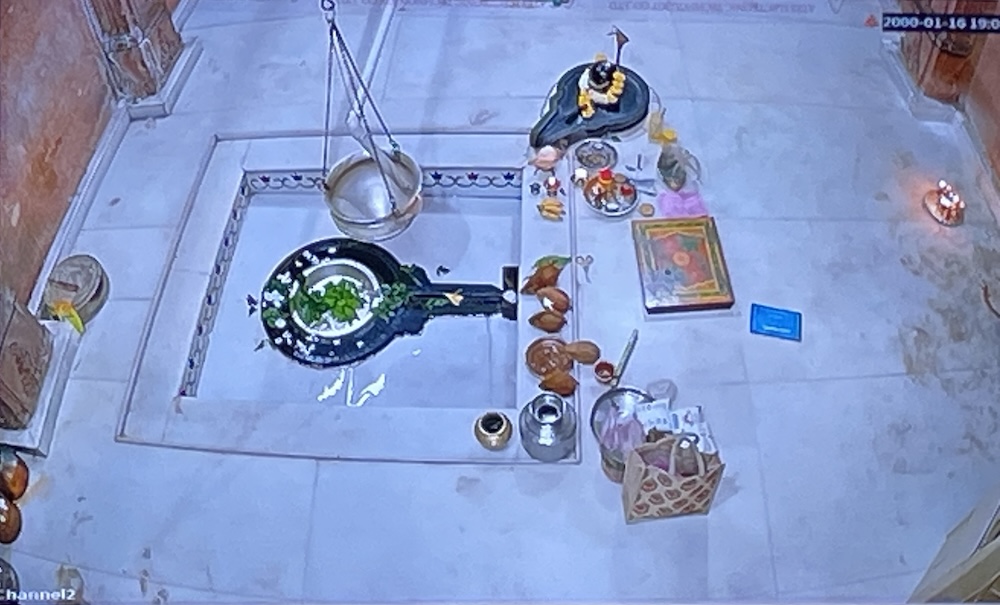
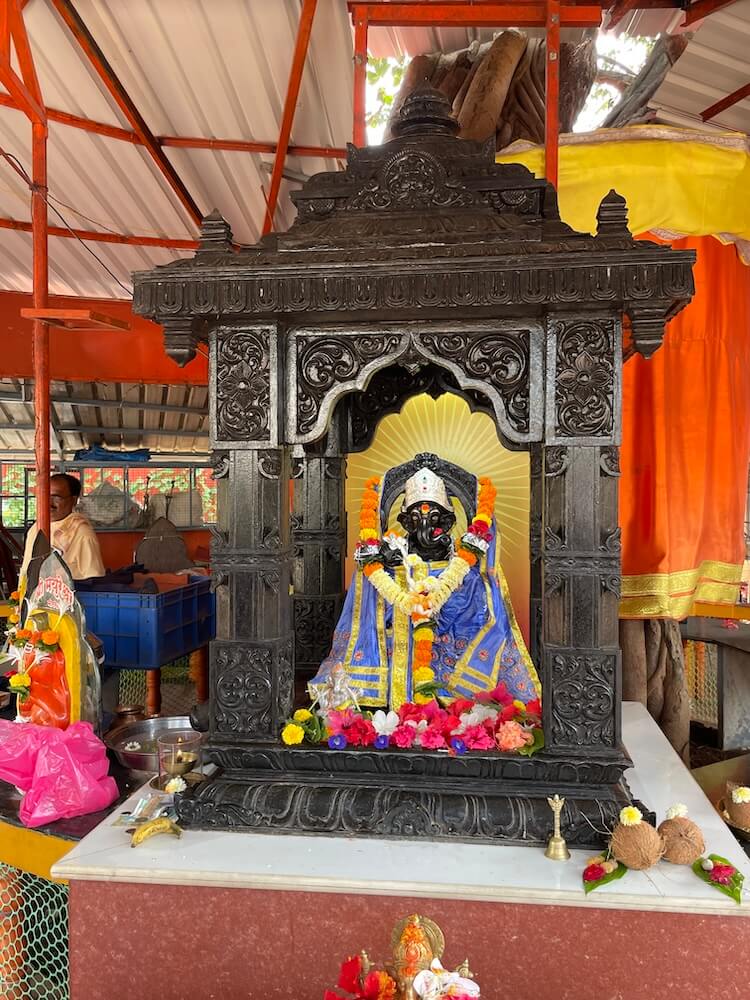
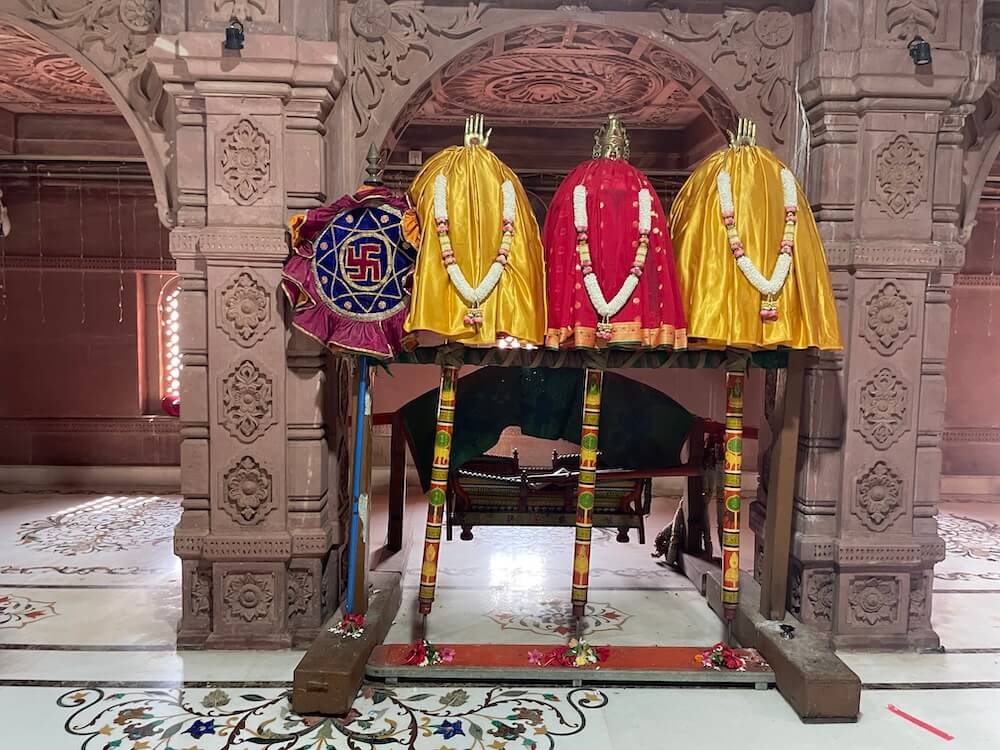
On the left side of the Antarala, Tarangakathyas (waving staffs) are kept. From the Antarala, there is a circumambulatory path around the Garbhagriha. In front of the Garbhagriha is a large idol of Nandi, carved from a single stone. The idol’s composition and intricate carvings clearly indicate its ancient origin. On the facade of the Garbhagriha, in beautifully carved Devakoshtakas (niches resembling shrines), there is an exquisite idol of Hanuman on the left and Ganesha on the right. Inside, on the floor, in a square recessed area, is the Bandeshwar Pindi. Adjacent to it is another small Pindi. Below the Mukha Lingam in this square recessed area, the Shivlingams discovered by Nar Jog Sawant are consecrated. An Abhishekapatra (vessel for ritual anointing) is placed above them. Water is continuously supplied to it through a pipe from the sacred well behind the temple. Devotees draw water from this well and pour it into the vessel installed there. The second small Shiv Pindi in the Garbhagriha is a Banalinga, and flower petals are offered upon it. After having Darshan of Bandeshwar, there are paths on both sides to exit after completing the Pradakshina (circumambulation).
One of the architectural marvels of the Bandeshwar temple, built at a cost of crores of rupees, is its intricate carvings, as well as the Kalashas (finials) adorning the temple. On both sides of the Gajaprishtakara roof, from the Mukhamandapa to the Antarala, there are twelve squat Amalakas on each side, topped with Kalashas, forming Shikharas (spires). Similarly, a total of चाळीस Kalashas are arranged in a single row along the center of the roof. The octagonal Shikhara of the Garbhagriha is crowned with a dome-shaped Amalaka and a Kalasha.
The Bandeshwar Palkhi (palanquin procession) takes place daily, and Bhajans (devotional songs) are also performed. Devotees from all three states – Maharashtra, Goa, and Karnataka – come here for Darshan. The temple is thronged by devotees during festivals such as Gudi Padwa, Narali Pournima, Hanuman Jayanti, Narak Chaturdashi, Dev Diwali, Holi, Mahashivratri, and Navratrotsav.
Adjacent to the Bandeshwar temple is the Bhumika Devi temple. Bhumika Devi is the village deity of Banda. According to some scholars, the village of Banda previously had an area called Devkond. This area is now located in the vicinity of the Mumbai-Goa Highway that passes through here. It was the abode of Banda’s village deities and family deities. After the discovery of the Swayambhu Lingam of Bandeshwar, with the intention of having all deities in one place, the deities from Devkonda were consecrated near Bandeshwar in १७५३, and a temple in the form of Shiv Panchayatana was built here. Since then, this temple has been known as Shri Bandeshwar Bhumika Panchayatana.
At the sacred Bhumika Devi Mandir, on the dawn of the second day of Datta Jayanti, that is, Margashirsha Krishna Pratipada, the Divine Mother is given a ceremonial Mahasnan. Thereafter, the Devi is adorned with beautiful garments and ornaments. Her lap (Oti) is filled with five fruits by five revered Varsaldars, followed by the married daughters (Maherwashini) who also fill the Devi’s Oti. During this time, devotees offer and make vows. On this auspicious day, a joint palanquin procession of Bandeshwar and Bhumika Devi takes place. On other occasions, only the palanquin procession of Bandeshwar is held every Monday. After the joint palanquin procession, a Dashavatara performance is held at night. The next day is celebrated with Dahikala. Following the Dahikala, the deities are carried in a palanquin to the river. On their return, offerings of grains, fruits, and other food items are made to the deities. Upon reaching the temple, the Divine Mother is reverently re-enthroned with great devotion and worship. Near Bhumika Devi, there are also temples dedicated to Shri Ganesha, Ravalnath, and Vetal. During the Yatra, Ravalnath is also consulted for divine guidance (Kaul). These four temples, along with Shri Bandeshwar, form the ‘Shiva Panchayatana’ structure of the temple complex. In the village of Banda, there is a memorial temple dedicated to Saint Sohiroba, and within the former Dutch factory, which now houses the police station, there is a temple of Pateshwar.
This sacred temple stands as a testament to deep spiritual devotion, ancient architectural grandeur, and rich local cultural traditions.
The sanctum sanctorum houses the divine idol consecrated according to ancient Vedic traditions, surrounded by serene courtyards and traditional temple architecture.
Navratri, Maha Shivratri, Annual Temple Jatra & Deepotsav
Compare and book flights, secure top-rated local hotels near the temple, hire reliable guides, and rent cars instantly.
Extend your pilgrimage by visiting other highly sacred temples located nearby.


Add ₹999 more to unlock FREE SHIPPING!
Your sacred cart is currently empty.
Shop Photo FramesFill in your delivery details below to place your order.
Add comment