
Add ₹999 more to unlock FREE SHIPPING!
Your sacred cart is currently empty.
Shop Photo FramesThe village of Amarapur, situated at the confluence of the Krishna and Panchganga rivers, is believed to be an ancient Siddhasthana (a place of spiritual accomplishment). This village houses an ancient temple of Amareshwara. Devotees believe that the sixty-four Yoginis, who serve Amareshwara, reside in this place. It is said that due to the spiritual significance of this location, many Siddha Purushas (enlightened beings) performed penance in this area. Nrusimha Saraswati Swami, who is considered a complete incarnation of Shri Dattatreya, also performed penance here for १२ years and installed the Shri Datta Padukas before departing. The village was named Nrusimha Wadi / Narsobachi Wadi due to the stay of Shri Nrusimha Saraswati. Every day, thousands of devotees visit this Paduka temple for Darshan.
According to the book ‘Medieval Maharashtra – Social and Cultural Life’ by Professor M. Shri. Mate, ‘The Datta Sampradaya is one of the sects that emerged in medieval Maharashtra. Like the Mahanubhava sect, the Datta Sampradaya is also primarily prevalent in Maharashtra. The credit for being the original founders of this sect goes to Shripad Shrivallabha and Nrusimha Saraswati. As seen in the book Gurucharitra, both of them had studied the Vedas in the traditional manner, had been on pilgrimages, and both had attained great authority in the path of Yoga.’ Devotees of Nrusimha Saraswati consider him an incarnation of Dattatreya. Nrusimha Saraswati was born in १३७८ AD at Ladache Karanja in Washim district, during the time when Hasan Gangu Bahmani established the Sultanate in Maharashtra.
The biography of Nrusimha Saraswati is narrated in the book ‘Gurucharitra’, written by Saraswati Gangadhar around १५४८ AD (Shaka १४७०). In its ११th chapter, it is stated that ‘Upon birth, the child uttered the extraordinary sound of Omkara.’ This means that immediately after birth, the chanting of Omkara began from his mouth. He never cried like a normal child. This surprised everyone. The astrologers of that time predicted his horoscope, saying, ‘This boy will be worshipped in the three worlds. By his mere sight, the fallen will be purified.’ According to Gurucharitra, his birth name was Shaligram. However, he was always called Narahari. Until he was seven years old, he could not speak any word other than Omkara.
At the age of ten, in the year १३८८, the elderly ascetic Shri Krishna Saraswati of Varanasi gave him Sannyasa Diksha. Thereafter, while on a pilgrimage, he arrived in १४२१ at the village of Amarapur, situated at the confluence of the Panchganga and Krishna rivers. At that time, in the two years of १४२१ and १४२२, a severe famine occurred throughout Maharashtra. During this period, Nrusimha Saraswati performed penance here for १२ years. In १४३४, while leaving for Gangapur Kshetra, at the request of the sixty-four Yoginis, he installed beautiful sandy Padukas and Annapurna Janhvi under an Audumbar tree on the banks of the confluence. It is said that these Padukas were crafted from Moonstone, which is why they do not wear away despite the constant Jalabhishek (water offering). Devotees believe that because the Swami granted a boon that Datta-seva performed at these Padukas would bear fruit, one’s wishes are fulfilled upon having Darshan of these Padukas. Vasudevanand Saraswati Tembe Swami called Narsobachi Wadi the capital of Datta Maharaja. Tembe Swami mentioned in a poem, ‘Mat Chita Chinti Sachi Hi Wadi Narsobachi’.
A legend is told about this temple that the daughter of the Adil Shah of Bijapur was blind. He came to Narsobachi Wadi and prayed. Due to that prayer, the girl regained her sight. Then the Sultan built this temple and gifted the two villages of Aurwad (Amarapur) and Gaurwad on the riverbank to the temple for its maintenance. It is also said that because a Muslim Sultan built the temple, it has no Kalash (spire). The Gurucharitra records that Nrusimha Saraswati had also cured a boil on the lap of the Bahmani Sultan of Bidar, Alauddin Ahmad (II), just as he had healed the daughter of Adil Shah.
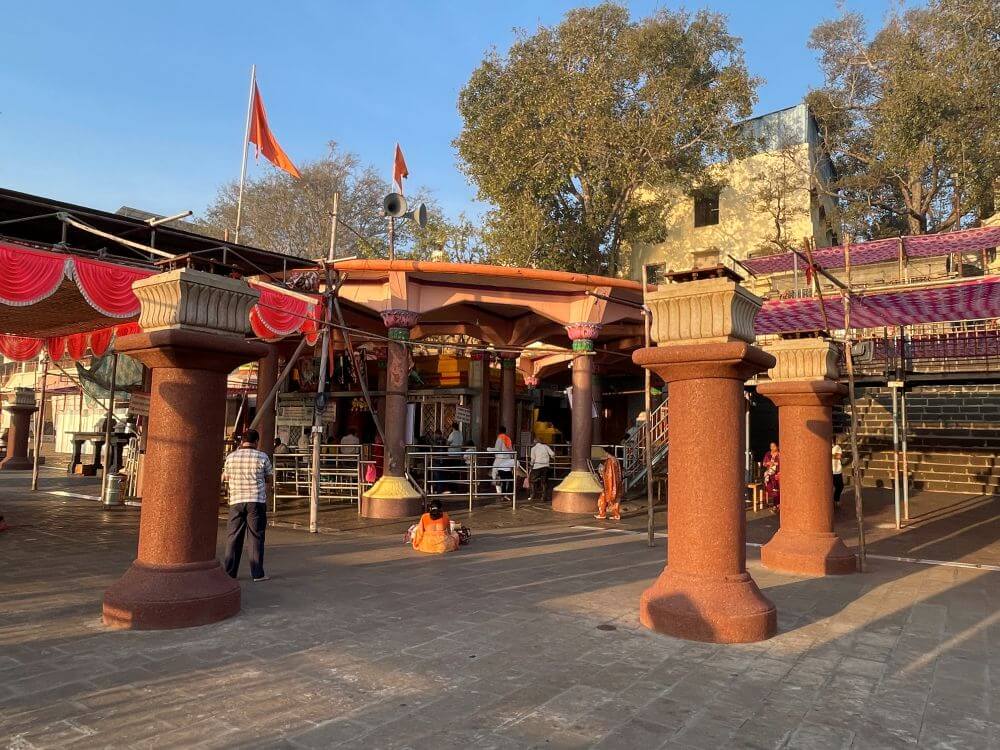
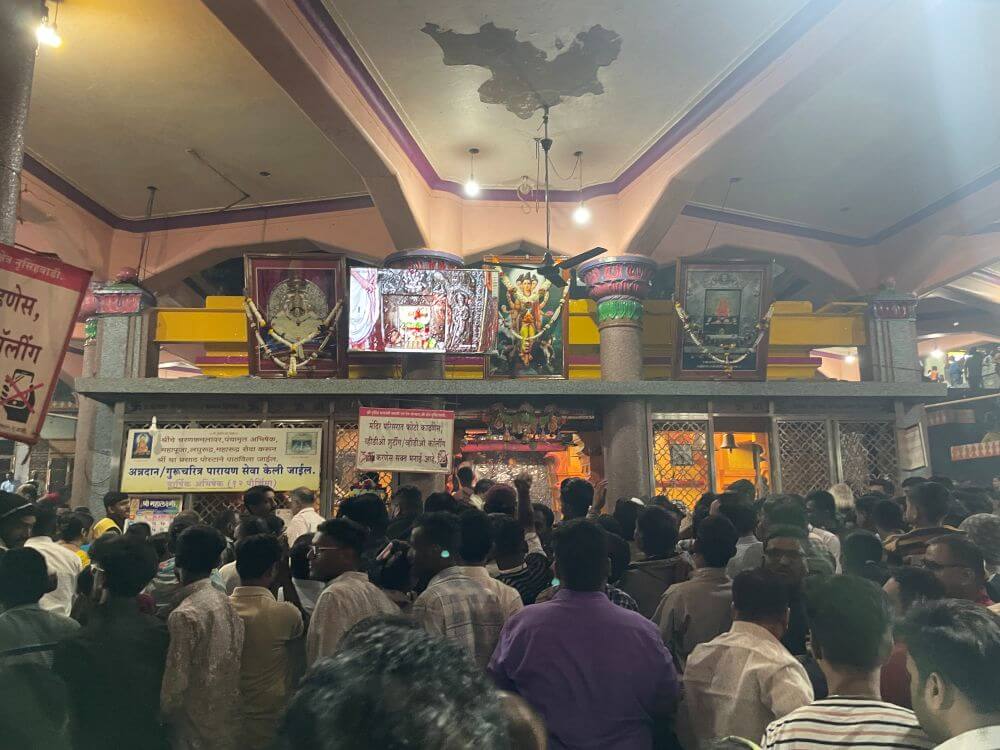
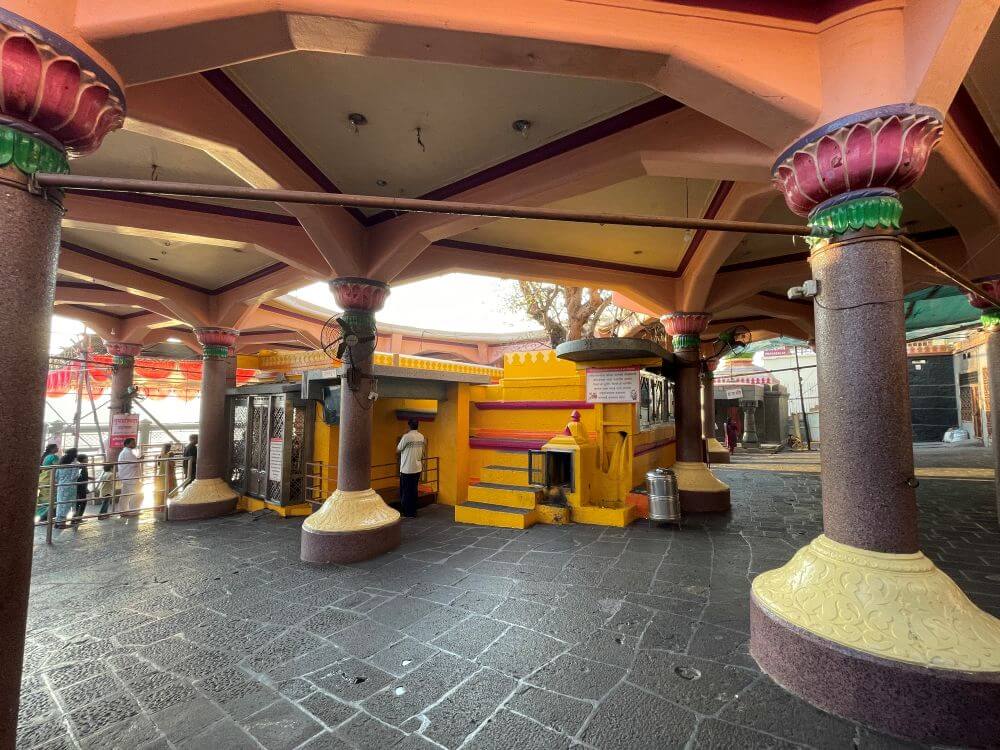
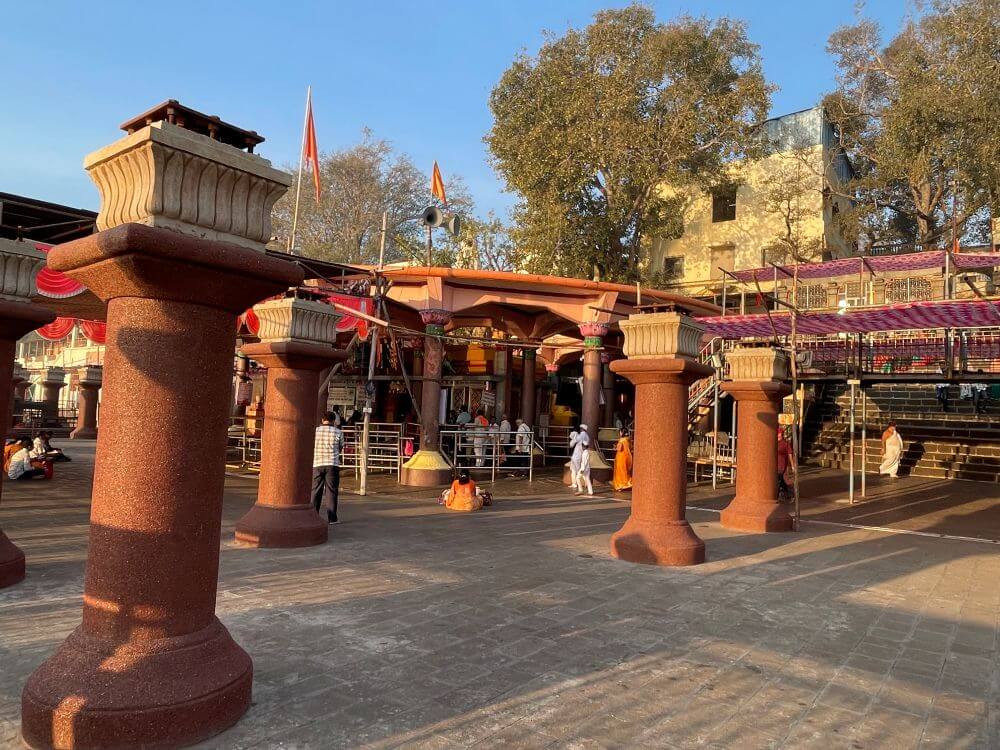
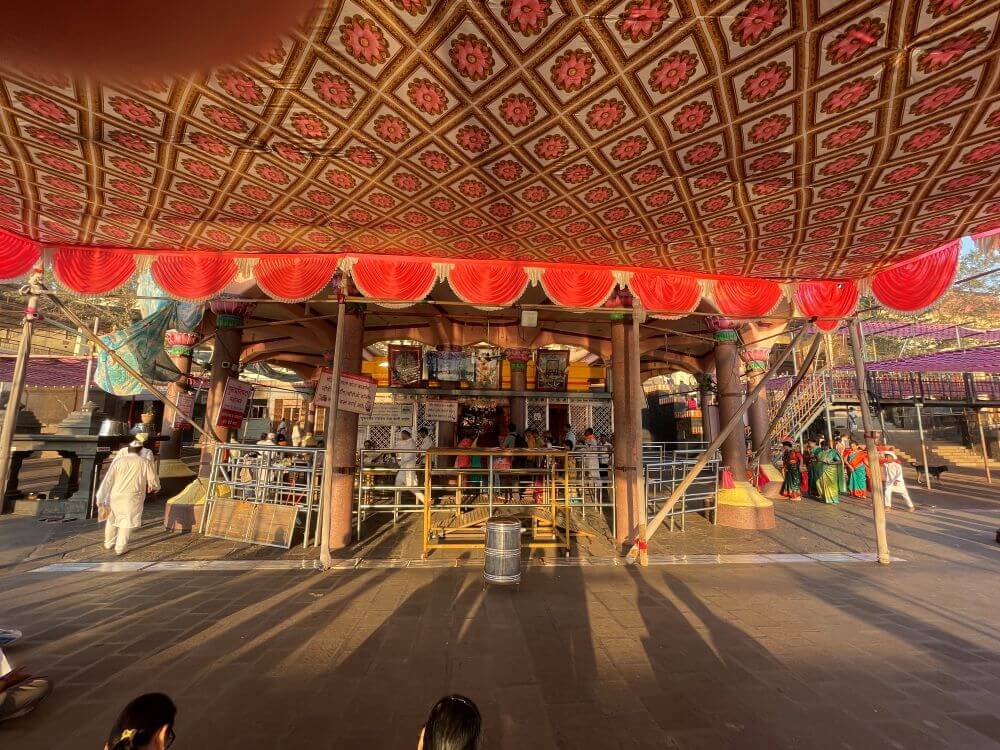
This temple, built by Adil Shah, is at the confluence of the Krishna and Panchganga rivers. While going towards the temple through the large market of the village, there are shops selling Prasad, worship materials, and food items on both sides. Moving forward from here, one descends the stairs to reach the vast river ghat. On the river ghat, there is an open circular Darshan Mandap with १२ circular pillars on the outside and ६ on the inside. The lower part of the pillars is somewhat wide and features vine carvings. On the upper side of the pillars, there is a lotus-shaped capital, topped by beams and a roof. The central circular part of the roof is open. Under this open roof, beneath an Audumbar tree, is the rectangular stone-built Paduka temple. The door to the sanctum sanctorum is small, and inside are the Padukas installed by Shri Nrusimha Saraswati. The front part of the sanctum is covered in silver plating. On the lintel, there is a Ganapati carving, and on both sides are peacock, Swastika, and Om symbols. Above this is an image of Shri Nrusimha Saraswati and a strip decorated with floral patterns. On both sides of the door are mace-bearing gatekeepers. Nearby is a self-manifested (Swayambhu) Shri Ganesh idol. The Samadhi temple of Yogi Ramchandra is also here. Additionally, there are Samadhi temples of Tembe Swami, Narayan Swami, Kashikar Swami, Gopal Swami, and Mouni Swami.
A short distance from the temple is the Annachhatra. Here, Mahaprasad is distributed to the devotees. This grand structure has seating arrangements for hundreds of devotees at a time. Narsobachi Wadi is a prominent place of the Datta Sampradaya. Festivals like Datta Jayanti, Guru Dwadashi, and Nrusimha Saraswati Jayanti are celebrated here. When the river water rises during the monsoon and begins to flow out through the southern door of the temple, the ‘Dakshin Dwar Sohala’ (Southern Door Ceremony) is celebrated. Various rituals like Javal (first haircut), Munja (thread ceremony), Dashkriya, Janan Shanti, and Navagraha Shanti are performed here.
Near the temple, one can see the view of the confluence of the Panchganga and Krishna rivers. About two kilometers from here, at the Kurundwad Ghat, is the Samadhi of Santaji Ghorpade, the Commander-in-Chief of the Maratha Empire. His mortal remains were cremated at this very spot. Here stands the Mahadev Panchayatan temple built by Santaji Ghorpade’s father, Mhaloji Ghorpade.
This sacred temple stands as a testament to deep spiritual devotion, ancient architectural grandeur, and rich local cultural traditions.
The sanctum sanctorum houses the divine idol consecrated according to ancient Vedic traditions, surrounded by serene courtyards and traditional temple architecture.

Navratri, Maha Shivratri, Annual Temple Jatra & Deepotsav
Compare and book flights, secure top-rated local hotels near the temple, hire reliable guides, and rent cars instantly.
Extend your pilgrimage by visiting other highly sacred temples located nearby.


Add ₹999 more to unlock FREE SHIPPING!
Your sacred cart is currently empty.
Shop Photo FramesFill in your delivery details below to place your order.
Add comment