
Add ₹999 more to unlock FREE SHIPPING!
Your sacred cart is currently empty.
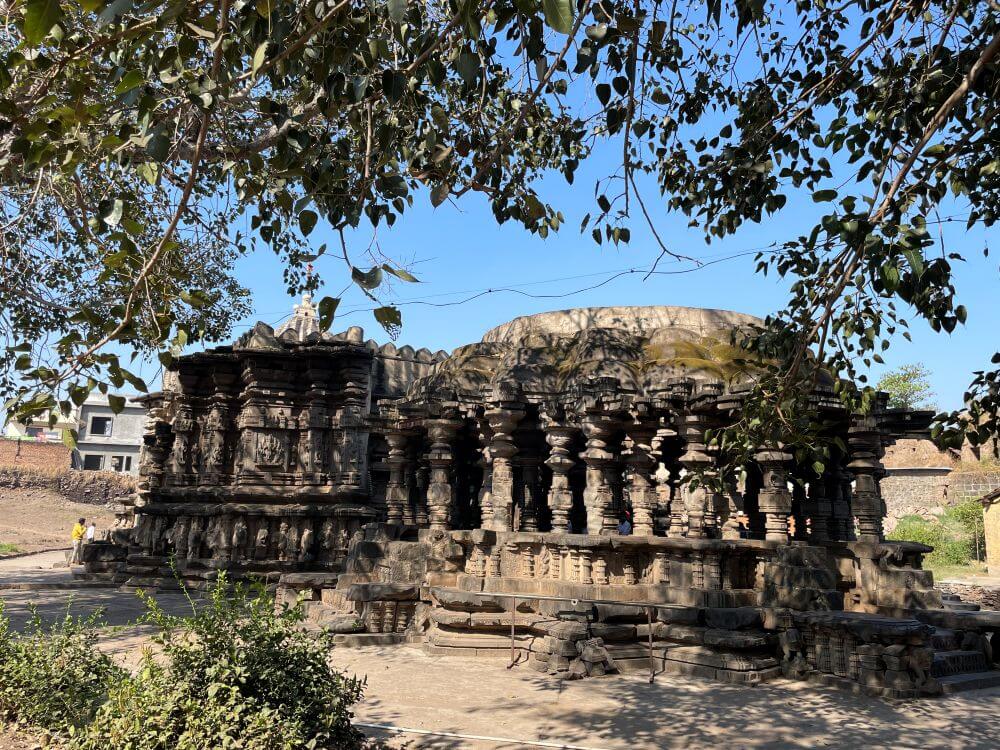
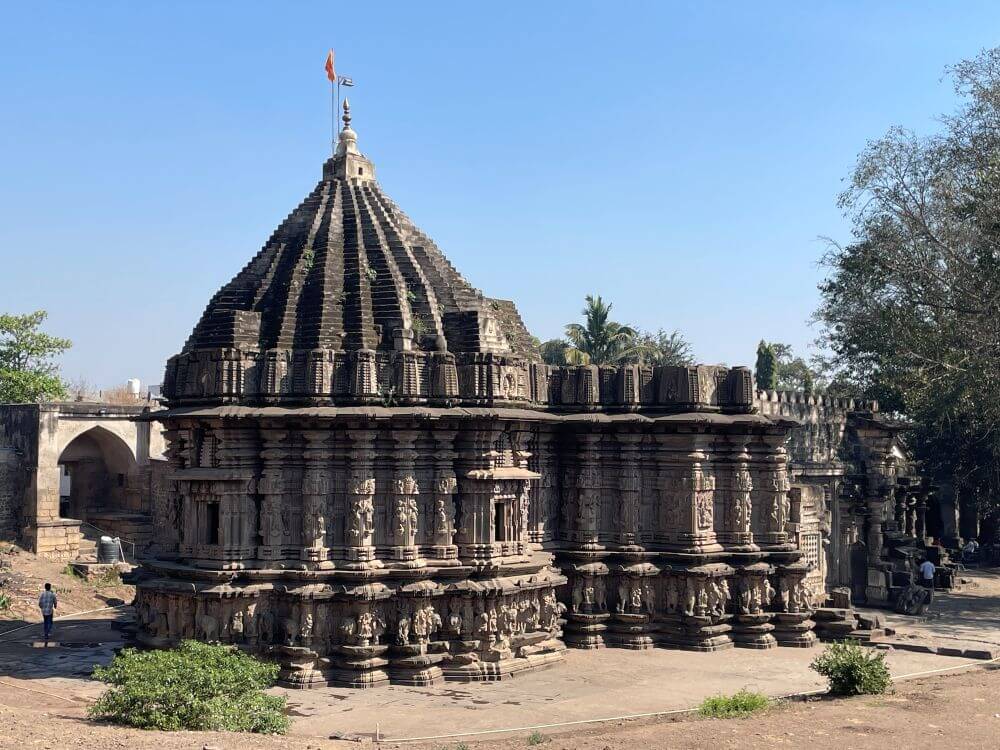
Shop Photo FramesThe exquisitely beautiful Kopeshwar Temple at Khidrapur is an indescribable manifestation of ancient temple architecture, the architectural prowess of that era, and the artistic brilliance of its sculptors. This temple, dating back approximately 800 to 1000 years, is often described as ‘poetry in stone.’ While the temple is significant from an architectural perspective, it also holds unique religious importance. This is because the Lingas of both Shiva and Vishnu are enshrined here in the same sanctum sanctorum. Every day, a large number of devotees and tourists flock to this temple to offer prayers and admire the beauty of its sculptures.
The village of Khidrapur is situated in a crescent-shaped bend of the Krishna River in the Kolhapur district. The ancient name of this village was Koppam. According to some scholars, when the village came under the control of the Adil Shahi commander Khidr Khan, he renamed it Khidrapur. A battle took place at Nesari in the Chandgad taluka of Kolhapur district between Chhatrapati Shivaji Maharaj’s commander-in-chief, Prataprao Gujar, and Bahlol Khan. Khidr Khan, who served as an advisor to Bahlol Khan, was present in this battle, which is etched in the public consciousness due to the poem ‘Vedat Daudale Veer Marathe Saat.’ Khidrapur is also known by another name, Wadi Kopeshwar. A site dedicated to Kopeshwar has existed here since ancient times.
There are two Lingas in this temple: Kopeshwar and Dhopeshwar. A legend associated with this states that when Shiva was insulted during the Daksha Yajna, a grief-stricken Sati leaped into the sacrificial fire and gave up her life. Enraged, Shiva created Virabhadra and slew King Daksha. He became Kopeshwar Mahadev, consumed by the sorrow of Sati’s separation. He had granted a boon to his devotees that anyone who visited the Banknath Linga at Raybag Bagewadi, the Shankhnath Linga at Sankeshwar, and the Kopeshwar Linga at Khidrapur in succession on the same day during Pradosh would attain immediate salvation (Swarga). Consequently, many devotees began visiting these sites, and after offering prayers at the Kopeshwar temple, they would ascend to heaven directly from the temple’s pavilion, as per Shiva’s boon. Thus, the pavilion came to be known as the ‘Swargamandap’ (Heavenly Pavilion). As the number of people ascending to heaven began to increase rapidly, the gods rushed to Vishnu and asked him to find a solution to this problem. In response, Vishnu installed his own Linga in front of the Kopeshwar Linga. As a result, upon entering the Khidrapur temple, devotees could no longer immediately see the Kopeshwar Linga. The condition of the boon could not be fulfilled, and the gods’ problem was resolved. Thus, Vishnu, who came to stop those ascending to heaven, became known as Dhopeshwar. Even today, the first sight one gets in the sanctum is that of Dhopeshwar, followed by Kopeshwar.
Another unique feature of the Kopeshwar temple is the absence of a Nandi, which is an inseparable element of a Shiva temple. The legend regarding this is that King Daksha’s Yajna took place at Yadur, across the Krishna River. Nandi had accompanied Sati there and remained behind. Therefore, the site of the Nandi remains at Yadur, where there is a temple dedicated solely to him.
There is no concrete evidence regarding exactly when the Khidrapur temple was built. Some historians believe that the site of Kopeshwar certainly existed before 1077 AD. This is based on an inscription found at Yevur in the Gulbarga district of Karnataka, which mentions that a person named Shankar Arya worshipped the Koppa deity at Koppam with various vows to be blessed with a son. This clarifies that a temple of the Koppa deity, or Koppeshwar, existed here long before that. This region was under the rule of the Chalukyas for a long time, and they were devotees of Shiva. It is said that this temple may have been built during their reign, as its architectural style aligns with the Chalukyan period. However, historian V. V. Mirashi has estimated that this temple might have been built by the Shilahara King Gandaraditya, whose reign was from 1105 to 1140 AD. Overall, a scholarly argument is presented that there was initially a small temple of Kopeshwar here. The Chalukyas built a larger temple, and later, during the Shilahara period, the temple was renovated. It reached its completion during the reign of the Yadavas of Devagiri.
From the 3rd century BC until 218 AD, Khidrapur was a small village in the Satavahana empire. Following this, it was ruled by the Rashtrakutas and then by the Chalukyas until 975 AD. After the Chalukyas, the Khidrapur region came under the control of the Shilaharas. This part of Khidrapur was a ‘Kurukshetra’ of that time, meaning it was a battlefield. In 1052 AD, a major battle took place here between the Chalukyas of Kalyani and the Chola kings of Kanchi, in which the Cholas suffered a major defeat. Later, a battle occurred here between the commander Bijjala, who succeeded the Chalukyas of Kalyani, and Vijayaditya, the son of the Shilahara King Gandaraditya. This is mentioned in an inscription in the Kopeshwar temple. Another major battle took place on the battlefield of Khidrapur. When the Shilahara King Bhoja II of Kolhapur attempted to throw off the suzerainty of the Yadavas of Devagiri, the Yadava King Singhana attacked him. In the battle that took place in the Khidrapur area in 1213 AD, Singhana defeated King Bhoja and annexed the Shilahara kingdom of Kolhapur. An inscription of this Yadava King Singhana is present in the Kopeshwar temple. The inscription mentions that on the occasion of a solar eclipse on a Monday in the month of Chaitra in Shaka Samvat 1136 (1214 AD), King Singhana donated the village of Kudaldamwad (present-day Kurundwad) for the worship of Kopeshwar. After this, Khidrapur remained peaceful for many years. It is said that the Kopeshwar temple suffered the impact of the attack on the Yadava empire by Malik Kafur, the commander of Alauddin Khilji, at the beginning of the 14th century. It appears that Muslim invaders damaged many of the sculptures in this temple. Despite these human-made crises and various natural calamities over time, the temple stands tall even today.
This temple is built in the Bhumija style of architecture. Its construction was achieved by interlocking stones without the use of any binding mortar. This method of construction is also known as Hemadpanti. The temple is 103 feet 6 inches long and 65 feet wide. The current height of the temple, including the shikhara (spire), is 52 feet 6 inches. The structure of the temple consists of a Nagarkhana, Swargamandapa (mukhamandapa), Sabhamandapa, Antarala, and Garbhagriha. As one enters the temple premises located on one side of the village, one first encounters the Nagarkhana. The entrance of the Nagarkhana features four door jambs, a torana (archway) at the top depicting a replica of the temple spires, and an image of Lord Ganesha on the lalata-bimba (lintel). On the upper part of the doorway, elephant figures are carved on both sides. The Nagarkhana is constructed of stone and brick and is of a more recent period. The Nagarkhana houses an image of Lord Vishnu and a Veeragala (hero stone).
Upon entering from here, one sees the indescribable Swargamandapa of the temple. This mandapa is built separately from the main temple and has a circular design. In the center of this mandapa, which has a diameter of 26 feet, is a monolithic circular stone slab with a diameter of 14 feet, known as the Rangashila. The Swargamandapa has no roof; when one stands on the Rangashila and looks up, the sky is visible. There are a total of 48 pillars in this mandapa, 12 of which surround the Rangashila. Above these pillars surrounding the Rangashila is a row of canopy-shaped niches containing sculptures of various deities. At the top of the pillars, the Ashtadikpalas (guardians of the eight directions) are depicted, either seated on or standing beside their respective vehicles. To the east is Indra, with his consort Shachi or Indrani and his vehicle, the elephant. To the southeast is the fire deity Agni, seated on a ram with his consort Svaha. To the south, Yama is mounted on a buffalo with his consort Dhumorna. The deity of the southwest, Nirriti, with a fearsome expression, is on his vehicle, a ghost (preta). To the west is the water deity Varuna with Varuni on a makara (mythical sea creature), and to the northwest is Vayu with his consort, mounted on a hare. To the north is Kubera with Vriddhi, mounted on a horse, and to the northeast is Ishana with his consort, mounted on Nandi. The exterior of the Swargamandapa is decorated with carved lion figures. In ancient times, performances of dance, singing, and instrumental music were presented on the Rangashila here.
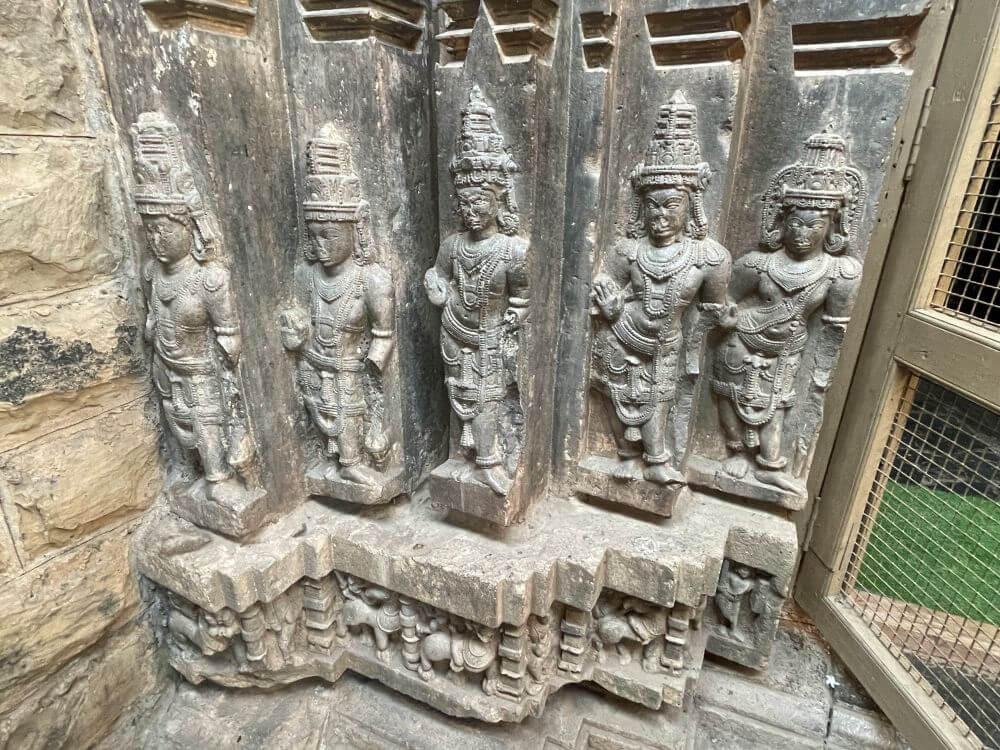
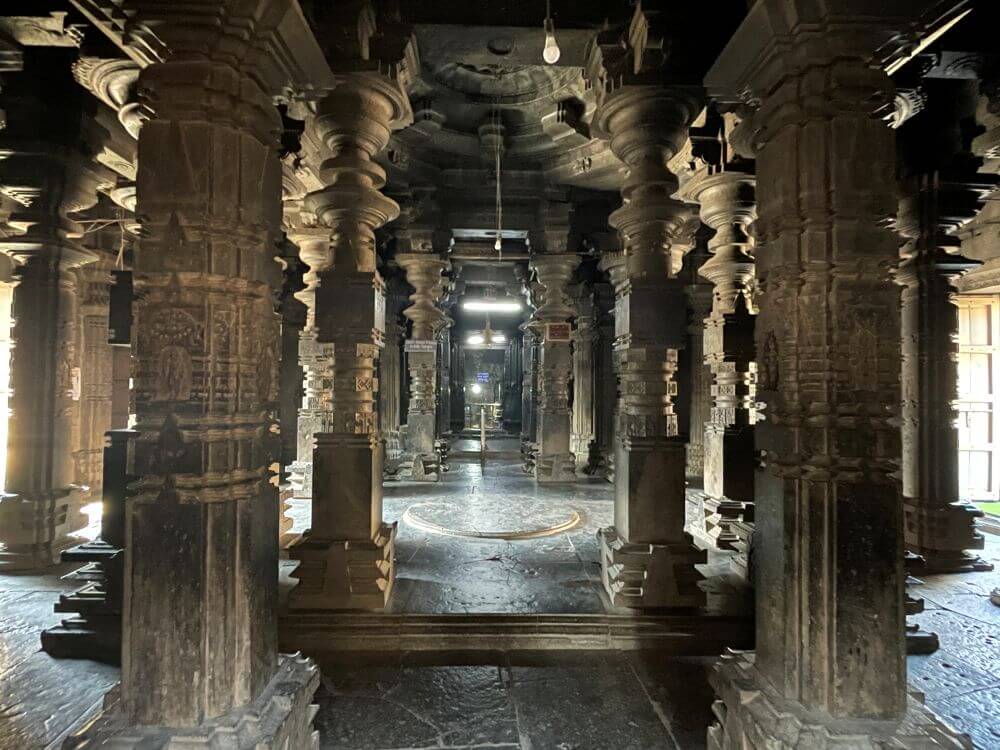
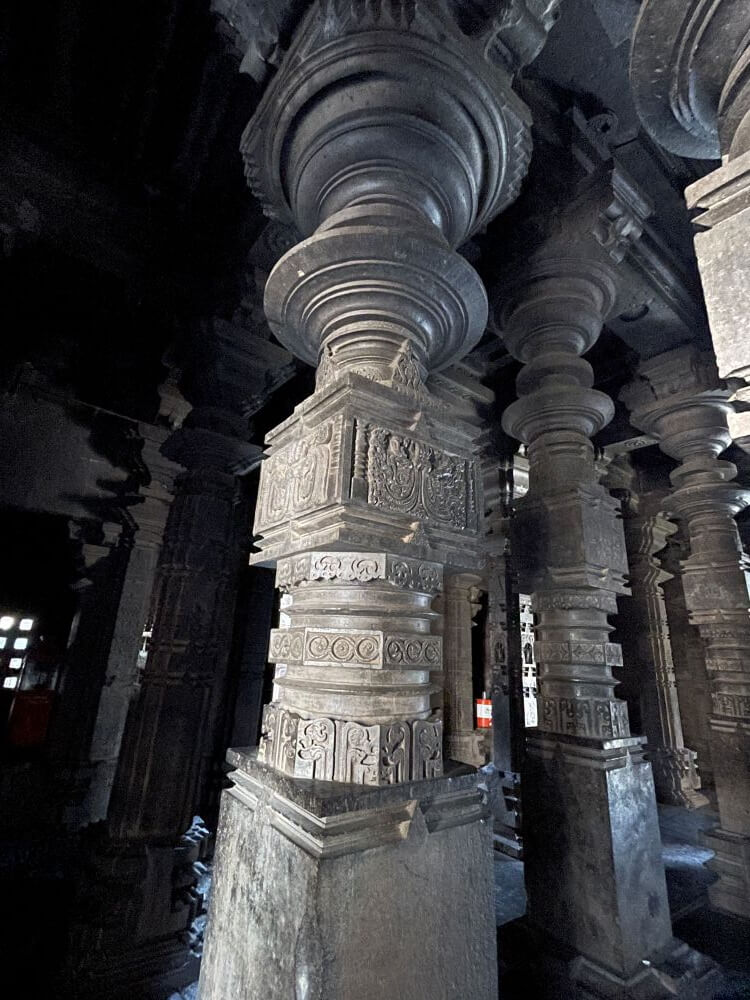
Moving forward from the Swargamandapa, one reaches the spacious Sabhamandapa of the temple. This is in the form of a Gudhamandapa, meaning it is enclosed by walls on all four sides. The Sabhamandapa has three entrances. On both sides of the main door frame, on the door jambs, are carved figures of dwarapalas (gatekeepers) as well as the rivers Ganga and Yamuna. Above the door frame is a torana, and on the lalata-bimba is Gajalakshmi. In front of this door is a rangoli-like intricate carving in stone. On the threshold, some words are inscribed: ‘Mugati Gopalun Sinday Jugalhukap’. The inscription is fragmentary and some letters are indecipherable, so the meaning remains unclear. Upon entering the Sabhamandapa, one’s eyes are drawn to the beautifully carved pillars. In the center of this vast 50×50 foot square Gudhamandapa is a circular Rangashila. There are 12 pillars in the central area, surrounded by 20 square pillars. The walls of the mandapa contain 28 semi-pillars (pilasters) carved into them. On all three sides of the mandapa, there are six latticed windows (jalavatayana) carved out of stone for ventilation. Each of these latticed windows features a different type of intricate design. At the top of the mandapa is a canopy-shaped structure containing a stone chandelier.
The pillars here are of three different types. While square at the base, the middle and upper parts of some of these pillars are of a different style. Various sculptures are carved on the square sections of all these pillars. Scenes such as the meeting of Shri Ram and Hanuman from the Ramayana, the story of the tortoise and the royal swan from the Mahabharata, and the friendship between the crocodile and the monkey from the Panchatantra are skillfully carved into these small squares. In addition, there are sculptures of Indra, Vishnu, Brahma, Shankar, Mahishasuramardini, Ganpati, Hanuman, Garuda, Madan, Sursundaris, Vyala, Kirtimukha, and Mahavir. Notably, there is also a mithuna (erotic) sculpture on one of the pillars. Along the walls to the left of the Sabhamandapa, on the platforms, are two large horizontal panels of the Saptamatrikas.
The Antarala (vestibule) of the temple is 20×20 feet. In this pillar-less chamber, there are sculptures of young women carved onto the stone walls. These figures, adorned from head to toe, are broken in some places. On the north wall of this chamber, there is an inscription in the Kannada language and script. In the Garbhagriha (sanctum sanctorum) of the temple, there are the lingas of Kopeshwar and Dhopeshwar. The stone of the Shalu-nka (base) of the Shiva-pindi here is black, while the linga is reddish. The structure of the linga of Vishnu, i.e., Dhopeshwar, is like a round pillar. There are three niches in the Garbhagriha, with semi-pillars on both sides of each. Additionally, there are a total of 15 female sculptures and three male sculptures carved here.
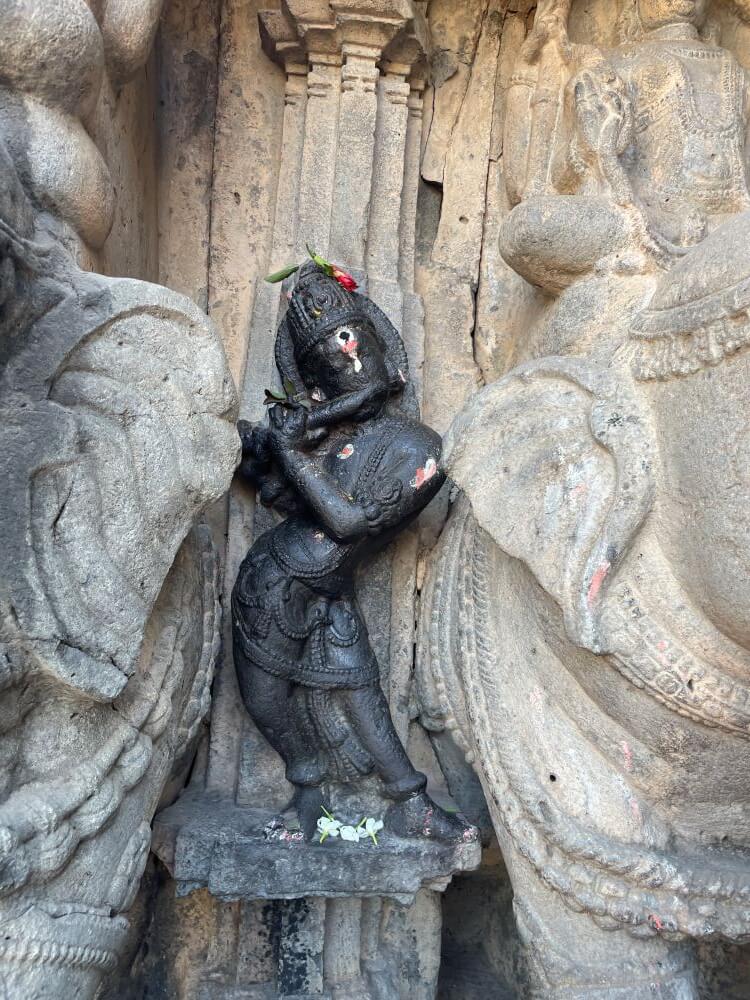
The Kopeshwar temple is as rich in carvings and sculptures on the outside as it is on the inside. There is not a single inch of space on this temple that does not feature a sculpture or carving. The temple stands on a 1.5-meter-high plinth (adhisthana). The base of the plinth consists of layers of khura (hoof), padma (lotus), and padma again. Above this is the gajathara (elephant layer). There are a total of 92 elephants in this layer, and no two elephant sculptures are alike. Because of this gajathara, it appears as if the entire weight of the temple is supported by these elephants. Various deities are mounted on the backs of these elephants. In the spaces between the two elephants, images of various deities are also carved. Notable among these are the sculptures of Muralidhar Krishna, Chamunda, and Arab and dark-skinned traders. Above this is the manushyathara (human layer). This layer contains images of deities such as Mahaganpati, Mahasaraswati, Mahishasuramardini, Shankar with Ganga-Parvati, and Vishnu with Lakshmi. Scenes from the Ramayana and Mahabharata are carved here. Similarly, one can see incredibly beautiful sculptures of Sursundaris. Sculptures of Sursundaris such as Putravallabha, Darpana, Nartaki, Patralekhika, and Alasa have added to the beauty of the temple. In this temple, the walls have been constructed by joining semi-pillars together. Due to this specific structure, the Kopeshwar temple appears star-shaped. The shikhara of the temple is conical and is covered with lime plaster. This is not the original shikhara of the temple; it was built after the Maratha period using lime plaster.
The administration of this temple is conducted through the Shri Swami Jagadguru Shankaracharya of Karveer Peeth. In the year 1706, the village of Khidrapur was granted as an endowment (Inam) in the name of the Shankaracharya of Karveer Peeth. Since then, the ownership of the temple has also rested with the Karveer Peeth. Previously, there was a Math of the Jagadguru Shankaracharya within the temple premises, where knowledge was imparted to students. Since 1954, the responsibility for the protection of this temple has been taken over by the Archaeological Survey of India.
Every Monday, the Palkhi (palanquin procession) of Kopeshwar is taken out at this temple. The Palkhi completes three circumambulations (pradakshina) of the temple. Every year, on Phalgun Dashami, the Laghurudra recitation is performed on behalf of the Karveer Peeth. From the month of Chaitra to Jyeshtha, the ‘Butti Puja’ of the Lingas of Kopeshwar and Dhopeshwar is performed. The Kannada word ‘Butti’ means curd rice. Here, the Lingas are coated with curd rice, which is then shaped into the faces of Shiva and Vishnu. Subsequently, figures of Shiva-Parvati, Nandi, Ganapati, and Vishnu are crafted on the Shivalinga using the rice. A grand fair is held at the Kopeshwar temple every year on the day of Vishal Tirtha Amavasya in the month of Paush. Similarly, a large crowd of devotees gathers here on Mahashivratri and on the Mondays of Shravan.
This sacred temple stands as a testament to deep spiritual devotion, ancient architectural grandeur, and rich local cultural traditions.
The sanctum sanctorum houses the divine idol consecrated according to ancient Vedic traditions, surrounded by serene courtyards and traditional temple architecture.
Navratri, Maha Shivratri, Annual Temple Jatra & Deepotsav
Compare and book flights, secure top-rated local hotels near the temple, hire reliable guides, and rent cars instantly.
Extend your pilgrimage by visiting other highly sacred temples located nearby.


Add ₹999 more to unlock FREE SHIPPING!
Your sacred cart is currently empty.
Shop Photo FramesFill in your delivery details below to place your order.
Add comment