
Add ₹999 more to unlock FREE SHIPPING!
Your sacred cart is currently empty.
Shop Photo FramesIn southern Maharashtra, various branches of the Patwardhan dynasty, which rose to prominence during the Peshwa era, emerged sequentially in places such as Miraj, Sangli, Tasgaon, Jamkhandi, Mirajmala, and Budhgaon. Kurundwad was one of these. Kurundwad is known as a noble town of distinguished individuals who have left their mark on the national and global stage through their own achievements, and it is also characterized by the sweetness of its sweets like Basundi, Khawa, and Pedhe, owing to its fertile land and abundance of dairy. Along with its history, this village is also religiously significant. It is in this very village, blessed with the presence of many Hindu and Jain temples, that the famous Vishnu temple from the eighteenth century is located.
The Vishnu temple here is also known as the Raghavji Temple. This temple was built during the era of the princely state. The history of this state is that Haribhat was the progenitor of the Patwardhan family here. His third son, Tryambak Hari, also known as Appa, founded Kurundwad. Tryambak Hari was in the service of the Bhonsles of Akkalkot. He frequently traveled to Kapshi. Kurundwad was originally a village belonging to the Ghorpades of Kapshi; however, due to a need for funds, Ranoji Ghorpade of Kapshi mortgaged the village to Tryambak Hari. It was acquired by Tryambak Hari in 1733. He, in Kurundwad’s
He developed the settlement. He assisted the Peshwas in extending the southern boundary of the Maratha Empire up to the Tungabhadra River. Consequently, in the year 1771, the Peshwas granted him the jagir of Kurundwad and the surrounding regions.
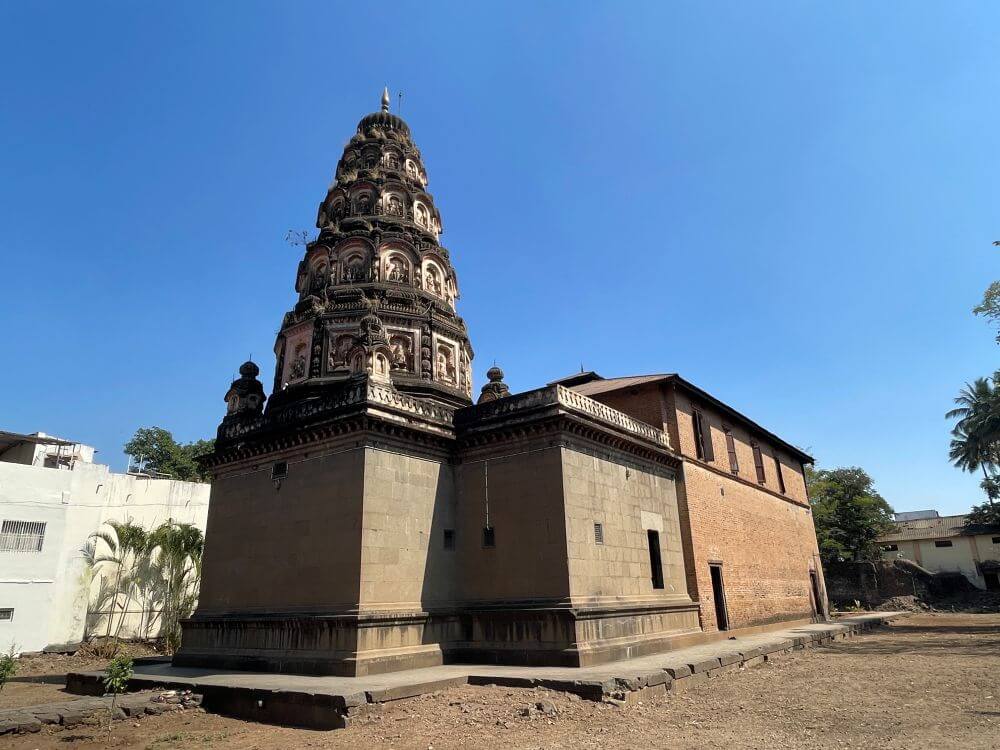
According to the inscription in this temple, Raghunathrao Nilkanth, also known as Dadasaheb Patwardhan, the grandson of Shrimant Tryambak Hari, built the Vishnu temple here in the year 1795. Therefore, this temple is also known as the Raghavji Temple after his name. Later, in 1880, Sitabaisaheb, the wife of their great-grandson Shrimant Raghunathrao Keshav, constructed a Sabha Mandap (assembly hall) for the temple. Sitabaisaheb’s name can be seen inscribed on many stone slabs here. The temple is situated in a large courtyard. Previously, there was a high stone perimeter wall on all four sides. Now, this wall is visible on three sides. In the center of this courtyard stands this temple, which features the distinct architectural style of the Maratha period. The architectural design consists of a sanctum sanctorum built of square stone slabs, with small turret-like structures at the four corners of its roof, and a high, circular spire that tapers towards the top. This spire consists of four to five levels, which are known as Bhumi. It is constructed of stone or brick and contains numerous niches. Within these niches, idols of gods, goddesses, and saints are carved in lime plaster. A modak-shaped Amalaka on the spire, topped with a Kalash, and a large Sabha Mandap in front of the sanctum is a temple design typically seen in Marathi temple architecture of the seventeenth and eighteenth centuries. The Vishnu temple of Kurundwad is also of a similar type.
This temple stands upon a high plinth. Space has been provided all around the temple for circumambulation. The temple structure is made of stone, while the tall spire above it is constructed of bricks. In the small shrines on the spire, one can see the ten incarnations of Vishnu, Ganesha, Riddhi-Siddhi, and other deities, as well as Jain idols. Here, below the Amalaka, small replicas of the Amalaka are installed on all four sides. The overall construction of the pinnacle is extremely attractive.
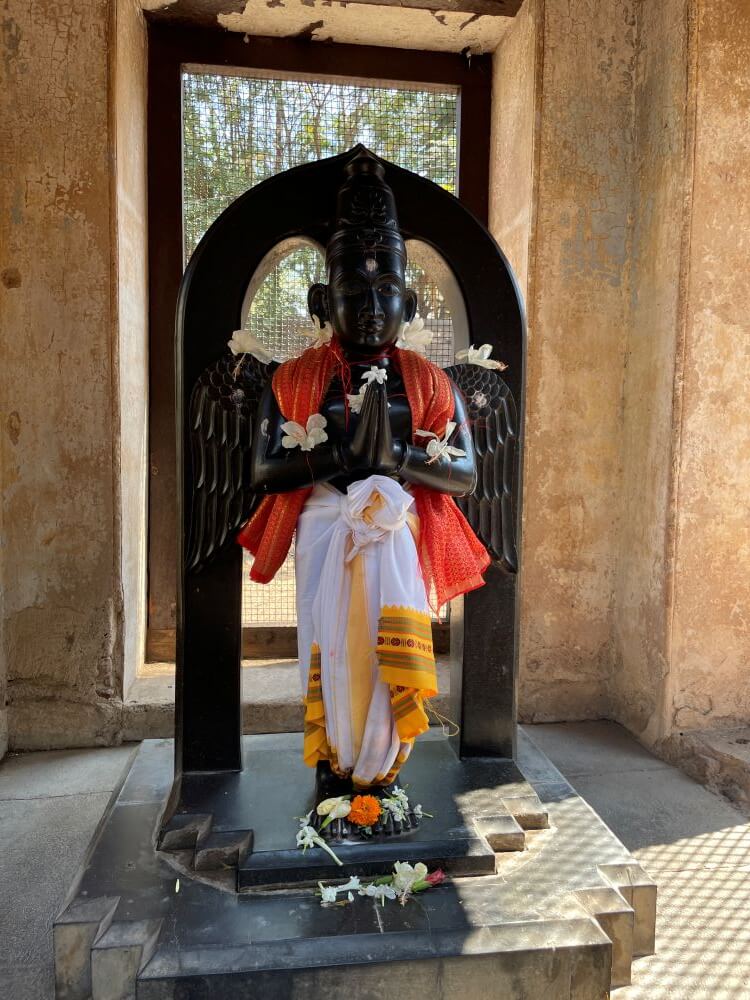
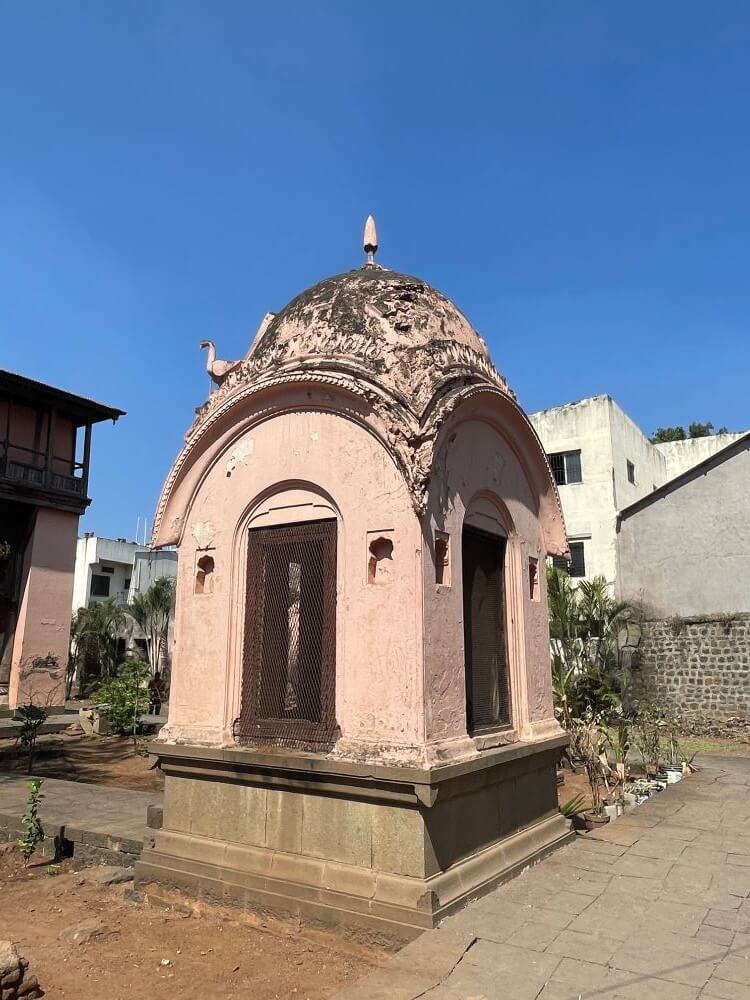
In front of the temple, on a high and large platform, a beautiful dome-shaped shrine (Garuda Mandap) has been constructed. Inside this shrine, there is an idol of Garuda carved from black stone. Both hands of the idol are in a posture of salutation. Near this shrine, there is a stone Tulsi Vrindavan. Both Garuda and Tulsi are deities of the Vaishnava family. Garuda is considered to be the vehicle of Lord Vishnu. Tulsi is considered the consort of Lord Vishnu. On the day of Devutthana Ekadashi, the marriage of Tulsi with Lord Vishnu is performed.
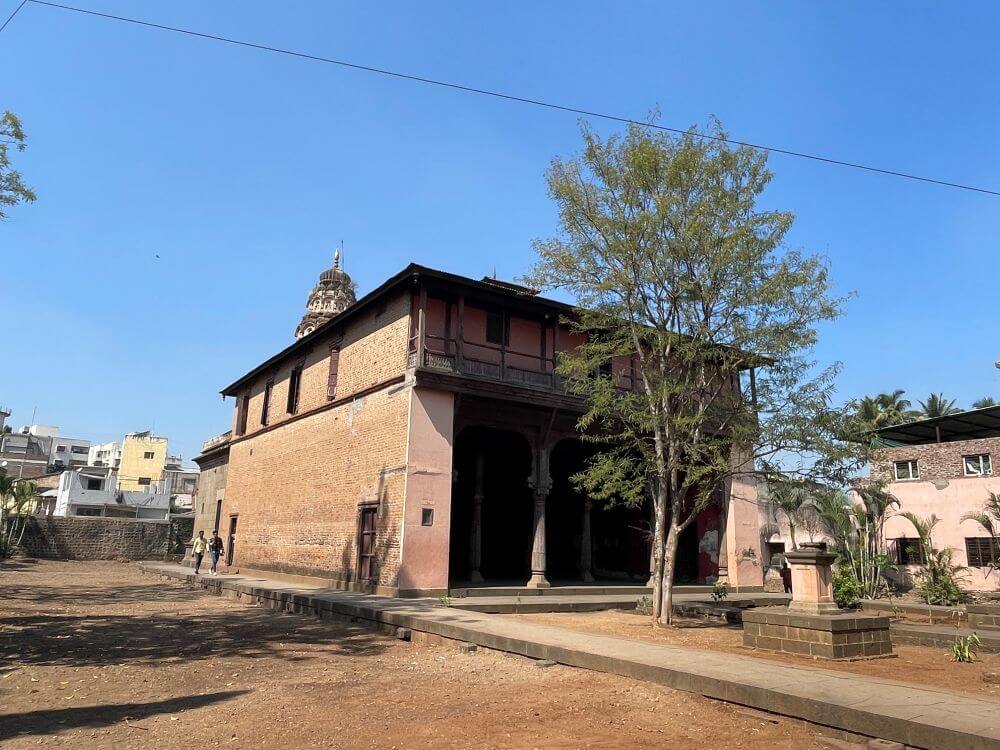
From here, there is a path made of dressed stone leading to the Sabha Mandapa. The Sabha Mandapa is two-storied, and its ground floor is quite high. This Sabha Mandapa has no entrance gate; it is completely open from the front. There are high walls on both sides. A short distance inward from these walls, there is a row of intricately carved teak wood pillars. There are five pillars on each side. Above them are arched wooden brackets. In the center of the ceiling, there is a floral pattern carved into the wood. The entire floor of the Mandapa is tiled. A hexagonal-shaped hollow cellar can be seen here. Regarding this, local legends suggest that there is a passage from this cellar leading to the Kurundwad Ghat. Some say there is a path from here to the Tulsi Vrindavan outside, while others believe it to be a Yajna Kunda.
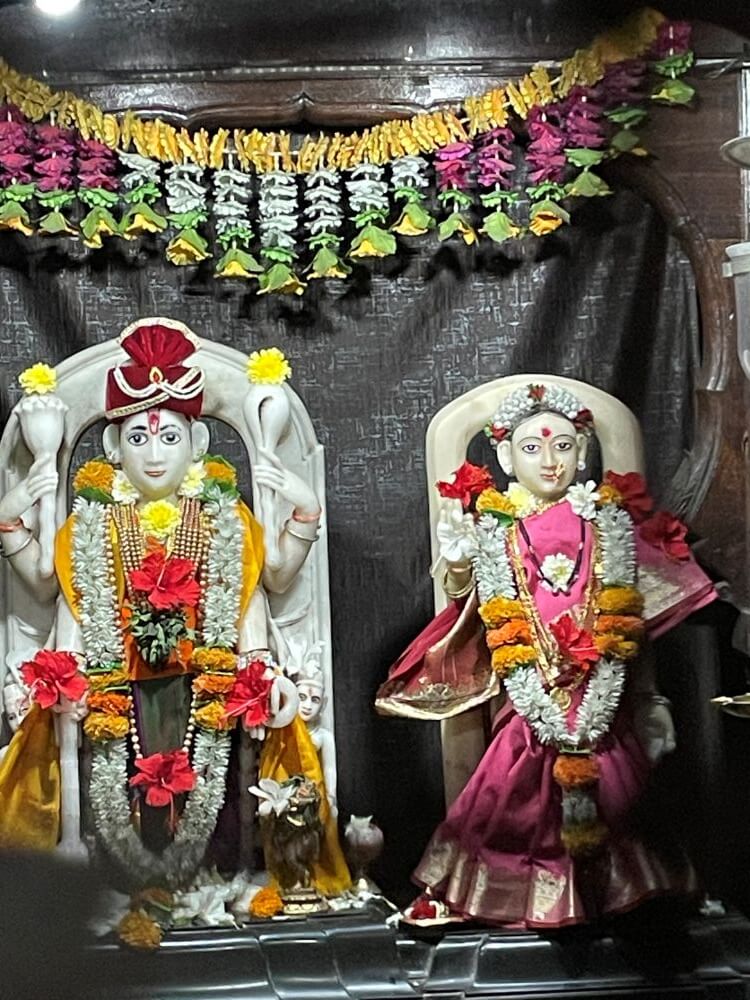
Five steps above the main assembly hall lies the sub-assembly hall of the temple. The wooden pillars there are exceptionally beautiful. They are carved with designs of lotus petals, which are dear to Lord Vishnu. Further ahead, one can see a total of three doors leading to the sanctum sanctorum. The two side doors are closed. In the center, there is a stone door frame. Above it, at the lalatabimba position, is an idol of Lord Ganesha. Inside the sanctum, on a high pedestal, within a carved wooden shrine, are the marble idols of Lord Vishnu and Goddess Lakshmi.
Every morning and evening, a large crowd of devotees gathers at this temple. Festivals and auspicious occasions such as Ekadashi, Deepavali, Gudi Padwa, and Vijayadashami, as well as programs like Kirtans, are celebrated here with great enthusiasm. Many scholars make it a point to visit to observe the architecture of this temple.
This sacred temple stands as a testament to deep spiritual devotion, ancient architectural grandeur, and rich local cultural traditions.
The sanctum sanctorum houses the divine idol consecrated according to ancient Vedic traditions, surrounded by serene courtyards and traditional temple architecture.

Navratri, Maha Shivratri, Annual Temple Jatra & Deepotsav
Compare and book flights, secure top-rated local hotels near the temple, hire reliable guides, and rent cars instantly.
Extend your pilgrimage by visiting other highly sacred temples located nearby.


Add ₹999 more to unlock FREE SHIPPING!
Your sacred cart is currently empty.
Shop Photo FramesFill in your delivery details below to place your order.
Add comment