
Add ₹999 more to unlock FREE SHIPPING!
Your sacred cart is currently empty.
Shop Photo FramesThe Shri Siddheshwar Temple is renowned as the presiding deity (Gramadaivat) of Baramati city in Pune district. Situated on the banks of the Karha River, this temple is considered significant from both historical and architectural perspectives. The ‘Dwadashamati’ city mentioned by Shridhar Swami in his scripture ‘Shivalilamrut’ is the present-day city of Baramati. This temple is the primary center of faith for the local devotees. There are a total of twelve Shiva temples along the banks of the Karha River from Saswad to Songaon, and this is one of the most important among them. Saint Dnyaneshwar Maharaj and Saint Tukaram Maharaj had resided in this place. During the historical era, Shahaji Raje Bhosale, Chhatrapati Shivaji Maharaj, and subsequently the Peshwas provided protection and royal patronage to this temple.
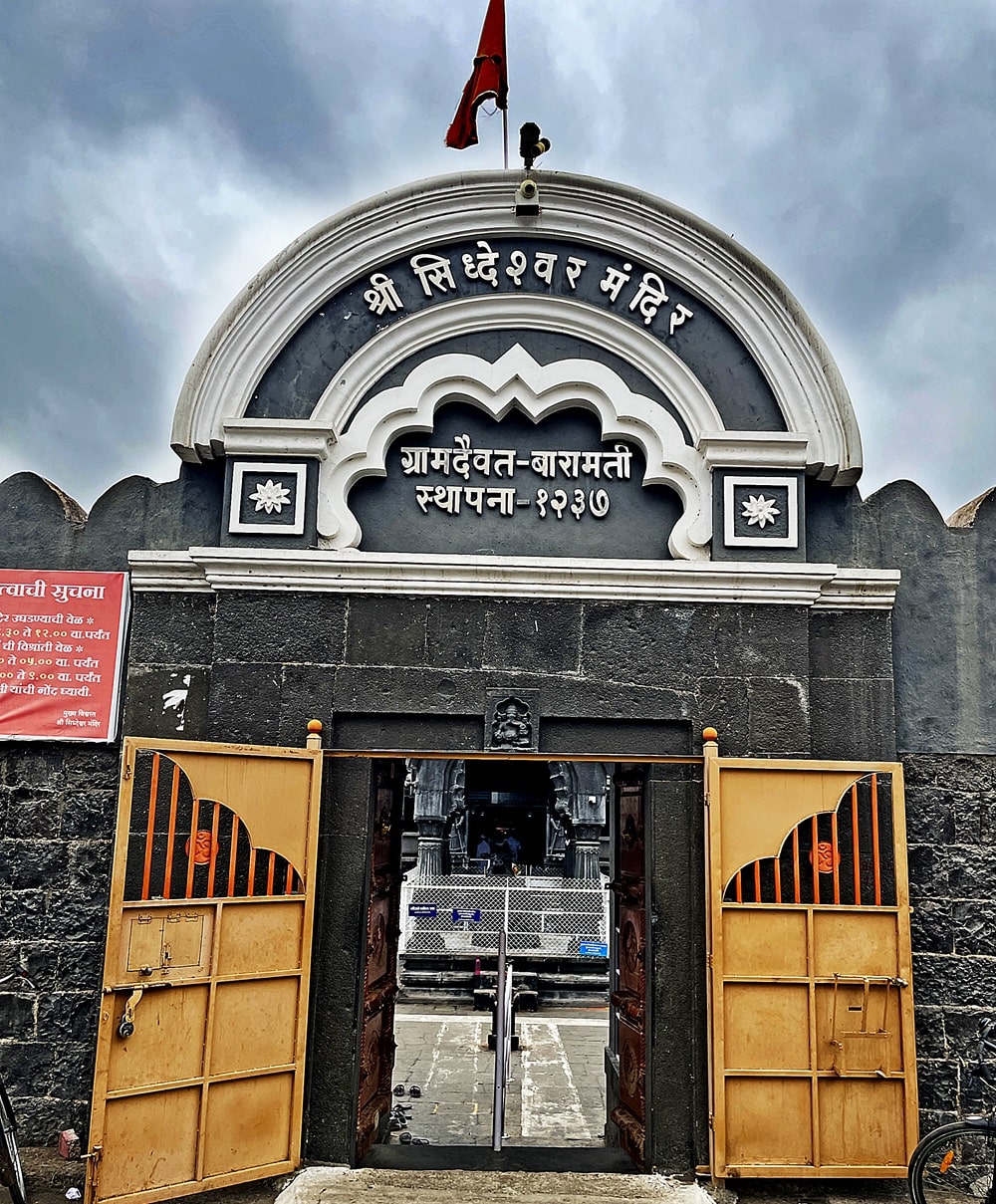
According to historical records and inscriptions on the temple, the construction of this structure began under the guidance of the Yadava king Singhana (II). The inscription ‘Established – 1237’ is found on the temple’s construction, and it took the artisans a full 40 years to complete this magnificent temple. Built on a solid foundation using a mixture of gold, silver, and lead, this structure is considered the first major historical monument of the old settlement known as Bhimthadi in the Baramati Pargana. In the medieval period, this temple gained significant political importance. During the period of Aurangzeb’s invasion, Chhatrapati Shivaji Maharaj, along with Shahaji Raje Bhosale, capably shouldered the responsibility of protecting this temple. Later, during the Maratha Empire, Peshwa Balaji Vishwanath Bhat paid special attention to this shrine. In the year 1723, the Peshwas wrote a special decree (Sanad) in the Modi script, entrusting the management and worship responsibilities of this temple to Pandurang Date. Even today, the Date family manages the daily affairs of the temple. That decree is preserved here as a testament to history.
It is said that Saint Dnyaneshwar Maharaj used to visit this temple regularly for darshan and had himself installed an idol of Lord Ganesha here. Devotees believe that there is a sacred stone in this temple upon which the imprints of Dnyaneshwar Mauli’s hands and fingers are visible. Jagadguru Saint Tukaram Maharaj also used to stay at this temple during his Pandharpur Wari. The ‘Shivalilamrut’, considered an unparalleled scripture in Marathi literature, was composed by the poet Shridhar Swami in the sacred atmosphere of this very temple around the year 1728. The famous Aryakar poet Moropant was a son of Baramati, and he completed the creation of many of his poems while sitting in the premises of this temple.
The temple is situated on an elevated spot in the central part of Baramati city, on the banks of the Karha River. The temple is surrounded by high stone fortifications on all four sides. One enters the spacious courtyard of the temple through the main entrance in the fortification. Two highly characteristic and life-like sculptures of gatekeepers (Dwarapalas) are carved on the entrance. On both sides of the courtyard, there are cloisters supported by ornate pillars. The old system of underground stone channels designed to drain rainwater in the temple premises is still as effective today. No matter how heavy the rainfall, not even a drop of water accumulates in the area. These stone channels have never required repairs even after hundreds of years. This is considered an excellent example of ancient water management.
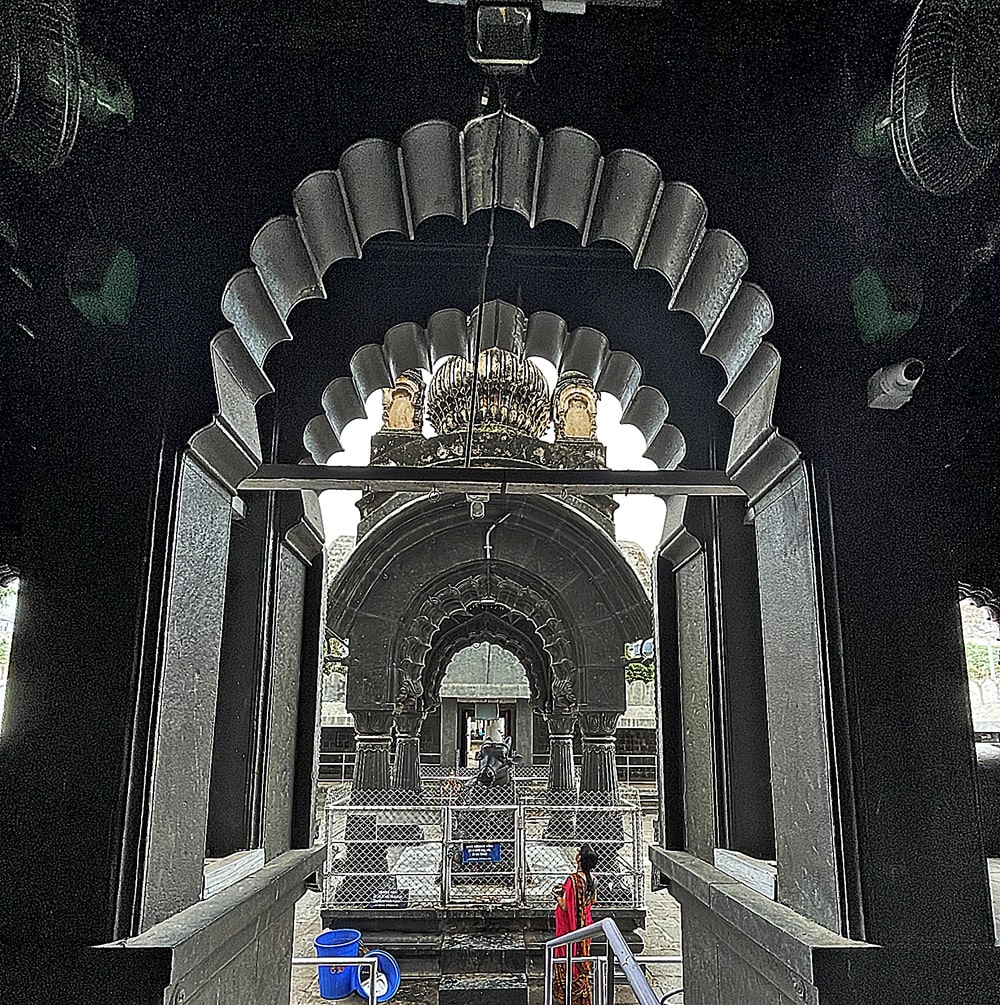
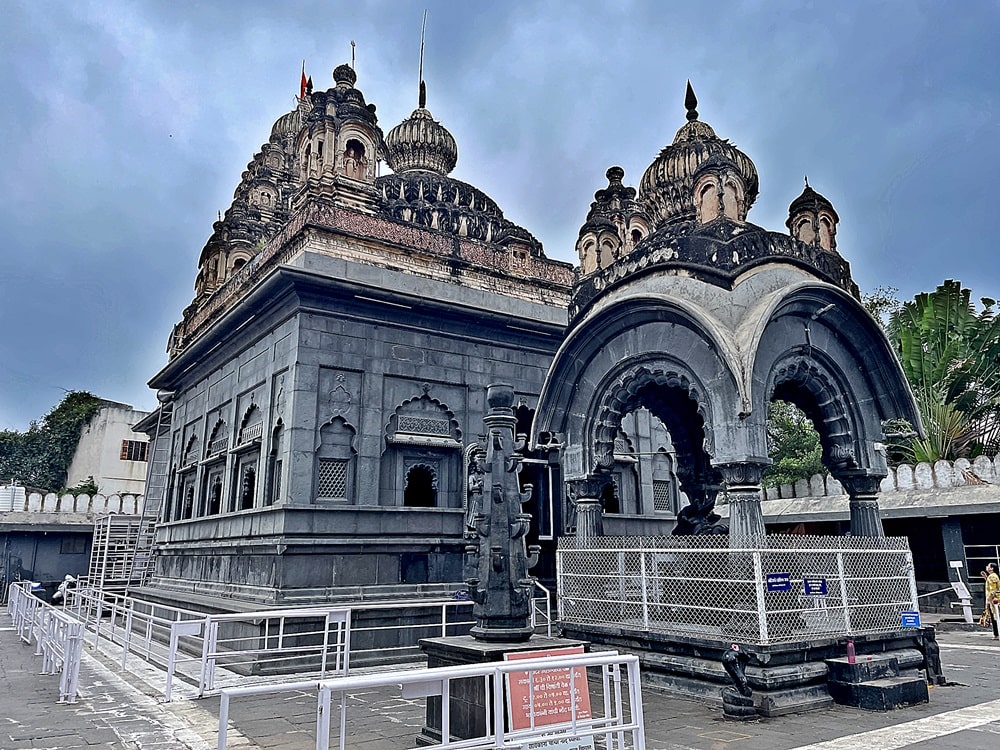
In front of the temple, on a plinth two and a half feet high, stands a characteristic Nandi Mandapa. A Nandi carved from black stone is seated in this canopy-covered Nandi Mandapa, which is twelve feet long and twelve feet wide. This Nandi has a five-inch tall stone bell around its neck and a beautifully carved belt with fifty bells on its body. A unique feature of this Nandi is that when viewed from the front, one ear appears to be turned to listen to the devotee’s plea, while the other ear seems turned towards Lord Mahadeva. It is said that the Nandi that was here previously was twice as large as the current one and was in a standing position. However, it broke, and the current Nandi was fashioned from one of its pieces. Snakes are carved behind both its ears. The four pillars in this pavilion have beautiful carvings. These pillars are connected to each other by arched gateways. In front of the Nandi Mandapa and facing the main temple stands a stone lamp pillar (Deepmal).
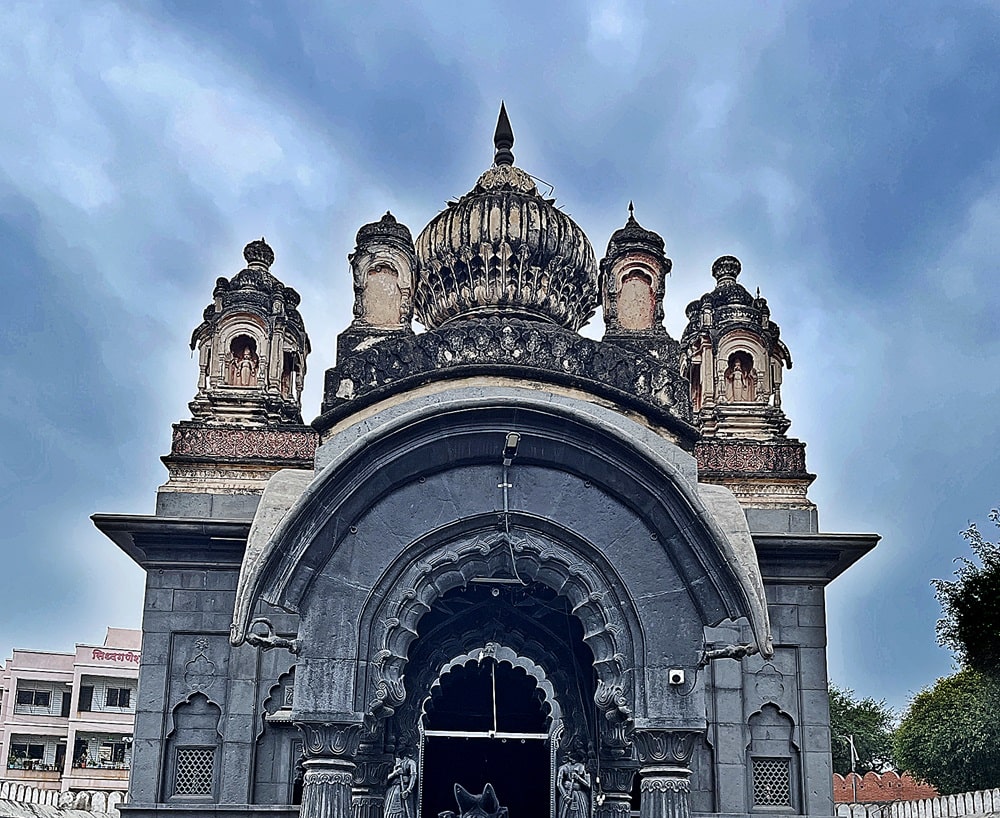
On the outer walls of the Hemadpanti temple, crafted from black stone, there are open arched windows similar to the Nandi Mandapa. The specialty of these stone windows with lattice work is that each window features independent and distinct carvings. On both sides of the main entrance of the temple, characteristic gatekeeper sculptures are carved, similar to the entrance in the fortification. Through the entrance, one enters the assembly hall (Sabhamandapa) of the temple. In this square and spacious assembly hall, there are stone seats (Kakshasanas) four feet high and four feet wide. It is said that these were used for performing Satyanarayan Puja or religious recitations on Shravani Mondays. In the center of the assembly hall, there is a large brass tortoise. Beneath it, there used to be a lotus-shaped stone fountain. On the ceiling inside the assembly hall, eight figures are carved in a circular pattern on the underside of a dome with a diameter of twenty-four feet. The center of the carved lotus in this dome, the center of the fountain on the floor, and the pinnacle (Shikhara) of the temple are all in a single straight line.
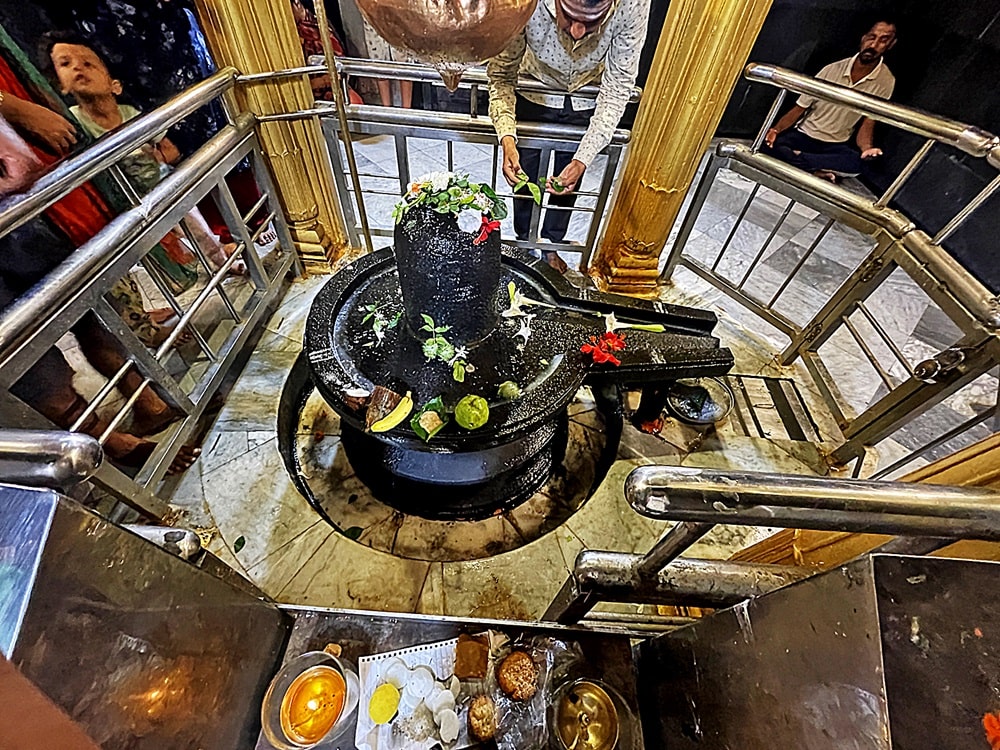
In the niches on the front wall of the sanctum sanctorum (Garbhagriha), idols of Lord Parashurama and Kalbhairava are installed on either side. On the entrance of the sanctum, there are carvings of Nandi, a lion, a standing Ganesha, and a seated person. One enters the sanctum of the temple through this entrance. Inside the sanctum, there is a Shiva Linga made of a single piece of stone placed in a four-pillared pavilion on the floor.
Behind the Linga are idols of Ganpati and Karhamai. On the dome-shaped ceiling above the Linga, there was formerly a secret Linga and a water tank. Due to the dome-shaped structure, an echo can be heard here. Here too, the Shiva Linga, the center of the lotus above, and the pinnacle are all in one line. It is said that there is a secret tunnel in the sanctum, from which three paths emerge.
One of these paths leads to the Maruti temple in Malad, the second to the fort in Medad, and the third to the mansion (Wada) of Babuji Naik. Shrimant Babuji Naik was the moneylender to the Peshwas. The pinnacles of the Nandi Mandapa, the sanctum, and the hall are all constructed of bricks and are in the Hemadpanti-Nagara style.
The Mahashivratri festival is celebrated on a grand scale at the Siddheshwar Temple. On this day, a massive crowd of devotees gathers on the banks of the Karha River. On the occasion of Mahashivratri, a week-long continuous chanting of the Lord’s name is organized at the temple, featuring programs of Bhajans, Kirtans, and discourses.
On Mahashivratri and every Ekadashi, a special Mahabhog of curd-rice is offered to the Shiva Linga of Lord Shiva. During the holy month of Shravan, Rudrabhishek and special worship rituals are performed every Monday from dawn. At that time, the entire premises resonate with the chants of ‘Har Har Mahadev’.
This sacred temple stands as a testament to deep spiritual devotion, ancient architectural grandeur, and rich local cultural traditions.
The sanctum sanctorum houses the divine idol consecrated according to ancient Vedic traditions, surrounded by serene courtyards and traditional temple architecture.
Navratri, Maha Shivratri, Annual Temple Jatra & Deepotsav
Compare and book flights, secure top-rated local hotels near the temple, hire reliable guides, and rent cars instantly.
Extend your pilgrimage by visiting other highly sacred temples located nearby.


Add ₹999 more to unlock FREE SHIPPING!
Your sacred cart is currently empty.
Shop Photo FramesFill in your delivery details below to place your order.
Add comment