
Add ₹999 more to unlock FREE SHIPPING!
Your sacred cart is currently empty.
Shop Photo FramesThe temple of Goddess Vijayadurga, the deity who brought peace and prosperity by conquering a demon, is situated at Keri. This magnificent temple, which is over four hundred and fifty years old, is a center of attraction for countless devotees of the Goddess as well as scholars of temple architecture in North Goa. The reason for this is the intricate Kavi art carvings and woodwork found within the temple. In this spacious and grand ancient temple, the annual festival (Yatra) held in the month of Margashirsha is a major event for the surrounding five villages. Thousands of people gather here to witness the Sangod (boat festival) that takes place during this time.
Regarding the name Vijayadurga, the mythological legend states that in ancient times, in the Shankhavali region, a demon named Kalantaka had caused great distress to the people. Born in the Bashkal lineage, that blue-complexioned demon was a wearer of shroud-like garments and possessed smoke-colored eyes. He killed many Brahmins with the blade of a plow. The Brahmins there then sought refuge with Lord Mahadeva. Witnessing the calamity befalling them, Mother Parvati became enraged. She vowed to slay the demon. Assuming the form of Durga, she fought the demon. She uprooted a tree and struck it against his chest. Upon that, he collapsed, losing his life. To commemorate the victory the Goddess achieved over the demon, people honored her with the name Vijaya. They also urged her to stay there to dispel the fear among the people. Since then, the Goddess began to reside in the city of Shankhavali.
Thus, the original seat of Goddess Vijayadurga is Shankhavali (Shankhwali or Sankhwal). According to information provided by temple scholar Vinayak Narayan Shenvi Dhume in the book ‘Devbhumi Gomantak’, the shrine of Goddess Vijayadurga was established at Shankhwali until before the middle of the sixteenth century AD. Around the year 1560 AD, it was relocated to Keri. Its history, like other temples in Gomantak, is linked to the history of the Portuguese Inquisition and religious persecution. In the year 1560 AD, the ‘Inquisition’, or the institution of religious inquiry, was established in the Goa islands, and a cruel wave of conversions and religious persecution spread across Goa. On 1 May 1560, a group of Jesuit priests arrived with a fleet at the village of Kuththal in Sasashti. However, even before that, people had hidden the deities from the village temples and moved them elsewhere. Since the village of Shankhwali was adjacent to Kuththal, it is inferred that the people there must have also moved the idols of the deities from their village temples elsewhere. A reference to this is found in the ‘Kokanakhyan’, a text composed in 1729 AD. Regarding the relocation of these deities, it states: ‘Kushasthali Shrimangesh Priyoli. Verane Mahalasa Mahdadoli. Shankhavali dev donhi sthali. Keri ani Velingasi. Velingasi Narasimha Santeri. Vijayadurga te Keri majhari. Ani Keloshichi Shantadurga bari. Rahili Kavale te grami.’ This makes it clear that before 1 May 1560, Goddess Vijayadurga was brought to Keri and consecrated.
The story regarding the installation of the Goddess here is that before establishing this deity in Keri village, the idol of the Goddess was hidden in the waters of a pond in front of the Madhav temple at Agastipur, also known as Agapur, in the Kavale village of Ponda Taluka. Thereafter, one day, a Brahmin of the Kashyap lineage from Keri village had a dream. In the dream, a radiant woman appeared before him and said, ‘I am your family deity (Kulaswamini). A devotee has kept me in the pond at Agapur. Tomorrow morning, as soon as you wake up, take the ripe bunch of bananas you see on the banana plant in front of your house and the blooming flower bud you see on the Ketaki plant nearby, and offer them to me in the Agapur pond. Then, take a dip in the pond. My image will come into your hands. Take it, bring it to this village, and install it.’ After doing as instructed, the Brahmin found the idol of the Goddess. He carried it on his shoulder and began bringing it to Keri village. On the way, at one point, the idol suddenly became heavy. He then placed it there. Seeing this miracle, people
bowed to the Goddess with devotion and built a small temple for the Goddess at that very spot. Over time, a devotee of the Goddess with the surname Laghate, who had earned great fame in Pune during the Peshwa era, expanded this temple. Later, in 1875, Pandurang Ramchandra Vaidya, a devotee and Mahajan of the Goddess from Keri, along with the cooperation of the people, built a Sabha Mandap (assembly hall) for the temple. Subsequently, in 1897, Madhavrao Govind Dhopeshwarkar from Sawantwadi built the Nagarkhana and the Gopura building for the temple at his own expense. In later times as well, the temple was renovated on various occasions.
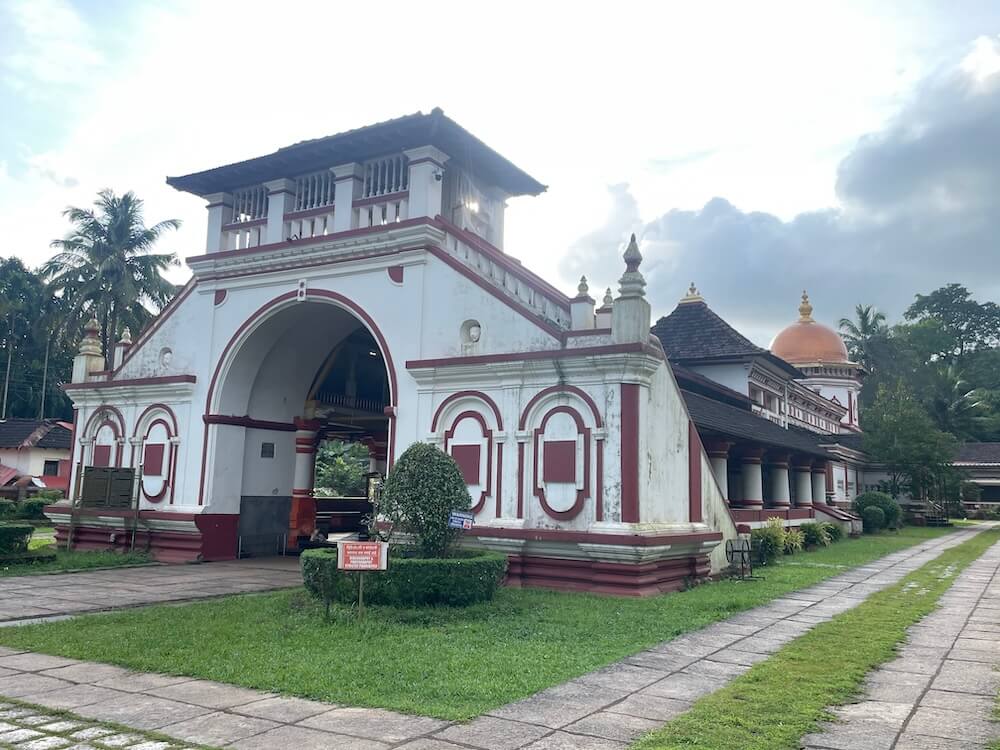
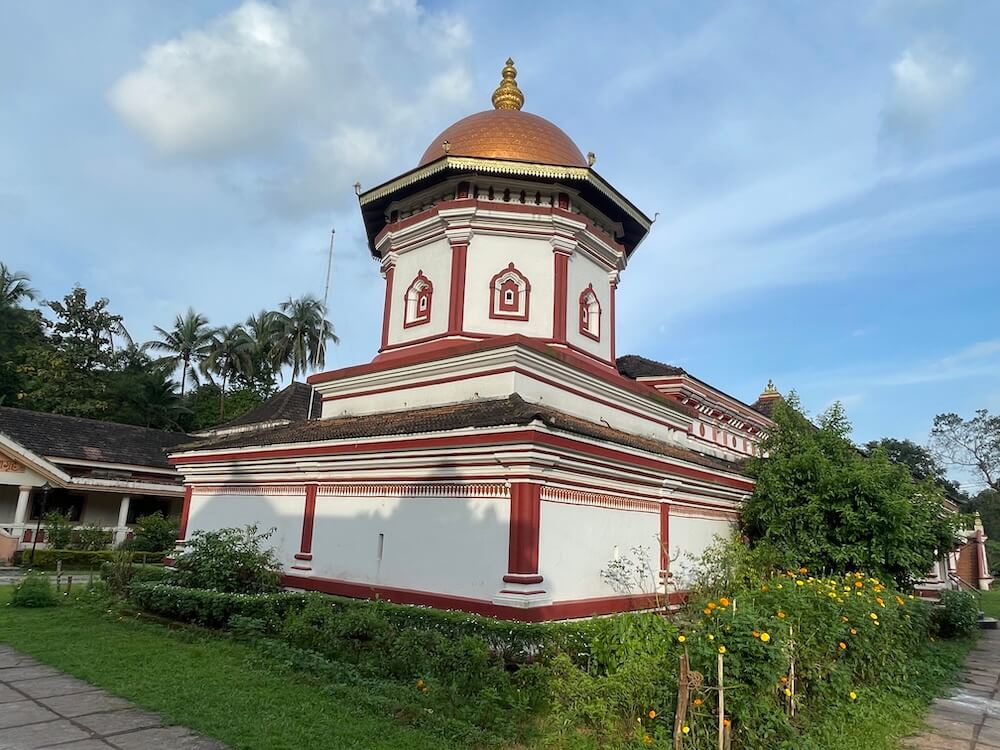
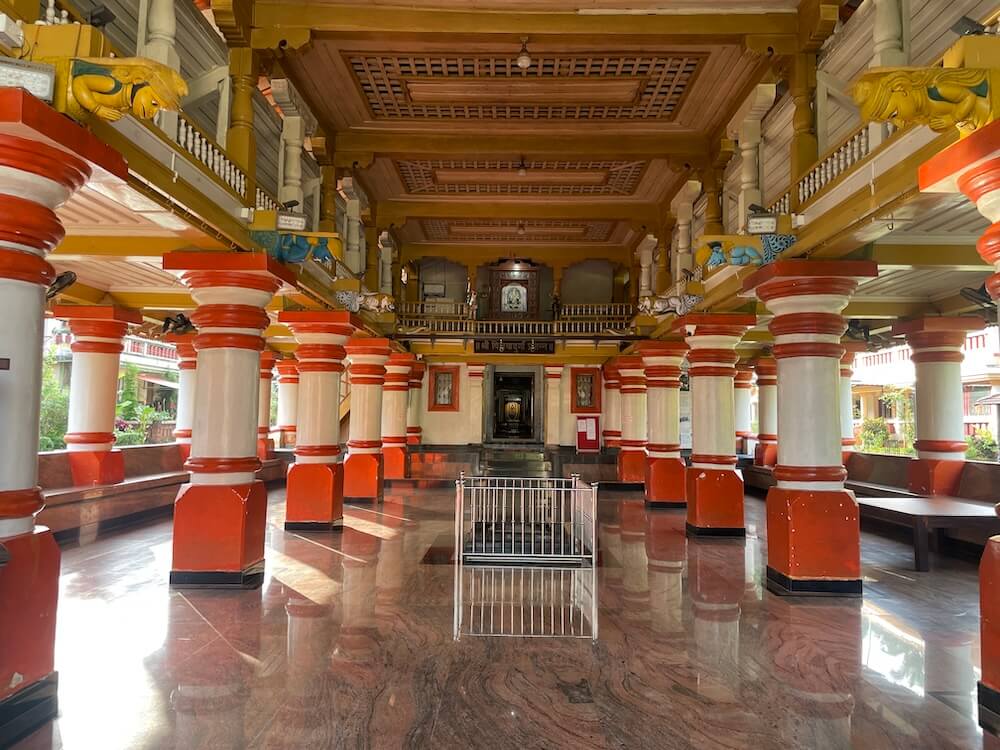
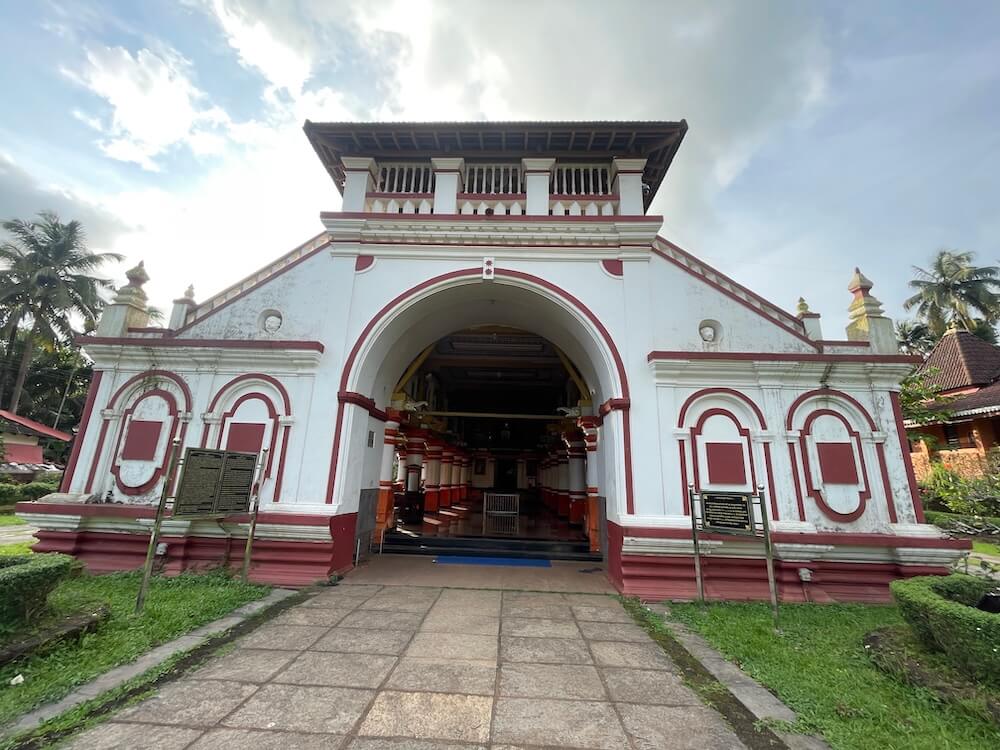
The temple is situated in a picturesque area, in a spacious courtyard adorned with greenery and flowering plants. In the temple courtyard, there is a grand, tower-like octagonal seven-story lamp pillar (Deepastambha). It has a flat roof at the top with railings on all four sides. In front of this stands the grand structure of the temple, built in the Gomantak architectural style. According to this architectural style, the temple is structured with a Nagarkhana, Sabha Mandap, Ardhamandap, Mahamandap, and Garbhagriha (sanctum sanctorum). The Nagarkhana is located above the entrance, which has a large arch for the main gate. The Sabha Mandap is of a semi-open type. It has side seats (Kakshasanas) on the left and right, with circular pillars between them. A few feet away from here, on both sides, is a row of wide, circular pillars. The bracket figures (Taranghastas) at the top of the pillars are carved with various animal and human forms. There is a wooden balcony over the Sabha Mandap, and the ceiling here is also decorated with wooden panels. There is a Homa Kund (sacrificial fire pit) in the center of the Sabha Mandap. A large image of Goddess Vijayadurga is placed in the Makhar (shrine) in the front balcony. From here, one ascends four steps to enter the Antarala (vestibule) of the temple. The Antarala has large arched windows. Below them are Kakshasanas.
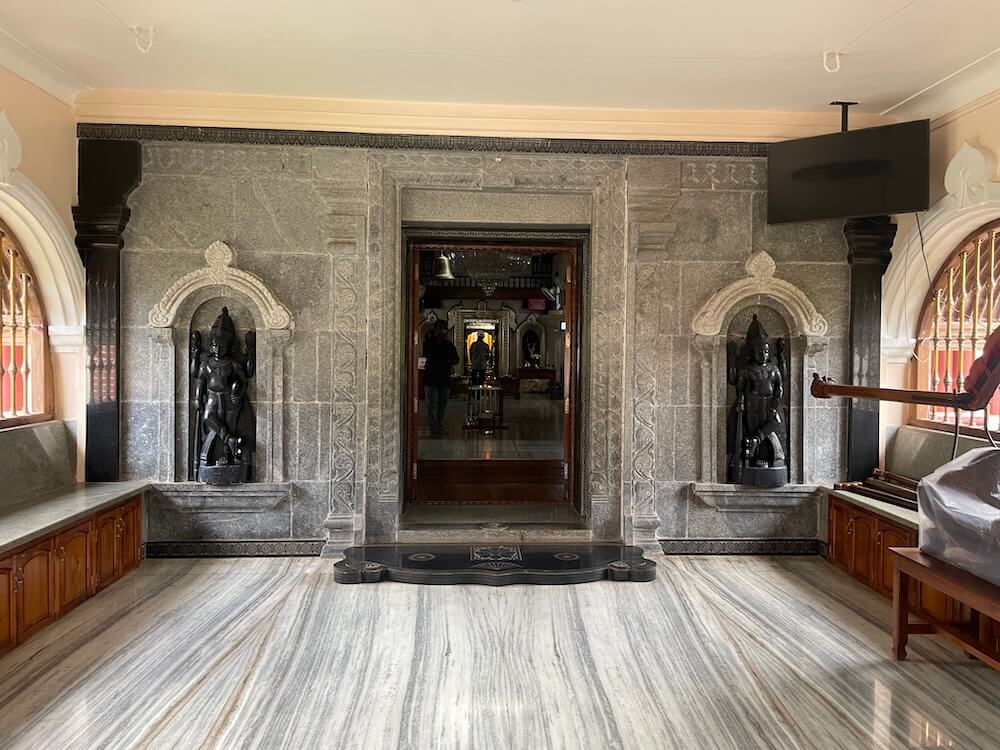
On the stone facade wall of the Mahamandap, there are large idols of Vaishnava Dwarapalas (gatekeepers) carved in black stone on both sides. The door frames of the Mahamandap entrance are carved with floral patterns. In the left and right walls of the Mahamandap, there are large arched windows. At some distance from them, on both sides, is a row of wide circular pillars connected to each other by large arches. A large glass chandelier hangs from the ceiling inside. One of the specialties of this Mahamandap is the Kavi art carving done here. A Samai (traditional lamp) is placed in the center of the Mahamandap. The entrance to the Garbhagriha is covered with silver plating and features exquisite carvings. Two large peacocks are carved into the upper two corners of the door frame, while lion figures are present at the base of the pillars. At the lintel position, a Kirtimukha is carved, with an image of Lord Ganesha above it. On both sides of the entrance, there are large sculptures of Dvarapalas housed in ornate, tall niches. Inside the sanctum sanctorum, the idol of Mother Vijayadurga is seated within a large silver canopy. Adorned with garments and ornaments, this idol is in the eight-armed Mahishasuramardini form. In the Goddess’s right hands, she holds the tuft of Mahishasura in one, an arrow in the second, a bow in the third, and a discus in the fourth. In her left hands, she holds the tuft of Mahishasura in the first, a shield in the second, a bow in the third, and a conch in the fourth. Mahishasura lies fallen near the Goddess’s feet. There are divine attendants on both sides of the Goddess. This stone idol of the Goddess features a golden mask and a captivating crown on her head. It is said that the original idol here dated back to the eighth or ninth century. Due to its dilapidated state, a new stone idol was crafted and formally consecrated on the ninth day of the dark fortnight of Vaishakha, Shaka era १८९९ (११ May १९७७). The old idol was immersed to the right of this temple, and a large Tulsi Vrindavan was built over it.
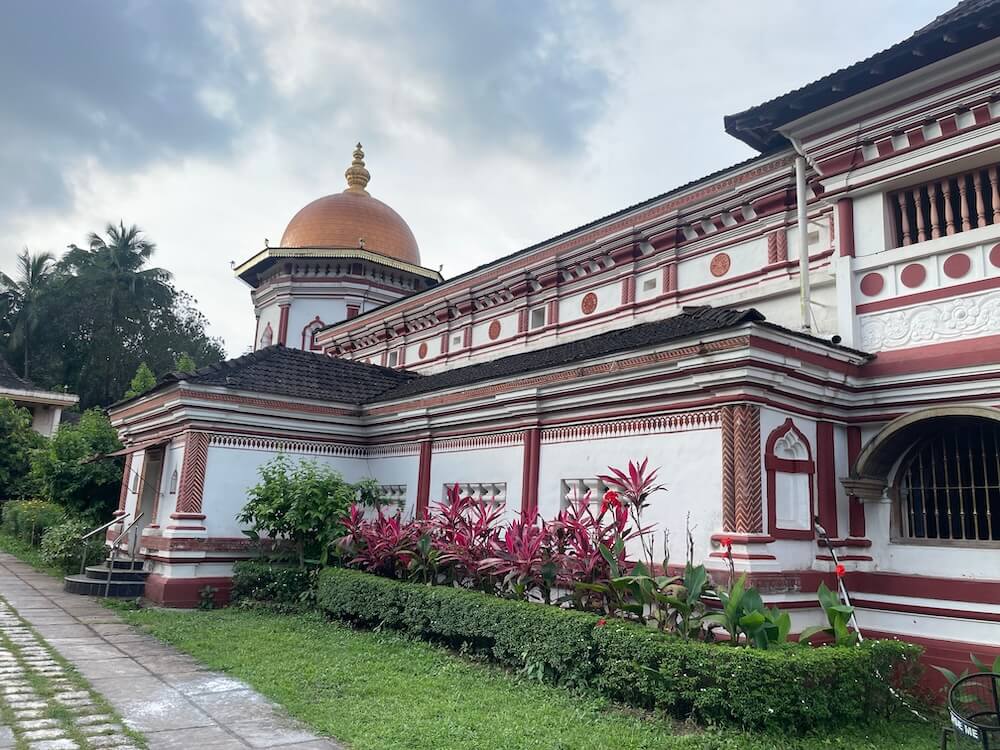
Above the sanctum sanctorum of the temple stands a spire, characteristic of Goan architectural style, resembling a tower topped with a dome and a finial. This spire, as well as the inner and outer walls and pillars of the temple, are decorated with Kavi-style carvings. In the temple courtyard, there is a small shrine dedicated to Shri Dandapani. This deity is considered an integral deity of Goddess Vijayadurga and is known by three names: Shri Kshetrapal, Shri Dandapani, and Shri Vyaghra (Vagara).
Rituals and festivals are performed in the temple in a traditional manner. Similarly, festivals such as Ashwin Navaratri, Kojagiri Purnima, Mahashivratri, Ram Janma, and Vijayadashami are celebrated here with great enthusiasm. Every month, on the tenth day of both the waxing and waning lunar fortnights, the Palanquin procession of Goddess Vijayadurga takes place at night. It is believed that the Goddess was relocated during the month of Margashirsha; therefore, the Malhari Navaratri is celebrated in the temple during this month. This festival lasts from the first day of the waxing fortnight of Margashirsha to the full moon day. Devotees associated with the Gajantlakshmi temple of Volvoi are specially invited to this festival. They hold the honor of maneuvering the ‘Sangod’ (boat). The Sangod festival is a major attraction of this pilgrimage. Thousands of devotees gather here to witness the procession of the Goddess carried in an elephant’s howdah. The tradition of seeking Prasad-Kaul (divine guidance) is practiced at the temple.
This sacred temple stands as a testament to deep spiritual devotion, ancient architectural grandeur, and rich local cultural traditions.
The sanctum sanctorum houses the divine idol consecrated according to ancient Vedic traditions, surrounded by serene courtyards and traditional temple architecture.
Navratri, Maha Shivratri, Annual Temple Jatra & Deepotsav
Compare and book flights, secure top-rated local hotels near the temple, hire reliable guides, and rent cars instantly.
Extend your pilgrimage by visiting other highly sacred temples located nearby.


Add ₹999 more to unlock FREE SHIPPING!
Your sacred cart is currently empty.
Shop Photo FramesFill in your delivery details below to place your order.
Add comment