
Add ₹999 more to unlock FREE SHIPPING!
Your sacred cart is currently empty.
Shop Photo FramesAccording to ancient legends, Lord Balaji is none other than an incarnation of Bhagwan Vishnu Himself, who descended upon Earth through the blessings of Maharishi Bhrigu. Across our sacred land, Bharatavarsha, there are many temples dedicated to Balaji in His Vishnu svarupa. Among these is a renowned and historic temple situated in Washim. Enclosed by ramparts like a fort, this temple is revered as a significant historical and religious heritage site in Washim district. Known also as the Tirupati of Vidarbha, this temple was established by Diwan Bhavanipant Kaloji (Kalu) of the Nagpurkar Bhosales. Due to its distinctive architecture, one can witness the Kiranotsava, the festival of sun rays, here during the period of Uttarayana.
Regarding Śrī Bālājī Deva, the legend goes that in Satya Yuga, Maharṣi Bhṛgu approached Bhagavān Viṣṇu to ascertain which Deity should receive the accumulated fruits of the penance performed by the ṛṣis and munis. To test Bhagavān, Maharṣi Bhṛgu kicked Viṣṇu upon His chest. Thereupon, Lakṣmī Devī, who resides in Viṣṇu’s heart, became enraged and left Devaloka, descending to Earth. Bhagavān Viṣṇu, feeling that Maharṣi Bhṛgu’s feet must have been pained, gently massaged them and thereby destroyed the eye of pride that resided in his feet. Then, the revered sage Bhrigu offered all his accumulated spiritual merits to Lord Vishnu and bestowed a blessing, saying, “In the age of Kali, You shall fulfill the desires of every supplicant upon the Earth.” Thereafter, Lord Vishnu manifested upon the Earth as Shri Balaji, establishing Himself to fulfill the aspirations of His devotees.
The history of this sacred Balaji Mandir is intimately connected with these venerable personages. According to the revered text, ‘Nagpur Prantacha Itihas’ (History of the Nagpur Province), penned by the esteemed Yadav Madhav Kale and published in the year एक हजार नऊशे चौतीस, Shri Bhavani Kaloji was a hereditary Patwari (revenue officer) of Khadidhamani and other villages in Mangrulpir Taluka. He belonged to the Rigvedi Deshastha Brahmin lineage. His revered father’s name was Kaloji, from which the family derived the surname ‘Kalu’.
Shri Bhavani Kaloji’s nephew, Rajaram Walke, initially served under Sabajiraje, the revered brother of Nagpur’s Janajiraje Bhosale. At that time, Sabaji’s cantonment and jagir (feudal estate) were situated in Darwha. After some time, Rajaram ascended to the position of Sabaji’s Diwan (chief minister). Through his good offices, Shri Bhavanipant was introduced to Sabaji. In due course, he too became Sabaji’s Diwan. Later, he forged a deep friendship with Janajiraje Bhosale and rose to become the chief commander of the Bhosale army.
The Bhosales held the right to collect *chauthai* from the province of Odisha (Cuttack). For this collection, Shivbhat Sathe was appointed as the *subedar* of the Cuttack province. However, he committed significant embezzlement. Consequently, Janhojiraje removed him from his *subedari* in April १७६१. But Shivbhat began a rebellion and incited the *zamindars* of the Cuttack province. Finally, in the year १७६४, Janhojiraje appointed his relative, Chimnabapu, as the *subedar* of Odisha. At that time, Bhavani Pant Kaloji, a seasoned warrior, was sent along with him. They defeated Shivbhat and drove him out of the Cuttack province. It is said that four years prior to this campaign, an idol of Balaji was discovered during an excavation in Washim.
Regarding this, the ‘Washim Gazetteer’ records a legend that around the year १७६० CE, a horseman was casually digging the earth with a stick he carried. At that time, he saw a part of a deity’s hand. Excavation was then carried out there. Therein were found the sacred images of Brahmā, Bālājī (Vishṇu), Mahādev, Pārvatī, Gaṇapati, Nāg, and Devī. These divine murtis had been reverently interred here to protect them from desecration during Aurangzeb’s campaign in the Deccan. With the passage of time, people forgot their existence, and these were among those very murtis.
Another sacred legend regarding these murtis recounts that around the year १७७७, while digging the earth for the final rites of a Rājput lady in Vāshim (at the site near the Chandreshvar Mandir, close to the present-day Gopāl Tālkiz), these sacred images were discovered. Among them was the divine murti of Bālājī, which is now enshrined in the present Bālājī Mandir.
When the tale of these murtis reached Bhavānīpant Kāḷojī, he immediately journeyed to the excavation site. There, he made a solemn vow: should his campaign be successful, he would consecrate a magnificent Bālājī Mandir at that very spot. Upon the triumphant completion of his campaign, he fulfilled his sacred promise and erected this holy temple.
The Gazetteer states that the construction of this temple spanned twelve years. This indicates that the building work commenced in the Christian year एक हजार सातशे सहासष्ट and was completed in एक हजार सातशे अठ्ठ्याहत्तर. An inscription on a pillar on the exterior of the temple records the date of its consecration as ‘Shravana Shuddha Trayodashi, Shake एक हजार सातशे’ (which corresponds to the sixth of August, एक हजार सातशे अठ्ठ्याहत्तर). According to some scholars, the tithi mentioned herein marks the commencement of the temple’s construction, which was completed in the year १७८३. The prana-pratishtha ceremony for the murti of Shri Balaji and other deities was performed here by Shri Bhavanipant Kaloji on the २२nd of August, १७८३ (Shravana Vadya Dashami, Shake १७०५).
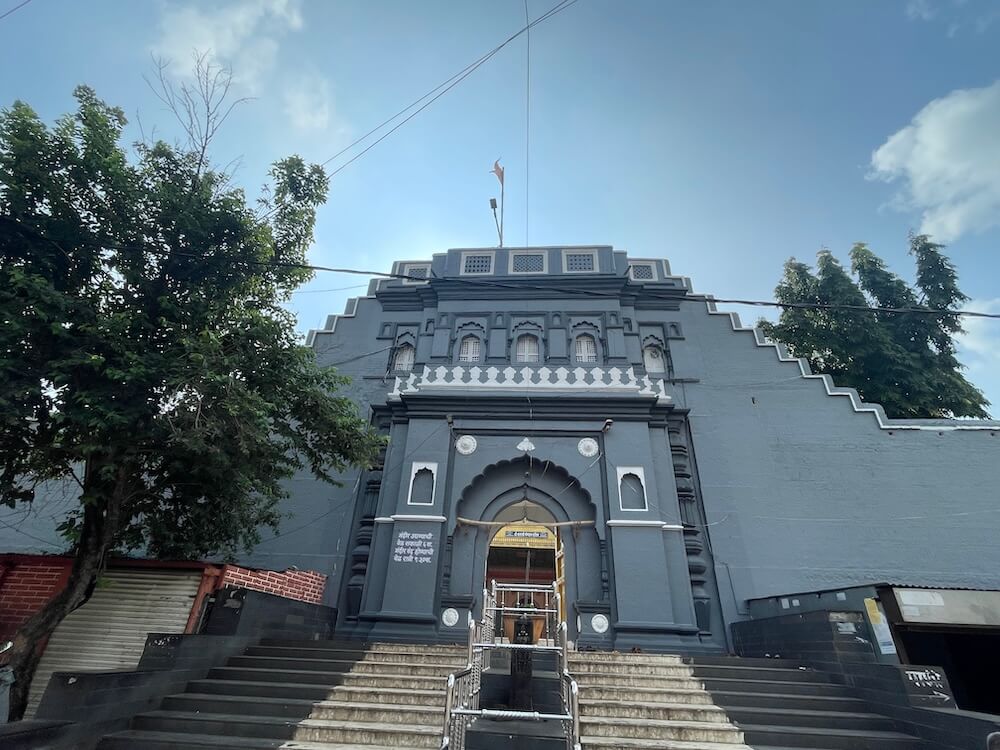
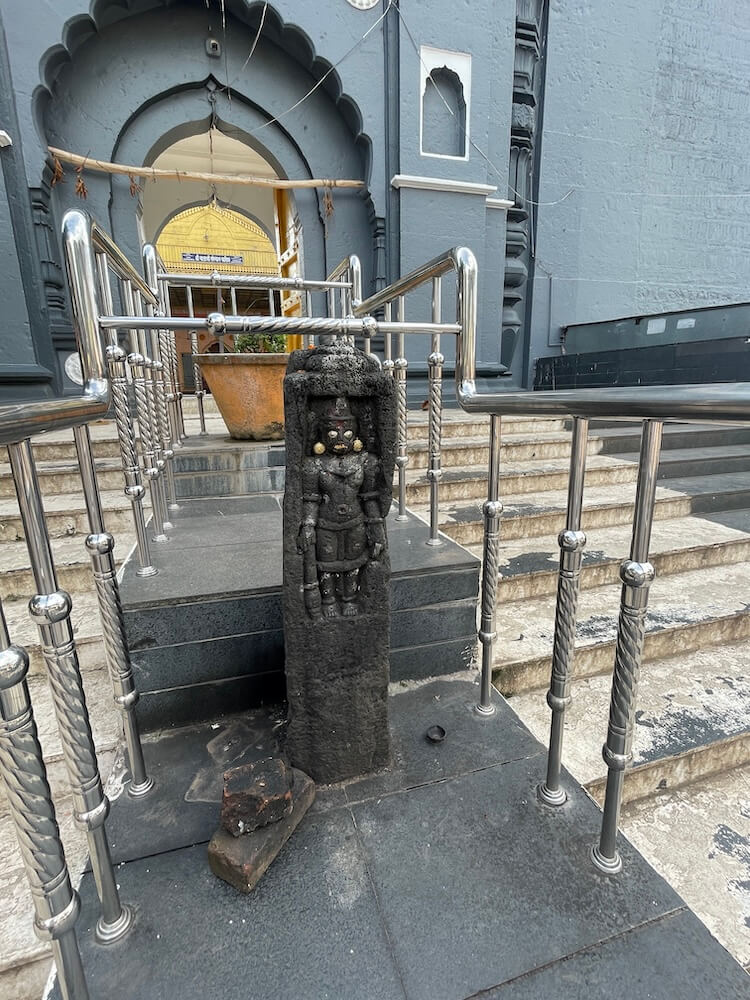
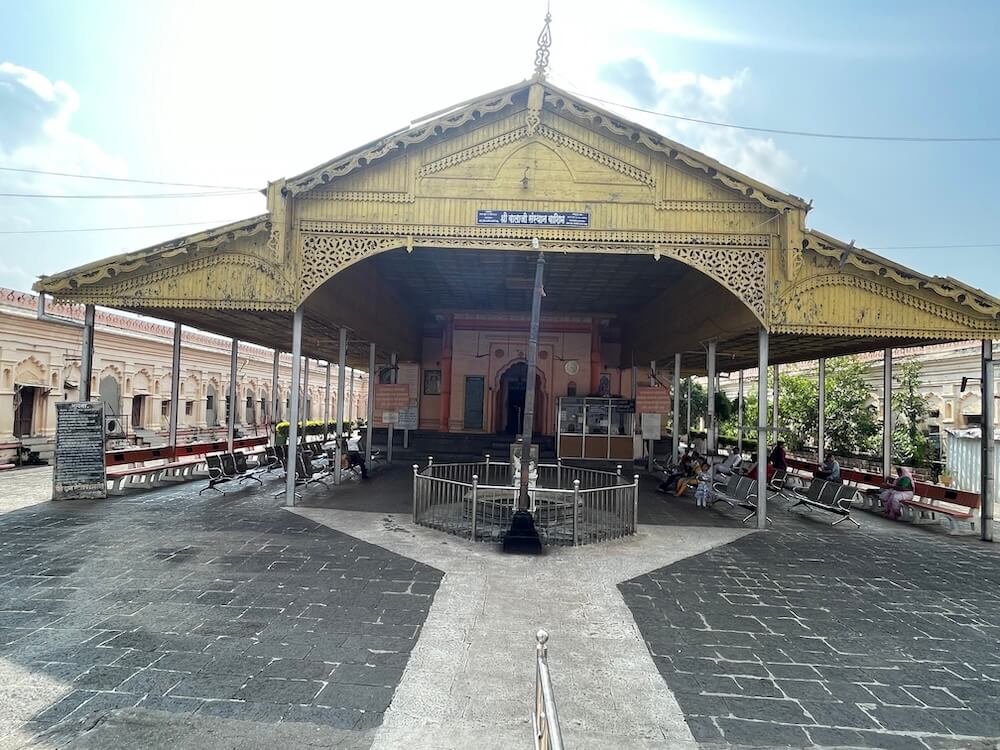
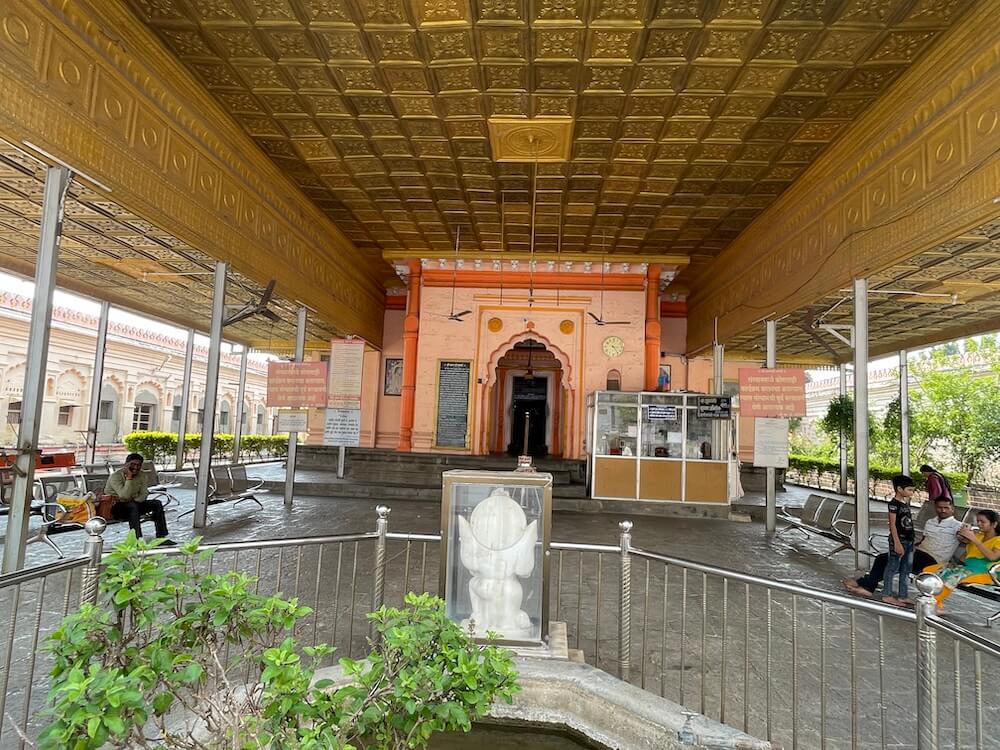
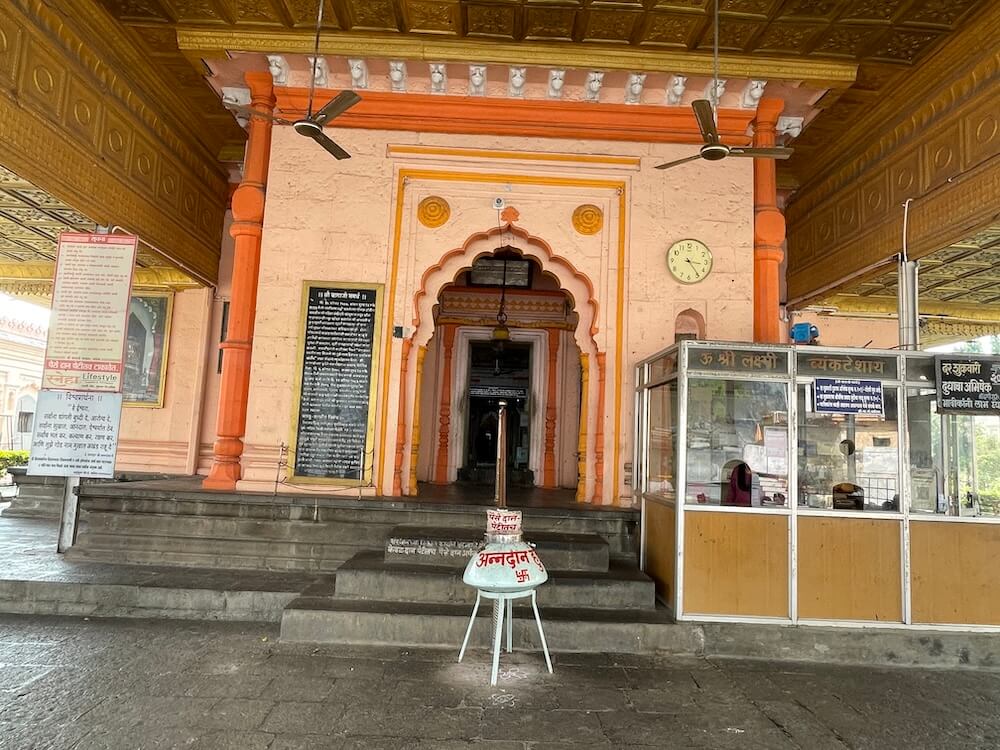
This temple, with a history spanning approximately two hundred and fifty years, is surrounded on all four sides by a fortified wall. Within this enclosure stands an east-facing main gateway. In the middle of the steps leading up to the main gateway, an ancient stone pillar is placed, upon which the sculpture of a doorkeeper is carved. The main gateway of the temple precinct is constructed of stone. Above the entrance arch of this tall, magnificent main gateway, there is a structure resembling a nagarkhana (drum house), featuring five small latticed windows. On both sides of the entrance, there is a descending wall shaped like steps. This main gateway is fitted with large wooden doors. From here, one enters the stone-paved courtyard of the temple. Directly ahead is a tall metal flagpole. Nearby are an octagonal Padmakunda (lotus pond) and a Tulasi Vrindavan (sacred basil garden). In front, there is a grand open-style wooden mandapa (hall). It is said that this mandapa was erected in nineteen thirty-seven by Krishnarao Yashwantrao Kalu. The main temple structure here is built upon a high plinth.
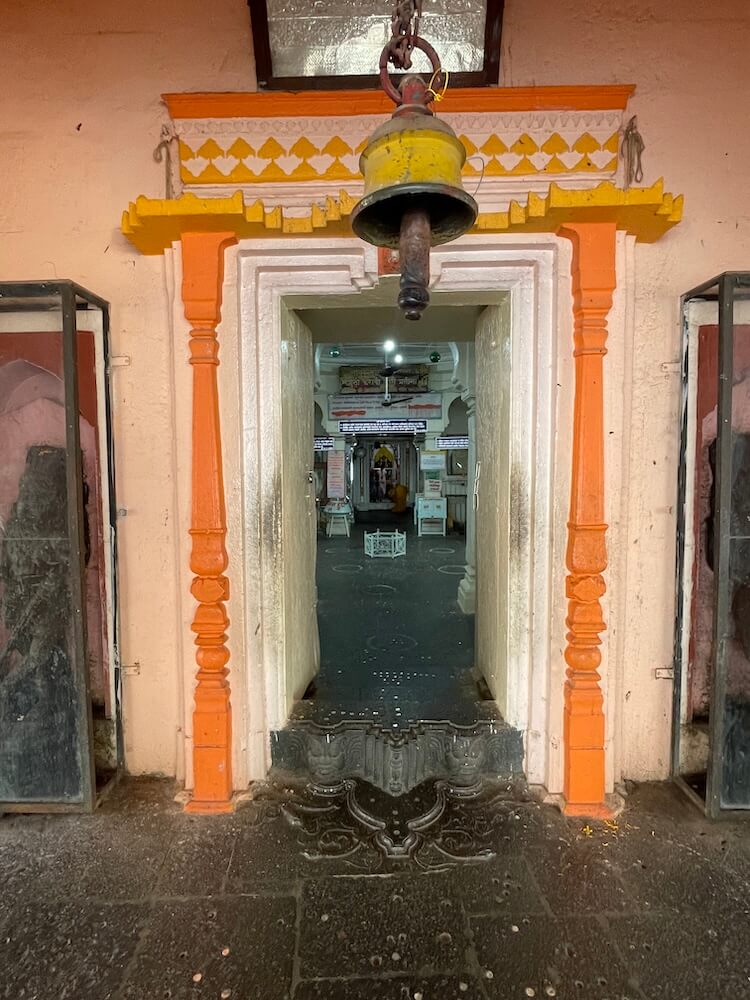
This ancient temple is structured with a Mukhamandapa, a Sabhamandapa, an Antarala, and a Garbhagriha. One enters the Mukhamandapa of the temple by ascending four steps. The entrance to the Mukhamandapa is a double-arched gateway with an ornate arch. Below the ceiling of this entrance are carved *tarangahastas*. A rare, old metal bell hangs from the ceiling of the Mukhamandapa. The distinguishing feature of this bell is its unusually large clapper. Inside, on both sides of the entrance to the Sabhamandapa, ancient idols of the *dwarapalas* Jaya and Vijaya are preserved in glass cabinets. The stone entrance to the Sabhamandapa is a simple *trishakhiya* design, with pillar-like carvings along the doorframe. At the *lalatabimba* of the frame, there is a Ganesh sculpture. The *utranga* section features an ornamental *torana*, while *kirtimukhas* are carved on the *mandaraka*. In the circular Sabhamandapa, square pillars are carved on all four sides. These pillars have semi-circular *tarangahastas*, which give the appearance of two pillars being connected by a circular arch. The Sabhamandapa has entrances on all three sides. On the floor of the Sabhamandapa, one can see numerous coins embedded by devotees. Although these coins have become smooth due to continuous foot traffic over years, the carvings on some coins are still visible today. A *kurmashilpa* is enshrined in the center of the Sabhamandapa. The arched entrance to the Antarala of the
temple is adorned with blue and purple glass pieces. In front of the wall to the left of this entrance, large portraits of Tirupati Balaji and the Balaji of this temple are displayed. Within the Garbhagriha, a tall idol of Balaji, adorned with rich garments and flower garlands, is consecrated in a high stone *makhar* carved into the back wall. This is a Vishnu Janardani idol, carved on a slab that is triangular in its upper part and rectangular in its lower part. The idol is four-armed, holding a conch, discus, mace, and lotus in its hands. A silver crown adorns the idol’s head. At the base of the
idol, a metal *utsavamurti* of Balaji is enshrined. On both sides of this tall stone *makhar*, there are three small *devakoshthakas* each. Ancient idols discovered during excavations are consecrated within these, including idols of Vishnu, Mahadev, Saraswati, Lakshmi, Ganapati, and others. Based on their stylistic features, it is surmised that these idols may date back to the eleventh century. The Garbhagriha of the temple is topped by a tall *shikhara* in the eighteenth-century Maratha architectural style. The golden-hued *shikhara* gleams with *devakoshthakas* on all four sides. Adorned with many small *kalashas*, this *shikhara* culminates in a large *kalasha* at its apex. Within the temple’s outer wall, on all three sides, there are buildings constructed like old mansions. Among these, behind the temple, is a Narasimha temple. This temple is opened once a year on Narasimha Jayanti. In one place, a wooden chariot used in the *Rathotsava* is kept. Near the temple is a *pushkarini* named Devtalav, also known as Balaji Talav. This pond was constructed during the building of the Balaji Temple. At the
Balaji Temple, devotees can have *darshan* daily from six o’clock in the morning until nine-thirty at night. The *Kakad Aarti* is performed here every morning at dawn. Additionally, the *Abhisheka* for the *utsavamurti* takes place from six-thirty to eight-thirty in the morning, followed by the *Balbhog Aarti* at eight-thirty in the morning. The *Mahanivedya Aarti* is performed here between eleven and eleven-thirty, while the *Sayam Aarti* is at eight o’clock at night and the *Shejarati* at nine o’clock. Festivals such as Shri Ram Navratra from Chaitra Shuddha Pratipada to Navami, the temple’s anniversary on Shravan Shuddha Trayodashi, the *Pranapratishtha* day on Shravan Vadya Dashami, Gokulashtami, Ashwin Navratra, Dahihandi, and Gopalakala are celebrated with great devotion. This temple is considered an important pilgrimage site in Washim, attracting a constant flow of devotees and tourists.
This sacred temple stands as a testament to deep spiritual devotion, ancient architectural grandeur, and rich local cultural traditions.
The sanctum sanctorum houses the divine idol consecrated according to ancient Vedic traditions, surrounded by serene courtyards and traditional temple architecture.
Navratri, Maha Shivratri, Annual Temple Jatra & Deepotsav
Compare and book flights, secure top-rated local hotels near the temple, hire reliable guides, and rent cars instantly.
Extend your pilgrimage by visiting other highly sacred temples located nearby.


Add ₹999 more to unlock FREE SHIPPING!
Your sacred cart is currently empty.
Shop Photo FramesFill in your delivery details below to place your order.
Add comment