
Add ₹999 more to unlock FREE SHIPPING!
Your sacred cart is currently empty.
Shop Photo FramesAt the foot of the sacred pilgrimage site renowned as Khanderaya’s Jejuri, stands the Ballaleshwar Shiv Mandir, a rare manifestation of historical and architectural brilliance from the Peshwa era. This temple is nestled approximately साठ feet deep below the earth’s surface, within the embankment of a lake. During the excavation of this lake, which was constructed by Thorale Bajirao Peshwe in the अठराव्या century for both devotional and military needs, the Swayambhu Lingam of Ballaleshwar was discovered. This sacred site holds special significance due to its Maratha architectural style, advanced water management, and its Pataleshwar form. Many devotees believe that a pilgrimage to Jejuri remains incomplete without first having the darshan of this Ballaleshwar after visiting Jejuri Fort.
Until the early अठराव्या century, the foothills of Jejuri Fort were covered by a vast expanse of barren land. This region, located in the eastern ranges of the Sahyadri mountains, received very little rainfall. Furthermore, Jejuri’s terrain is predominantly rocky and hilly, meaning there was no natural system available to store rainwater. The area at the foot of the fort resembled a natural valley or a deep depression. During the monsoon, water from the mountains would flow rapidly through here. Due to a severe water shortage in this dry region, devotees visiting the fort faced immense hardships. Additionally, Jejuri, being close to Pune and on the route to Satara, served as an important stop for the Maratha army. However, establishing a large cavalry camp there was difficult due to the lack of water.
To alleviate this water scarcity in Jejuri, Thorale Bajirao Peshwe undertook the construction of a large lake here between the years १७३७ and १७४० CE. This lake spans an enormous area of approximately ३६ to ३७ acres. During the construction of the lake, an ancient Shiva Lingam was found deep within the earth. Recognizing the spiritual significance of this Lingam, Thorale Bajirao Peshwe ordered the construction of a temple at that very spot. After the Peshwas, the Holkar dynasty of Indore made significant contributions to the development of Jejuri. Ahilyabai Holkar provided special funds for the preservation and repair of this area, in addition to constructing structures on Jejuri Fort. Certain marks on the temple walls indicate that its renovation took place during the Holkar period. Peshwa-era sardars Ragho Mambaji and Haripant Phadke also played crucial roles in the construction of this sacred edifice.
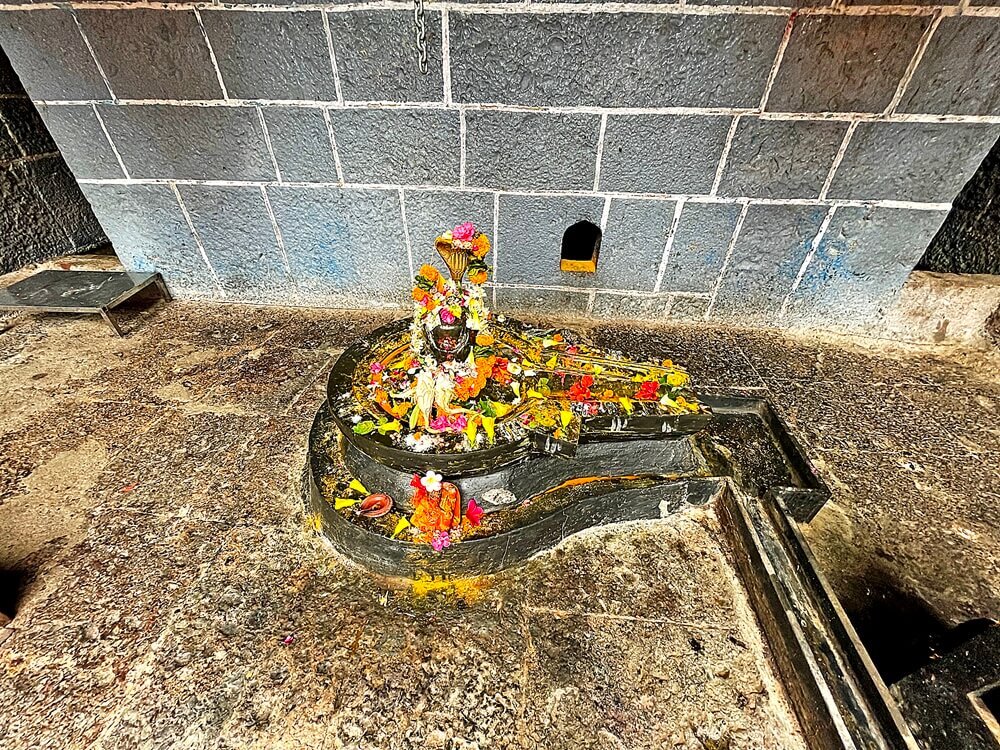
The Ballaleshwar Temple in Jejuri carries a special aura around its name. While the name ‘Ballaleshwar’ is generally associated with the Pali Ganapati, one of the Ashtavinayakas, this site in Jejuri is dedicated to Lord Shiva. Scholars hold various opinions regarding the origin of this name. According to some researchers, Thorale Bajirao Peshwe may have named this Shiva shrine Ballaleshwar in memory of his father, Balaji Vishwanath, also known as Ballal. When the Peshwa lake excavation began, workers encountered a hard rock at a specific spot deep within the earth. Upon more careful excavation, a Swayambhu Shiva Lingam manifested there. This description is found in the ‘Martand Vijay’ text, which narrates the glory of the Jejuri region. A Shiva Lingam situated so deep within the earth is considered Pataleshwar and symbolizes the energy and stability within the earth’s womb.
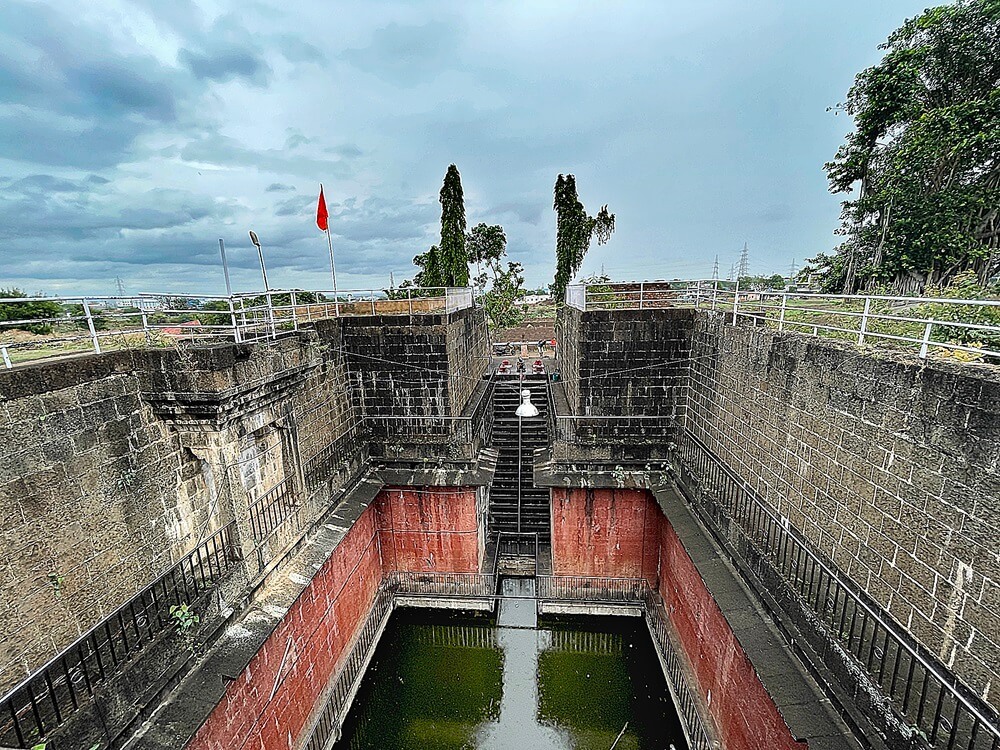
After entering Jejuri town, this Peshwa lake and Ballaleshwar Temple are located on the Neera-Pandharpur road, which lies to the south-east, or Agneya, direction of Khandoba Fort. If one walks from the foot of the fort, the temple can be reached in ten minutes. Upon entering the temple premises, the massive embankment of the lake first catches the eye. Many ancient trees line the banks of this lake. Standing on the bank, one can behold a beautiful view of Jejuri Fort.
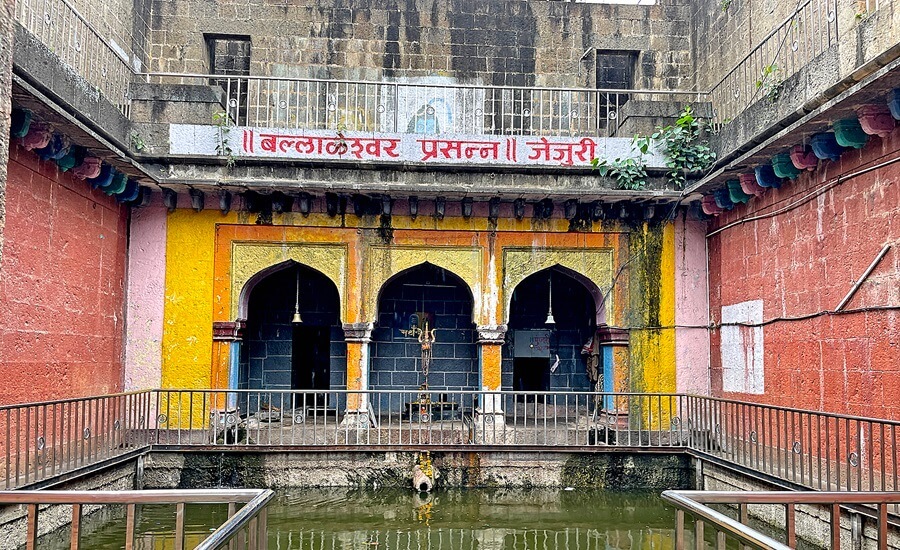
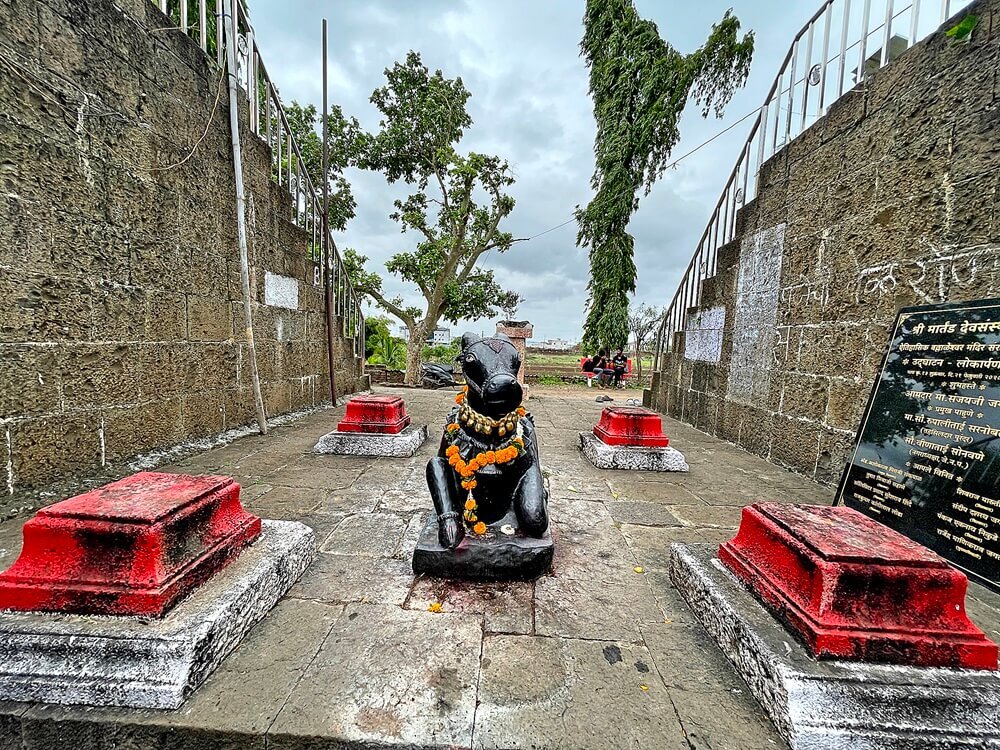
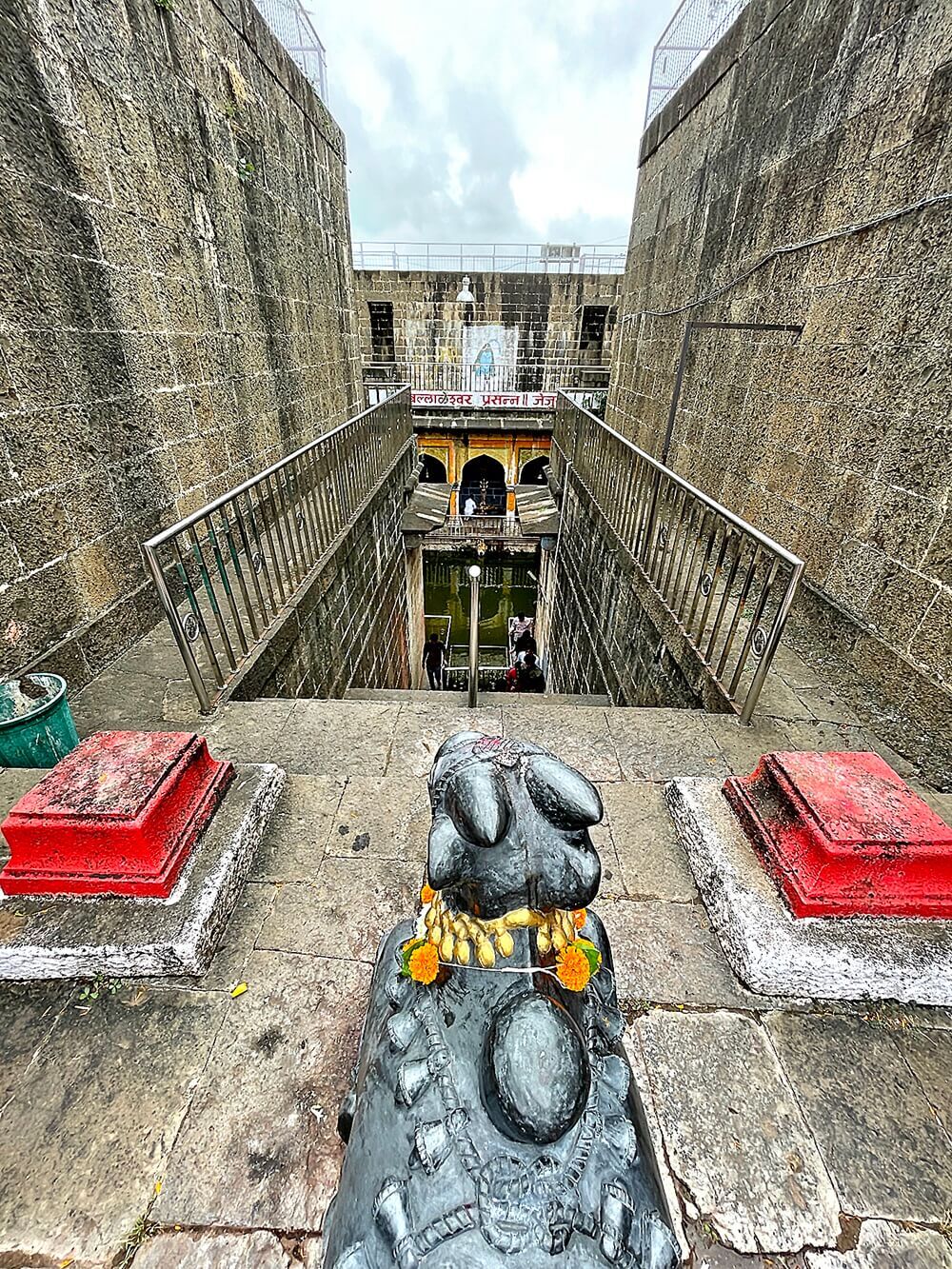
The Ballaleshwar Temple is a beautiful example of Maratha architecture and Peshwa-era engineering prowess. This temple is built approximately ६० feet deep below the earth’s surface, directly within the strong embankment of the lake. For entry to the temple, a path of stone steps has been created, descending from the eastern embankment of the lake. Upon entering the temple, one first encounters a grand stone arch-like entrance leading to a flight of steps that descend into the temple. Further ahead, in front of the temple, there is a large idol of Nandi on a platform. Four semi-pillars surround Nandi on all four sides. The structure here suggests that there might have been a Nandi Mandap previously. The temple does not have a traditional tall shikhara, but there are some small stone domes at ground level. These domes are used to ensure proper ventilation within the Garbhagriha.
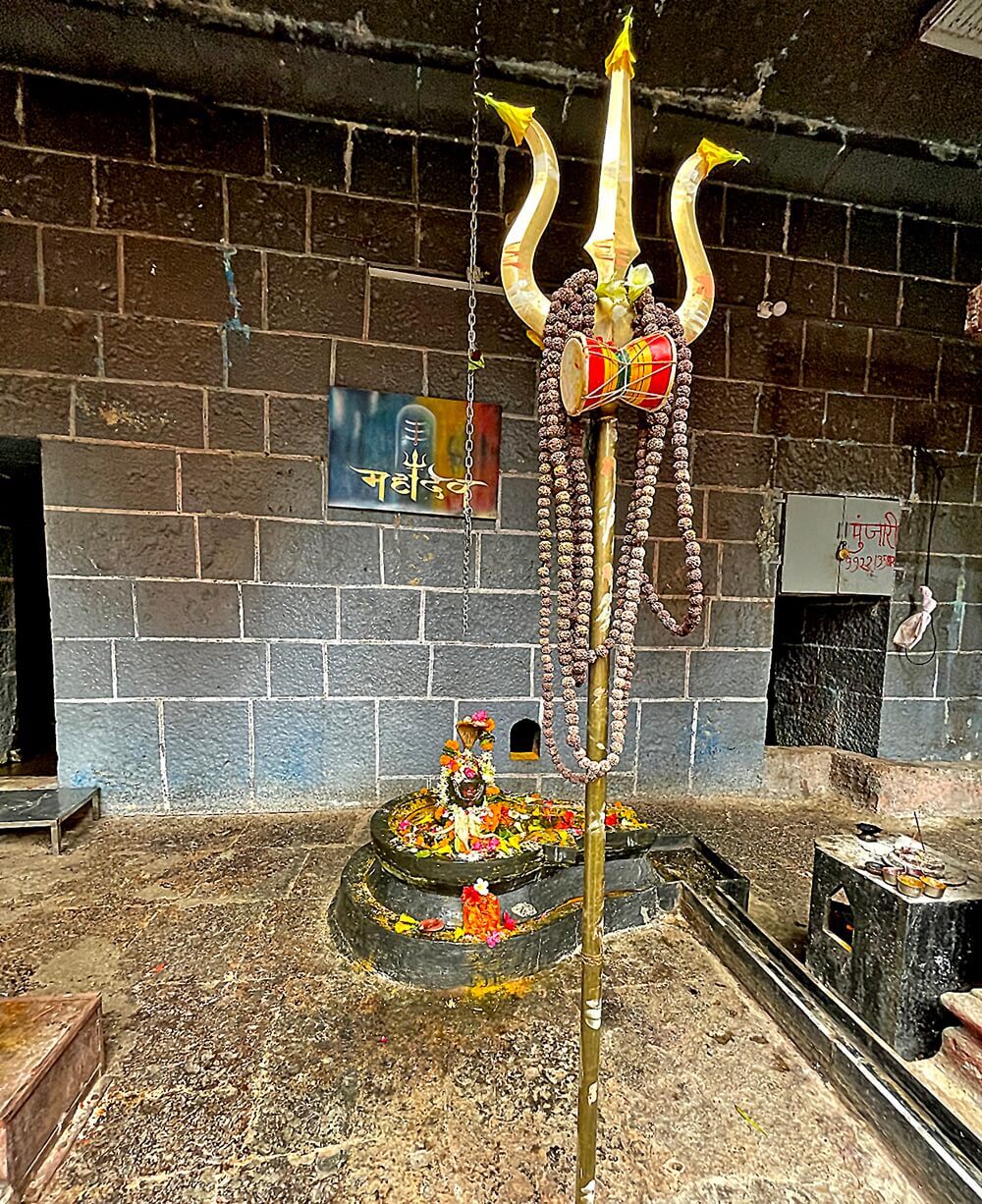
The special architectural marvel of the temple is its Garbhagriha. This sanctum sanctorum is carved into the inner side of the main wall of the lake. Surprisingly, even with a huge volume of water in the lake, water does not seep into the Garbhagriha through this wall. Inside the Garbhagriha is the Shivpindi of Ballaleshwar, and the design allows the lake water to fall directly onto this pindi through a Gomukh. During Rangpanchami, sunlight falls directly onto this pindi in the Garbhagriha from a specific angle. In front of the Garbhagriha is a Pushkarani. Its water management system, used for irrigation, remains efficient to this day.
Mahashivratri is the major annual festival at this temple. A grand three-day fair is held here on the Vadya Chaturdashi of the Magh month. During this period, special Mahapuja and Rudrabhishek are performed for the Shiva Lingam. On the night of Mahashivratri, the entire temple is illuminated with the glow of lamps. Every Monday in the Shravan month sees a large gathering of devotees. On this day, the tradition of bringing water from the Karha River in a kavadi and performing abhishek for the deity is still preserved. Mahaprasad, or food donation, is organized for all devotees who visit on Shravani Somvar. Also, on Somvati Amavasya, when Khanderaya’s palanquin proceeds to the Karha River for a sacred bath, thousands of devotees make it a point to visit Ballaleshwar on their return journey.
This sacred temple stands as a testament to deep spiritual devotion, ancient architectural grandeur, and rich local cultural traditions.
The sanctum sanctorum houses the divine idol consecrated according to ancient Vedic traditions, surrounded by serene courtyards and traditional temple architecture.
Navratri, Maha Shivratri, Annual Temple Jatra & Deepotsav
Compare and book flights, secure top-rated local hotels near the temple, hire reliable guides, and rent cars instantly.
Extend your pilgrimage by visiting other highly sacred temples located nearby.


Add ₹999 more to unlock FREE SHIPPING!
Your sacred cart is currently empty.
Shop Photo FramesFill in your delivery details below to place your order.
Add comment