
Add ₹999 more to unlock FREE SHIPPING!
Your sacred cart is currently empty.
Shop Photo FramesHuman settlements such as villages, towns, and hamlets have migrated since ancient times for various reasons, with natural disasters being a primary cause. Instances of temples migrating along with their villages are rare. However, the Hanuman Temple in Tung, located in the Miraj taluka, has been relocated here along with the village, including the original stones used in the temple’s construction. Devotees believe that this is a ‘Jagrut Deva’ (an awakened deity) who fulfills their prayers. Because of this, a weekly fair is held here every Saturday, and thousands of devotees arrive to seek the blessings of the deity.
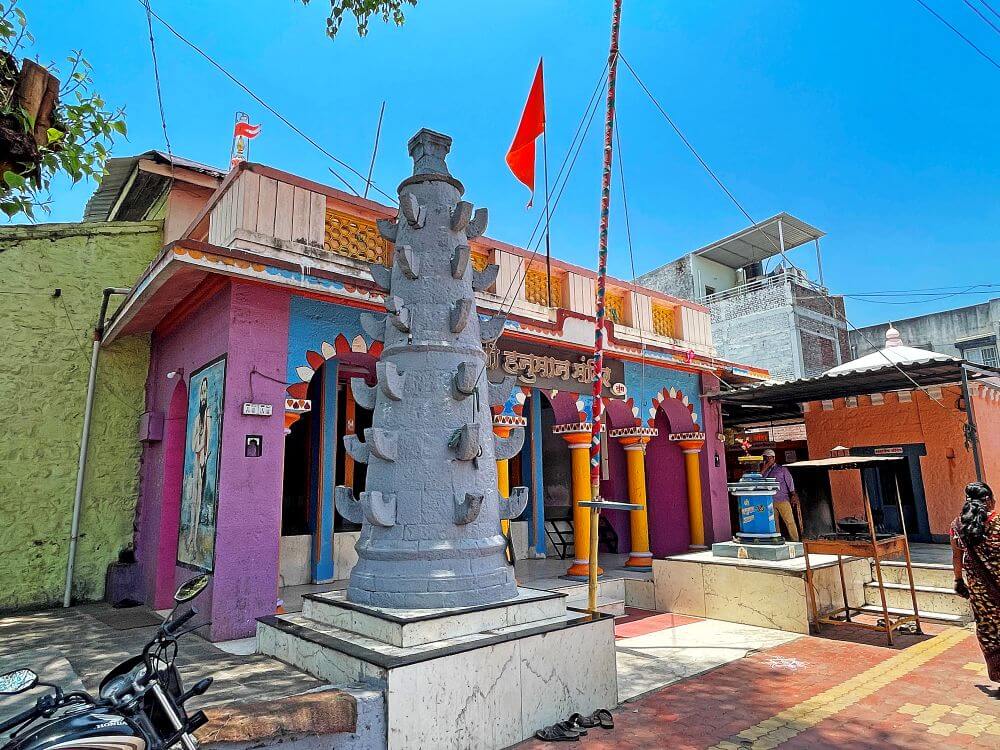
According to the local villagers, this temple was established by Samarth Ramdas Swami. However, it is not counted among the eleven famous Maruti temples established by Samarth. It is also said that Samarth Ramdas Swami had taken darshan of this Maruti. Previously, this village was situated on the riverbank. However, the village suffered greatly due to constant flooding. Therefore, in the year 1875, it was decided to relocate the village. At that time, this temple was also shifted along with the village to a higher location called Tung. The stones from the construction of the original temple were brought to this place, and the temple was rebuilt exactly as it was before. Because it is situated on a high, or ‘uttung’ place, this deity came to be known as Tung Maruti. Since 1875, the Maruti Janmotsav has been celebrated here with great pomp and enthusiasm to this day.
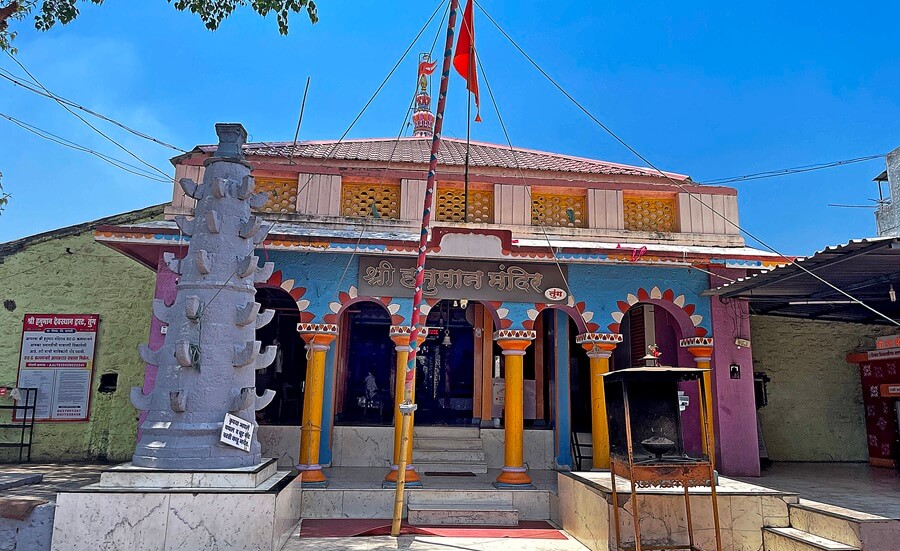
In the courtyard in front of the temple, there is a three-tiered circular Deepmala (lamp tower). Beside it, on a raised platform, are the Tulsi Vrindavan and the Bhasmakund. The main hall (Mukhamandap) of the temple is situated at a slightly higher level than the courtyard. The Mukhamandap features six circular, intricately carved pillars. The circular bases of the pillars are somewhat wider, and upon them are three There are rings. The pillars feature vertical fluted carvings, with a square capital at the top. Due to the brackets above the capital, five semi-circular arches have been formed on the pillars. There are entrances on the left and right sides of the Mukhamandapa.
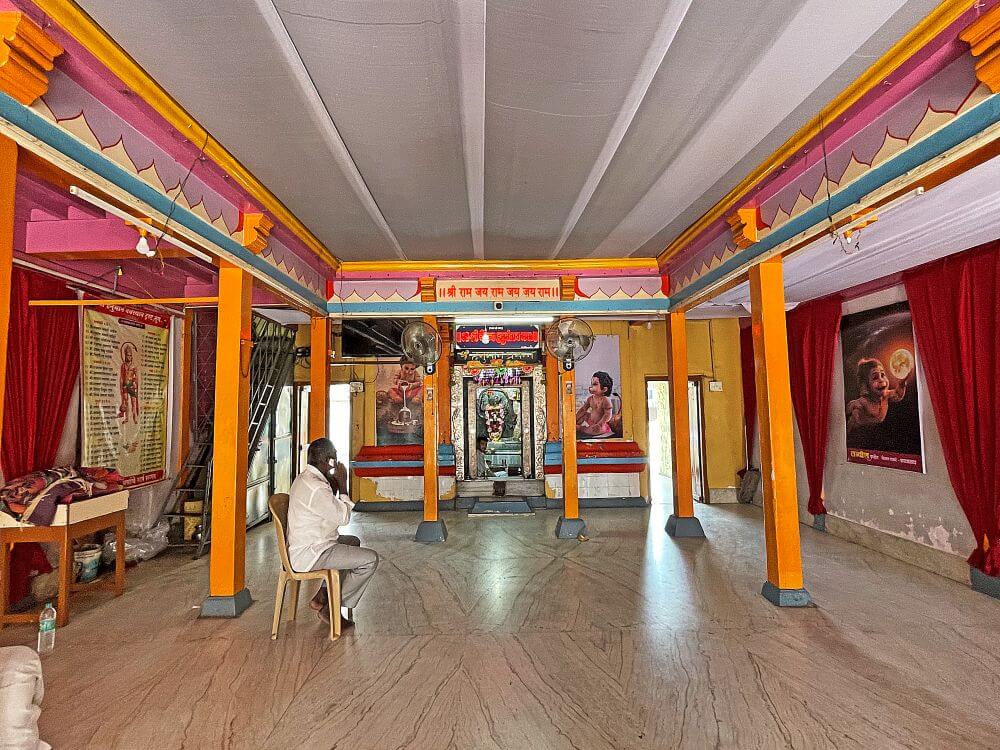
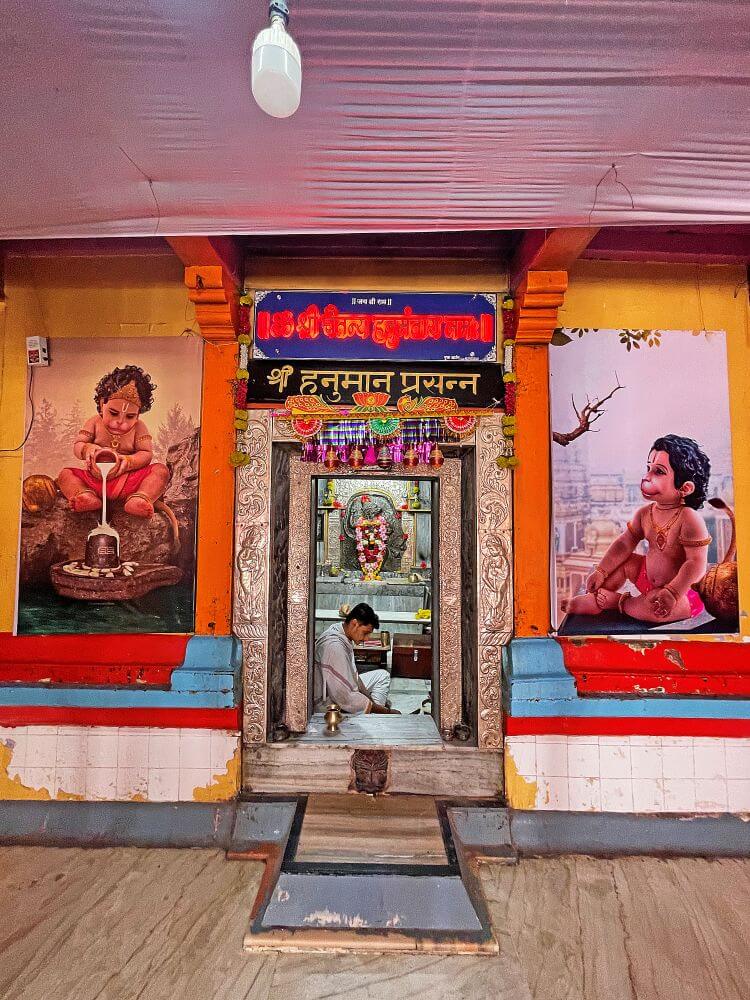
There are three steps to ascend to the wooden, two-storied, enclosed Sabhamandapa (assembly hall), which is situated at a higher level than the Mukhamandapa (main porch). The Sabhamandapa features four rows of four square pillars each. The pillars in the outer rows are integrated into the walls. The stone bases of the wooden pillars are square in shape. There is a Kurma-shilpa (tortoise carving) on the floor of the Sabhamandapa. An iron staircase is located near the wall to access the upper floor. The Sabhamandapa has entrances on both the left and right sides of the sanctum sanctorum’s doorway.
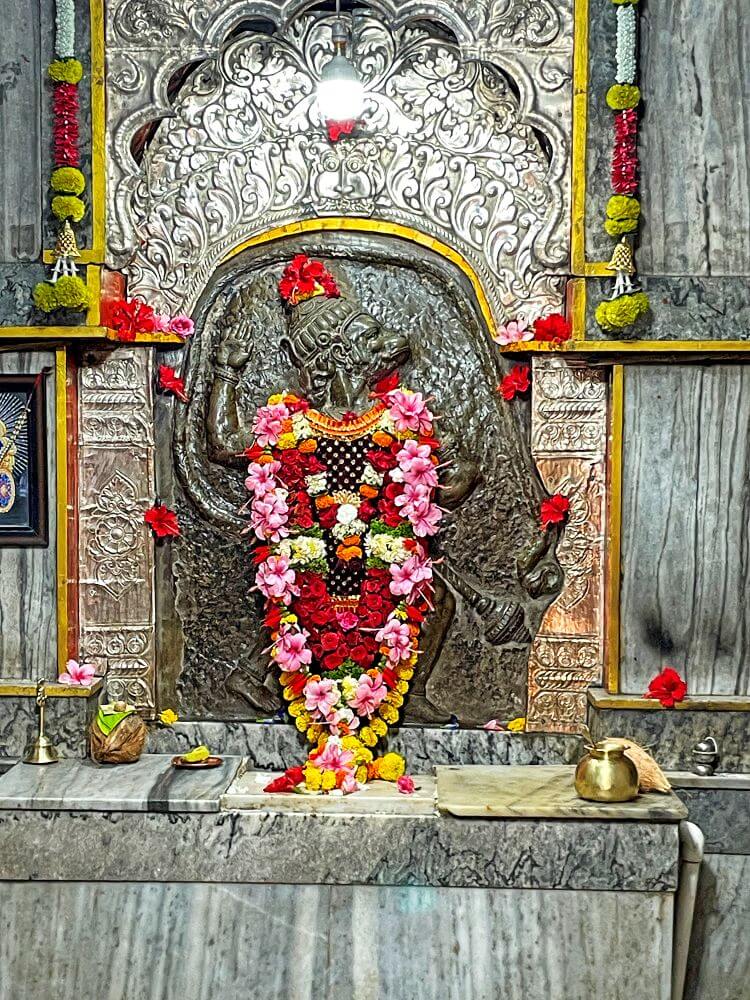
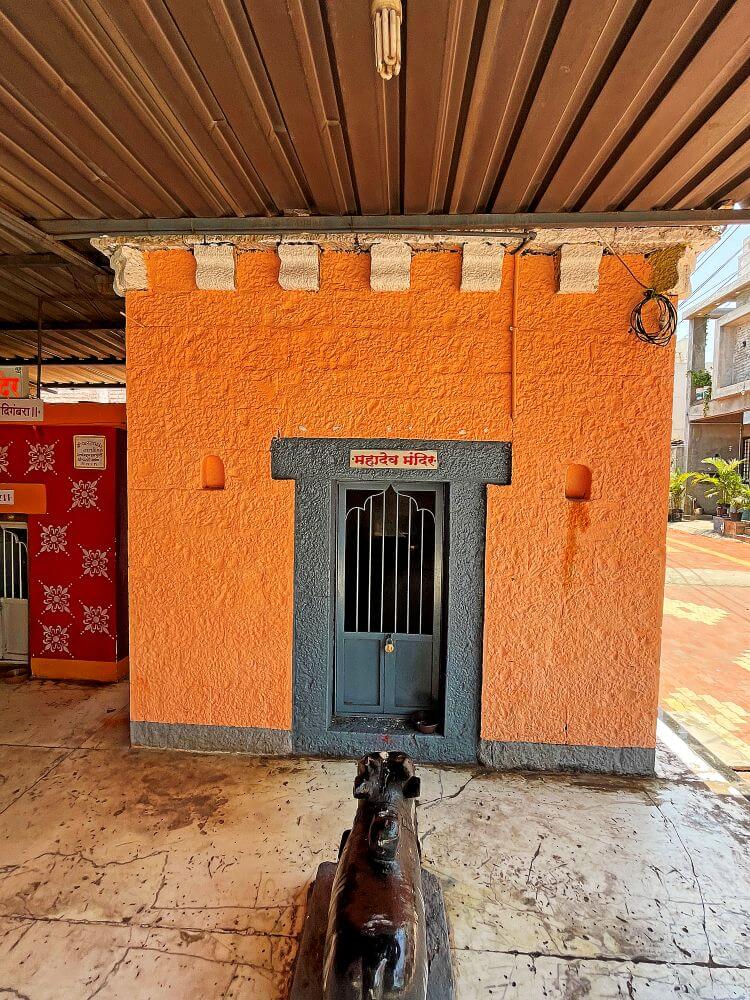
Further ahead is the ancient sanctum sanctorum (Garbhagriha) of the temple, featuring stone masonry in the Hemadpanti architectural style. On the first doorframe of the sanctum, there are floral carvings, and an idol of Lord Ganesha is placed at the Lalatabimba (the central decorative block above the doorway). On the second doorframe, at the lower side The doorframe and the upper section are adorned with floral and leaf motifs. There is a Kirtimukha on the Mandarka. The door jambs and the lintel are covered with silver plating. Inside the sanctum sanctorum, there is a standing idol of Maruti placed on a Vajrapitha. The original idol is carved from black stone. In 1980, it was coated with a Panchadhatu (five-metal) Vajralepa. The Prabhavali (halo) behind the idol features floral and leaf carvings. The outer walls of the sanctum sanctorum are painted with scenes depicting various episodes from the Ramayana. On the roof of the sanctum, there are four small spires at the corners, and the main central spire, which tapers upwards, features sixteen Urushringa-style sub-spires. At the apex of the spire, there is an Amalaka shaped like two lotus flowers stacked one upon the other, topped with a Kalasha. To the left of the temple is the Dattatreya temple. Inside this temple, there is a marble idol of Dattatreya and his Padukas (footprints) placed on a Vajrapitha. Beside this temple is the Mahadeva temple. In front of the temple, there is a black stone idol of Nandi on a Vajrapitha, and a Shiva Linga in the sanctum sanctorum. There are some Nagashilas (serpent stones) in the courtyard. An Annachhatra Mandap (free food distribution hall) has been erected in half of the courtyard.
At the temple, Chaitra Purnima and Hanuman Jayanti are celebrated with great devotion and enthusiasm. April 8th, the temple’s anniversary, is celebrated every year as the birth anniversary of Maruti. During the annual festivals, programs such as bhajans, kirtans, pravachans, jagaran, music, and dance are organized at the temple. During all annual festivals, the Palkhi Sohala (palanquin procession) of Marutiraya is celebrated in a devotional atmosphere and with great fervor. Thousands of devotees participate in the Palkhi Sohala, showering gulal amidst the rhythmic beats of dhol-tasha. Every Saturday, a large number of devotees visit for darshan and to fulfill their vows. An Annachhatra (free food distribution) is run at the temple daily. Every Saturday, about five thousand devotees partake in the Mahaprasad here.
This sacred temple stands as a testament to deep spiritual devotion, ancient architectural grandeur, and rich local cultural traditions.
The sanctum sanctorum houses the divine idol consecrated according to ancient Vedic traditions, surrounded by serene courtyards and traditional temple architecture.
Navratri, Maha Shivratri, Annual Temple Jatra & Deepotsav
Compare and book flights, secure top-rated local hotels near the temple, hire reliable guides, and rent cars instantly.
Extend your pilgrimage by visiting other highly sacred temples located nearby.


Add ₹999 more to unlock FREE SHIPPING!
Your sacred cart is currently empty.
Shop Photo FramesFill in your delivery details below to place your order.
Add comment