
Add ₹999 more to unlock FREE SHIPPING!
Your sacred cart is currently empty.
Shop Photo FramesIn Indian culture, the two principles of Shiva and Shakti are considered the origin and foundation of the creation and operation of the universe. The rule that where Shiva resides, Shakti also dwells, is prominently visible in the design of pilgrimage sites across the country. In this lineage, at the field of Lord Vaijnath—one of the twelve Jyotirlingas—the Kalratri Devi Temple, a symbol of the non-duality of Shiva and Shakti, is considered a vibrant and significant Shaktipeeth. It is believed that this Goddess is the sister of Vaijnath. The temple is characterized by the idol of the Goddess in the Ardhanarinateshwara form, the unique meeting ceremony of brother and sister on Dussehra, and the tradition of reciting the ‘Ratrisukta’ as a remedy for mental ailments.
The seventh of the Navadurgas is Goddess Kalratri. The seventh day of Chaitra and Ashwin Navratri is considered an important day for the worship of this Goddess. ‘Kaal’ means time or death, and ‘Ratri’ means darkness. The name is interpreted as the one who destroys ignorance, darkness, and evil tendencies. The Goddess has a world-famous temple in Varanasi, while another major temple is located in Kanchipuram in South India. Since Parli is a Jyotirlinga site, Shiva is considered ‘Mahakal’ here, and it is believed that His power exists in the form of Mahakali or Kalratri. The temple of the Goddess here is contemporary to the Parli Vaijnath temple. Scholars believe it dates back to the Yadava period, i.e., approximately the twelfth to thirteenth century.
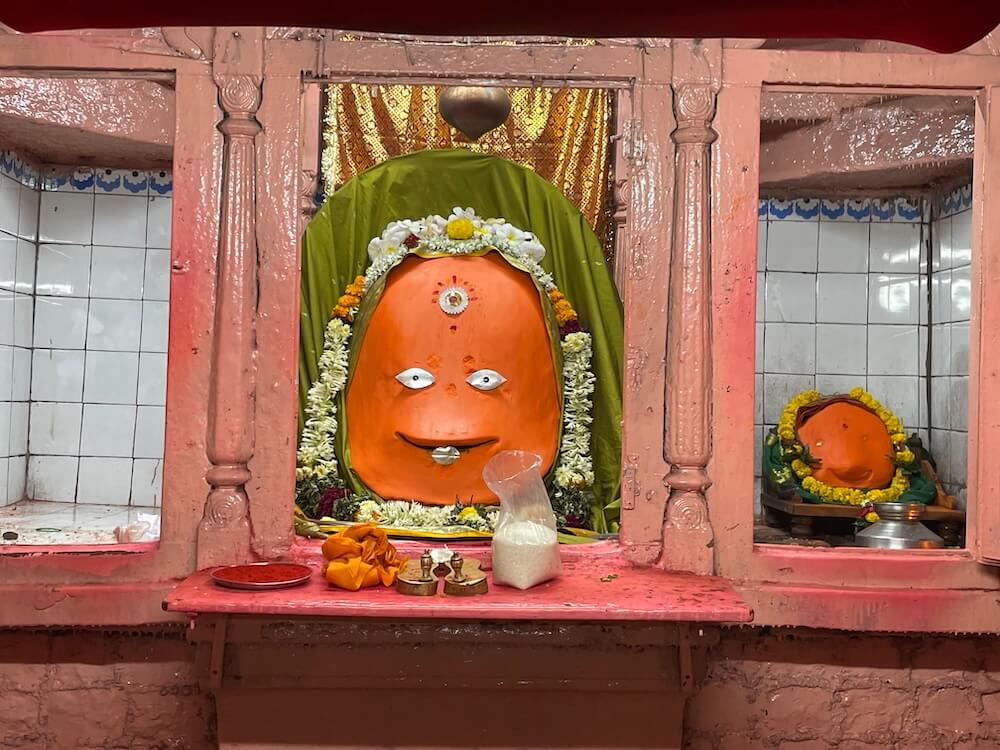
The legend regarding this temple states that the pot of nectar (Amrit) emerged from the churning of the ocean by gods and demons. To prevent the pot from falling into the hands of the demons, Vaijnath took the pot and fled towards Parli. At that time, Vaijnath’s sister, Goddess Kalratri, hid her brother behind her to protect him. This is why, when looking at the idol here, one sees the form of the Goddess from the front and a Shivling from the back.
Another legend about the Goddess states that in ancient times, King Vishwapati of the Mahakosala kingdom was governing his state. His son, the heir to the throne, suddenly developed a strange mental illness. He began to suffer from constant hallucinations and lost all consciousness. Many remedies were tried by royal physicians and sorcerers, but his illness did not subside. One day, the King learned of the glory of Kalratri Devi in the Parli region. He brought his son to Parli and began a rigorous ritual for Goddess Kalratri. Through the recitation of the ‘Ratrisukta’ from the Vedas and the worship of the Goddess, a miracle occurred; his son’s illness was completely cured, and he regained his intelligence and memory. Since then, the belief has been established that reciting the Ratrisukta in this temple provides relief from mental distress.
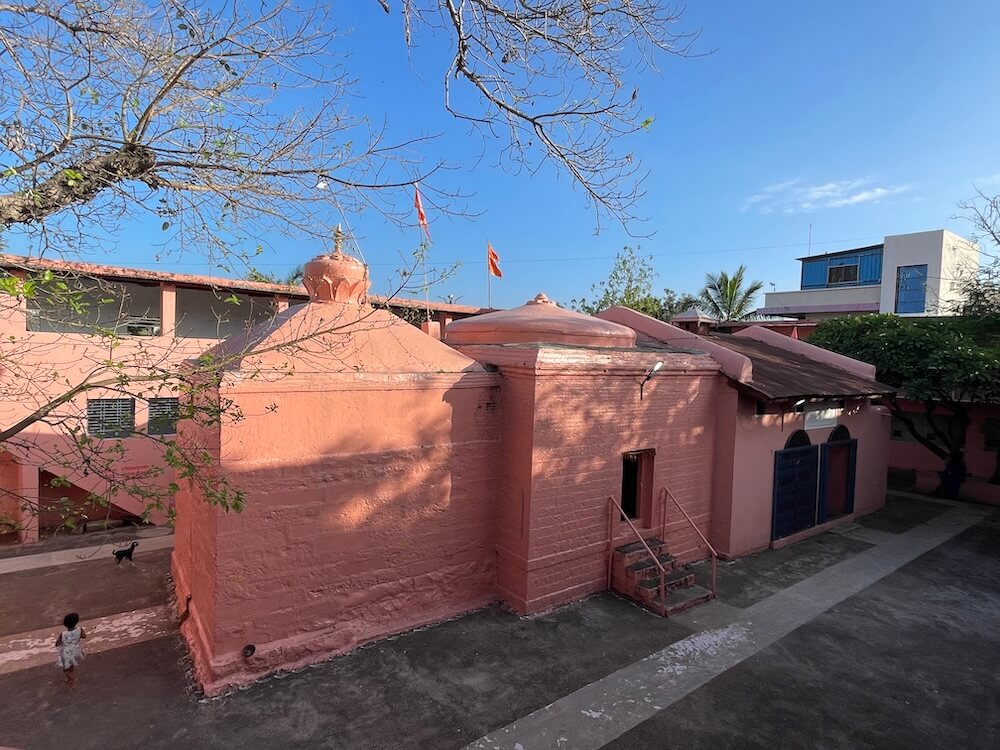
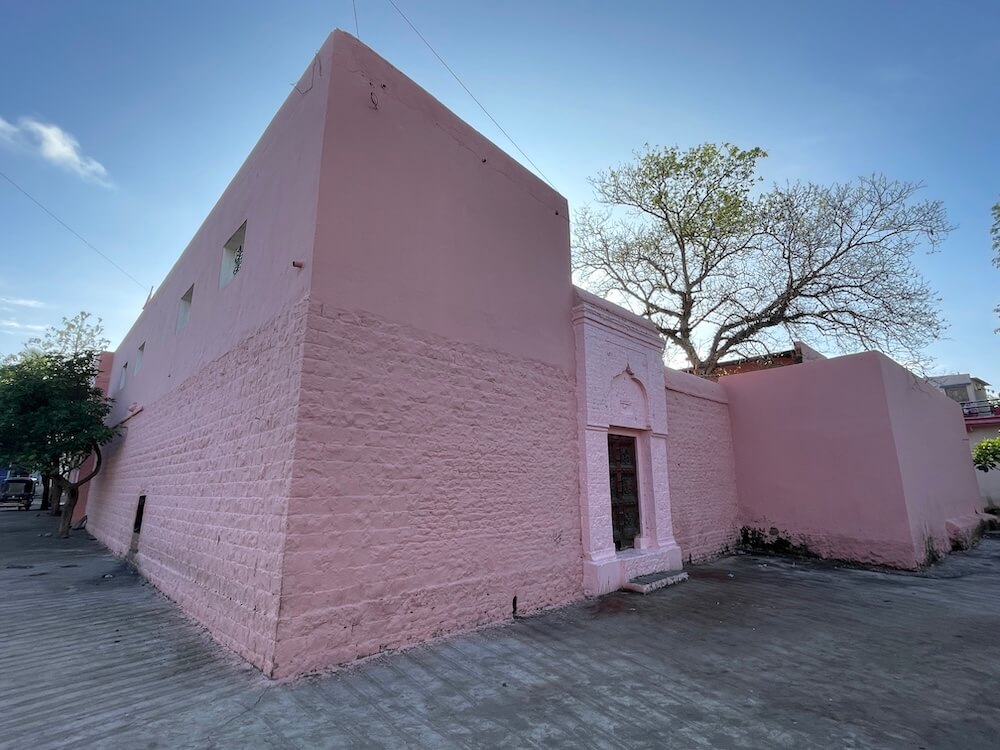
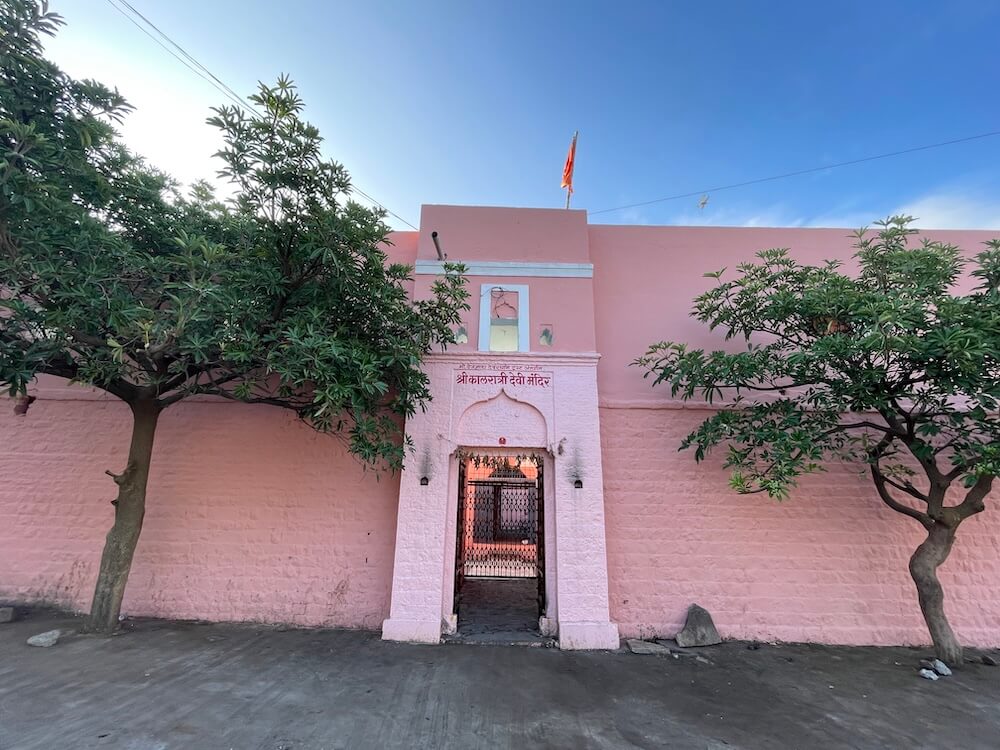
The Kalratri Devi Temple is surrounded by a strong stone fortification about twenty feet high. Inside the two-story entrance of this fortification, there is a guard room, and on the upper floor, there is a Nagarkhana (drum house). In the courtyard, adjacent to the fortification, are two-story buildings. These include a Bhaktaniwas (pilgrim lodging) and residences for temple attendants. There is a staircase on the outside of the buildings to reach the upper floor. The temple structure consists of a Sabhamandap (assembly hall), Antarala (vestibule), and Garbhagriha (sanctum sanctorum). In front of the entrance to the Sabhamandap, there are ancient stone platforms on both sides with tapering lamp pillars (Deepstambhas). On one of these platforms, there is a Shivling, and on the other, stones representing some local deities. The Sabhamandap has two more doors in the right and left walls. The entrance to the Sabhamandap is slightly higher than the courtyard. In this stone-paved Sabhamandap, there is a sacrificial altar (Yajnakunda) in the center and several niches in the walls. In one of these niches, there is a sculpture of Khandoba-Mhalasa riding a horse. The ceiling is made of sloping metal sheets supported by wooden beams on the walls.
Further ahead, the Antarala is at a higher level than the Sabhamandap. There are three steps to the entrance of this Antarala. On the first step, there is a carved moonstone (Chandrashila). The door frames are decorated with vertical carvings, and there is an auspicious sculpture on the lintel. There is an arched gateway above the entrance. In the Antarala, baskets of flour and salt are kept. Devotees coming for the darshan of the Goddess offer items like flour, salt, grains, chilies, and spices in these baskets. The Antarala has a corner-vault structure in all four corners, topped by a dome-shaped ceiling. On the front wall of the Garbhagriha, in a niche to the right of the entrance, is a sculpture of Sheshashayi Vishnu. Lakshmi is near Vishnu’s feet, and Brahma is on the lotus emerging from his navel. One of Vishnu’s hands is under his head. In the upper two hands, he holds a conch and a discus. The fourth hand is in the Abhaya Mudra (gesture of fearlessness).
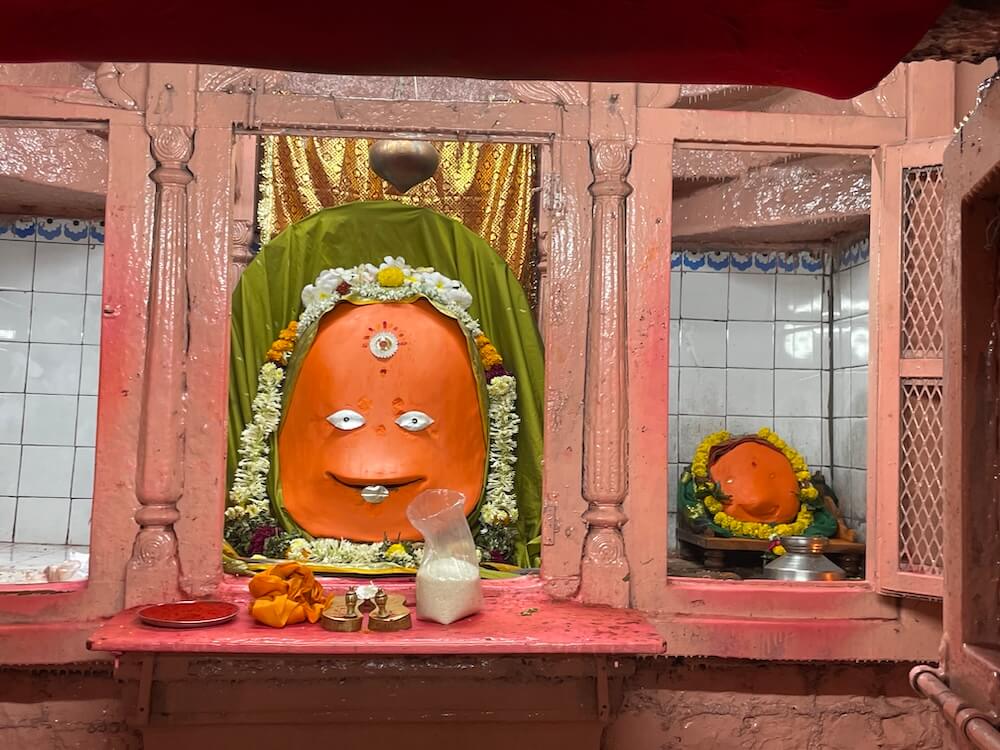
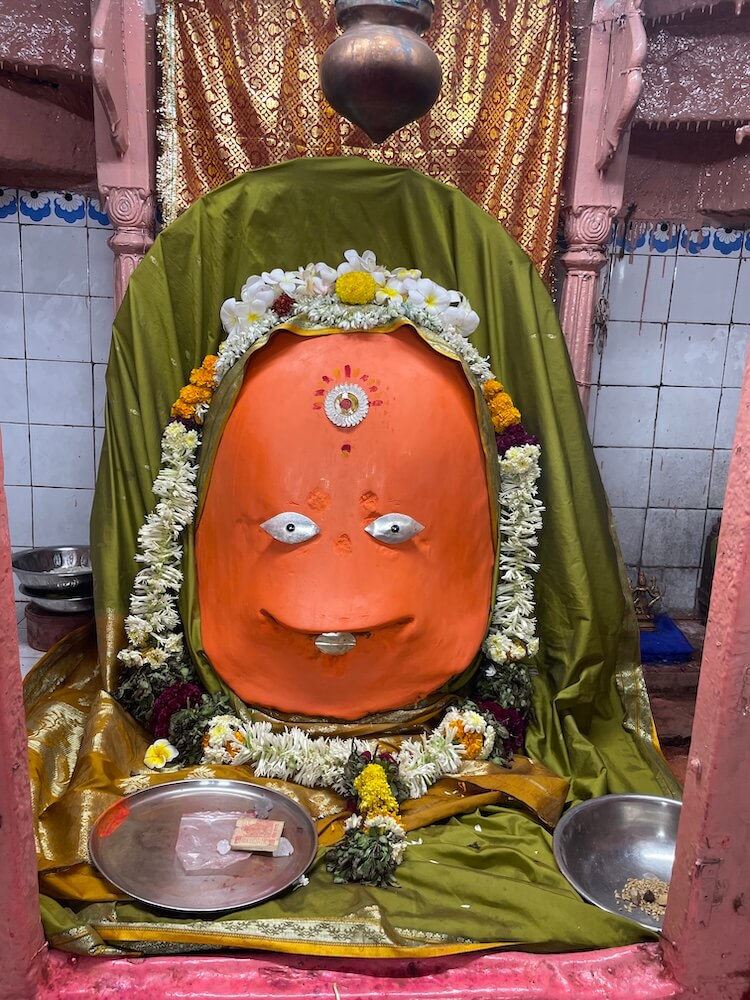
There are doors on the right and left sides to exit the Antarala. In front of the Antarala is the Garbhagriha. The entrance to the Garbhagriha is slightly higher than the Antarala. The carvings on the door frames and the lintel have become somewhat blurred. In the Garbhagriha, there is an idol in the form of a Tandala (a naturally formed stone) on a Vajrapitha (diamond pedestal). The front part of the idol is the face of the Goddess, while the back part is a Shivling. Generally, temples of the Goddess are in a feminine form, but the Kalratri Devi of Parli is in the Ardhanarinateshwara form. This form is considered a symbol of the non-duality of Shiva and Shakti. It is said that the idol has this form because Goddess Kalratri hid Vaijnath behind her. The eyes, tongue, and bindi of this Goddess, adorned with clothes and ornaments, are made of silver. An Abhishek vessel is hung from the ceiling above the idol.
In the Garbhagriha, behind the Vajrapitha, in a niche on the right side, there is an idol of the Goddess’s power in Tandala form on a wooden plank. Next to this idol is a brass idol of the eight-armed Goddess. On the back wall of the temple, on the Mandovara (exterior wall), a battle scene is carved. There is a circular Shikhara (spire) on the ceiling of the Antarala. At the top of this Shikhara is a stupika. There is a square Shikhara on the ceiling of the Garbhagriha. At the top of the Shikhara are the Amalaka and the Kalash.
Sharadiya Navratri is the main annual festival here. For ten consecutive days, dance and music programs by Aradi, Gondhali, Waghya-Murali, and Paradewale performers take place in the temple. A Yajna is organized in the temple on the night of Ashtami. At this time, the Chhabina (procession) of the Goddess is taken out. Programs like Jagran, Gondhal, Aarti, and recitation of hymns are organized. On Dussehra, Vaijnath comes in a palanquin to meet the Goddess. On behalf of Vaijnath, the Goddess is offered a saree and blouse piece, and her lap is filled with a coconut and betel nut. Then, the Goddess sits in a palanquin and sets out for the border crossing (Simollanghan) behind Vaijnath’s palanquin. After circumambulating the local Batubhairav temple, both palanquins circumambulate the Vaijnath temple. Thereafter, the Goddess’s palanquin returns to the temple after a procession through the village.
On the day of Dussehra, all the citizens of the city gather at the Dussehra ground. The palanquins (Palkhi) of Vaijnath and the Goddess arrive here. The citizens participate in the tradition of ‘Sona Lutne’ (symbolic exchange of gold/Apta leaves). After the palanquins return to the temple, the citizens head back to their respective homes. The period from Dussehra to Purnima is considered the Goddess’s time of rest (Shayankal). The festival of the Goddess is celebrated on Kojagiri Purnima. Chaitra Navratri is the second major festival celebrated here. During this time as well, religious programs are organized for ten days. There is a large influx of devotees at the temple on Tuesdays, Fridays, Ashtami, Purnima, Amavasya, and other auspicious days. The management of this temple is overseen by the Vaijnath Devasthan Trust.
This sacred temple stands as a testament to deep spiritual devotion, ancient architectural grandeur, and rich local cultural traditions.
The sanctum sanctorum houses the divine idol consecrated according to ancient Vedic traditions, surrounded by serene courtyards and traditional temple architecture.
Navratri, Maha Shivratri, Annual Temple Jatra & Deepotsav
Compare and book flights, secure top-rated local hotels near the temple, hire reliable guides, and rent cars instantly.
Extend your pilgrimage by visiting other highly sacred temples located nearby.


Add ₹999 more to unlock FREE SHIPPING!
Your sacred cart is currently empty.
Shop Photo FramesFill in your delivery details below to place your order.
Add comment