
Add ₹999 more to unlock FREE SHIPPING!
Your sacred cart is currently empty.
Shop Photo FramesNagaon, which is currently an important tourist destination in Alibag Taluka, was formerly known as ‘Naggram’ or ‘Nagum’. In ancient times, the Naga people lived in large numbers in the Konkan region. The name Konkan itself is derived from the name of a valiant clan of the Nagas here. In memory of this, Nagas are worshipped as deities in many places. Nagaon is one such village. There is a temple of the Nagas here, which contains stone images of the Nagas. It is said that this village got the name Nagaon because of this Naunag (Nine-Naga) temple.
In ancient times, it was believed that the Naga people lived in the netherworld, known as Patal or Rasatal. Mahital is a part of this. Historian V. K. Rajwade, in his miscellaneous essay ‘Konkan and the Naga People’ (Rajwade Lekhsangraha, Part २, pp. २२९-२३५), has stated that the region of Mahital or a part of this region was later named Aparantaka. The Nagas had many clans. Vasuki, Takshaka, Karkotaka, Kaliya, and Kukun were some of them. These Sanskrit names of the clans later evolved into Marathi surnames. From Vasuki came Vase and Bhase; from Takshaka came Takhe and Tikhe; from Karkotaka came Kokate and Gokate; from Kaliya came Kaliyai, Kalye, and Kale; and from Kukun came Konkane. The name Konkan is derived from a valiant person of this Kukun Naga clan.
The original habitat of the Naga clans was Naglok, also known as Mahital or Aparant or Konkan, from where they spread in all directions. For some time, the Naga people had major conflicts with other people. However, in the Mahabharata, Arjuna married the Naga princess Ulupi. This indicates that there were good relations between the Naga people and others. Govardhan Brahmins are still found in regions like Nagaon, Pal, Nagothane, and Tale. Historian Rajwade has also stated that they might be descendants of the Brahmarshi named Govrat, who lived in the Patal of the Nagas. Ancient traces of the Naga lineage still exist in Nagaon today. The temple of the nine Nagas is the primary trace among them. It is said to be the original deity of Nagaon. There is also a Nageshwar temple here.
In ancient times, the area from Mumbai to the Revdanda creek was known as the Ashtagar region of Raigad. Nagaon is an important village among these Ashtagars that preserves the footprints of history. Nagaon is mentioned in the travelogue of the Portuguese traveler De Castro from the year १५३८. According to it, this part was previously at a ‘gunshot’ distance from the mainland in the sea, meaning the distance a cannonball would travel at that time. It was a long and narrow island. There were many islands in this area in the past. Due to the increase in population, the creeks between them were filled up, and this island was connected to the mainland. While walking in this village, the inscriptions, temples, and large trees here bear witness to its antiquity. Today, Nagaon is especially famous among tourists as a beautiful village nestled in coconut and betel nut groves on the seashore.
Historian V. K. Rajwade has read some inscriptions in this area. According to him, the inscription found near the Bhimeshwar temple dates back to the year १३६७. According to the text in this Devanagari inscription, at that time, Chakravarti Hambirrao of Thane had authority over this region. It is concluded that this village must have prospered during this reign. From the year १६०४ to १६३०, this area was under the control of Malik Amber. Thereafter, the Adilshahi, Nizamshahi, and Mughals had authority over this area from time to time. In the year १६७७, Shivaji Maharaj had authority here. Later, during the time of the Angres, the Portuguese rule received severe blows, and they left from here. Since Nagaon is close to Khanderi, Underi, and Padmadurg, the British tried to capture this area many times. For this, Shivaji Maharaj tried to secure it by building fortifications. Maratha commanders Maynak Bhandari and Daryasarang Daulatkhan had repeatedly repelled the British navy with their valor.
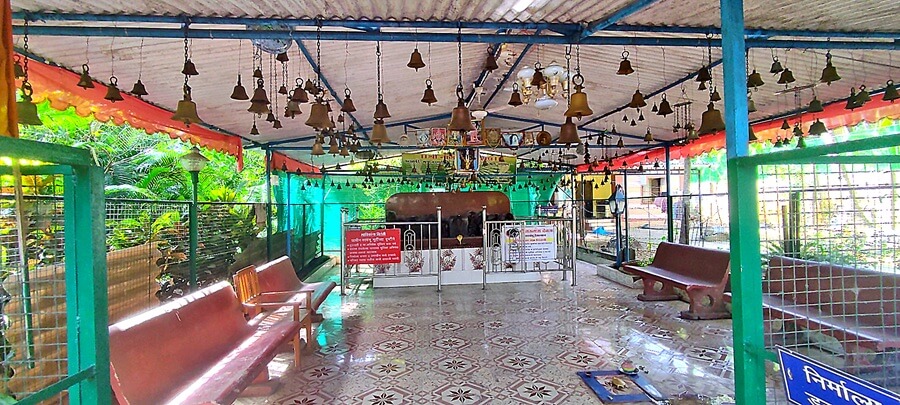
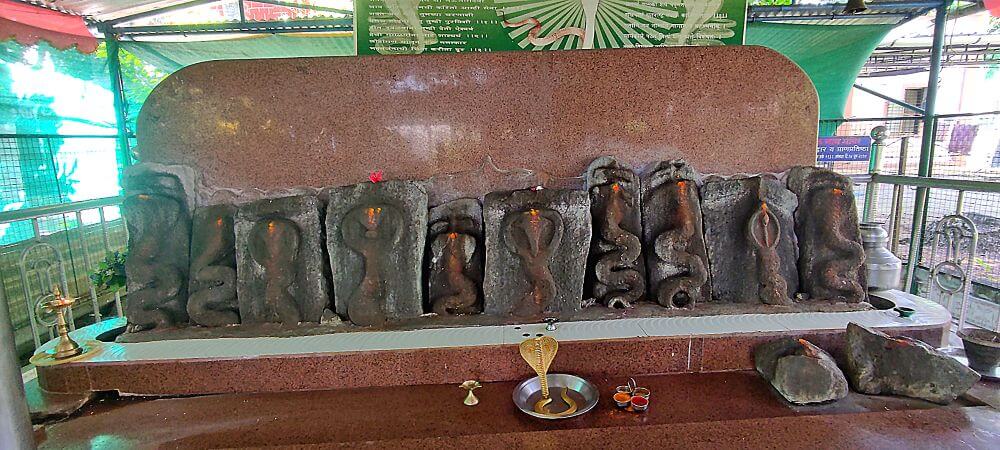
Located seven km from Alibag, the Naunag Temple in Nagaon is considered a ‘Jagrut’ (awakened) place in the surrounding region. At this place, which appears like an ordinary temple amidst coconut and betel nut groves, there is no idol of any deity. Here, there are only nine images of Nagas carved in stone. Although it is called the Naunag temple, there are actually ten images of Nagas here. One of these images is that of a guardian. Although there is no concrete information about how ancient these images are, the villagers here say that they are hundreds of years old. These images were found during the excavation of the land here. For many years, they were kept there and worshipped. In the year २०१०, these images were installed on a platform, and this place took the form of a temple. Even today, this temple has no walls. A tin shed has been erected here only for the convenience of the devotees.
The legend of this temple is that once, the Navnath Swamis were traveling and arrived at this place. Liking the area, they chose to stay here. They shed their original forms, assumed the form of Nagas, and later remained here in stone form. Devotees gather here every Monday and Thursday, as well as on Nag Panchami. It is the belief of the devotees here that if one starts the vow of this Naunag temple on a Thursday or Monday and continues it for three months, sorrow and poverty will disappear.
It is believed that this temple grants wishes. Bells are tied here as a fulfillment of a vow. A story is told about this: there used to be a bell tied in this temple. A woman who had five daughters was being harassed by her in-laws because she did not have a son. So, she made a vow that if she had a son, she would build a bell-arch here. Accordingly, she was blessed with a son; however, she forgot the vow she had made. For this, the Naga deity gave her a vision in a dream and reminded her of the vow. Admitting her mistake, she immediately built a bell-arch here. Since then, hundreds of devotees have offered bells here after the fulfillment of their vows.
This sacred temple stands as a testament to deep spiritual devotion, ancient architectural grandeur, and rich local cultural traditions.
The sanctum sanctorum houses the divine idol consecrated according to ancient Vedic traditions, surrounded by serene courtyards and traditional temple architecture.
Navratri, Maha Shivratri, Annual Temple Jatra & Deepotsav
Compare and book flights, secure top-rated local hotels near the temple, hire reliable guides, and rent cars instantly.
Extend your pilgrimage by visiting other highly sacred temples located nearby.


Add ₹999 more to unlock FREE SHIPPING!
Your sacred cart is currently empty.
Shop Photo FramesFill in your delivery details below to place your order.
Add comment