
Add ₹999 more to unlock FREE SHIPPING!
Your sacred cart is currently empty.
Shop Photo FramesThe town of Goregaon is situated at the confluence of the Kaal and Ghod rivers, which are tributaries of the Savitri River, in the Mangaon taluka of Raigad district. To the north of this town, atop a hill at an elevation of about 413 feet, stands the ancient Mallikarjun Mahadev Temple, which dates back 800 to 900 years. This temple is also referred to as the Siddheshwar Temple. It is an important Shiva shrine that preserves ancient historical heritage. A rare idol of Ganesha in the Ardhanari Nateshwar form and a Swayambhu (self-manifested) Shivling are the primary features of this temple.
Since ancient times, Goregaon was an important trading center and an inland port. Ships weighing up to 12 tons could easily reach this place. Around the year 150, the Greek geographer Ptolemy mentioned this place as ‘Hippokura’ in his travelogues. The history of the Mallikarjun Temple is linked to the Shilahar dynasty, which held power in North Konkan from the 8th to the 13th century. During the reign of the Shilahar kings, Goregaon was a major marketplace in the region. Records in the 1913 Kolaba Gazetteer suggest that this temple may have been built by a king named Mallikarjun from this dynasty.
Mallikarjun Shiva is mentioned in religious texts such as the Shiva Purana, Skanda Purana, and Linga Purana. ‘Mallika’ means Parvati and ‘Arjun’ means Shiva; thus, the name Mallikarjun means ‘Shiva who dwells with Parvati’. During the time of Chhatrapati Shivaji Maharaj, this town was a major center for the horse trade. The name ‘Ghodegaon’ (Horse Village), derived from ‘Ghod’ (horse) and ‘gaon’ (village), eventually evolved into Goregaon. During the Maratha period, horses were tested on the ‘Ghodegum’ hill before being sold in the market. Three large ponds were built in the village for the horses. As this place was close to the capital, Raigad Fort, it housed military camps. Later, in the year 1718, the place passed from the Siddi to the Peshwas. According to records from 1826, this village was a major town on the route of the Devghat and Kumbha Ghats, which connected Pune and Konkan. The 1883 Gazetteer also records it as a large marketplace.
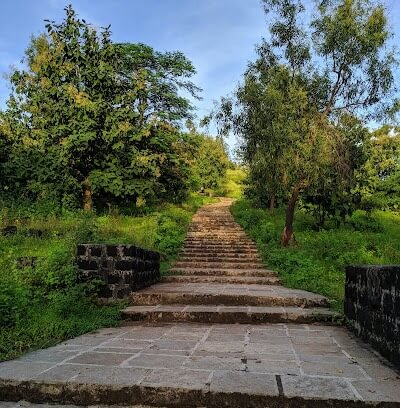
To reach this temple, located one kilometer from Goregaon town, one must climb about 350 to 400 stone steps from the base of the hill. Along the path of the steps, there are two rocks carved with traditional games and stone benches for rest. Upon reaching the hilltop, one encounters the main entrance, which leads into the temple courtyard. There are stone benches in this courtyard for the convenience of devotees. From this area, one can view the nearby railway line, the Kaal River, and the vast expanse of the distant Raigad Fort.
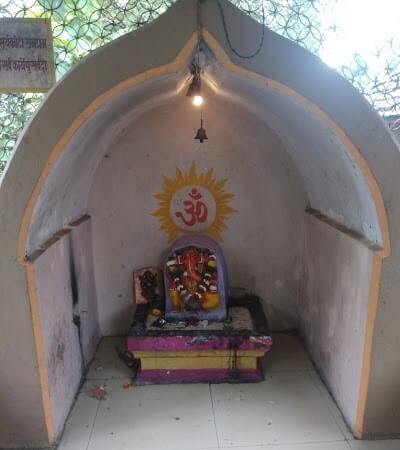
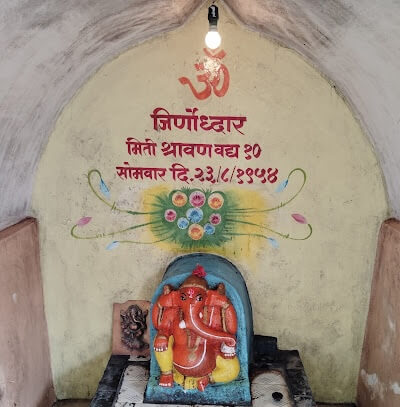
Next to the main temple, on the left, there is a pavilion with a tin roof. It houses a small shrine. In the niche here, there is an ancient, stone, and painted idol of Ganesha. The design of this idol is extremely rare, depicting the upper part of the body as male and the lower part as female. It is said to be the only idol of its kind in Raigad district. The main temple of Mallikarjun Mahadev is built entirely of black stone, and a tiled wooden assembly hall (Sabhamandap) was added in front of it at a later date. The assembly hall has lattice-like window walls on all four sides. In the center of this hall stands a Nandi idol carved from a single, monolithic black stone.
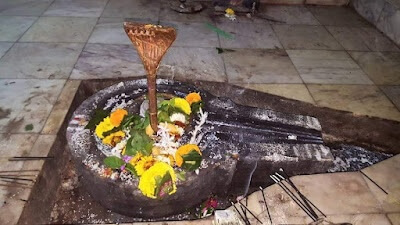
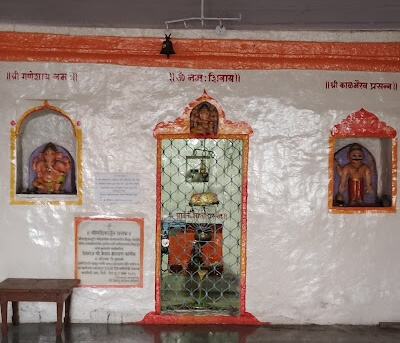
Beyond the assembly hall, leaving the circumambulation path, lies the original temple, which is the ancient stone sanctum sanctorum (Garbhagriha). Since the entrance to the sanctum is relatively small, one must bow down to enter. A sculpture of Ganpati is carved on the lintel of the entrance. In the niches on both sides of the entrance, there are stone idols of Ganpati and Kalbhairav (Kshetrapal). There are small windows in the sanctum for air and light. In the center of the sanctum, in a narrow stone space, there is a depression about four feet deep. Inside it are three naturally formed Swayambhu Shivpindis. A metal serpent deity (Nagdevta) is placed upon them. In the niche on the back wall of the sanctum is an idol of Mother Parvati. On the walls of the sanctum, there are markings of Shri Chakra symbols that underscore its tantric significance. The structure of the sanctum’s ceiling is also unique. Stone slabs have been stacked one upon another to create a small spire from the inside. A lotus is carved in the center, from which a bell is hung. There are lamp niches (Deepkoshtakas) in the stone walls of the sanctum and the circumambulation path.
Regarding the Shivpindi in the sanctum, there is a legend that in ancient times, when there was a shortage of rain, the villagers of the area would perform an abhishek of milk on this pindi. It was their belief that if the depression in the pindi filled with milk quickly, the rain would come early, and if it filled slowly, the rain would be delayed.
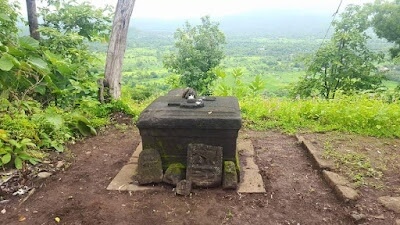
In the outer courtyard of the temple, there are two lamp pillars (Deepstambhas), one ancient and one new concrete one. Additionally, there are three memorial shrines (Samadhi temples) here. One of these is the Samadhi of the Siddha Purusha Saint Godirbaba. This shrine, situated on a stone pedestal, has a round dome-shaped spire. A window is carved into it for light and air circulation, and there is a Shivling inside. The other two Samadhis are said to belong to the first priest of the temple and the person who built the temple. Sculptures of a Shivling, Nandi, and footprints (Padukas) are carved into a single stone on them. Near the old platform, one can see Sati stones erected in memory of women who committed Sati, and some broken remains of Nandi idols from the 14th to 15th centuries.
On the left side of the temple, near the outer wall, a ‘Gadhegal’ (donkey stone) from the 14th to 15th century is kept. It features three layers carved with the sun, moon, a donkey-woman, and human figures. This stone conveys a message that those who usurp the temple’s land or property will be punished. The festival of Mahashivratri is celebrated with great enthusiasm at the Mallikarjun Temple. During the month of Shravan, there is a large crowd of devotees every Monday to perform abhishek on the Shivling. Due to the many waterfalls flowing in this area during the monsoon, the number of tourists is high. Devotees can visit this temple on Mondays. Since this area is a dense forest, the temple remains closed except on Mondays and festival days.
This sacred temple stands as a testament to deep spiritual devotion, ancient architectural grandeur, and rich local cultural traditions.
The sanctum sanctorum houses the divine idol consecrated according to ancient Vedic traditions, surrounded by serene courtyards and traditional temple architecture.
Navratri, Maha Shivratri, Annual Temple Jatra & Deepotsav
Compare and book flights, secure top-rated local hotels near the temple, hire reliable guides, and rent cars instantly.
Extend your pilgrimage by visiting other highly sacred temples located nearby.


Add ₹999 more to unlock FREE SHIPPING!
Your sacred cart is currently empty.
Shop Photo FramesFill in your delivery details below to place your order.
Add comment