
Add ₹999 more to unlock FREE SHIPPING!
Your sacred cart is currently empty.
Shop Photo FramesThe entire area in front of the famous Siddhivinayak Temple in Dadar is named after Prabhadevi, the family deity (Kuldevata) of Mumbai’s primordial king, Pratap Bimb. The entire locality housing this Goddess’s temple is known by her name. It is said that the presence of Prabhadevi here dates back at least 850 years. Furthermore, the known history of the current Prabhadevi Temple spans over 300 years. This Goddess is considered the presiding deity of the Pathare Prabhu community. According to religious belief, she is a form of Goddess Shakambhari. A grand fair (Jatra) of Prabhadevi is held here every year on Paush Purnima. Thousands of devotees participate in this pilgrimage festival with great enthusiasm.
Prabhadevi is also known as Banshankari Devi, in accordance with the name Shakambhari. Her original seat is at Badami in the Bagalkot district of Karnataka. According to mythological legend, a great famine lasting 100 years once occurred in the Tilakvan region of Badami. At that time, the Goddess created various trees, shrubs, and vegetables from water that emerged from the netherworld (Patala). Seeing this, demons began to destroy that sacred region. The Goddess then mounted a tiger and annihilated all those demons. The Goddess created vegetables from her own body. She also saved the lives of the people by bringing water from the Haridratirtha in the netherworld. For this reason, she was named ‘Shakambhari’, meaning ‘one who sustains with vegetables’ (Shakan Vibharti Iti Shakambhari). Because this Goddess resided in the forest, she acquired the name Vanshankari or Banshankari. The Chalukya kings of Badami worshipped this Banshankari Devi in her form as Shakti. In the 7th century, the Chalukya kings built a magnificent temple for the Goddess there.
The history of the Prabhadevi Temple is closely intertwined with the history of the metropolis of Mumbai. According to the records in the book ‘Mahikavatichi Bakhar’, edited by the historian V. K. Rajwade, two Bimb kings, whose capital was at Mahim, ruled over the islands of Mumbai. The first among them, and the primordial king of Mumbai, was Pratap Bimb. He belonged to the Maratha clan. His brother, Govardhan Bimb, was the king of Champaner in Gujarat. Pratap Bimb came from Champaner and conquered North Konkan. Initially, he established his capital at Kelwe-Mahim. Later, due to conflicts with the Shilahara kings, he arrived in 1138 CE at an island then known as ‘Baradbet’. He gave this island the name of his first capital, Mahim. He granted this Mumbai-Mahim region the status of a capital. The entire territory from Walkeshwar to Vasai was part of his kingdom.
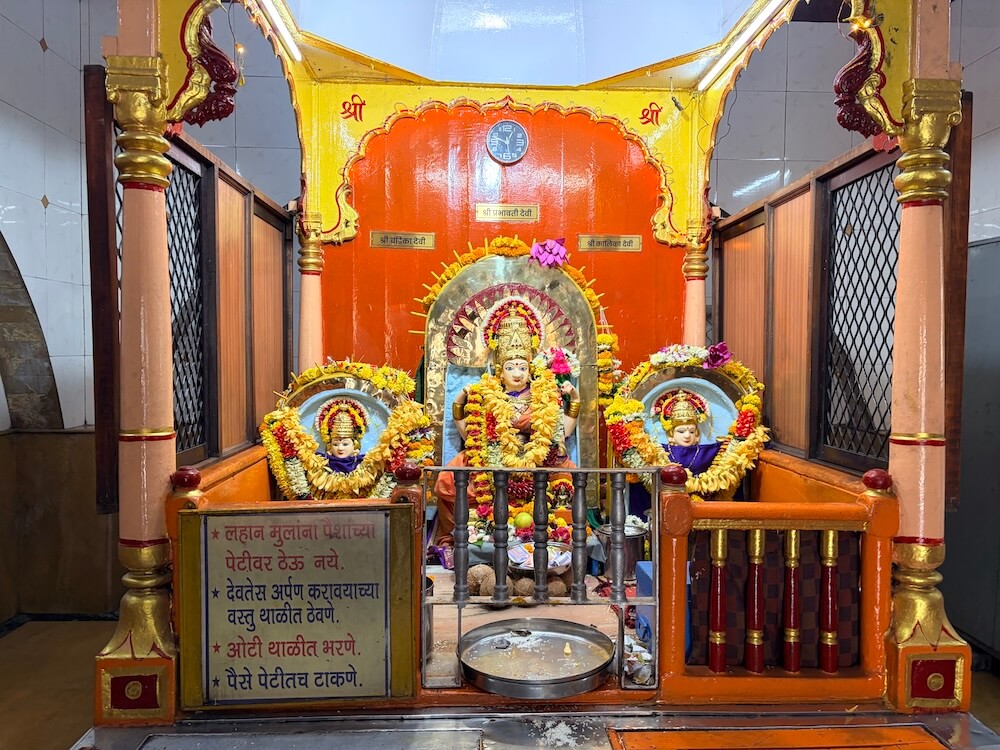
At the very beginning of the book ‘Mahikavatichi Bakhar’, a clear mention is found: “…King Suryavanshi Pratapbimb, Gotra Bharadwaj, Panchpravar, Shakha Katyayani, Kuldevata Prabhavati”. Similarly, the royal seal of Keshavdev Bimb, the grandson of Pratap Bimb, is also provided in this Bakhar. A verse is inscribed on this royal seal: “Bakladabhyam Yada Gotre Prabhavati Kuldevatah | Thane Sthane Kritam Rajyam Mama Mudra Virajitam ||”. In this, too, there is a clear mention that Prabhavati was the family deity of King Bimb. The family deity of Pratap Bimb’s chief secretary, Gambhirrao Suryavanshi, was Kalika. The Bakhar also states that the family deity of the royal priest Hemadpant was Chandika. The idols of these two deities are installed in the Prabhadevi Temple beside the main idol. Based on this evidence, history scholars argue that after establishing his capital at Mahim-Mumbai, Pratap Bimb must have built a temple for his family deity. He also installed the family deities of his important officials there.
Some different information regarding the history of this temple is found in the book ‘The Hindu Temples of Bombay’ (1895) by Krishnarao Raghunathji Navalkar, alias K. Raghunathji. According to his records, the original temple of Prabhadevi was at Kotwadi. This temple was established by Hemadpant, the then-chief priest of the Prabhus, on Paush Vadya Purnima, Shake 1217, that is, 1295 CE, at Kotwadi. This Kotwadi was situated to the left of the current Yashwant Natyagriha in Matunga. From this historical reference, it is clear that the Prabhadevi Temple was established on Mahim Island about seven to eight centuries ago.
In the 14th century, that is, in 1347 CE, a major battle took place at Byculla between Malik Nika, a commander of the Gujarat Sultan Mubarak Shah, and Nagardev, alias Nagarsha, the last Hindu king of Thane-Mumbai.
In that battle, Nagardev was defeated, and Muslim rule was established over Mumbai. Later, in the 16th century, on 21 January 1509, the Portuguese took control of Mahim Island. Like the Muslim rulers, the Portuguese Jesuits were also extremely intolerant of other religions. They began activities such as converting people of other faiths and demolishing their temples or mosques. At that time, Walkeshwar and the Mahalaxmi Temple also suffered the impact of these actions. According to K. Raghunathji’s information, the Portuguese’s evil eye also turned toward the Prabhadevi Temple. Around the year 1599, some individuals from the Pathare Prabhu community received information that the Portuguese were going to demolish the Prabhadevi Temple. At that time, to avoid the desecration of the idols in the temple, they safely placed those idols in a ‘Barav’ (a stepwell) near the temple. After this, the Portuguese razed the temple to the ground. From then until the arrival of British rule, the idol of the Goddess remained safe in that well.
Later, according to the treaty signed between Britain and Portugal in 1661, the British received Mumbai as a dowry. Under British rule, the religious atmosphere in Mumbai improved. It is said that around 1715, one day, a wealthy gentleman from the Pathare Prabhu community named Shyam Nayak had a vision of Prabhadevi. The idol of the Goddess was safe at the bottom of a well in a coconut grove owned by this gentleman. That idol was to be taken out from there, The Goddess had given him this command in a dream. After Shyam Nayak shared the details of this dream with his community members, they drained the water from the well and retrieved the idol of the Goddess. Subsequently, in the year 1715 CE, the Pathare Prabhu community constructed a new temple for the Goddess here. There is a historical inscription in this temple regarding this context. The text of this inscription is as follows: “||Shri|| The temple of Shri Mata Prabhavati was built by the entire Prabhu Kula Pathare community on Vaishakha Shuddha 11, Samvat 1771 Vikramadi.” The meaning of this inscription is that the idol of the Goddess was consecrated in the temple on the auspicious occasion of Vaishakha Shuddha 11, Vikram Samvat 1771. This new temple of the Goddess has now completed 311 years. In the intervening period, in the year 1835 CE, the first renovation of this temple was carried out at a cost of approximately eight thousand rupees at that time. Following this, the temple was also repaired in the year 1875 CE. Due to the renovation carried out a few years ago, this temple has attained its current beautiful form.
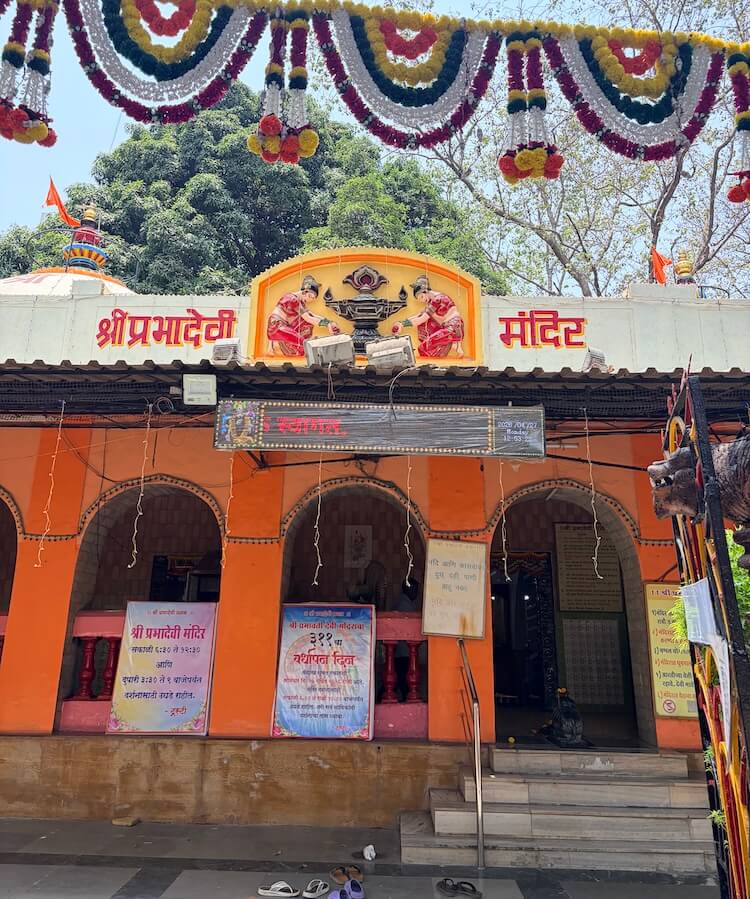
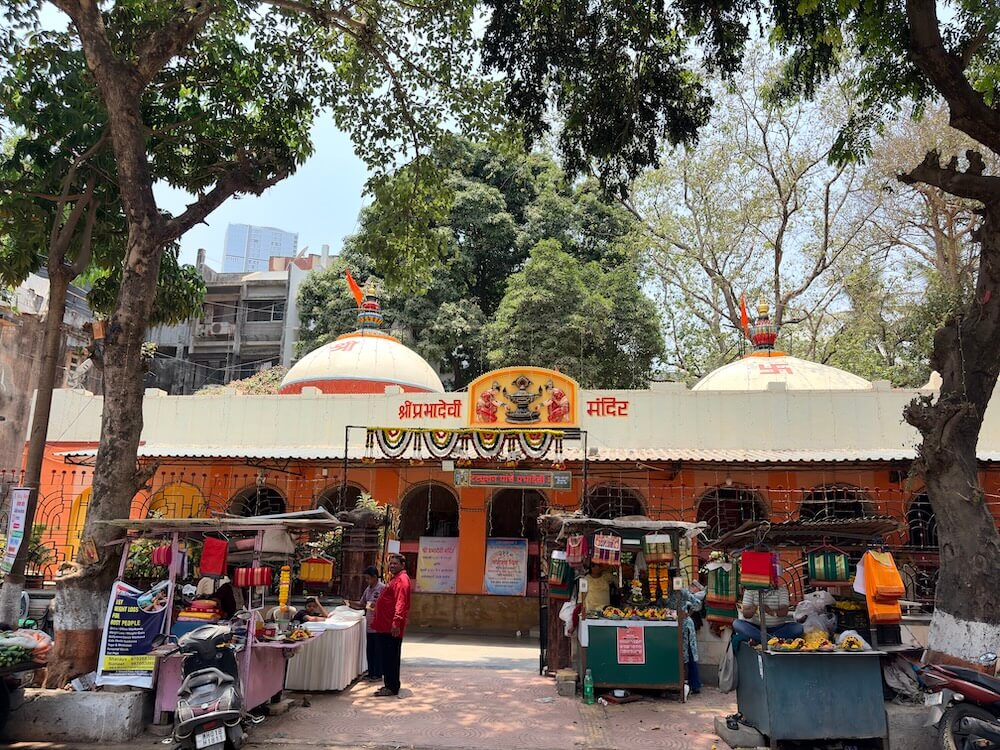
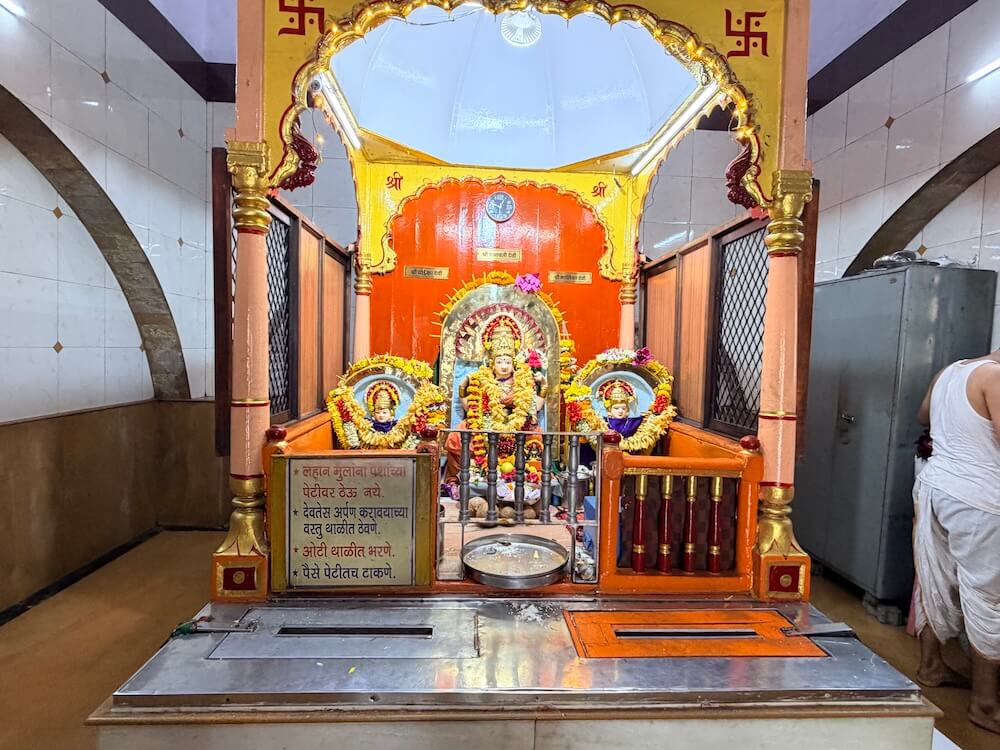
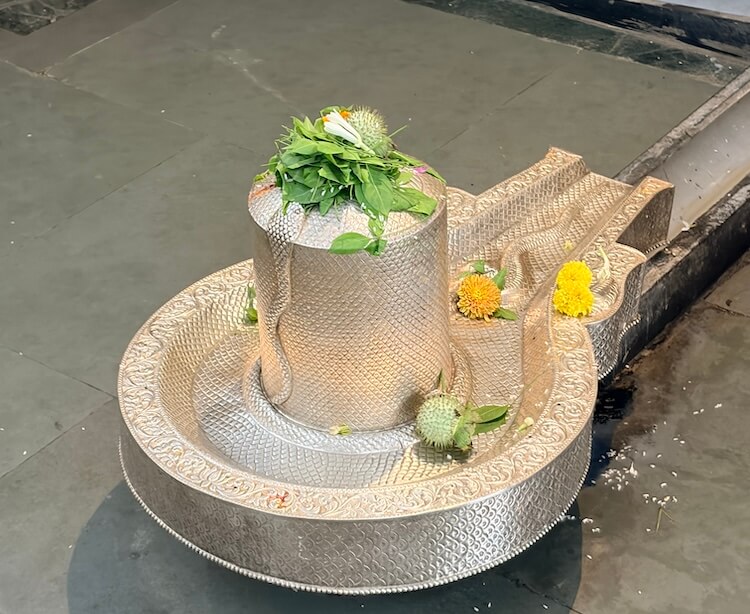
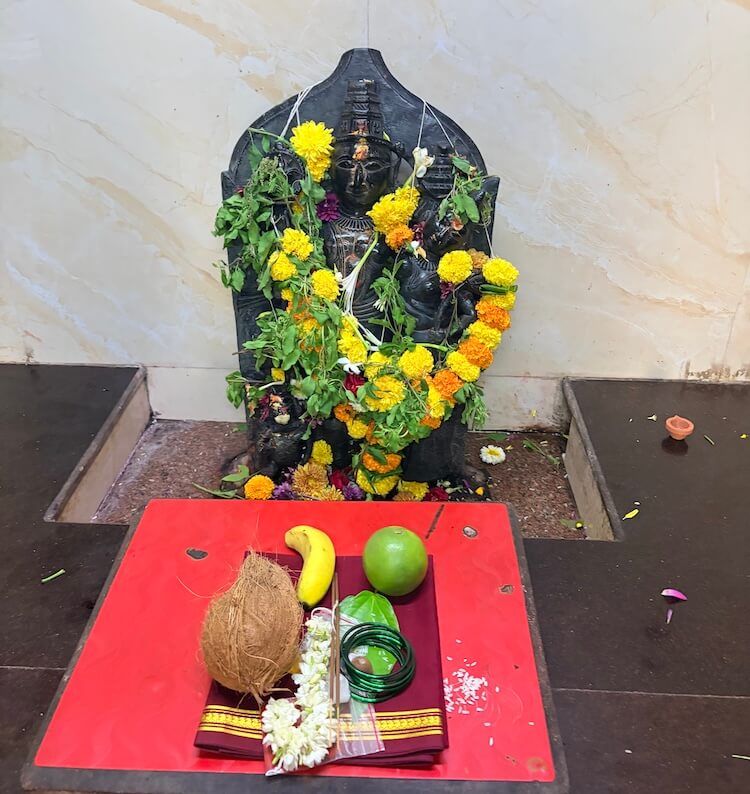
This temple is situated in a relatively very quiet area, close to the well-known Siddhivinayak Temple. A boundary wall has been built in front of this single-story temple. There are two magnificent lamp pillars (Deepstambhas) in the courtyard in front of the temple. The original structure of this temple consists of a long, horizontal hall resembling a veranda with wide arched windows and three sanctum sanctorums. There are two dome-shaped spires (Shikharas) on the temple, and three-tiered finials (Kalash) are installed on those spires. The rightmost sanctum in this temple is dedicated to Goddess Prabhavati. In this simple sanctum, the idol of Prabhadevi is seated on a high pedestal. This idol, approximately 3 feet tall, is carved in Kurvandi stone. Here, the Goddess grants darshan in a four-armed (Chaturbhuj) form. In her upper right hand, she holds a Rudraksha mala, and in her left hand, a lotus flower. One of her lower hands is in the Varada Mudra (boon-granting gesture), while the other is in the Abhaya Mudra (gesture of fearlessness). The Goddess is adorned with various garments and ornaments. She wears a beautiful crown on her head, and a golden leaf is embedded on the back slab of the idol. To the right of the Goddess is a standing stone idol of Goddess Kalika. A similar idol of Goddess Chandika is installed on the left. Both these idols are approximately 1.25 feet tall. These idols are also adorned with garments and ornaments. In the central sanctum of this temple is the seat of Sarveshwar Mahadev. In the leftmost sanctum, the idol of Lakshmi-Narayan is seated.
In this temple, there are also separate places for Hanuman, Shitala Devi, and Khokla Devi. There was a belief that various diseases, ailments, or physical deformities in humans occur due to the displeasure of divine powers. Furthermore, with the sentiment that these things are cured by their grace, human society used to worship many folk deities in the past. Shitala Devi and Khokla Devi are both such folk deities. Shitala Devi is considered the presiding deity of measles, chickenpox, and the smallpox disease caused by the ‘Variola major’ virus. Similarly, devotees have deep faith that Khokla Devi cures all throat ailments.
Navratri, Mahashivratri, Ashadhi and Kartiki Ekadashi, and Paush Purnima are the main festivals at this temple. During these festival periods, the entire temple is decorated with attractive electric lighting. During Navratri, the Chandika Path is recited before the Goddess. On Ashtami, which is two days before Dussehra, a grand Havan is performed here.
During this time, there is a large crowd of devotees of the Goddess here. Paush Purnima is considered the main anniversary of this temple. On this day, devotees can take darshan of the Goddess from 6 AM to 11 PM. On this occasion, a large fair is held here, much like in a village. The fair has a joyful atmosphere with toy shops, sweet stalls like Malvani Khaja, and swings for small children.
During the fair, thousands of devotees come here for darshan. The historical tradition of sprouting bitter fenugreek seeds to create beautiful shapes representing the temple’s name and the year of the fair is still preserved in this temple today.
This sacred temple stands as a testament to deep spiritual devotion, ancient architectural grandeur, and rich local cultural traditions.
The sanctum sanctorum houses the divine idol consecrated according to ancient Vedic traditions, surrounded by serene courtyards and traditional temple architecture.
Navratri, Maha Shivratri, Annual Temple Jatra & Deepotsav
Compare and book flights, secure top-rated local hotels near the temple, hire reliable guides, and rent cars instantly.
Extend your pilgrimage by visiting other highly sacred temples located nearby.


Add ₹999 more to unlock FREE SHIPPING!
Your sacred cart is currently empty.
Shop Photo FramesFill in your delivery details below to place your order.
Add comment