
Add ₹999 more to unlock FREE SHIPPING!
Your sacred cart is currently empty.
Shop Photo FramesThe Mumbai of today did not even exist until the last decade of the fifteenth century. Back then, it consisted of islands such as Great Colaba, Little Colaba, Mazgaon, Parel, Matunga, and Mahim. The seventh island was Worli. Worli was characterized by a small hill and a tiny village nestled upon it. Every village has a guardian deity. Accordingly, the village deity of Worli is Golfa Devi. This site of the Goddess in Worli has existed since at least the eleventh century, and it is said that the temple was established here in the twelfth century. This shrine of Golfa Devi is considered ‘Jagrut’ (spiritually awakened). Even today, the Koli and Bhandari communities seek the Goddess’s ‘Kaul’ (divine oracle) before undertaking any significant task.
One of the oldest historical records of the islands of Mumbai dates back to 150 AD. In those records, the Greek mathematician and geographer Claudius Ptolemy referred to these seven islands as ‘Heptanesia’. Among these, Worli was the smallest island after Colaba. In old English texts, Worli has been referred to as Worli, Wadali, Wareli, and Veruli. According to scholars, its original name was Varoli. J. Gerson da Cunha, author of ‘The Origin of Bombay’ (1900), states that there are three etymologies for the name Worli. The first suggests that due to the large number of banyan trees (Vatavruksha) here, the village was called ‘Vadachi Aali’ (Row of Banyan trees). From this, the word ‘Wadali’ was formed, which eventually corrupted into the name Varali. According to others, the village received a boon (Var) from Goddess Mahalaxmi, and thus it came to be called Worli. A third etymology suggests that the name comes from the Marathi word ‘Varli’, meaning ‘of the upper part’. Since this island was situated on the upper side to the north of the Mumbai island (from the Fort to Pydhonie), it received this name. Da Cunha is of the opinion that this etymology is the most plausible.
According to the ‘Mahikavatichi Bakhar’, Pratap Bimb, the brother of King Govardhan Bimb of Champaner—a feudatory of the Chalukyas of Anahilwad Patan in Gujarat—conquered the region from Daman to Chinchani-Tarapur, Palghar, Kelwe-Mahim, and Vasai in 1140 AD. Subsequently, in 1142 AD, he sent his Prime Minister, Balkrishna Rao Somvanshi, to conquer the region up to Walkeshwar. After conquering this area, Pratap Bimb established a ‘Desh-vasahat’ (settlement) here. He established his capital in the Barad island and named it after his first capital, Mahim (Kelwe). That is the Mahim of today. Thereafter, Pratap Bimb granted several villages here as ‘Inam’ (gift) to the officers and commanders who accompanied him. He granted the village of Worli to his Chief Secretary, Suryavanshi Gambhirrao. The Mahikavatichi Bakhar states regarding this: “To this Suryavanshi Gambhirrao, Chief Secretary, of Vasistha Gotra, whose family deity is Kalika, the village of Varoli was granted as an Inam and he was established as its lord.” Govind Narayan Madgaonkar, the author of ‘Mumbai-che Varnan’, provides an excerpt from another Bakhar in his book. This was a small Bakhar ‘written by a wealthy and ancient elderly Prabhu gentleman regarding the ancient history of Worli’. It mentions, “Shri Rajbimb Maharaj had granted the village of Worli as a hereditary Inam to his Patil.” This clarifies that the village of Worli existed before 1142 AD.
Golfa Devi is the village deity of Worli. There is no knowledge as to how the Goddess received this name. According to traditional folk tales that narrate the greatness of the site, King Pratap Bimb established the temple of Golfa Devi here in the twelfth century. Golfa Devi is also worshipped here under the name Shakambhari. Prabhavati, the family deity of King Pratap Bimb, is a form of Goddess Shakambhari. Scholars argue that after establishing his capital at Mahim, Pratap Bimb built a temple for his family deity, i.e., Prabhadevi. The festival (Yatra) of this Prabhadevi, located in the Prabhadevi area, is held on the full moon of Paush. This full moon is also called Shakambhari Purnima. Similarly, a festival is held at the Golfa Devi temple on Shakambhari Purnima. In the Prabhadevi temple, the idols of Kalika, the family deity of Pratap Bimb’s Chief Secretary Gambhirrao Suryavanshi, and Chandika, the family deity of the Royal Guru Hemadpant, are seated beside Prabhadevi. Similarly, in the Golfa Devi temple, the idol of Harbadevi, the family deity of Pratap Bimb’s Chief Accountant Anandrao Sheshvanshi, is seated beside Golfa Devi. According to Nitin Salunkhe, a researcher of Mumbai’s history and author of the book ‘Agnat Mumbai’, this confirms the possibility that King Bimb either re-established Golfa Devi here or that the Koliwada community adopted this family deity of King Bimb.
Just like the Koli and Bhandari communities of Worli, devotees from the Vaghari community of Kathiawad, Gujarat, participate in large numbers in the Golfa Devi festival. This community has established Golfa Devi temples in many places in Mumbai. The king of this community in Gujarat belonged to the Solanki royal dynasty. In the long introduction to the ‘Mahikavatichi Bakhar’, historian V. K. Rajwade has clearly stated that Solanki (Solanki) are indeed Chalukyas and that they are originally a Maratha clan. Along with this clan, many other Marathi clans went to the Patan region (Anahilwad Patan), and among them was a Maratha clan of the Bimb dynasty. These Kshatriyas with the surname Bimb had connections with the Kshatriyas with the surname Bhaum who ruled at Paithan. The Bimb were originally Maharashtrian, i.e., Marathas. Prabhavati, or Shakambhari, was the family deity of the Solankis just as she was of the Bimb. It is said that the Vaghari community, who were subjects of these Solanki kings, began worshipping Golfa Devi as Shakambhari after coming to Mumbai. Even today, a flag is offered to Golfa Devi by this community during the festival.
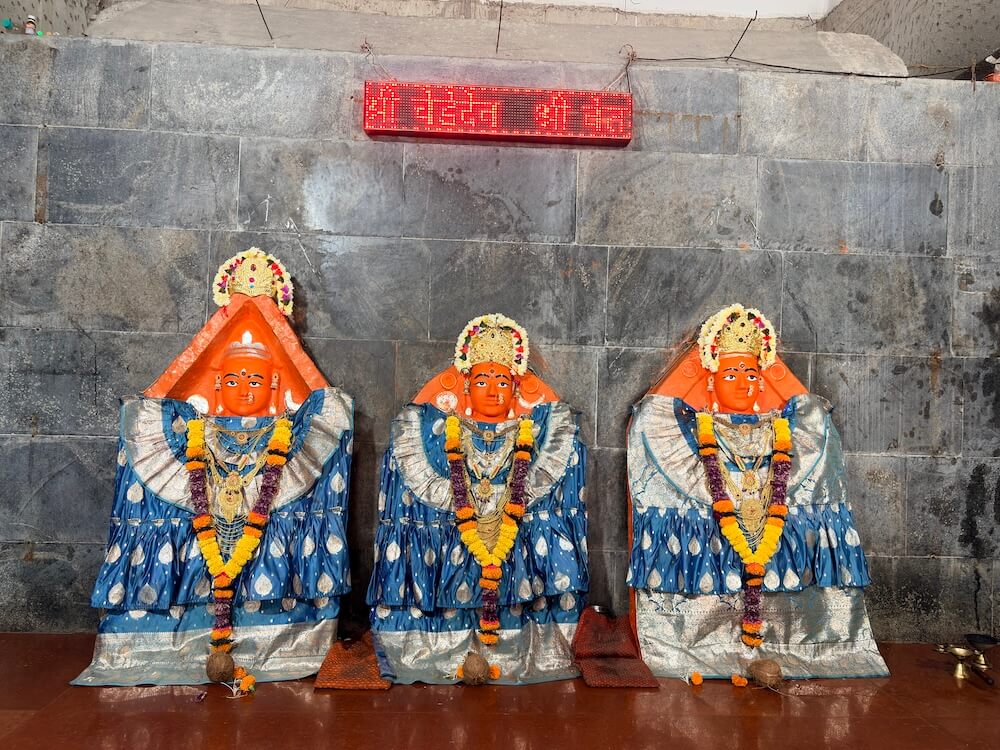
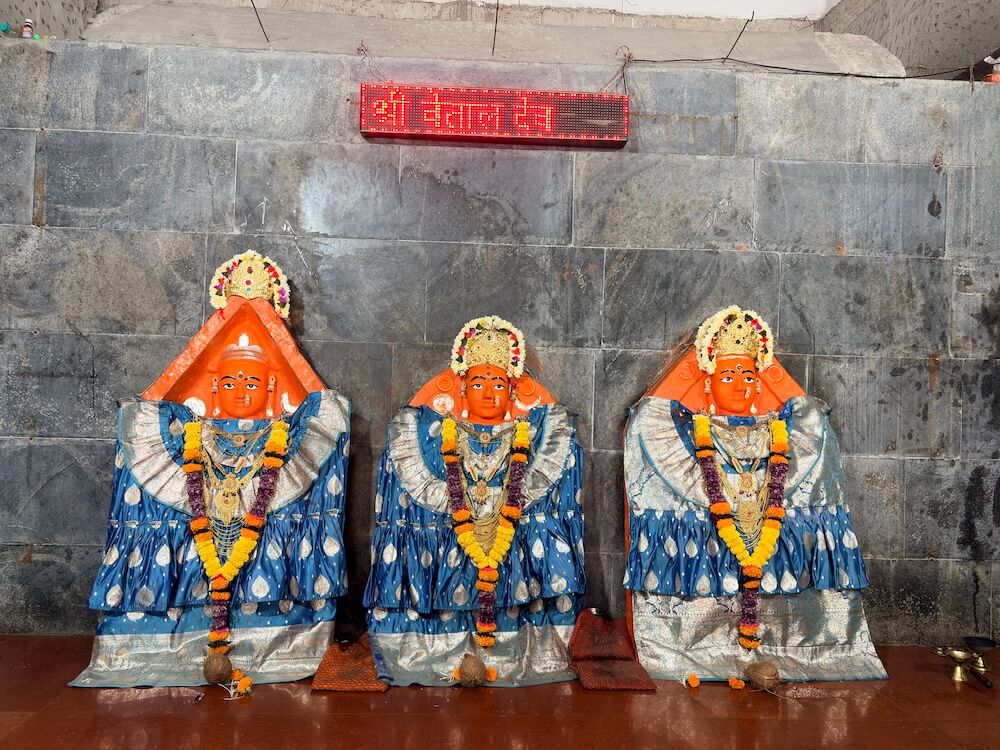
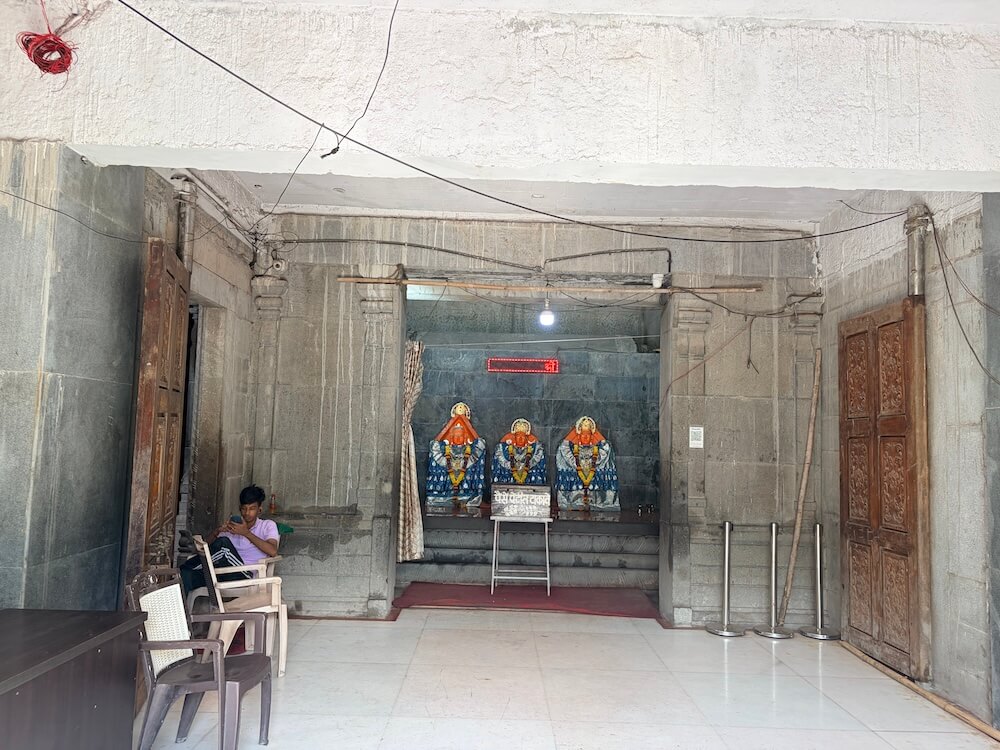
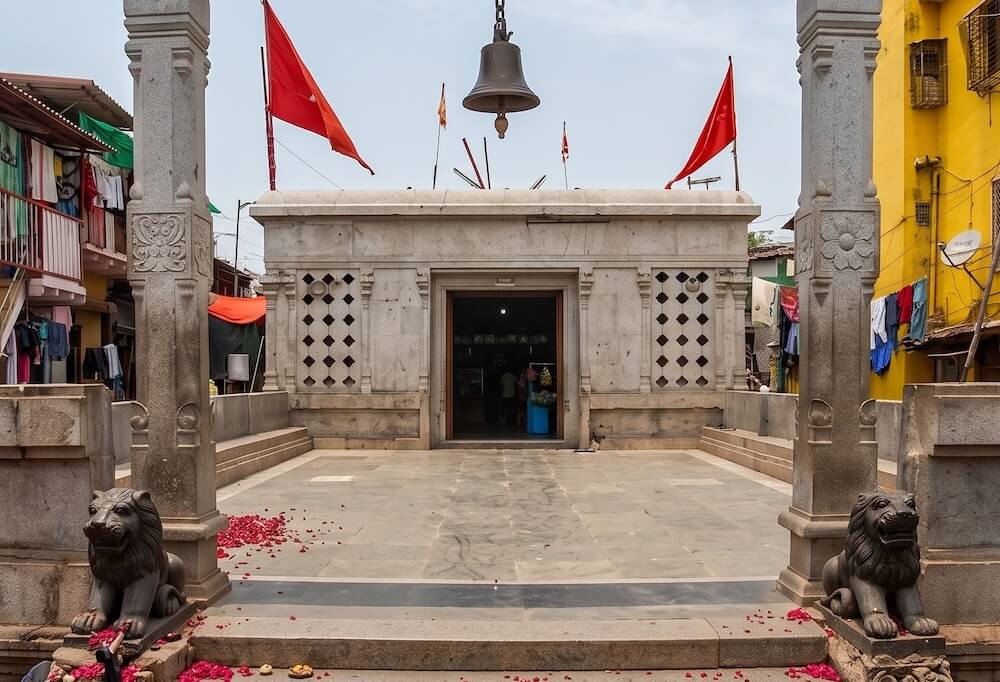
After walking some distance inside from the narrow road leading to Worli Koliwada, this temple of Golfa Devi is situated on an incline to the left. The temple is located on a high platform, which is accessed by climbing five steps. On both sides of these steps are two ancient stone-carved lion statues. There is seating arrangement on both sides of the platform for devotees. The temple structure consists of a Sabhamandap (assembly hall) and a Garbhagriha (sanctum sanctorum). The ceiling of the Sabhamandap is flat, while the Garbhagriha is topped by a high Shikhara (spire). The Garbhagriha is constructed of dressed stone. The ancient idol of Golfa Devi is installed in the center on a high stone pedestal. To the left of the Goddess are the idols of Sakba Devi, and to the right are the idols of Harba Devi. These idols are originally made of black stone and are adorned with vermilion (shendur). All three idols are decorated with garments, ornaments, and flower garlands. The idol of Golfa Devi has a semi-circular backstone, while the backstones of the other two Goddesses are triangular at the top. On the backstones of Golfa Devi and Sakba Devi, images of the sun and moon are carved beside the faces of the idols.
Devotees can have the darshan of the Goddess at the Golfa Devi temple from 6:00 AM to 9:00 PM. It is the firm belief of the devotees that this Goddess grants wishes. Many sailors seek the ‘Kaul’ (divine guidance) of the Goddess before venturing into the sea. This petition, or Kaul, goes as follows: “Mother, you are the mistress of this village. You have thirty-six eyes. You see everything. Yet, we pray that you accept this offering of flowers, leaves, and coconuts we have brought for you… and look, we are going into the sea tomorrow with our Gorakh Palkhi (boat), so we seek your command and permission… Speak, give us the answer of truth…” The guidance given by the Goddess is accepted as final.
The annual Yatra (fair) of the Goddess takes place on the full moon day of the month of Paush. This Yatra has a history of about 125 years. The entire Worli Koliwada participates in this Yatra with great enthusiasm. On the occasion of the Yatra, women who have married and moved out of the village (Maherwashini) make it a point to come for the Goddess’s darshan. On the day before the Yatra, an Abhishek and Haripath program are held here, followed by the decoration of the Goddess. On the day of the Yatra, thousands of devotees come to fulfill their vows. Countless people offer ‘Oti’ (a ritual offering) to the Goddess with a blouse piece and a coconut. This festive celebration continues from dawn until late at night.
This sacred temple stands as a testament to deep spiritual devotion, ancient architectural grandeur, and rich local cultural traditions.
The sanctum sanctorum houses the divine idol consecrated according to ancient Vedic traditions, surrounded by serene courtyards and traditional temple architecture.
Navratri, Maha Shivratri, Annual Temple Jatra & Deepotsav
Compare and book flights, secure top-rated local hotels near the temple, hire reliable guides, and rent cars instantly.
Extend your pilgrimage by visiting other highly sacred temples located nearby.


Add ₹999 more to unlock FREE SHIPPING!
Your sacred cart is currently empty.
Shop Photo FramesFill in your delivery details below to place your order.
Add comment