
Add ₹999 more to unlock FREE SHIPPING!
Your sacred cart is currently empty.
Shop Photo FramesThe religious and cultural character of modern Mumbai cannot be considered complete without the mention of this temple. This sacred site is the Siddhivinayak Temple in Prabhadevi. This temple is as famous as the Ashtavinayak regions of Ganesha and is the most popular Ganesha shrine in Mumbai. It is a place of faith for millions of people, ranging from common citizens to various dignitaries. This temple has a known history of two hundred and twenty-five years. Because an ancient idol of Ganesha with his trunk turned to the right is enshrined in the temple, this place is considered a Siddhapitha. Devotees have a deep faith that the Siddhivinayak here grants all wishes merely by his divine vision. Every Tuesday, one and a half to two lakh devotees visit this temple for darshan.
The history of the original site of Siddhivinayak here is unknown. The history of Ganesha worship on the islands of Mumbai dates back to at least the sixth century. The Kalachuri dynasty held power over the Aparanta region, which included the islands of Thane, Raigad, and Mumbai. The founder of this branch of the dynasty was Krishnaraja (550 to 570 CE). His silver coins were known as ‘Krishnaraja-Rupaka’. Some of these coins were found in the Kalbadevi-Thakurdwara area of Mumbai. This proves his authority over these islands. During the time of these Kalachuris, the ‘Shivasrushti’ was built on Gharapuri Island near Mumbai. A large sculpture of Ganesha, the son of Shiva, is carved there. The Shilaharas ruled the Konkan belt for about 400 years. A Ganesha idol from their era, between 1000 and 1200 CE, was found in Thane, which is ancient Shristhanaka. This Ganesha idol, 37 centimeters in height, is currently in the Chhatrapati Shivaji Maharaj Vastu Sangrahalaya in Mumbai. From this historical evidence, it is clear that Ganesha worship has been practiced in Mumbai and its surrounding areas since ancient times. Therefore, historians argue that the site of Siddhivinayak here must be ancient.
According to known history, the original old temple of Siddhivinayak was established on Durmukh Samvatsar, Kartik Shuddha Chaturdashi, Shake 1723, which is Thursday, 19 November 1801. Information about this temple was provided in the book ‘The Hindu Temples of Bombay’, published in 1895 by Krishnarao Raghunathji Navalkar, alias K. Raghunathji. According to these records, this temple was built by Laxman Vithu Patel (Patil). Laxman Patil was a construction contractor. There is also a legend that he built this temple with the financial support of Deubai Patil, a wealthy woman from the Agri community. Deubai Patil had taken a vow to build a temple to Ganesha to be blessed with a child. However, her husband passed away before she could have a child. Even in such circumstances, Deubai fulfilled her resolve to build the temple.
This small temple was situated in an area with many trees. There was a pond in front of the temple. The total built-up area of the temple was about 12 by 12 feet. There was a high parapet wall on all four sides of the temple’s 18-inch thick walls. Also, in the center, there was a round dome built of bricks. On all four corners of this parapet, high spire-like towers were erected. On the dome-shaped peak of the temple, there was an amalaka and above it a three-tiered pinnacle. Verandas with sloping roofs were built on the sides of the temple. In front of the temple, there was a simple, open-style pavilion with a sloping roof on two sides. Two or three lamp pillars (deepstambhas) were erected in front of that pavilion. Right in front of the temple, there was a small temple of Maruti. In the sanctum sanctorum, the idol of Siddhivinayak, carved from black stone, was installed. According to the records made by K. Raghunathji, there were two small and large idols of Hanuman next to the idol. These idols were also carved from black stone. In the year 1895, the management of this temple was handled by Sakharam Patil, the heir of Laxman Patil. A regular morning aarti of the deity used to take place here every day. For this purpose, a priest was appointed and was paid a salary. The Ganesha Chaturthi festival was celebrated in this temple in the months of Margashirsha, Chaitra, and Bhadrapada. On the occasion of this festival, stories, Puranas, and musical programs were organized in the temple. During the festival, a turban was tied on Ganesha’s head, and a cap was placed on the idol of Maruti.
According to K. Raghunathji’s information, in those days, an average of eight to nine devotees used to visit this temple for darshan daily. During special festivals or occasions, this number of devotees would go up to 100 to 125. This makes it clear that the temple was not very famous at that time. Mentions of important temples in contemporary Mumbai are found in Govind Narayan Madgaonkar’s ‘Mumbai-che Varnan’ (1863), J. Gerson da Cunha’s ‘The Origin of Bombay’ (1900), and the book ‘Chow-Chow: Being Selections from a Journal Kept in India, Egypt and Syria’ published by Lady Falkland in 1857. However, no record of the Siddhivinayak temple is found in these volumes. Also, the book ‘Bombay: A Photorama’, published by the Mumbai Municipal Corporation in 1981, contains photographs of Mumbai city from the period 1661 to 1931. There is no photograph of the temple in this book either. This temple truly gained popularity in the latter half of the twentieth century. After the republican system was implemented in India, i.e., after the year 1952, the crowd of devotees here gradually started increasing.
According to the tradition of the Swami Samarth Sampradaya, a legend is told regarding how this temple attained its glory. A saintly person named Ramkrishna Maharaj Jambhekar lived in this sect. He was born in 1898 at the house of his maternal uncle, Shriram Borwankar, who lived in the Goregaonkar Building in Girgaon. His uncle worked in a textile mill and settled in Surat after retirement. Later, Ramkrishna Maharaj got a job as a postman in Surat and was married there. Ramkrishna Maharaj was a devotee of the Gayatri Mantra and religiously inclined from childhood. In Surat, he received initiation from a Muslim Auliya. They attained certain spiritual powers from this saint. During this period, Jambhekar Maharaj, who had come to Mumbai, met Swami Samarth. Around the year 1930, he left Surat and came to reside at Prabhadevi. He lived in this area for about a decade. He would sometimes dress in women’s attire, observe the fasts of Ramadan, and during Navaratri, he would blow into earthen pots before the Goddess. Because he resolved the problems of devotees through the strength of his spiritual powers, he became widely renowned. He passed away on 10 January 1940, and a math was established for him near Dadar Chowpatty. Although Swami Samarth attained Mahasamadhi in the year 1878, his devotees claim that Ramkrishna Maharaj used to engage in spiritual communion with him. During one such conversation, Swami asked him, “What do you desire?” To this, Ramkrishna Maharaj replied, “I do not want anything for myself, but please grant glory to my Siddhivinayak.” Then Swami said, “Plant a sapling of the Mandar tree in the temple premises. As that tree grows, the glory of Siddhivinayak will continue to increase.” According to this belief, through the grace of Swami Samarth, the Siddhivinayak Temple attained great glory. Upon the recommendation of Jambhekar Maharaj, the worship and other arrangements at this temple were entrusted to priest Govind Chintaman Phatak from the year 1936. According to entries in the Marathi Vishwakosh, he retired from this service due to old age on 31 December 1973.
The Bangladesh Liberation War of the year 1971 and the famine of the year 1972 placed a great strain on the country’s economy. Although inflation and unemployment increased during this period, the number of devotees visiting the temple continued to rise rapidly. On special days like Sankashti Chaturthi, Ganesh Chaturthi, and Angarki Chaturthi, the number of visitors to the temple reached one and a half to two lakhs. Consequently, long queues of devotees began to form in the lanes around the temple area. At the same time, the original owner of the temple had fragmented the temple’s land and rented it out to various entities. This reduced the space around the old temple, leading to difficulties in managing the crowds and providing facilities to the devotees. Finally, through a court decision on 5 July 1980, the ‘Maharashtra Executor and Trustee Company Limited’ was appointed as the custodian trustee of the temple. Some elements went to court against this decision. Due to continuous legal disputes, the state government eventually restructured this trust management. The government enacted a separate law in this regard and brought this trust management directly under government supervision. Currently, the administration of this temple is handled by the ‘Shree Siddhivinayak Ganapati Temple Trust Management Committee’. After the establishment of this trust, a decision was taken to renovate the temple and make the temple premises more spacious. For this, the help of highly experienced architects, engineers, and foundation experts was sought.
The famous Shiva temple in Ambernath was built by King Chittaraja of the Shilahar dynasty, who also established the Walkeshwar temple in Mumbai. That historical Shiva temple still stands in excellent condition today. While building the new temple of Siddhivinayak, the architecture of that Shiva temple in Ambernath was kept as an ideal. This new design was approved by the project committee of Arun Dahanukar, Shashi Mehta, Baburao Shete, and Shashi Prabhu. Following this, on the auspicious occasion of Akshaya Tritiya on 7 April 1990, the ground-breaking ceremony for the proposed temple structure was performed by the then Chief Minister Sharad Pawar. The construction of the temple was completed in the year 1994. The ceremony for the installation of the pinnacle of this new structure was celebrated on a very grand scale. The ceremony commenced on Saturday, 4 June 1994, corresponding to Vaishakh Vadya Ekadashi, Shake 1916, at the hands of Chief Minister Sharad Pawar. The pinnacle installation ceremony of the temple was concluded on Monday, 13 June 1994, corresponding to Jyeshtha Shuddha Chaturthi, Shake 1916, at the hands of Shankaracharya Bharati Tirtha Swami of Sharada Peeth, Sringeri. According to information on the official website of the temple, the construction of this structure was completed at a cost of about three crore rupees.
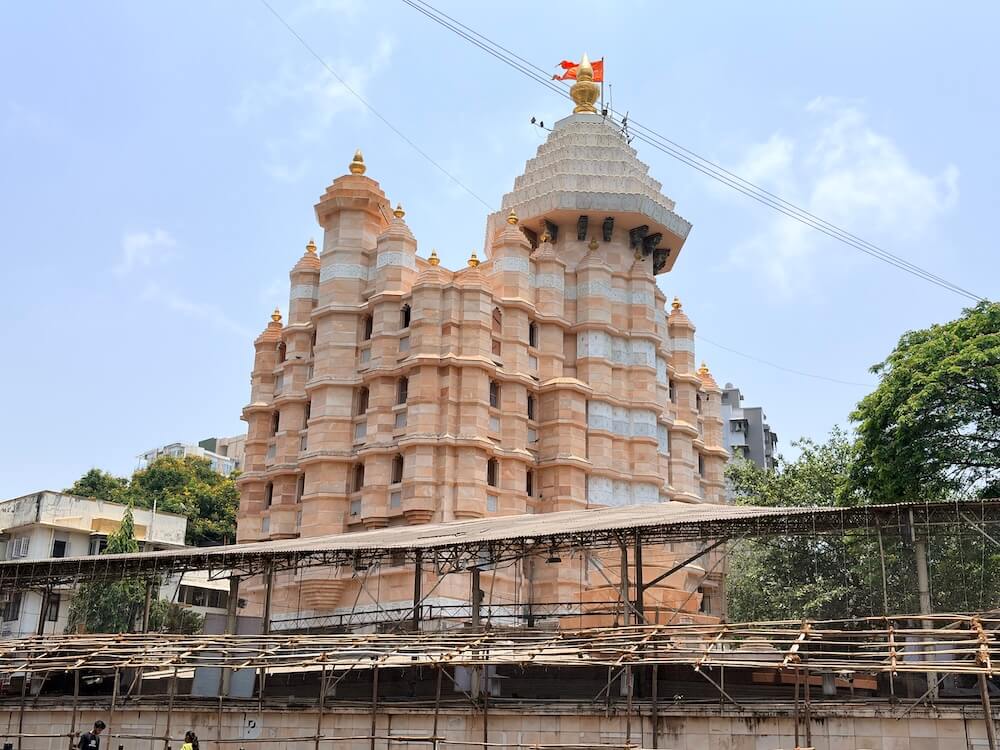
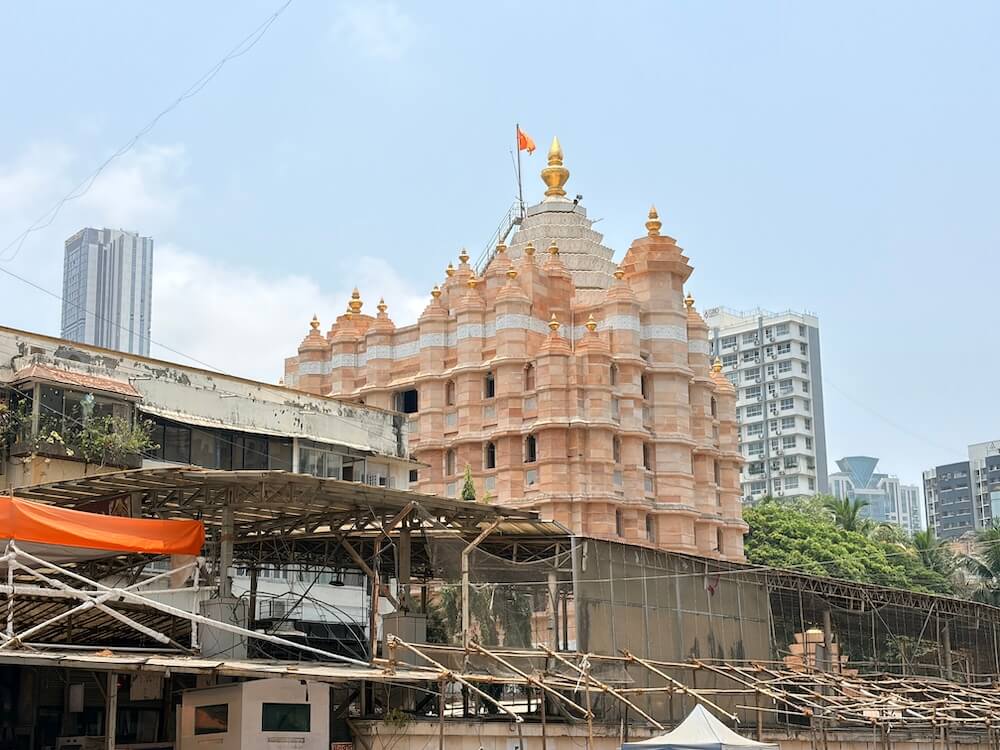
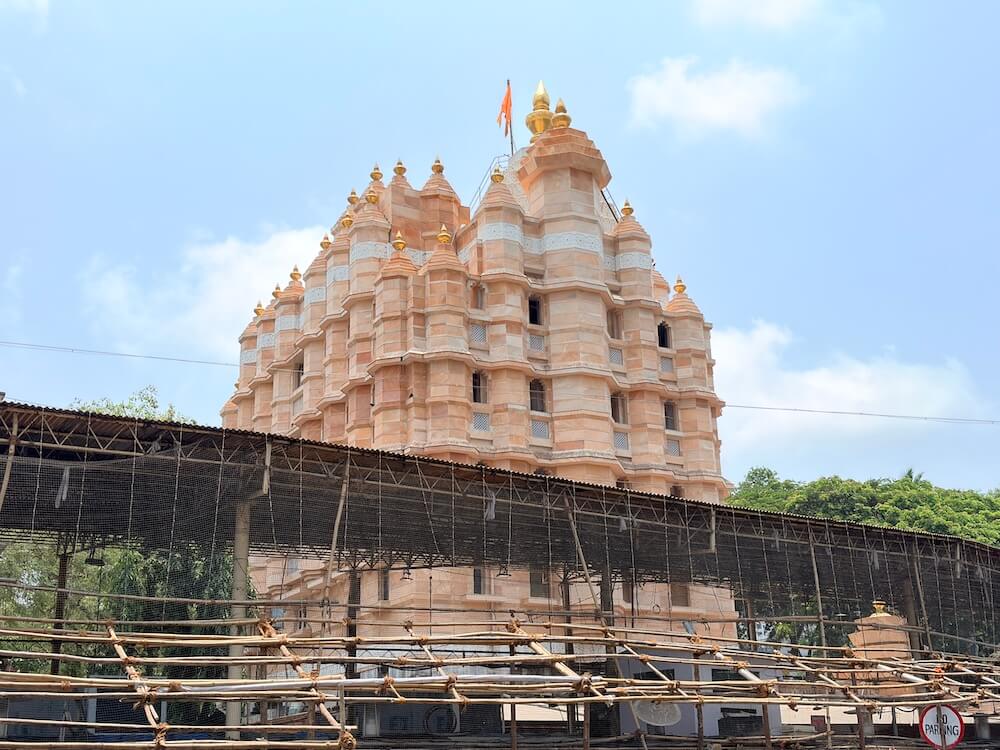
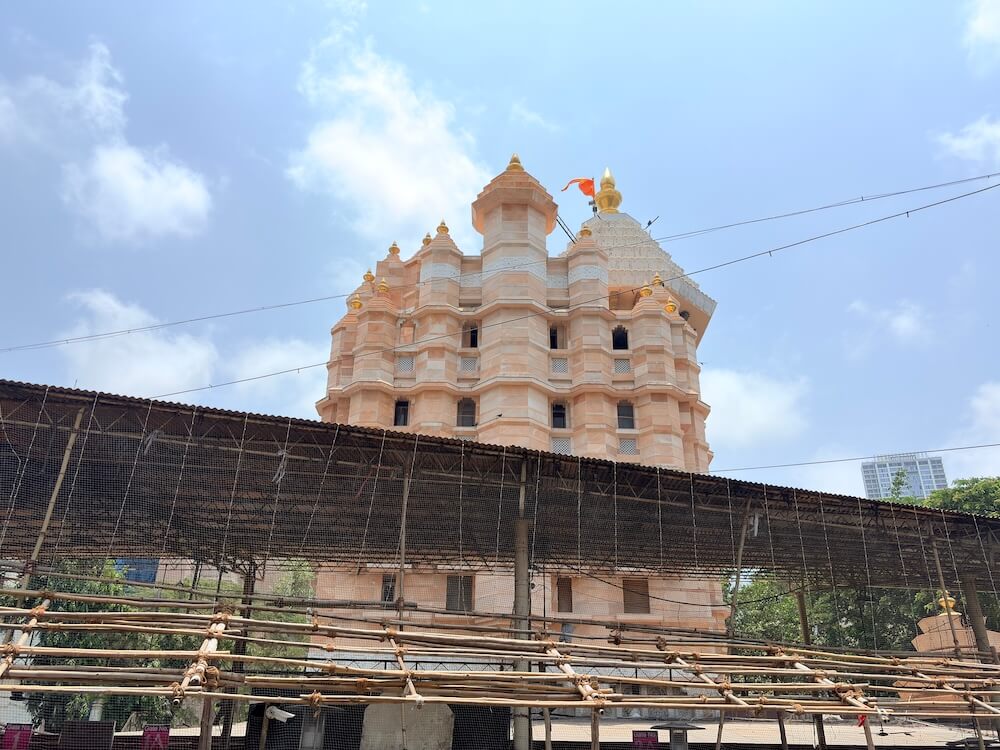
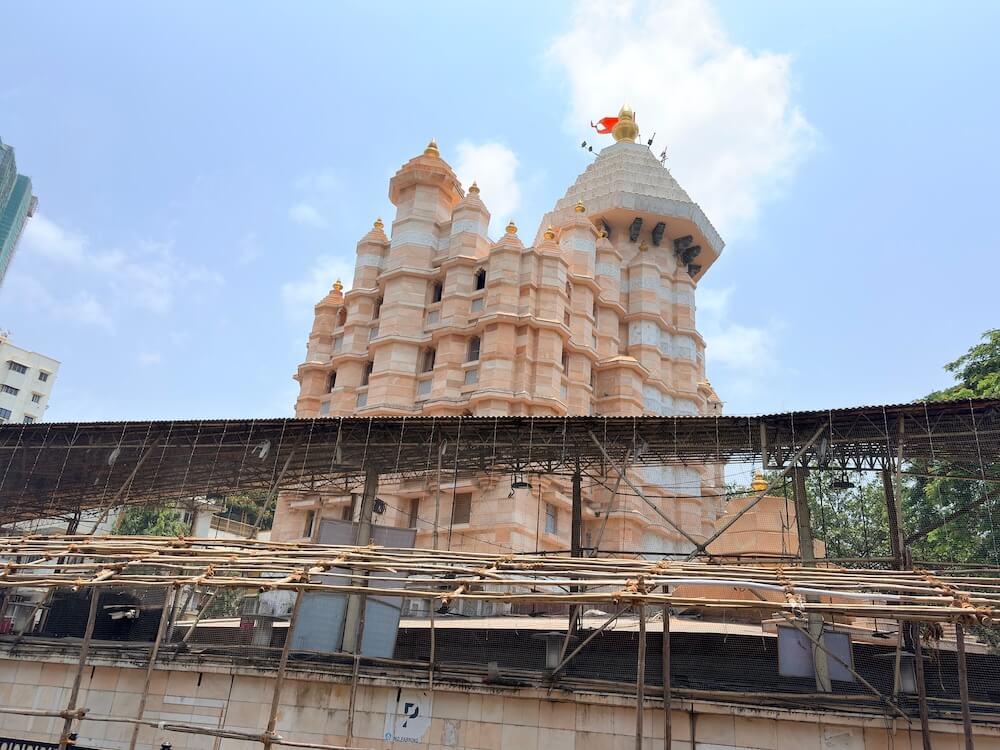
The new temple is a multi-angled, five-story structure built primarily using marble and pink granite stone. A long queue path has been created for entry into the temple. Keeping the security of the temple in mind, strict security arrangements like those at an airport have been maintained here. The main sanctum of the Lord is on the first floor of this building. The assembly hall of the temple is spacious and tall. A stepped platform has been created in one part of the assembly hall for devotees to sit and meditate. From here, one can have the darshan of the idol of Ganesha. There are two silver mouse idols in the assembly hall. These mice are considered the messengers of Siddhivinayak. Therefore, many devotees who come here express their wishes in the ears of these mice. There is also an ancient stone-carved idol of Maruti here. This idol was found during repair work on Elphinstone Road. In the year 1952, the then priest Govind Phatak built a small shrine here and installed this idol in it.
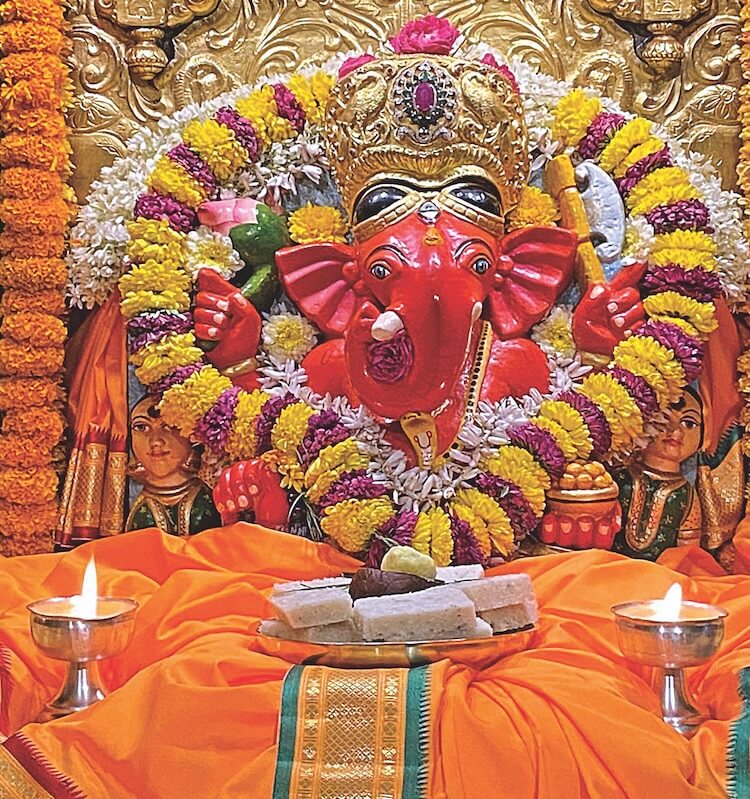
The assembly hall has a mezzanine floor. This area provides a darshan gallery as well as a separate space for Ganesh Yaga and Satyanarayana Puja. Thirty people can sit here for worship at one time. The sanctum sanctorum of the temple is spacious and octagonal in shape. There are twenty-one intricately carved pillars surrounding the sanctum. The sanctum has grand entrances about thirteen feet high facing the east, northeast, and north directions. Due to the great height of these entrances, more than three hundred devotees can have darshan of the Lord simultaneously from the main hall as well as the mezzanine floor. Gold-plated sheets with intricate carvings are affixed to the wooden doors here. Sculptures of various postures of Ganesha, the Navadurga, and the Navagraha are carved onto these doors. In this gold-plated, dome-shaped sanctum, the idol of Siddhivinayak is seated on a high altar within a golden arch. Here, the idol of Ganesha faces the northeast. It is significant in this context that one of Ganesha’s names in the ‘Mahaganapati Sahasranama’ is ‘Ishan’. The idol of Siddhivinayak here is made of black stone. This idol has been smeared with vermilion. The stone of the idol is two feet six inches high and two feet wide. The trunk of the idol is turned to the right. According to astrology expert Da. Kru. Soman, the belief that a Ganesha with a right-turned trunk is ‘strict’ and requires more rigorous purity is merely a misconception. Ganesha is never ‘strict’; he is always forgiving. In the Ganapatya tradition, a Ganesha with a left-turned trunk is considered to be of the lunar channel, meaning possessing cool qualities, while a Ganesha with a right-turned trunk is worshipped as the deity of intellect and valor. The form of a right-trunked Ganesha is also called a Siddhapitha. That is why temples of this form of Ganesha are called ‘Siddhivinayak Temples’. The Siddhivinayak here is in a seated position in the Padmasana posture. In the upper right hand of the four-armed idol is a lotus flower, and in the left hand is a parashu (axe). In the lower right hand is a rosary, and in the left hand is a vessel of modaks, which are very dear to Ganesha. Around the neck is a sacred thread resembling a serpent. The idol has ornaments on its arms, wrists, and feet. On the head is a golden crown shaped like a turban. A unique feature of this idol is that it has a third eye on its forehead, just like Lord Shankara. A small mouse idol is carved near the feet of the idol. On both sides of the idol are the figures of Riddhi and Siddhi, adorned with garments and ornaments. In one hand they hold a chauri (fly-whisk), and in the other, a vessel. To the left of the Siddhivinayak idol in the arch is a Shiva Linga, and to the right is a silver idol of Ganesha. Above the Siddhivinayak idol is a large relief sculpture of Shankar-Parvati.
On the second floor of this temple is the kitchen for the Lord’s great offering (Maha Naivedya) and a rest house for the priests. From here, the offering is taken to the main sanctum via a lift, or elevator. This floor also houses the administrative offices of the supervisor and assistant supervisor. The security and surveillance of the temple are managed from here. The third floor contains the chambers of the Chairman of the Trust, the Treasurer, and the Trustees. A visitor’s room, a committee hall, and a telephone room have also been established here. The fourth floor houses the Executive Officer’s chamber equipped with modern facilities, the administration department, the accounts department, the cash counting room, and the jewelry valuation department. This floor also has the chambers of the Deputy Executive Officer and the Finance and Accounts Officer, while the fifth floor houses the Mahaprasad department.
A highly attractive spire complex has been created at the highest part of the temple. According to Hindu temple architecture, the main idol in the temple and the temple spire must be in the same line. The spire here has been built according to these same rules. The center of this spire, meaning the pinnacle (kalash) above, and the tip of the crown on the head of the main idol are in one straight line. Its technical design is so precise that if a light ray were passed through the center of the spire, it would fall directly on the crown of the Lord’s idol. This eight-meter-high spire has eight octagonal levels. The new temple structure was completed on June १३, १९९४. At that time, the pinnacle of the old temple was respectfully removed, and a new pinnacle was installed. This new pinnacle weighs १५०० kilograms. This pinnacle has been completely covered in gold.
Every Tuesday, as well as on Sankashti and Angarki Chaturthi, at least one and a half to two lakh devotees visit this temple for darshan. On the day of Angarki Chaturthi, collective darshan begins at 2 AM and concludes at 1 AM the following night. On Tuesdays, after all rituals such as puja and abhishek are completed, the ground floor is opened for devotees at 1 PM. In the Hindu religion, Ganesha is the only deity among the revered gods whose two birthdays, Bhadrapada Chaturthi and Maghi Vinayaki Chaturthi, are celebrated. Both these festivals are celebrated here with great discipline amidst a massive crowd of devotees. Six days before the Vinayaki Chaturthi in the month of Magh, the idols of Siddhivinayak and Hanuman are anointed with sindoor. During this sindoor-anointing ritual, the main sanctum sanctorum remains closed to devotees. During that period, the silver idol of Siddhivinayak is placed outside for the devotees to view after performing a special pranapratishtha ritual. From Magh Pratipada to Rathsaptami, various religious and cultural programs are organized here for seven days from dawn until midnight. Around 12:40 PM, Ganesha’s birth anniversary is celebrated with the palana ritual. This is followed by a mahapuja with dugdhabhishek and aarti. Around 4 PM, a grand procession of the silver idol of Siddhivinayak is taken out through the Prabhadevi area. During the Ganeshotsav in Bhadrapada, a clay idol is installed in the assembly hall here. Until Anant Chaturdashi, various religious and cultural programs such as homa-havan and recitation of Brahmanaspati Sukta are organized. On the tenth day of the festival, the clay idol is immersed in the sea with a procession. Festivals like Ram Navami, Hanuman Jayanti, and Gokulashtami are also celebrated in this temple. In the ‘Mahaganapati Sahasranama’, at number 612, one of Ganesha’s names is given as ‘Ladupriyaya’. Because of this, the temple trust provides the mahaprasad of pure ghee laddoos and coconut barfi to the devotees. The temple receives donations worth crores of rupees from devotees every year. Through this fund, the temple carries out many socially beneficial works. Financial assistance is also provided to many needy individuals and poor students. There are many examples where the Siddhivinayak temple administration has provided significant help during natural disasters in the state. The temple also runs an independent library and study center. For security reasons, filming and photography are strictly prohibited in this temple.
This sacred temple stands as a testament to deep spiritual devotion, ancient architectural grandeur, and rich local cultural traditions.
The sanctum sanctorum houses the divine idol consecrated according to ancient Vedic traditions, surrounded by serene courtyards and traditional temple architecture.
Navratri, Maha Shivratri, Annual Temple Jatra & Deepotsav
Compare and book flights, secure top-rated local hotels near the temple, hire reliable guides, and rent cars instantly.
Extend your pilgrimage by visiting other highly sacred temples located nearby.


Add ₹999 more to unlock FREE SHIPPING!
Your sacred cart is currently empty.
Shop Photo FramesFill in your delivery details below to place your order.
Add comment