
Add ₹999 more to unlock FREE SHIPPING!
Your sacred cart is currently empty.
Shop Photo FramesThe village of Kinhai is located in the Koregaon taluka of Satara district. The temple of Goddess Ambabai, situated on the Sakhargad hill to the east of this village, is famous. Due to the scientific preservation and restoration work carried out on this ancient temple, it has received global recognition, and in the year 2014, it was honored by UNESCO with the Cultural Heritage Conservation Award. This temple, a place of faith for millions of devotees, has also been granted ‘B’ grade pilgrimage status by the Government of Maharashtra.
The legend of the temple is as follows: There is a vibrant seat of Goddess Yamai at Aundh in the Khatav taluka of Satara district. Near Kinhai, there is a village named Hivare. In the past, a gentleman named Tryambakpant Kulkarni lived there. He used to go to Aundh every day on horseback to seek the blessings of Goddess Yamai. He followed this routine for 12 years. Thereafter, Goddess Yamai decided to test him. Mr. Kulkarni’s wife was pregnant, and there was no one at home to assist with the childbirth. Therefore, his wife requested him not to go to Aundh; however, determined not to miss the Goddess’s darshan that he had maintained for 12 years, he went to Aundh and told the Goddess, “I am going to stay here for 15 days. I entrust the responsibility of my wife’s delivery to you.” He then stayed at Aundh for 15 days.
Upon returning home after 15 days, he saw that his wife’s delivery had been completed safely. When he asked his wife about it, she said that a sister from his distant relatives had performed the delivery and had also taken care of all the household chores. When he went to the river to look for that sister, who had gone there to wash clothes, he found the utensils, but no person was there. Kulkarni realized that the Goddess herself had come in the form of his sister and performed the delivery. The next day, Kulkarni went to Aundh and requested the Goddess to grant him darshan. The Goddess was pleased and appeared before him, asking him to seek a boon. He asked for the boon that the Goddess should accompany him and reside in his home shrine. The Goddess said “Tathastu” (so be it), but imposed a condition that he must not look back while walking on the path.
When they reached the foothills of Sakhargad, Kulkarni, not hearing the sound of the Goddess’s anklets, instinctively looked back, and the Goddess disappeared at that very spot. A stone appeared where the Goddess vanished. The stone of the Goddess is still there today, and it is known as the Ghatjai Temple. Thereafter, the Goddess told Tryambakpant that because he broke the condition, it was no longer possible for her to come home, but she said, “Understand that I reside wherever a wild cow in the surrounding hills releases streams of milk on its own without a calf, and worship me there.” Accordingly, where the wild cow released streams of milk on Sakhargad, there was a self-manifested (Swayambhu) stone of the Goddess. Later, the kings of the Pantpratinidhi dynasty of Aundh built a temple here.
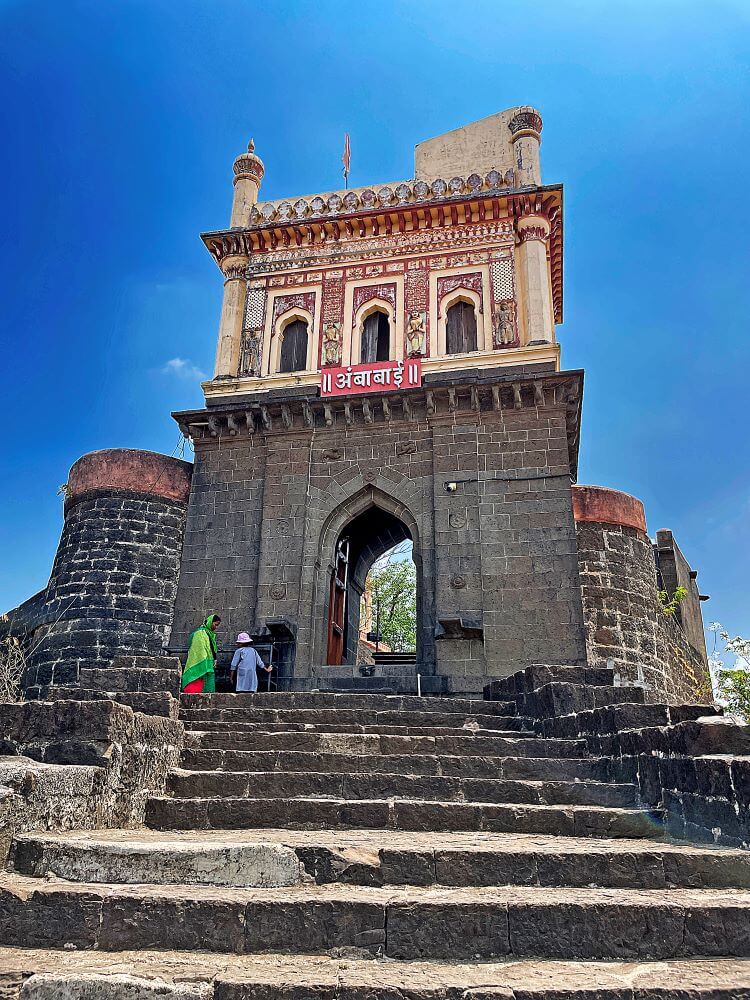
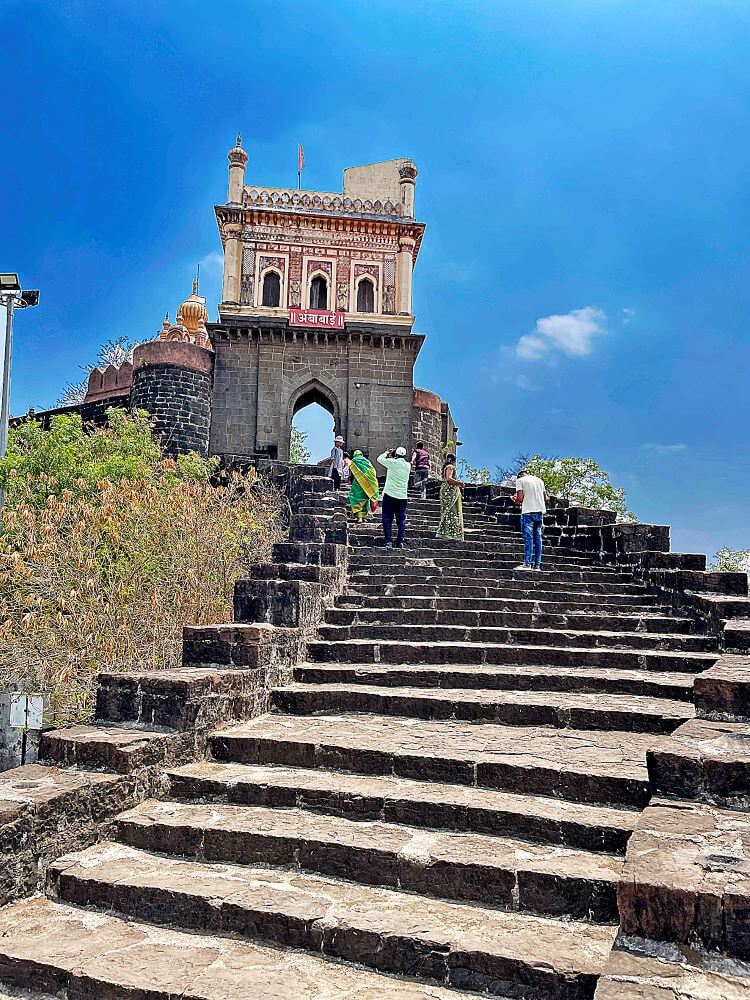
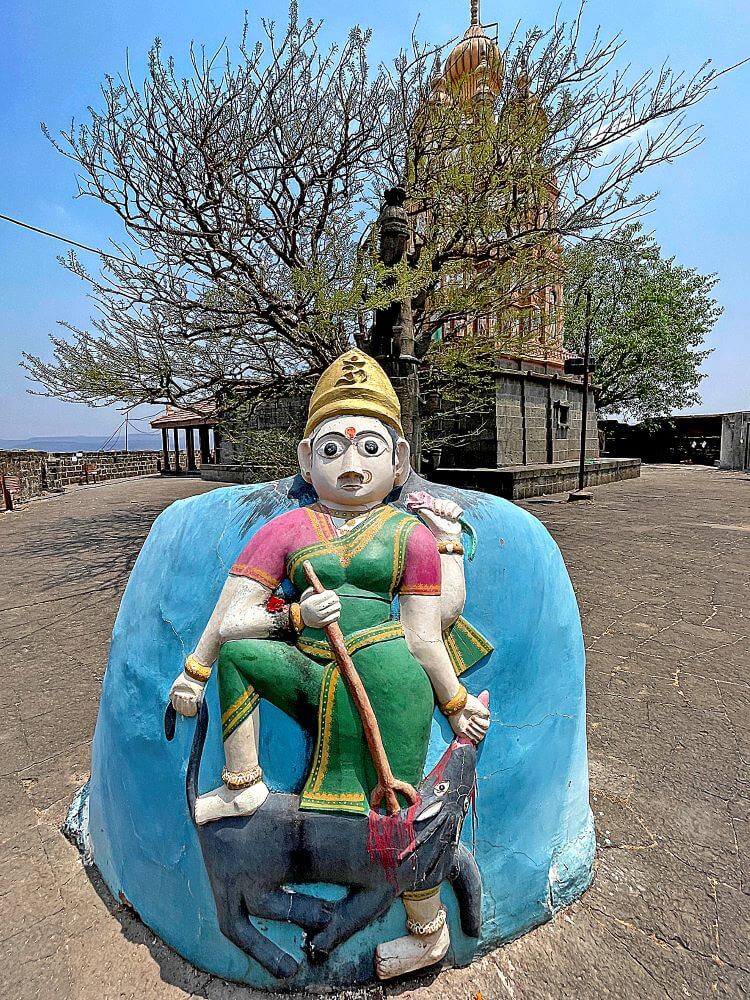
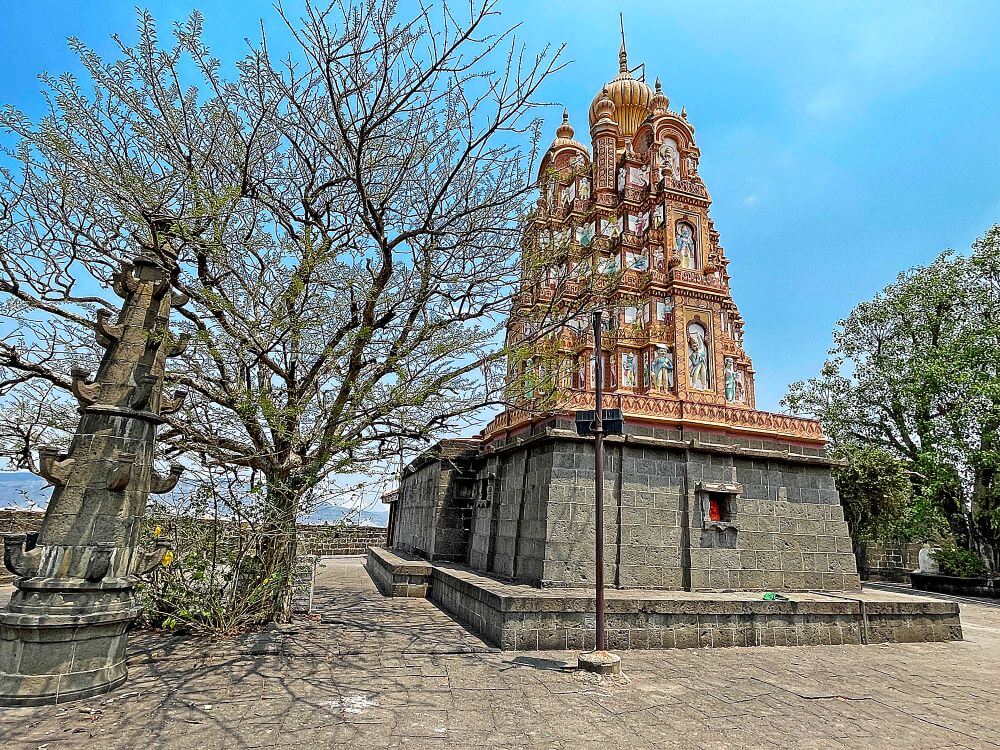
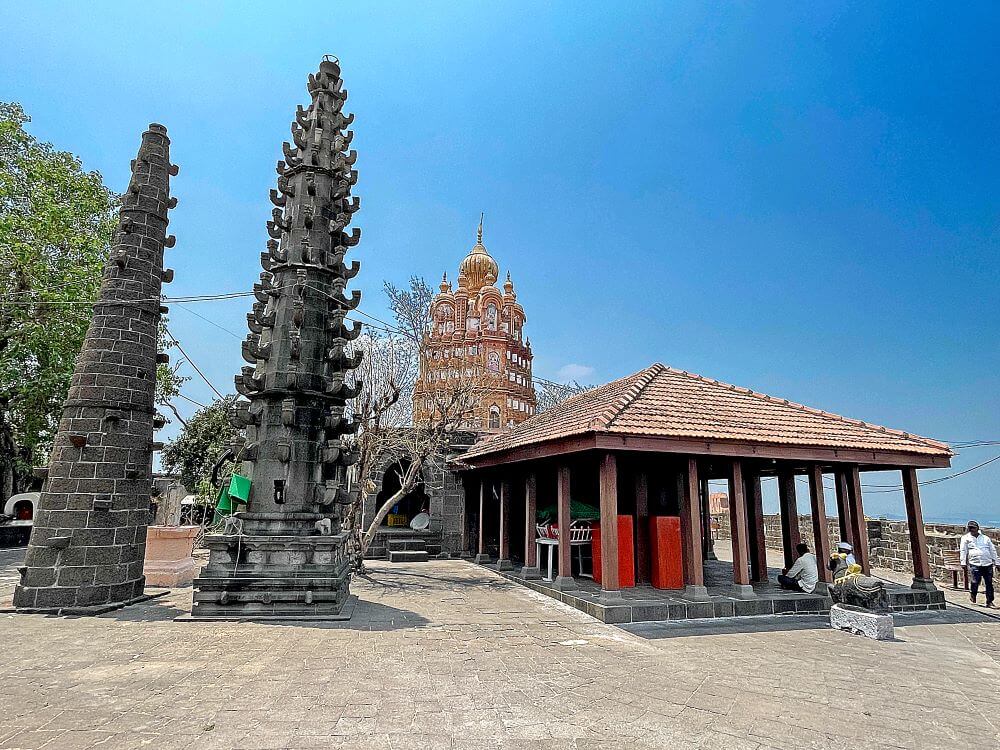
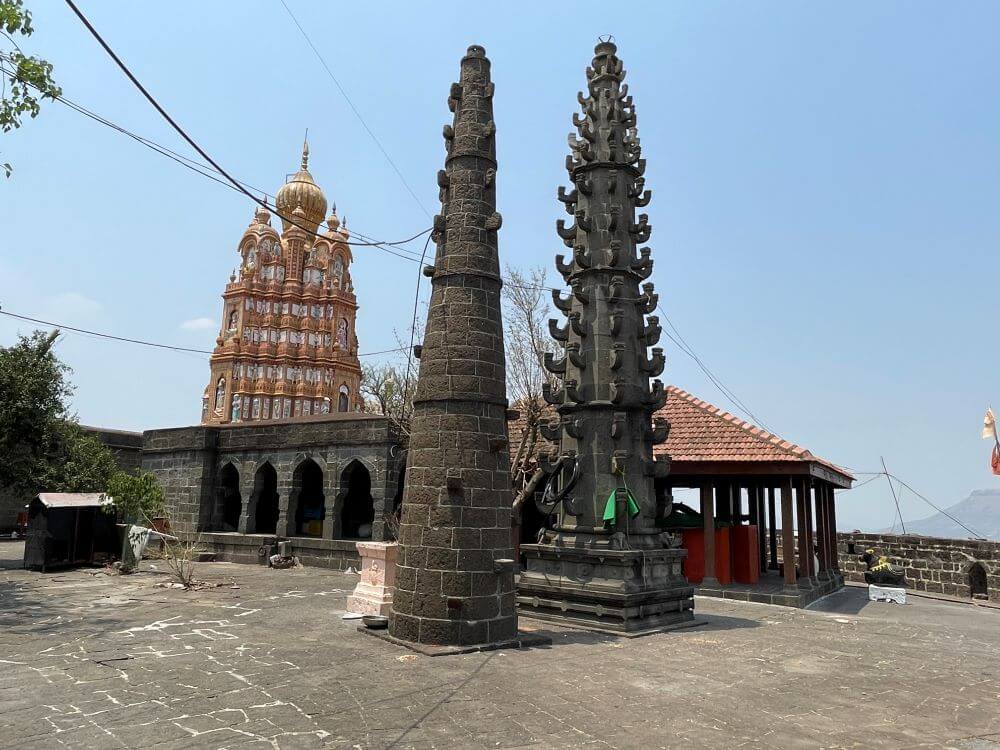
Because the Goddess has her seat on Sakhargad, she is famous as Sakhargad-Nivasini. This temple is two kilometers away from Kinhai village. There are two ways to reach here. One path consists of 250 steps from the foothills of the hill, and the other is a tar road that goes directly to the fort. If one comes by this road, the Ghatjai Goddess temple is reached before the pass. The inscription there records that the Ambabai temple was built by King Ramchandra Pantpratinidhi of Aundh between 1736 and 1746. The Ambabai temple is in the Hemadpanti style and is fully fortified. The fortification is three feet wide, built in dressed black stone, and topped with brickwork. There is a Nagarkhana (drum house) on the entrance gate of the six-bastion fortification. On the Hindu-style arches of this Nagarkhana, there are minarets in the Bahamani style. Delicate craftsmanship in lime adds to the beauty of the Nagarkhana. Upon entering the temple premises through the gate, one sees a one-meter-tall idol of the Goddess in black stone on the left side. The tall stone lamp pillars (Deepmalas) in the temple premises are built from the black stone of the Deccan plateau. Elegant peacocks are carved into the stone of these lamp pillars to hold lamps. The temple is made of stone masonry, and its characteristic spire (Kalash) is built using bricks and lime. The spire, which rises in stages, is interspersed with minarets. There are many sculptures of deities on the spire, including various forms of Ganesha, Durga, Vishnu, and others. The assembly hall (Sabhamandap) in front of this temple was built during the Peshwa period. However, it is made of wood. It contains some paintings made in the years 1933-34. There is another (first) hall attached to this pavilion in the original temple. This has doors on all three sides. The sanctum sanctorum (Garbhagriha) is completely enclosed. Inside the sanctum, there is the idol of Goddess Ambabai, which looks distinctive, adorned with a crown, various ornaments, and garments.
Pleased with the devotion of Tryambakpant Kulkarni, the Yamai Goddess of Aundh resides here in the form of Ambabai. In memory of this, every year on Kartik Purnima (Tripurari Purnima), the palanquin of Ambabai from Aundh comes to the foothills of Sakhargad. At the same time, the palanquin of Sakhargad-Nivasini Ambabai goes to the foothills to meet Goddess Yamai. This meeting ceremony is celebrated here with great enthusiasm and in the presence of thousands of devotees. It is the belief of the devotees that Goddess Yamai of Aundh stays here during the month of Kartik. The seat of the Goddess here is considered to be ‘Jagrut’ (awakened/vibrant), which is why hundreds of devotees come here every day for darshan.
The temple was being damaged by the wind, sun, and rain that blow day and night on the hill. At that time, with the permission of the temple committee, the Kinhai-based Kulkarni siblings undertook the scientific preservation and restoration work of the temple for their family deity and completed it. UNESCO took direct note of this preservation and restoration work, which was done in accordance with the original style, and awarded the Cultural Heritage Conservation Award in 2014. UNESCO distributes such awards with the intention of creating awareness in society about the importance of handing over our heritage to the next generation in its original form. At that time, the Sakhargad-Nivasini temple was selected for this award after inspection by experts from nine countries according to international standards.
This sacred temple stands as a testament to deep spiritual devotion, ancient architectural grandeur, and rich local cultural traditions.
The sanctum sanctorum houses the divine idol consecrated according to ancient Vedic traditions, surrounded by serene courtyards and traditional temple architecture.
Navratri, Maha Shivratri, Annual Temple Jatra & Deepotsav
Compare and book flights, secure top-rated local hotels near the temple, hire reliable guides, and rent cars instantly.
Extend your pilgrimage by visiting other highly sacred temples located nearby.


Add ₹999 more to unlock FREE SHIPPING!
Your sacred cart is currently empty.
Shop Photo FramesFill in your delivery details below to place your order.
Add comment