
Add ₹999 more to unlock FREE SHIPPING!
Your sacred cart is currently empty.
Shop Photo FramesThere are three and a half Shaktipeeths of the Goddess in Maharashtra. Tuljapur is the third complete Shaktipeeth among them. In the Devi Bhagavata, Tuljapur is also mentioned among the fifty-one Shaktipeeths. Known in various scriptures by names such as Tvaraja, Turja, Tvarita, Tulja, and Amba, the Goddess here is the Kulswamini (family deity) of Chhatrapati Shivaji Maharaj. The temple of the Goddess is situated in the area known as ‘Yamunachal’ in the Balaghat mountain range. It is estimated to have been built around the thirteenth century. Recognized as a national deity in a sense during the Shiv era, this Goddess is the Kuldevata (family deity) of many in Maharashtra. Because of this, there is always a large crowd of devotees here.
In the ‘Tulja Mahatmya’, the legend regarding the Goddess’s location here states that in the Krita Yuga, a Brahmin named Kardam lived in this region. At the time of his death, his wife, Anubhuti, was pregnant. Therefore, she could not perform Sahagamana (sati) with her husband. After giving birth some days later, she began penance on the banks of the Mandakini River. Once, a demon named Kukkut, who had come there for hunting, saw her. Seeing her radiant form, he became infatuated with her. He touched her body. At that moment, Anubhuti prayed to Mother Parvati in her heart. Hearing her call, Parvati herself appeared there in the form of Bhavani and slew the demon Kukkut. Because she came running immediately to the call of her devotee, this Goddess came to be addressed as Turja or Tvarita.
Connected to this legend is the story that the demon Kukkut had taken the form of Mahishasura while dying. The Goddess slew him. Therefore, the Goddess is enshrined here in the form of Mahishasurmardini. Under her feet lies the corpse of the demon, and she holds his head in her hand. Saint Eknath has bestowed the title of Ramvardayini upon this Goddess. According to the story in ‘Bhavarth Ramayana’, after the abduction of Sita, while Shri Ram was heading south in search of her, Mother Bhavani herself gave him darshan at one place. At that time, the Goddess had granted Shri Ram the boon to slay Ravana. This Goddess was also the Kulswamini of Samarth Ramdas Swami. Similarly, she was the presiding deity of Chhatrapati Shivaji Maharaj. According to the mention in ‘Sabhasadachi Bakhar’, when Afzal Khan marched forward, the Maharaj went to Pratapgad. There, he thought, ‘Whatever happens, we shall fight. We will not make peace.’ That same night, ‘Shri Bhavani of Tuljapur gave a tangible darshan to the Maharaj and said, “I am pleased. I am with you in every way. Through your hands, I shall have Afzal Khan killed.”’ There is no mention of the Bhavani sword in this chronicle. However, after receiving the blessings of Bhavani, the Maharaj killed Afzal Khan through his own valor.
According to the Marathi Vishwakosh, the temple of the Goddess here dates back to the thirteenth century. The oldest mention of this is found in an inscription from the year १३९७. This inscription, from the time of Mahamandaleshwar Kadamb Muruddev of the Tuljapur region, was found at Kati-Savargaon. It states that a person named Parasramiji Gosavi had come on a pilgrimage to Tuljapur. According to the १९६२ book ‘Temples and Legends of Maharashtra’ by M. S. Mate, Tuljapur is mentioned in a copper plate from the year १२०४, and it states the name of the Goddess as Tukai. After the middle of the seventeenth century, there are mentions of this place of the Goddess in many documents. When the Afghan commander Ahmad Shah Abdali marched on Delhi, the Mughals sought the help of the Marathas. At that time, before sending the Maratha army to Delhi under the leadership of Vishwasrao and Sadashivrao Bhau, Shrimant Nanasaheb Peshwa had prayed to Tuljabhavani. According to a sanad (decree) from the year १७६० regarding this, an inam (grant) was given by the Peshwas to the temple for daily worship, naivedya (food offerings), nandadeep (perpetual lamp), and chaughada (musical instruments). Alcohol was being consumed on a large scale in the temple premises as prasad. At that time, the Peshwas had partially implemented a liquor ban in this area.
There are records that Chhatrapati Shahu Maharaj, Mudhoji Nimbalkar, Ravarambha Nimbalkar, Damajirao Gaikwad, Mahadji Shinde, Sadhvi Ahilyadevi Holkar, as well as women from the Peshwa family visited Tuljapur. The slogan ‘Jai Bhavani’ is included in the royal emblem of Rajarshi Chhatrapati Shahu Maharaj of Kolhapur. Tuljabhavani was worshipped among the Sen and Karnat dynasties of Karnataka. Due to these dynasties, her glory reached Bengal, Mithila, Himachal, and Nepal. There are temples of Tuljabhavani in Kathmandu and Bhaktapur in Nepal. Here, Mother Bhavani is known by the name ‘Degu Taleju’. According to Nepalese tradition, the temple at Bhaktapur was built in the fourteenth century, in the year १३२४.
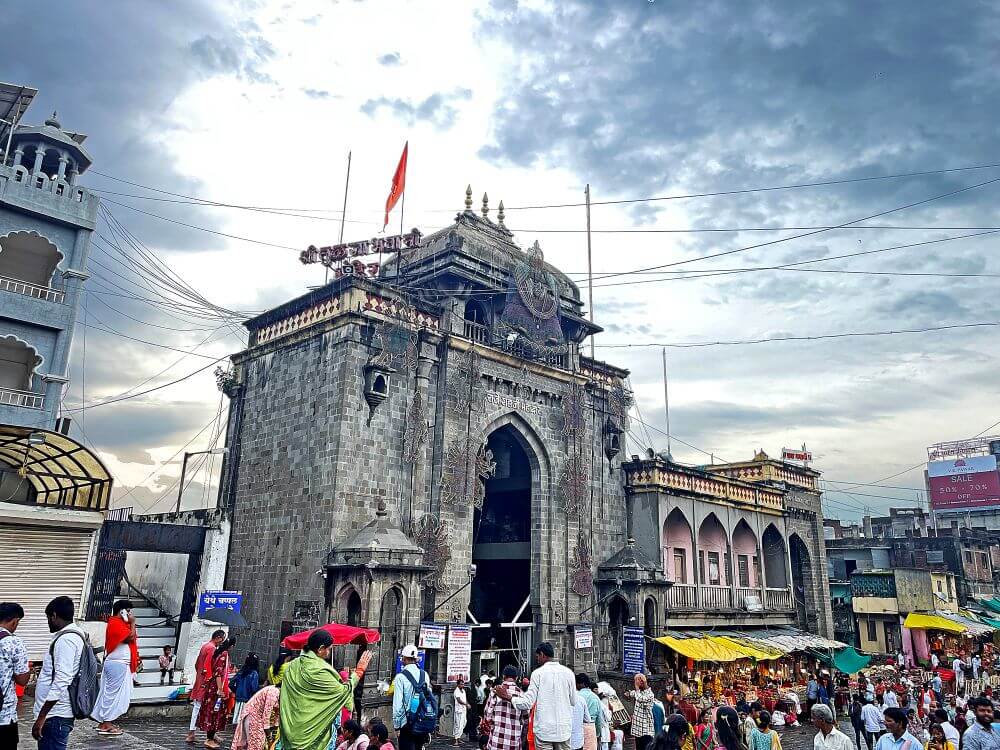
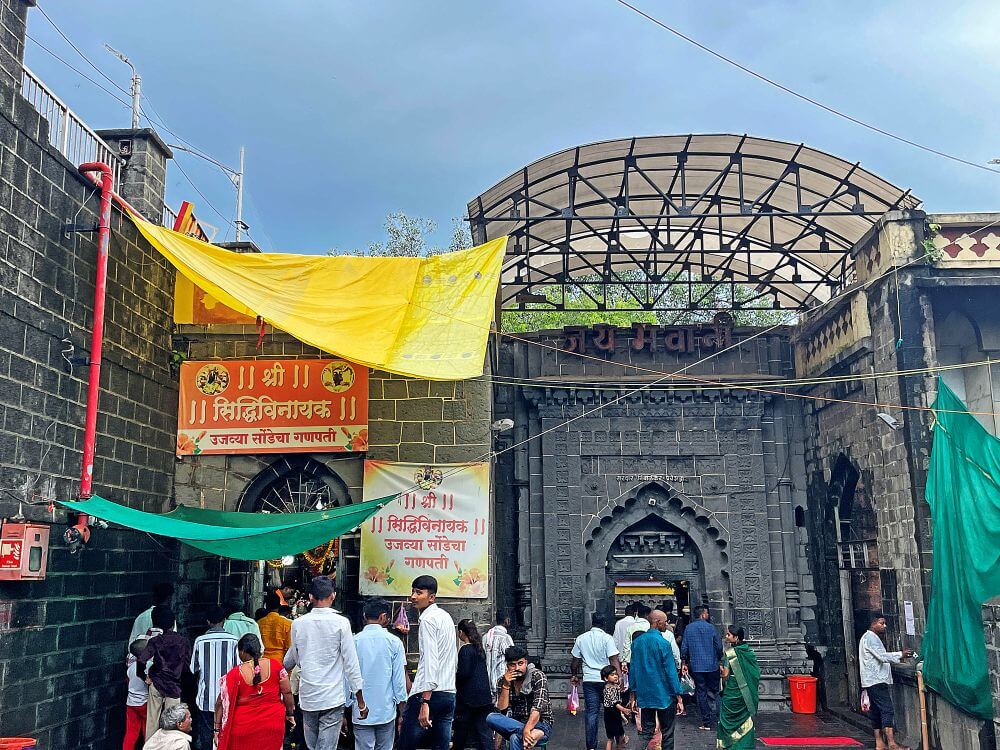
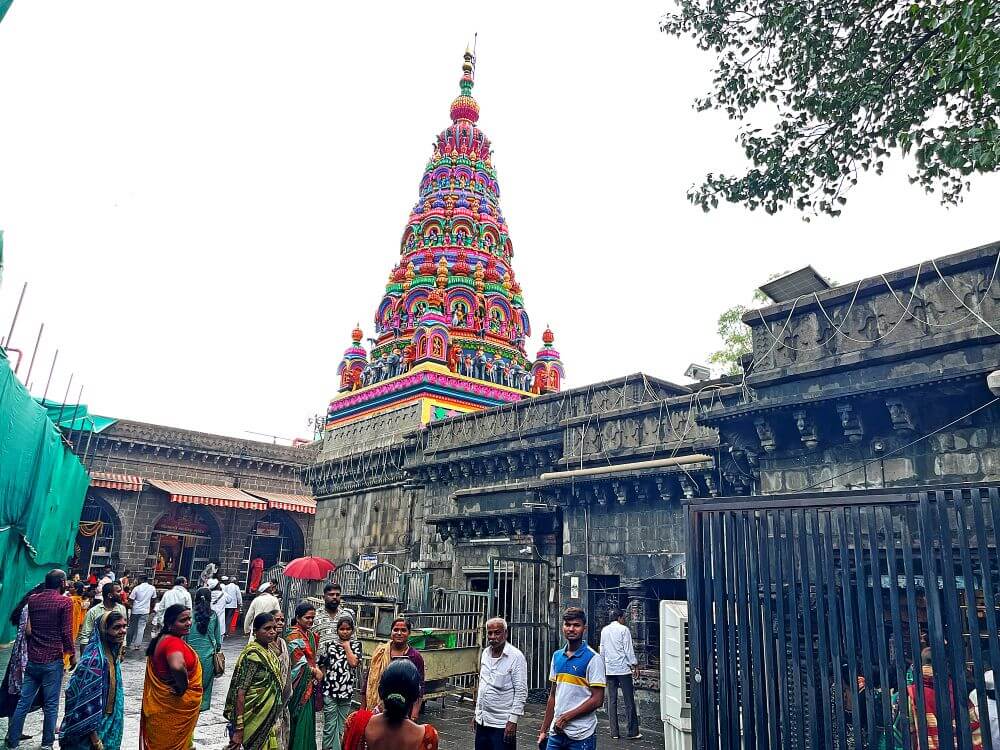
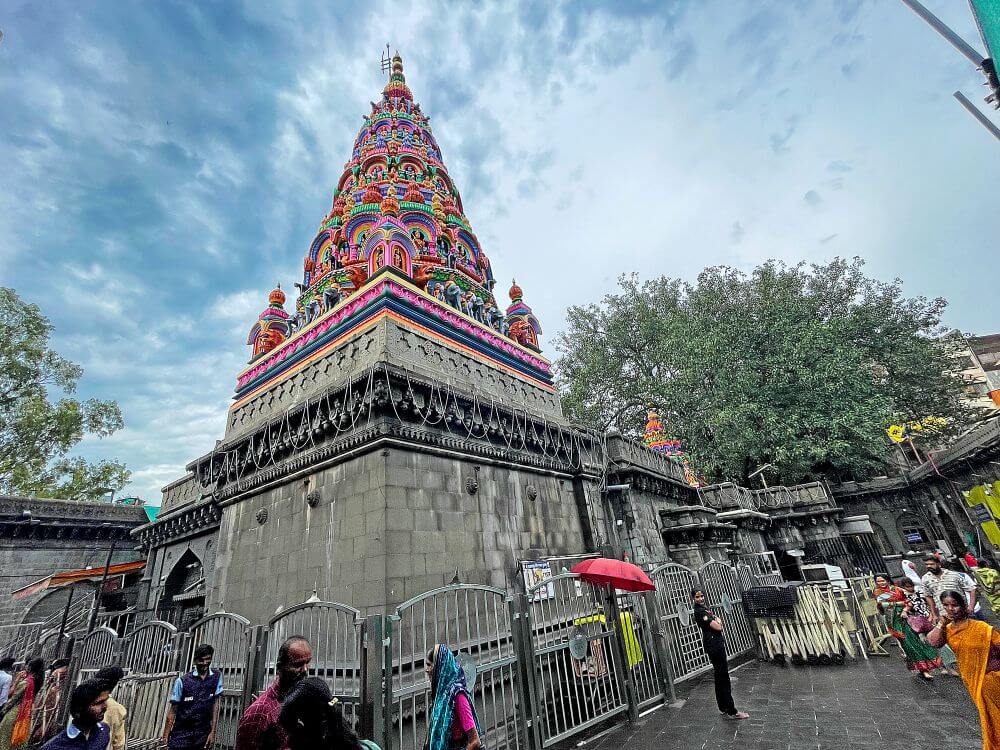
Archaeologically, the temple of the Goddess in Tuljapur, which is of Rashtrakuta or Yadava era, is situated in a grand courtyard. After making one’s way through the outer stone paving, the shops of worship materials on both sides of the path, and the ever-present crowd of devotees, one reaches two grand stone main gates of the temple complex. One of these main gates has been named after Shahaji Maharaj, and the other after Rajmata Jijau. After descending some steps from the Raje Shahaji Mahadwar into the courtyard, one reaches the Gomukh Tirtha. It is said that the water in this tirtha comes from the Mankawati Tirtha. According to popular belief, this water is from the Ganges.
On the left side here is a large water tank called Kallol Tirtha. It is said that this tirtha, measuring ४० by २० feet, must have been built in the fourteenth century. The mythological legend regarding this is that for there to be a water tirtha at this pilgrimage site, Brahma invited all the holy rivers and tirthas on earth here. Accordingly, all the tirthas, including the Ganga, Yamuna, and Saraswati, came here. They all gathered here, and a ‘kallol’ (commotion/surge) occurred. Therefore, Brahma named this tirtha Kallol Tirtha. Bathing in this tirtha before the darshan of the Goddess is considered meritorious.
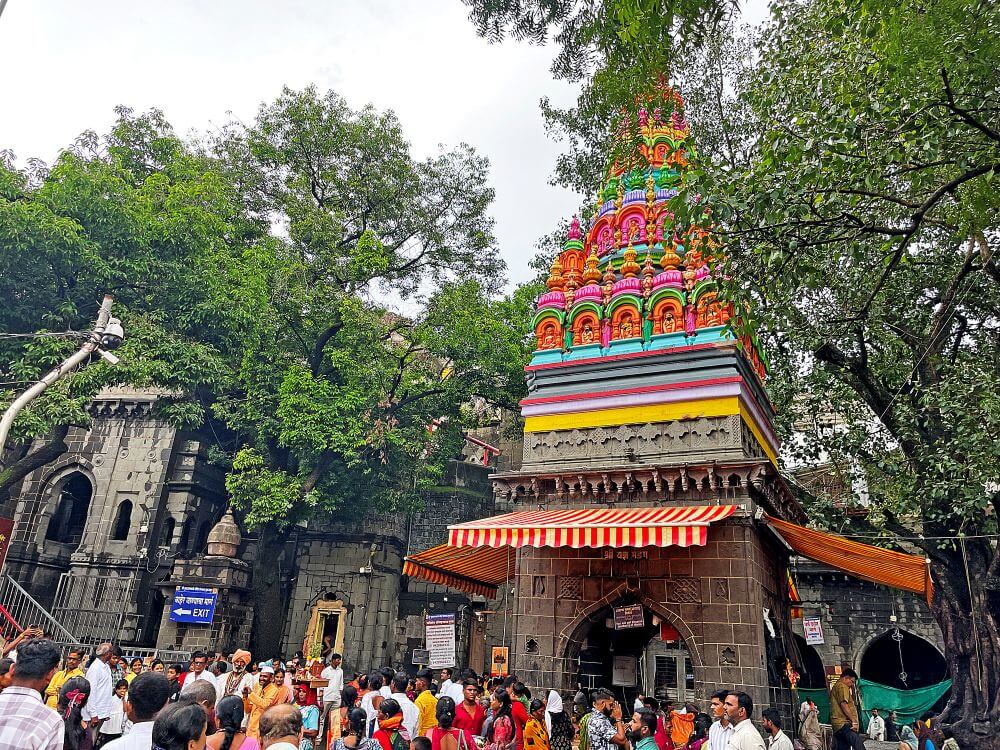
From here, near the entrance gate known by the name of Sardar Nimbalkar, is the place of Siddhivinayak. The idol of the right-trunked Ganpati is enshrined here. To the left of the entrance are Ganpati, Mahadev, There are small shrines dedicated to deities such as Vitthal-Rukmini. A short distance ahead is a large sacrificial fire pit (Homkund). On specific days, a ritual offering is made near this pit. Behind the Homkund is the designated place for the tonsure ceremony (Javal). In the courtyard of the Bhavani Devi temple, there are also smaller shrines dedicated to Adishakti Adimaya, Lakshmi-Narasimha, and Malhari Martand. Nearby is the site of the Chintamani stone, also known as Suknavati. This is a circular stone with two large and one small depression on its upper surface. Devotees place both palms on this stone to express their inner desires. If the stone rotates to the left, it is considered a ‘refusal’, and if it rotates to the right, it is considered an ‘acceptance’. There is a large crowd of devotees here to seek this divine omen (Kaul). Further ahead is the Chhatrapati Shivaji Maharaj entrance gate, where a Dattatreya temple is located. Additionally, the temple complex houses shrines for Annapurna Devi, Matangi Devi, and Yamai.
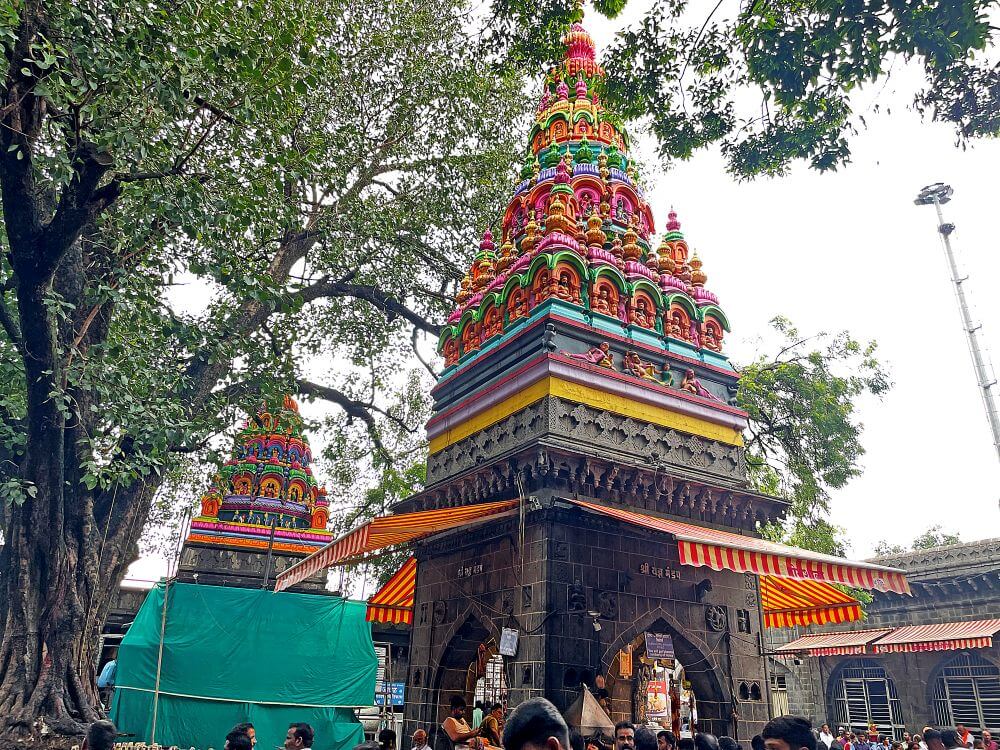
In the center of the courtyard stands the stone temple of the Goddess. The temple features a tall spire in the Maratha architectural style, topped with a golden finial (Kalash). It is said that many years ago, a devotee named Thigale from Beed donated this finial.
The idol of the Goddess is in the eight-armed Mahishasuramardini form, carved from Gandaki stone. She carries a quiver of arrows on her back, and in her hands, she holds a trident, a dagger, an arrow, a discus, a conch, a bow, and a drinking vessel. With one hand, the Goddess holds the tuft of the demon she has slain. On the crown upon the Goddess’s head is a Sayonilinga, and locks of hair emerge from beneath this crown. The Goddess is adorned with earrings, a mangalsutra, a moon-shaped necklace (Chandrahar), bangles, a waist belt, and anklets. Her right foot rests on the demon, while her left foot is on the ground. Between her feet, she holds the severed head of the demon. To her right are images of a lion and sages, while to her left is an image of Anubhuti in a posture of obeisance with her head bowed. On the back slab, at the top, are images of the moon and the sun.
The history of the Goddess’s idol is that during the invasion of Afzal Khan, he desecrated this temple. The Sabhasad Bakhar describes this event as follows: “He broke the idol of Shri Bhavani, the family deity of the Maharaj, ground it into powder, and mixed it into grain. As soon as he broke the Bhavani idol, a divine voice echoed: ‘O base Afzal Khan, from today, on the twenty-first day, I shall sever your head, destroy your entire army, and satisfy the nine crore Chamundas.’ Such was the divine proclamation.” Following this, the current idol of the Goddess was consecrated here. According to historian G. H. Khare, the current idol was crafted in the seventeenth or eighteenth century.
The Goddess is worshipped four times a day. The festivals of Sharadiya Navratri and Dussehra are celebrated with great enthusiasm in the temple in the presence of lakhs of devotees. On the day of Vijayadashami, a procession of the Goddess’s idol is taken out in a palanquin. The festival of Rangpanchami is also celebrated with great fervor at the temple. The ‘Chhabina’ ceremony of the Goddess is also celebrated here in the presence of thousands of devotees. The circumambulation of the temple by the palanquin carrying the festival idol and the holy sandals (Paduka) of the Goddess is called Chhabina. The Chhabina is held every Tuesday, on the day before the full moon, on the full moon day, and the day following it. The Chhabina is also held on Diwali Padwa and Gudi Padwa. The Chhabina is not held for 21 days during the Goddess’s period of rest (Nidrakal).
The administration of this temple is conducted according to the ‘Deul E Kavayat’ act prepared by the Nizam. According to history scholar Dr. Satish Kadam (Tuljapur), the sixth Nizam, Mir Mahbub Ali, had established a separate department to manage religious affairs. To resolve disputes among the priests of the Goddess and to establish law and order, the Nizam government took over the temple on 17 Ardibehist 1318 Fasli, which is 2 March 1909, and created the ‘Deul E Kavayat’ act. Although the government now has control over the temple, the traditional rituals and customs within the temple are still performed according to this act today. Devotees can have the darshan of the Goddess in this temple daily from 4 in the morning until 10 at night.
This sacred temple stands as a testament to deep spiritual devotion, ancient architectural grandeur, and rich local cultural traditions.
The sanctum sanctorum houses the divine idol consecrated according to ancient Vedic traditions, surrounded by serene courtyards and traditional temple architecture.
Navratri, Maha Shivratri, Annual Temple Jatra & Deepotsav
Compare and book flights, secure top-rated local hotels near the temple, hire reliable guides, and rent cars instantly.
Extend your pilgrimage by visiting other highly sacred temples located nearby.


Add ₹999 more to unlock FREE SHIPPING!
Your sacred cart is currently empty.
Shop Photo FramesFill in your delivery details below to place your order.
Add comment