
Add ₹999 more to unlock FREE SHIPPING!
Your sacred cart is currently empty.
Shop Photo Frames“Where the name of Lord Shiva is chanted, how can there be the bondage of birth, death, and worldly existence?” As one travels from Satana town towards Dodheshwar via Bhakshi, an iron arch bearing a board with this sacred Shloka comes into view along the way. A short distance from there, amidst the naturally bountiful region of Baglan, stands the temple of Dodheshwar (Dodveshwar) Mahadev. Beneath the Shivling in the sanctum sanctorum of this 16th-century temple, a continuous stream of fresh spring water flows.
Between the 12th and 16th centuries, the Baglan region was ruled by the Bagulshah dynasty of the Rathore clan from Kannauj. Hence, the region came to be known as ‘Baglan’. This temple was constructed during the reign of King Veeramshah Rathore of the Bagul dynasty in the Shalivahana Shaka year 1502. A mention of this year is found in an inscription within the temple. According to historical records, the pious Punyashree Ahilyabai Holkar had immense devotion for Lord Dodheshwar. She visited here frequently to offer prayers and perform worship. She had also constructed a stepwell (Barav) here for the devotees. Furthermore, she granted the land of Kotbel village as a gift (Inam) to the temple to create a sacred grove (Devrai) of wood apple (Kavath) and Bel trees for worship offerings. Recently, after the renovation of the temple in 1992, it acquired its present form.
It is said that there are five Shivlings in the temple premises. The legend regarding this states that a cow used to come regularly to a large anthill and spontaneously shower her milk there. Out of curiosity, when the villagers looked inside the anthill, they found a large root. Near that root, a Shivling was discovered. That Shivling exists there even today and is known as ‘Muleshwar’. The temple of Lord Muleshwar is situated on the hill to the right of the Dodheshwar temple. Some also refer to it as ‘Phirta Mahadev’ (the Wandering Mahadev). The root near the anthill belonged to a vine. Tracing that vine, another Shivling was found, which became known as Veleshwar. At some distance, a flower was seen on that vine, where another Shivling was located, named Fuleshwar. From that flower grew a fruit, giving rise to Faleshwar, and from the fruit emerged a milk-like substance, leading to the name Dugdheshwar Mahadev. Over time, the word ‘Dugdheshwar’ evolved into the popular name ‘Dodheshwar’. It is also said that Dodheshwar finds mention in the Padma Purana.
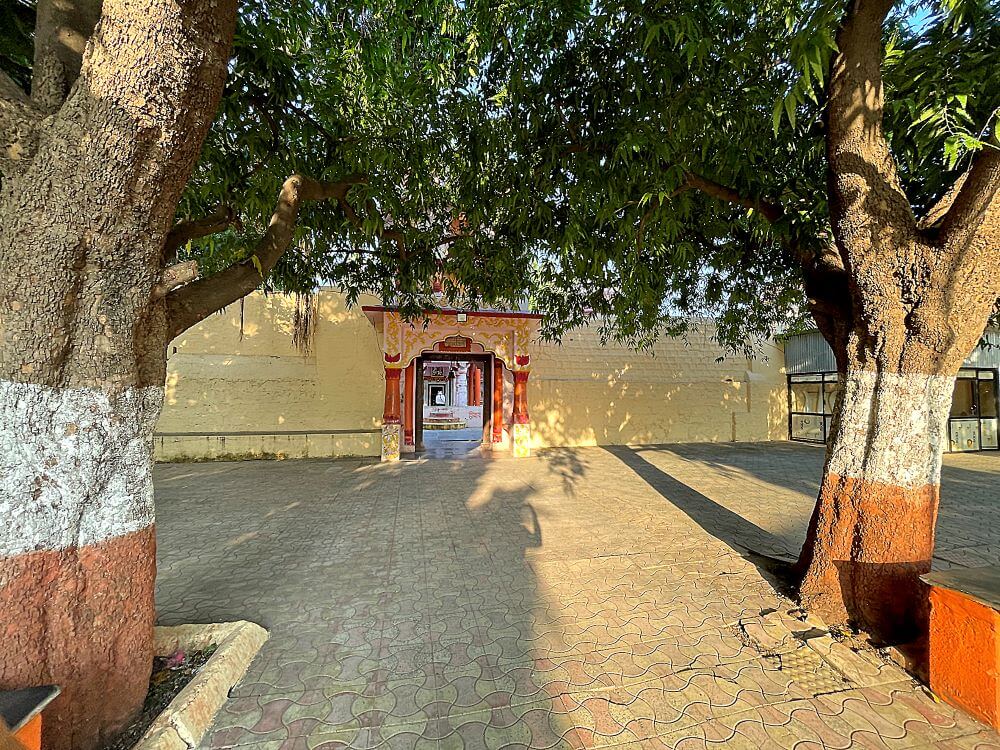
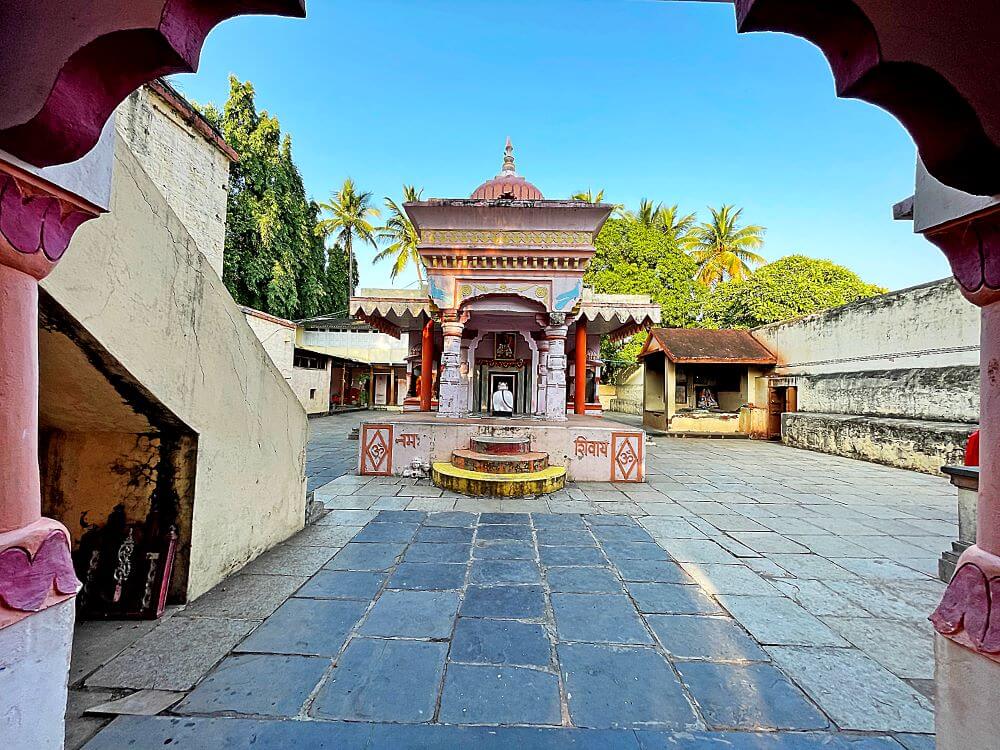
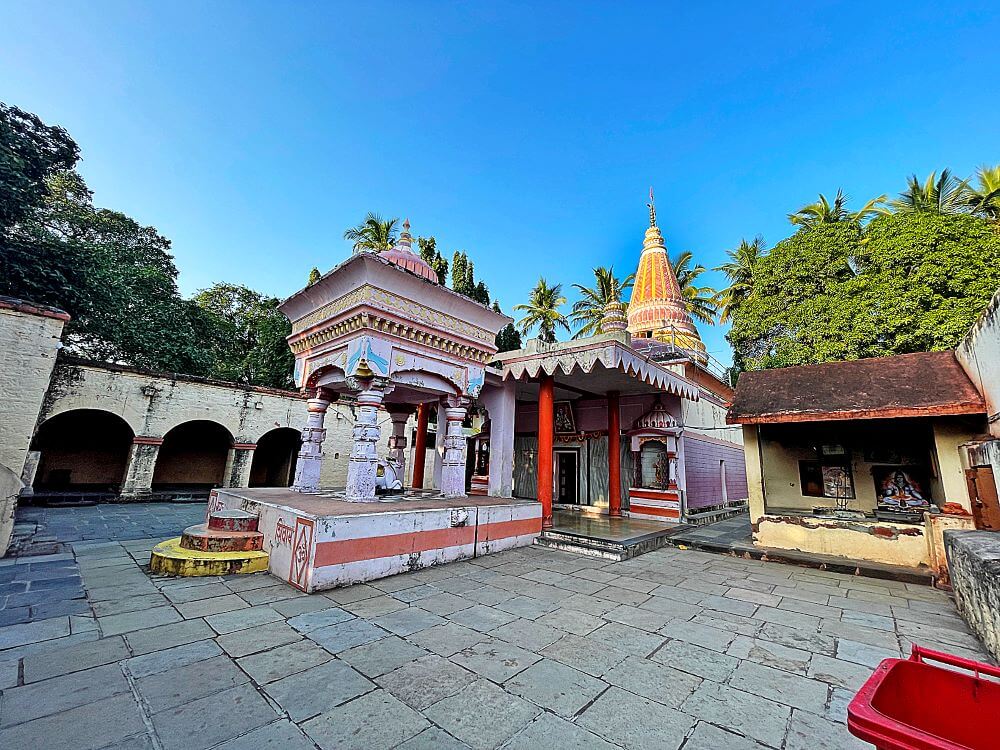
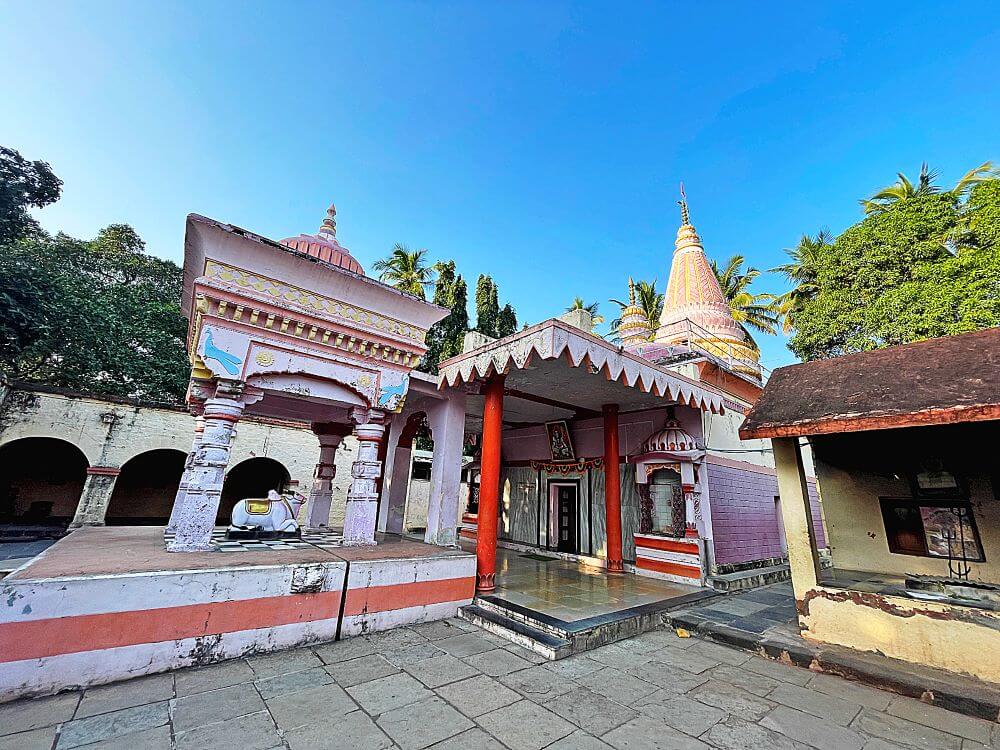
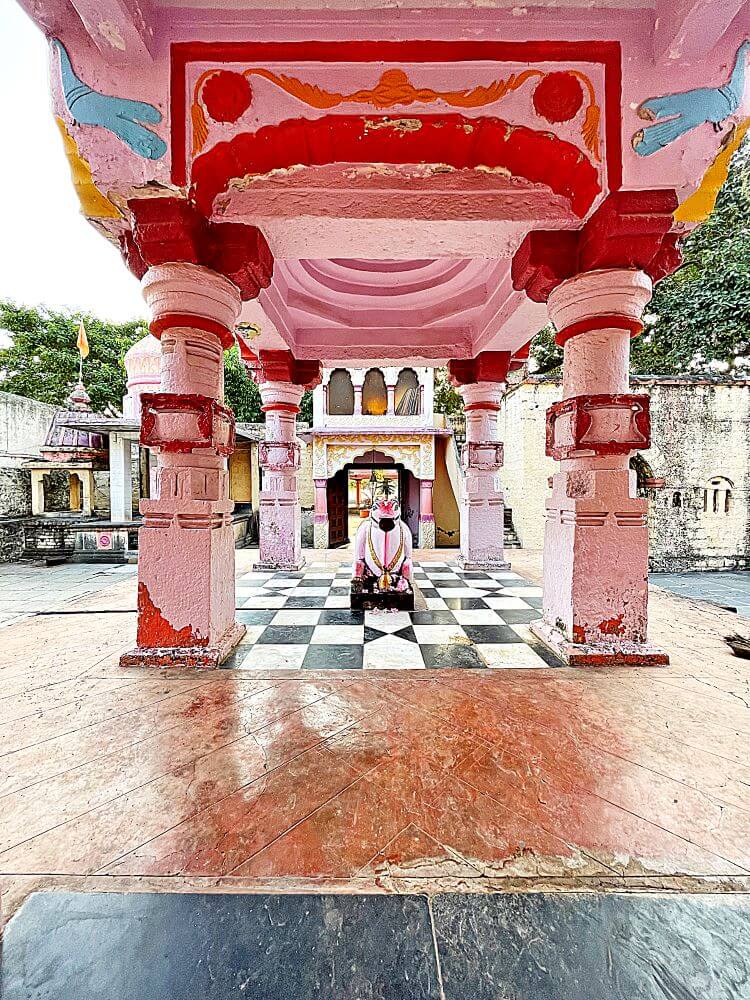
The surroundings of the Dodheshwar temple are adorned with lush green foliage. Upon reaching the area, the sacred spire (Kalash) of the temple comes into view through the tall trees. Walking past the row of shops selling Prasad and worship materials, one enters the temple courtyard through its outer ramparts. The courtyard is paved and lined with various sacred trees such as Bakul, Champa, Mogra, Banyan, Peepal, Tamarind, and Bel. Ascending the marble steps, one reaches the Nandi Mandap. On the left side of the Nandi Mandap is an idol of Lord Ganesha, and on the right side is an idol of Lord Krishna.
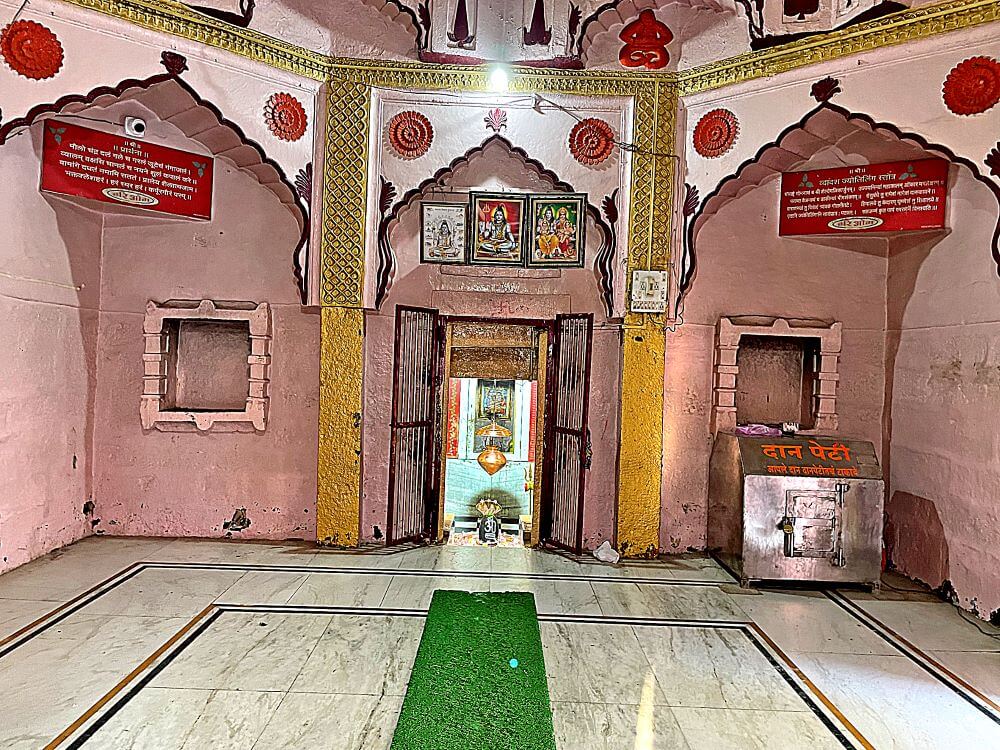
Upon entering the main Sabhamandap (assembly hall), one immediately feels the temple’s divine antiquity. The relief sculptures of gods and Gandharvas set within the arched walls, along with the intricate carvings, are truly remarkable. Descending a few steps from the Sabhamandap, one reaches the stone Garbhagriha (sanctum sanctorum) housing the sacred Shivling. Here, one can behold the exquisitely crafted Shivling, a metal Shivling beside it adorned with a mask of Lord Mahadev, a protective canopy formed by the hood of Sheshnaag, and a Trishul (trident) with a Damru attached to one side.
It is said that the Dodhyad River, originating in the mountain range behind the temple, splits into two streams; the main stream flows beneath the Shivling, while the second stream flows through a Gomukh spout. The history of many temples and pilgrimage sites in Maharashtra is associated with the Pandavas. Accordingly, a legend attributes this temple’s origin to the Pandavas, who are believed to have consecrated this Shivling during their stay here. Therefore, this sacred place is also called ‘Pandaveshwar’.
Within the temple premises lies the Nirvana Samadhi of Shri Mahant Rampuriji Maharaj, Thanapati of Dashnam Shri Panch Juna Akhada of Kashi. He played a key role in developing this sacred site. The temple complex also houses a Dharamshala (rest house), a guesthouse, and a kitchen. There are two separate Kunds (holy bathing tanks) for male and female devotees.
On every Shravan Monday and on the auspicious occasion of Mahashivratri, a vast throng of devotees gathers here. On Shravan Mondays and Mahashivratri, ST buses run from Satana bus stand to Dodheshwar temple every half hour from early morning until midnight. Thousands of devotees arrive during these times to seek the darshan of Lord Dodheshwar. The villagers mention that on Mahashivratri, this count reaches around 1.5 to 2 lakh devotees.
This sacred temple stands as a testament to deep spiritual devotion, ancient architectural grandeur, and rich local cultural traditions.
The sanctum sanctorum houses the divine idol consecrated according to ancient Vedic traditions, surrounded by serene courtyards and traditional temple architecture.
Navratri, Maha Shivratri, Annual Temple Jatra & Deepotsav
Compare and book flights, secure top-rated local hotels near the temple, hire reliable guides, and rent cars instantly.
Extend your pilgrimage by visiting other highly sacred temples located nearby.


Add ₹999 more to unlock FREE SHIPPING!
Your sacred cart is currently empty.
Shop Photo FramesFill in your delivery details below to place your order.
Add comment