
Add ₹999 more to unlock FREE SHIPPING!
Your sacred cart is currently empty.
Shop Photo FramesThe village of Nagothane is situated on the banks of the Amba River in the Sahyadri mountain range. The temple of the village deity, Jogeshwari Devi, located in the Tintale area here, is a place of faith for thousands of devotees. It is believed that Jogeshwari is a form of Goddess Bhavani. Since there is a shrine of Bhairavnath in this temple, the Goddess is also known as ‘Bhairi Bhavani’. She is the family deity (Kuldevata) of many families in this region. On Chaitra Krishna Pratipada, the palanquin of this Goddess is taken in a procession through the entire town of Nagothane. Thousands of devotees participate in it at that time. This palanquin procession takes a full three days to complete the circumambulation of the village.
The legend of this temple is that many years ago, Hiru Tadkar from Murawadi near Nagothane had gone to the plateau east of Nagothane village to graze his cattle, as he did every day. At that time, he felt as if someone was calling out to him; however, thinking it might be an illusion, he ignored it. The same thing happened again the next day. He looked everywhere in the vicinity, but saw no one. Wondering who could be calling him, he returned home in the evening. While he was asleep that night, the Goddess appeared to him in a dream and said, “I am at the place where you go to graze your cattle. Bring me to your village.” ‘Place me standing wherever I feel heavy.’ The next day, when Tadkar went to the mountain plateau to graze the cattle as usual, he saw the stone idol of the Goddess there. Seeing the idol exactly as it had appeared in his dream, he bowed down before it.
As instructed by the Goddess in his vision, he carried the idol on his head and set off towards the village. On the way, when he reached the area of the three ponds in Nagothane, the idol began to feel heavy. He thought that if he placed the idol down while standing, there was a possibility of it breaking, so he tried to place it down gently; however, unable to bear the weight of the idol, he passed away the moment he set it down. Later, the villagers consecrated the idol at this very spot. A few days later, a member of the Powale family here became possessed by the spirit of Bhairi and said, “Jogeshwari is my sister; consecrate me beside her.” Following this, the villagers The essence of Bhairavnath Maharaj was brought from the Bhairi temple in Goregaon, near Mangaon, and installed beside the Goddess. Subsequently, the idols of Bhairavnath and Wagheshwar Maharaj were consecrated here. Since then, this temple of Jogeshwari Mata and Bhairavnath Maharaj, situated in the vicinity of the three lakes in Nagothane, has become renowned.
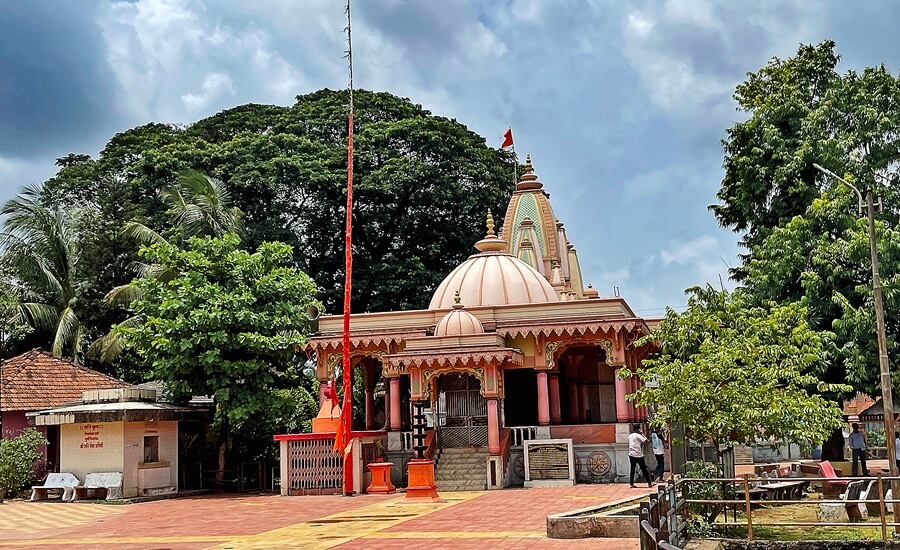
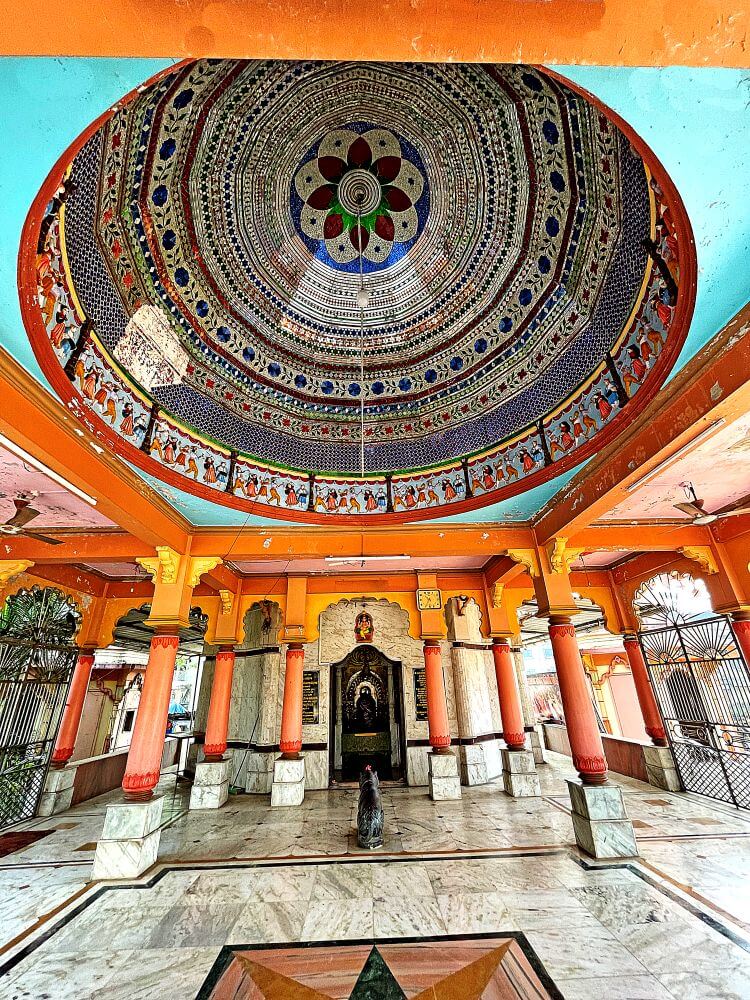
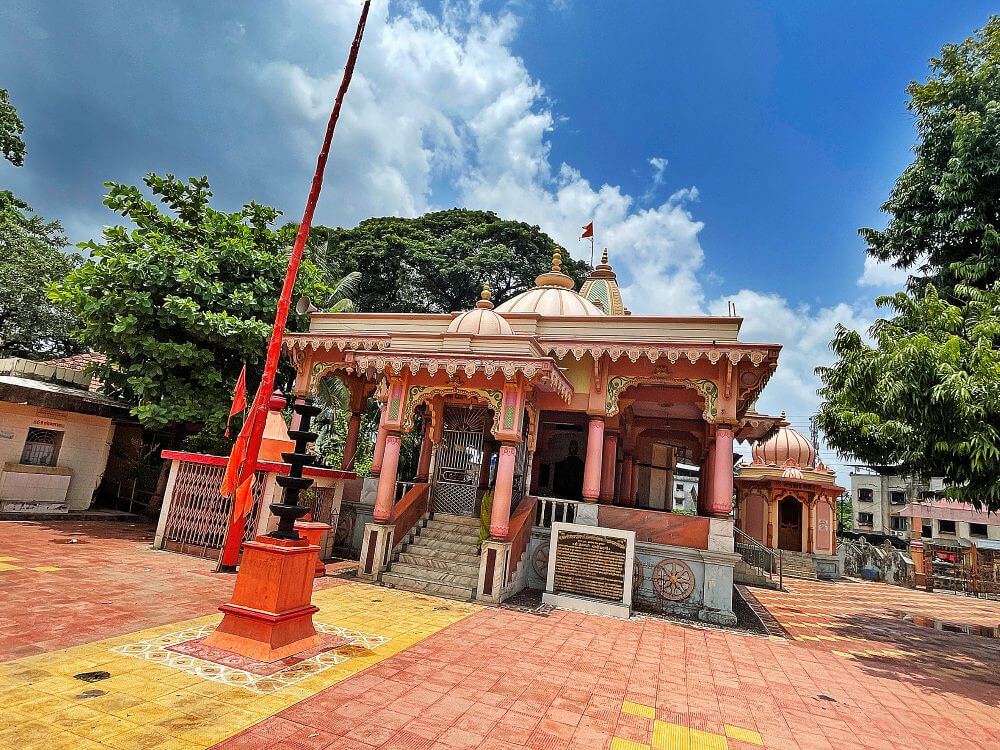
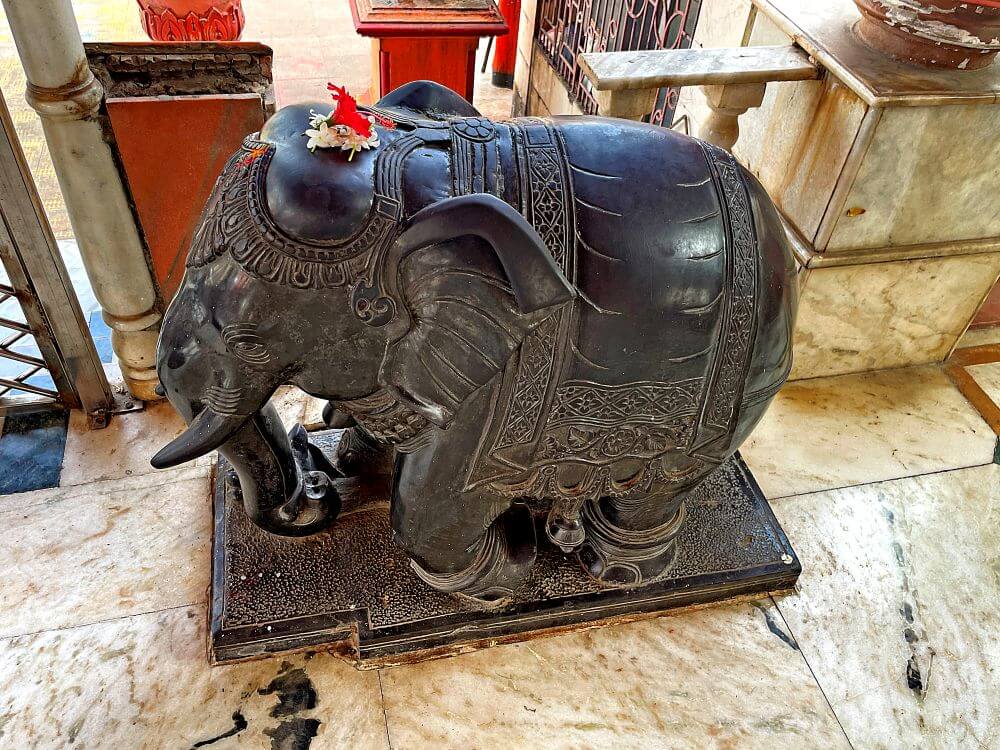
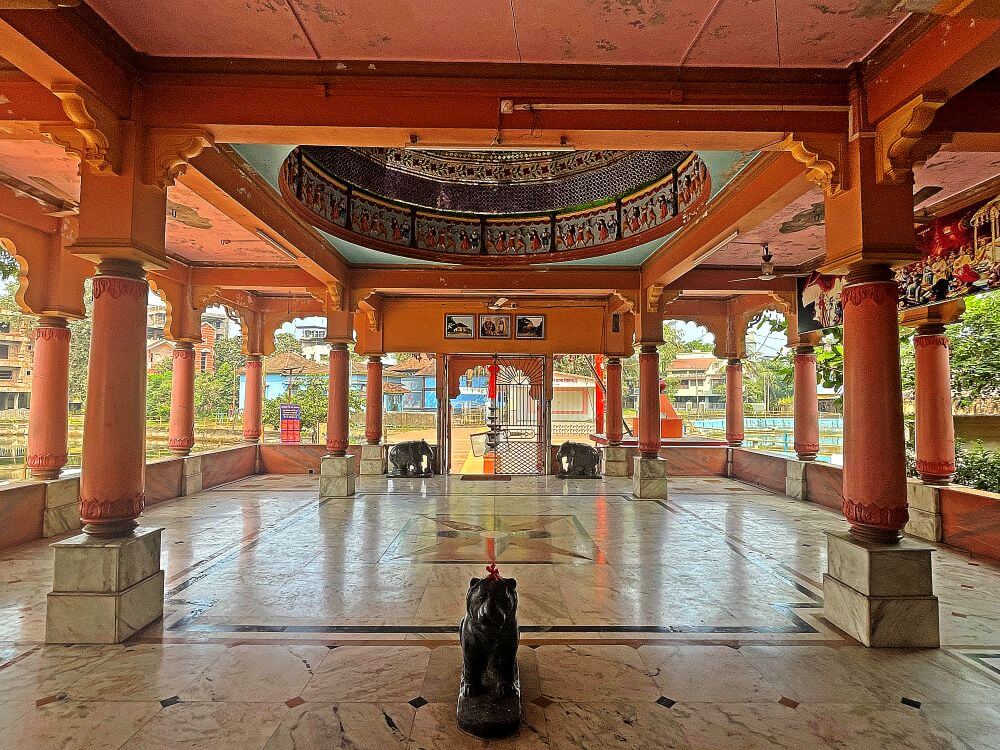
Located in the heart of Nagothane town, this temple is surrounded by three ponds. Upon passing through the temple archway, one enters a spacious courtyard. In the center of this courtyard stands the Jogeshwari Bhairavnath Temple. The temple structure consists of a Mukhamandapa (entrance porch), a Sabhamandapa (main assembly hall), and a Garbhagriha (sanctum sanctorum). In front of the Mukhamandapa stands an ancient stone Deepastambha (lamp pillar) resting on the back of a tortoise. To reach the Sabhamandapa of this temple, which is situated on a high plinth, there are eight steps leading up from the Mukhamandapa. The Sabhamandapa here is semi-open in design and features side seating (kakshasanas). The entire Sabhamandapa is paved with marble flooring. Beyond the Sabhamandapa, leaving space for a circumambulatory path (pradakshina marg), lies the Garbhagriha. Inside this sanctum, on a central pedestal, is the idol of Goddess Jogeshwari, flanked by the idols of Bhairavnath Maharaj and Wagheshwar Maharaj on either side. There are three shikhars (spires) crowning the Mukhamandapa, the Sabhamandapa, and the Garbhagriha respectively.
It is said that this temple was established around the 18th century. Previously, the temple of the Goddess had a tiled roof. The temple attained its current form after its renovation in 1995. Following the renovation, new idols of the Goddess were consecrated in this temple. As per the tradition of immersing old idols, the original idol was immersed in the sea at Harihareshwar. After some time, the immersed idol washed back ashore, and it was subsequently installed in a smaller temple.
It is said that there was a plague epidemic in 1896. At that time, the villagers had left their homes and hearths to take refuge in the forest. There was no one in the village. When thieves attempted to rob the village, the Goddess appeared riding a white horse and protected the village. Seeing the Goddess, the thieves fled. Even today, the villagers believe that the sound of horse hooves and anklets can be heard in the temple premises and the village at midnight.
Navaratri is a major festival of the Goddess. On the first day of Navaratri, Ghatasthapana is performed. Following this, various religious programs are held. Events such as Gondhal of the Goddess, Bhondla dance, Fugadi competitions, Haldi-Kumkum, Kirtan, Bhajan, and Haripath are celebrated here. The Palkhi festival of this Goddess takes place on Chaitra Krishna Pratipada. At that time, the entire temple premises and the area around the three lakes are illuminated with electric lights. Regardless of where the residents of Nagothane may be, whether within the state or outside, for employment or business, they are always present here during this time. This Palkhi of the Goddess, which has a tradition spanning hundreds of years, is carried throughout the village amidst the sound of drums and the bursting of firecrackers. Previously, this Palkhi procession used to conclude on the same night; however, due to the increase in population, it now continues for three days. The Tadkar and Powale families hold a place of honor in this procession.
The temple premises are surrounded by three ponds. The first of these is known as Motyacha Talav. It earned this name because a ‘mota’ (a large leather bucket) was used to draw water from the pond. The construction of this pond dates back to the era of Chhatrapati Shivaji Maharaj. The inner sides are lined with dressed stone masonry to secure the water. The other two are known as Naske Talav. They were given this name because the water in them is not potable.
This sacred temple stands as a testament to deep spiritual devotion, ancient architectural grandeur, and rich local cultural traditions.
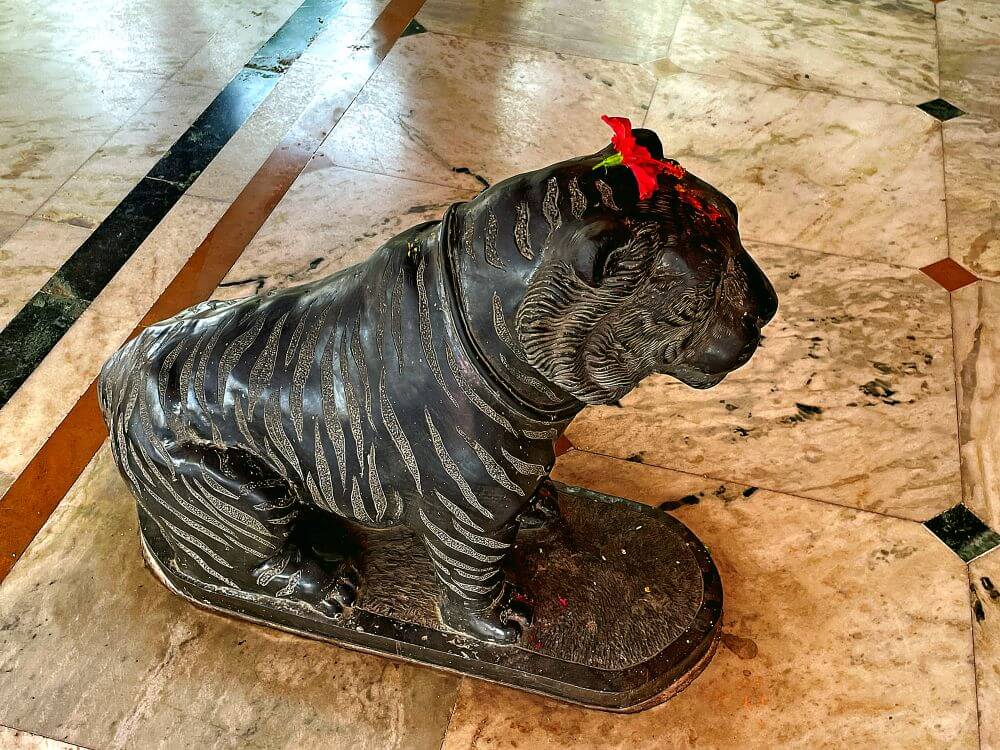
The sanctum sanctorum houses the divine idol consecrated according to ancient Vedic traditions, surrounded by serene courtyards and traditional temple architecture.
Navratri, Maha Shivratri, Annual Temple Jatra & Deepotsav
Compare and book flights, secure top-rated local hotels near the temple, hire reliable guides, and rent cars instantly.
Extend your pilgrimage by visiting other highly sacred temples located nearby.


Add ₹999 more to unlock FREE SHIPPING!
Your sacred cart is currently empty.
Shop Photo FramesFill in your delivery details below to place your order.
Add comment