
Add ₹999 more to unlock FREE SHIPPING!
Your sacred cart is currently empty.
Shop Photo FramesConsidered the final destination in the Ashtavinayaka pilgrimage sequence, the Sri Mahaganapati Temple at Ranjangaon is regarded as an extremely important place of faith for devotees. This site holds a special place among the eight power centers (Shakti Peethas) of the Ashtavinayaka. Here, Lord Ganesha had bestowed His darshan in His massive ‘Mahotkata’ form. This temple is considered a sacred place representing the confluence of devotion (bhakti), power (shakti), and liberation (mukti). The glory of this sacred region is spread across the entire Maharashtra. The Ashtavinayakas hold a very significant place on the cultural and religious landscape of Maharashtra. Ganesha is considered the deity of intellect and the remover of obstacles in all endeavors; therefore, this deity holds the preeminent right to worship in the daily life of Maharashtra. The Ashtavinayakas are eight swayambhu (self-manifested) temples of Ganesha in Maharashtra. These temples are primarily located in the districts of Pune, Raigad, and Ahilyanagar. All these murtis are considered ‘swayambhu’. Although the size and characteristics of the murti at each location differ, their core form is fundamentally that of Lord Ganesha.
These eight abodes include Mayureshwar of Morgaon, Chintamani of Theur, Siddhivinayak of Siddhtek, Mahaganapati of Ranjangaon, Vighneshwar of Ozar, Girijatmaj of Lenyadri, Varadavinayak of Mahad, and Ballaleshwar of Pali. According to religious belief, this pilgrimage begins with the darshan at Morgaon, and after having darshan of all the Ganeshas, the pilgrimage concludes by returning to Morgaon. The importance of these temples increased further during the Peshwa era. The Peshwa family were staunch devotees of Ganesha; hence, they made immense contributions to the repair and maintenance of the temples. Consequently, the influence of the Peshwa-era architectural style is clearly visible in the temple architecture. The Mahaganapati of Ranjangaon is mentioned in detail in the ‘Upasana Khanda’ of the ‘Ganesha Purana’ text, primarily in chapters ४४, ४५, and ४६. According to it, in ancient times, the name of this region was Manipur. Tripuraasura was born through the penance of Sage Gritsamada. Tripuraasura had performed intense worship of Lord Ganesha and obtained three impenetrable cities made of iron, silver, and gold, along with the boon of immense power. Backed by this power, he began harassing the gods. Thereafter, he even attempted to claim authority over Mount Kailash itself. Lord Shiva set out for war to defeat Tripuraasura, but initially, he did not achieve success. Then, upon the advice of Narada Muni, Lord Shiva devoutly worshipped Lord Ganesha in this very Manipur region. Pleased by Lord Shiva’s devotion, Ganesha gave him darshan and granted him the boon of victory to slay Tripuraasura. Subsequently, on the day of Kartik Shukla Pournima, Lord Shiva destroyed all three cities of Tripuraasura with a single arrow. After this victory, at the very spot where Ganesha gave darshan to Shiva, Lord Shiva Himself consecrated the Mahaganapati. Because of this, this Ganesha is called ‘Tripurari Varada Mahaganapati’. History scholars claim that the original construction of the temple at Ranjangaon must date back to the ninth or tenth century. Ancient stone murtis and distinctive carved slabs found from time to time in the temple premises corroborate this claim. Over the course of time, this temple was renovated many times and acquired a new form. According to historical records, the current construction of the main sanctum sanctorum (garbhagriha) of the temple was completed by Thorle Madhavrao Peshwa in the year 1764 CE. During the Peshwa period, this temple received special royal patronage. They had issued a sanad (decree) for the daily management of this sacred shrine. The tiled assembly hall (sabhamandapa) on the facade of the temple was renovated by Sardar Kibe of Indore at his own expense. Additionally, the construction of the galleries (ovaryas) surrounding the temple was brought to completion by the capable Maratha sardars Shinde and Pawar.
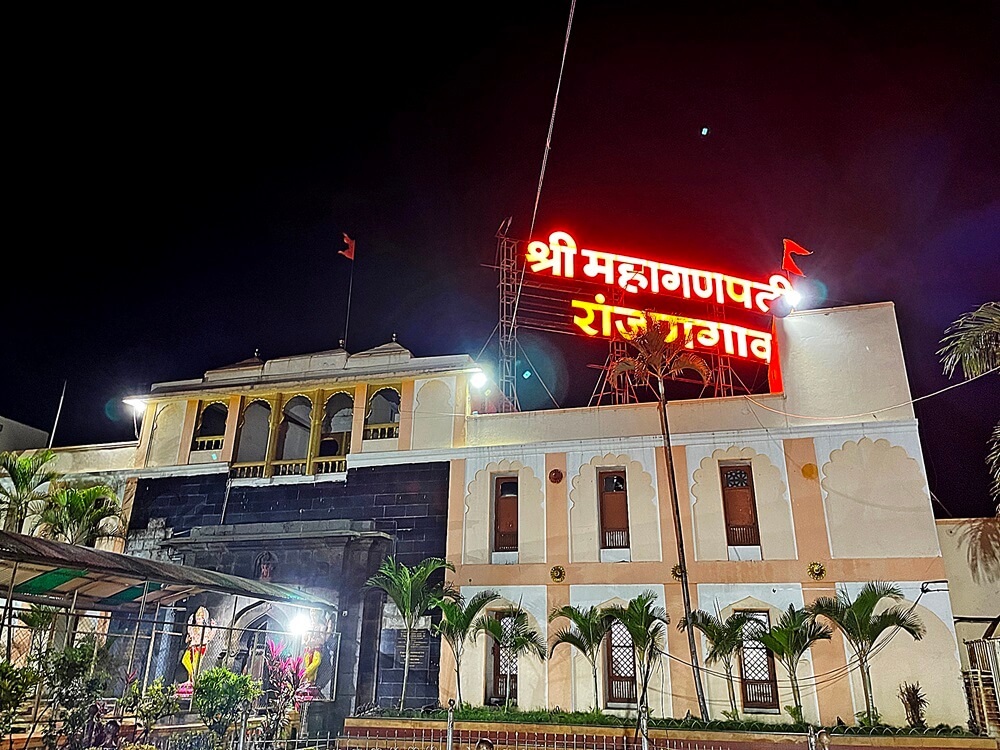
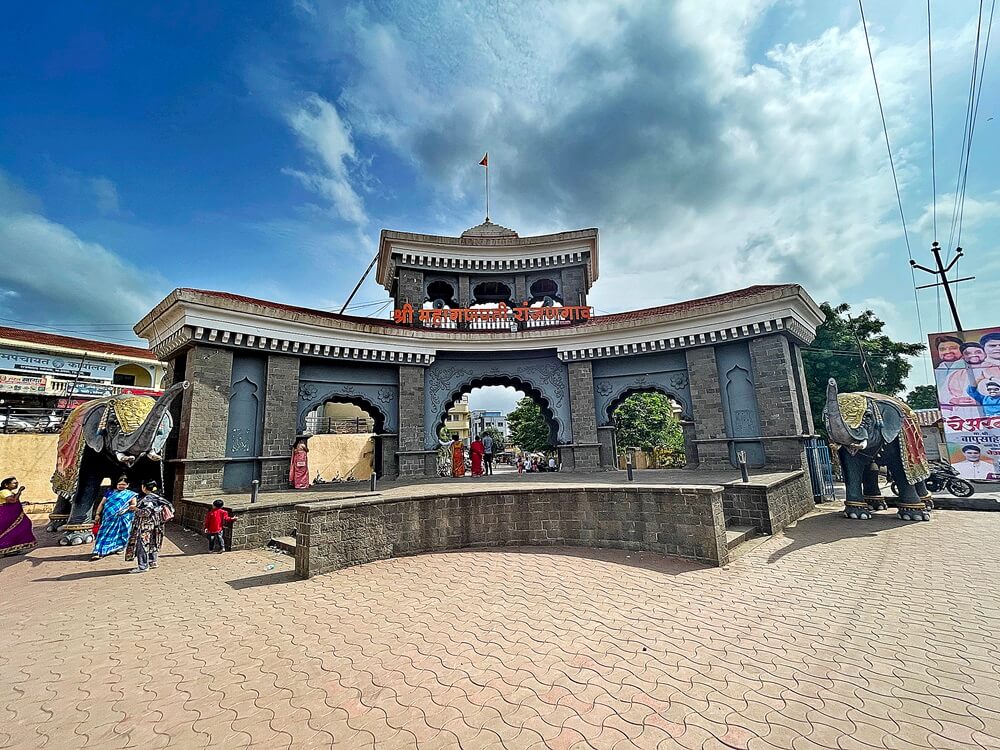
This Mahaganapati temple is situated in an area of about seven and a half acres. Within the boundary wall surrounding the temple, there is a two-storied grand entrance (mahadwara) with attractive elephant sculptures on both sides. In front of the entrance, there is a platform and seating for devotees. This fortress-like grand entrance has a total of three gateways. Arched toranas are carved on all three of these gateways. On the inner side of the main entrance are guard rooms. On the second floor of the grand entrance is the nagarkhana (drum house). On the roof of this nagarkhana is a dome-shaped shikhara, surmounted by a kalasha and a flag.
Coming inside through the entrance leads into the spacious courtyard of the temple. On both sides of the path leading from the grand entrance toward the temple are shops selling worship materials. Descending a few steps from here, we reach in front of the main temple. In the courtyard in front of the temple stands a small, semi-open temple supported by four ornate pillars. In this temple, upon a vajrapitha, are a Shiva linga and a vermilion-anointed stone of Munjoba. In front of the Shiva linga is the murti of Nandi.
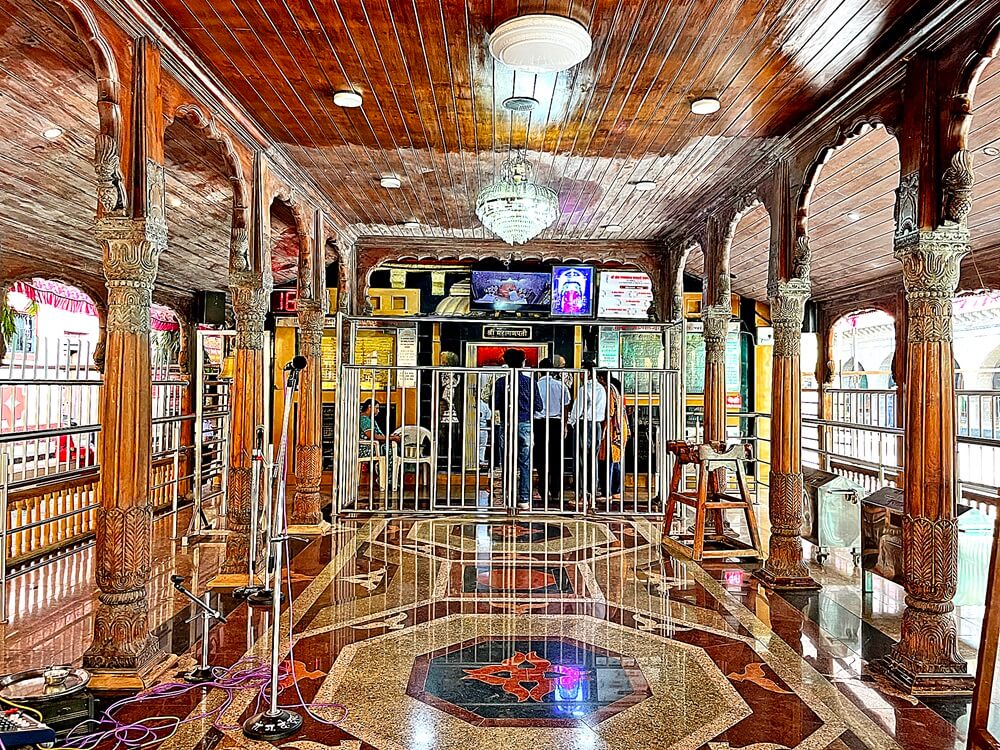
The layout of the main temple consists of a queue hall (rangamandapa), assembly hall (sabhamandapa), vestibule (antarala), and sanctum sanctorum (garbhagriha). The rangamandapa has stainless steel railings for managing the queues of devotees. This rangamandapa connects further to the sabhamandapa. In the sabhamandapa, there are four rows of wooden pillars. The pillars in each row are connected to one another by arched brackets. Resting on the wooden beams over the pillars is a wooden ceiling covered with tiles. In the sabhamandapa, facing the entrance of the antarala, is a silver murti of the mouse (mushaka).
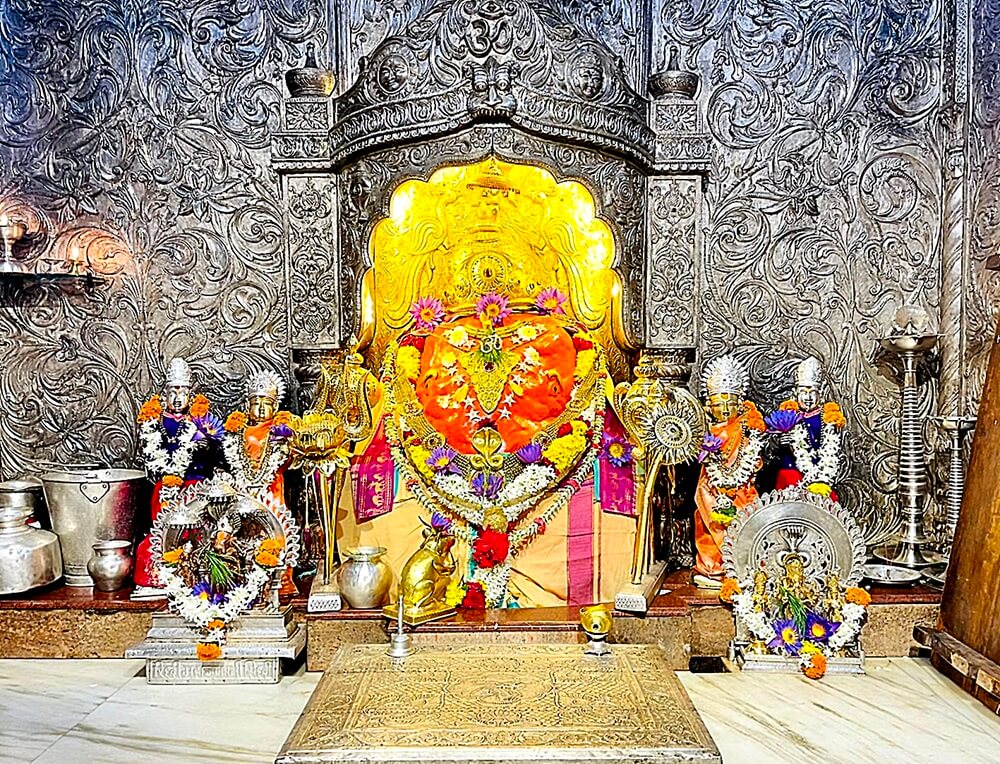
On both sides of the entrance to the sabhamandapa are silver murtis of door guardians (dwarapalas). The entrance to the antarala features intricate carving, with a murti of Ganesha at the top. There are two additional doors on the right and left sides to exit from the antarala. Further ahead is the entrance to the garbhagriha. The door frames and panels here are clad in embossed silver sheets. Due to the low height of the doorway, one has to enter the garbhagriha by bowing down. In the garbhagriha, against the back wall, is the vermilion-anointed stone murti of Mahaganapati. Beside Ganesha are silver murtis of Riddhi and Siddhi. All the interior walls of the garbhagriha are covered with silver plating featuring leaf and floral designs. There are niches (devakoshthakas) in the right and left side walls. On the roof of the sabhamandapa is a stepped, square-shaped shikhara, topped with an amalaka and a kalasha. On the roof of the garbhagriha is a five-tiered square shikhara. At the top of the shikhara are two amalakas placed one above the other, surmounted by a kalasha and a flag.
Near the Mahaganapati Temple, there is a temple dedicated to Lord Mahadeva. This temple houses Nandi and a Shivlinga in the sanctum sanctorum. Next to the Mahadeva Temple is the temple of Vitthal-Rakhumai. Further ahead, there is another small temple containing silver idols of Lord Ganapati along with Riddhi and Siddhi. In the temple courtyard, there is a Peshwa-era stone-built stepwell (barav). There is a Shivlinga in the niche of the stepwell. In the courtyard, at the back of the temple, is the Dhyanmandir (Meditation Hall). On the walls of the meditation hall, paintings providing information about the temple have been displayed. Among these, the painting of Lord Mahadeva worshipping Ganapati and the painting of Mahaganapati with ten faces and twenty hands are particularly special. The meditation hall houses the image of Morya Gosavi, silver padukas (footwear), and elephant sculptures. On another wall, there are sculptures of the Ashtavinayaka.
To the left of the temple are stone-built cloisters (ovaryas). The history of the temple is depicted through paintings on the walls of the cloisters. In the temple courtyard, there is a large building for the Annachhatra (free community kitchen). Next to this building is a two-storey Bhakta Niwas (pilgrim rest house). A free health centre is operated here. Outside the temple fortification lies the ‘Swanand Udyan’ (garden). The pond here is filled with lotus flowers, and various animal and bird replicas have been created in the garden.
Many festivals and celebrations are observed throughout the year at the temple. Every year, the Ganeshotsav is celebrated from Pratipada to Shashthi in the months of Bhadrapada and Magh. Notably, during this period, the villagers of Ranjangaon do not install independent idols of Ganapati in their respective homes, but instead worship collectively at the main temple. The tradition of ‘One Village, One Ganapati’ is considered a major highlight of this holy place. Tripurari Purnima, which falls after Diwali, holds special significance here. On this day, the entire temple illuminates with a grand display of lamps (Deepotsav). The ‘Atharvashirsha Patta’ crafted on a gold sheet by the temple trust is a special attraction of this temple.
This sacred temple stands as a testament to deep spiritual devotion, ancient architectural grandeur, and rich local cultural traditions.
The sanctum sanctorum houses the divine idol consecrated according to ancient Vedic traditions, surrounded by serene courtyards and traditional temple architecture.


Navratri, Maha Shivratri, Annual Temple Jatra & Deepotsav
Compare and book flights, secure top-rated local hotels near the temple, hire reliable guides, and rent cars instantly.
Extend your pilgrimage by visiting other highly sacred temples located nearby.


Add ₹999 more to unlock FREE SHIPPING!
Your sacred cart is currently empty.
Shop Photo FramesFill in your delivery details below to place your order.
Add comment