
Add ₹999 more to unlock FREE SHIPPING!
Your sacred cart is currently empty.
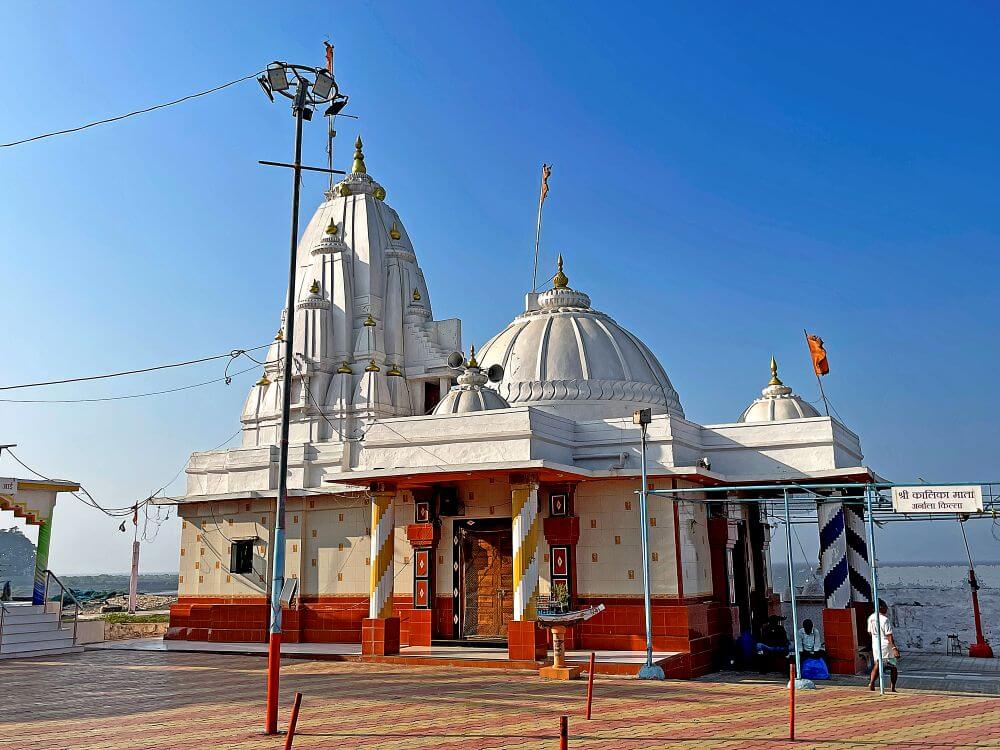
Shop Photo FramesThe Kalika Mata temple, dating back to the Peshwa era and situated on the Arnala sea fort—considered the most formidable fort in the Palghar district after the Vasai Fort—is one of the most renowned ancient temples in the region. Located within the sea fort, which is built at the mouth of the Vaitarna River approximately 250 meters into the sea, this Goddess is a place of deep faith for thousands of devotees, including the local Koli community. Known as a ‘Jagrut’ (awakened) deity who grants the wishes of those who pray with sincerity, hundreds of devotees visit the Arnala fort every day to seek her blessings.
Arnala Fort, a witness to many historical events during the Mughal, Portuguese, Peshwa, and British regimes, is also known as a Jal-durg (sea fort) as well as Janjira-Arnala. Sultan Mahmud Begada of Gujarat built this fort-like structure on Arnala Island in 1516 AD. Around 1530 AD, it was conquered by the Portuguese. At that time, the structures inside had domes and arches. The Portuguese demolished them and built a rectangular fort, 700 meters long with circular bastions, and stationed a military contingent there for protection. After Chimaji Appa conquered the Vasai Fort in 1738 AD,
Before that, in 1737 A.D., during the Maratha invasion of Salsette Island, Shankaraji Keshav captured the Arnala Fort from the Portuguese without much resistance. In a letter sent to Shrimant Chimaji Appa on April 13, 1737, Shankaraji Keshav stated, “I have returned from Kali Arnalia. Arnala was captured with great tact.” There is a Marathi inscription on the northern gate of this fort. It mentions that this fort was rebuilt in Shaka 1659 (1737 A.D.) during the reign of Peshwa Bajirao I by the fort architect Baji Tulaji. Shankaraji Keshav, under the supervision of Bajirao Belose and Chintaman Shivdev, employed three to four hundred men to strengthen this fort. The auspicious time (muhurta) for the commencement of its construction was determined by the astrologer Girdhar Joshi of Agashi. In terms of size and structural strength, this fort ranks second only to the Vasai Fort among all the forts in North Konkan.
According to a legend, while excavation for this fort was underway, idols of Goddess Kalika and Goddess Sheetala were discovered here. Around the same time, the Goddess appeared in a vision to an officer of the Peshwas, declaring that this was Her abode. She instructed that a temple be built at this site and that the construction of the fort should proceed only thereafter. Accordingly, in the year 1737 C.E., the Peshwas built a small tiled temple and consecrated the idols of the Goddess within it. The temple attained its present form after its renovation in the year 1977 C.E.
To reach Arnala from Virar railway station, one must take an ST bus, municipal transport bus, or an auto-rickshaw. From there, one must take a ferry boat to reach the fort on Arnala Island. This distance across the sea is approximately one kilometer. This fort, which covers an area of 700 square meters, has three gates, and the main entrance faces north. The mention of the renovation of this gate by Peshwa Bajirao I is inscribed in the center of its arch. This arch features exquisite carvings, with lions on both sides and elephants holding garlands in their trunks. There is also a temple of Trimbakeshwar within this fort.
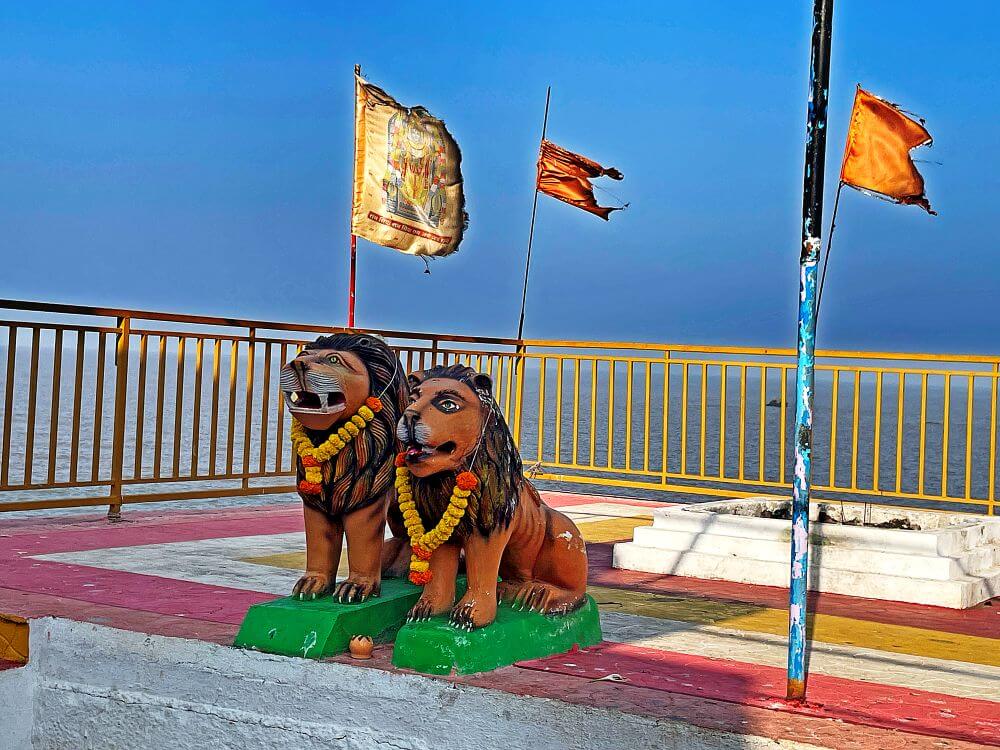
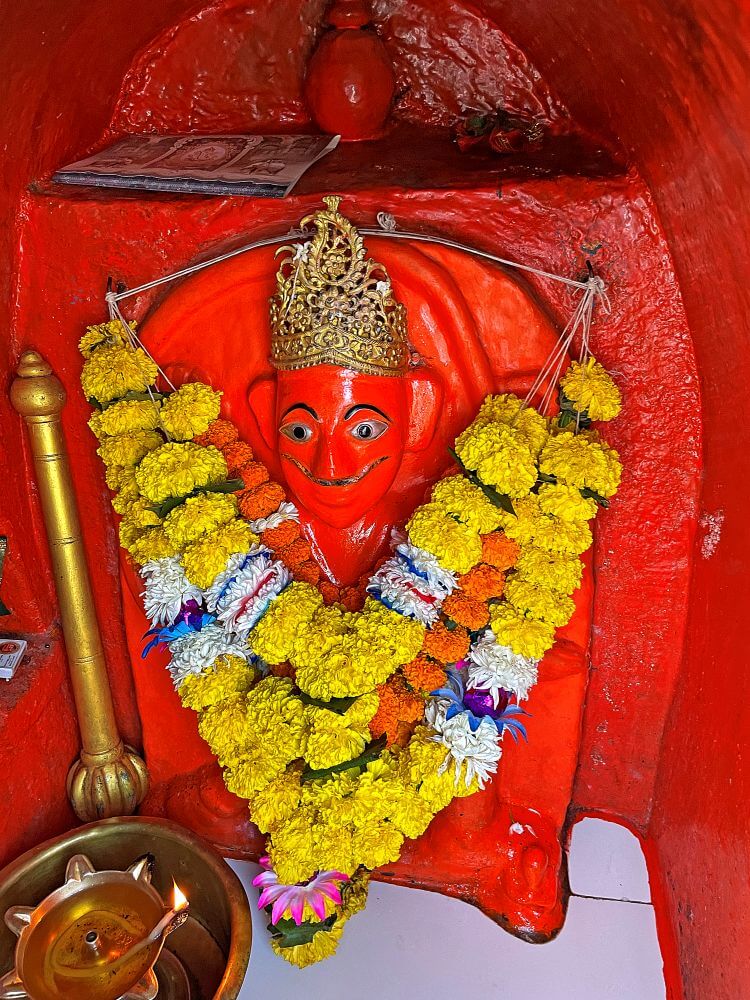
In the large courtyard in front of the Kalika Mata temple, there is paving with paver blocks. On the high platform in front of the temple, there are two statues of a lion, the vehicle of the Goddess, and behind them is a large Homa-kunda. Outside the temple, there is a small shrine of Hanuman and a boat-shaped Tulsi Vrindavan. This Hanuman idol has a golden crown on its head and a mustache on its face. It is said that the foundation of this Kalika Mata temple is 19 feet deep and sweet water was found there. The structure of the Kalika Mata temple consists of three Mukhamandapas (entrance porches), a Sabhamandapa (main hall), and a Garbhagriha (sanctum sanctorum). The temple has Mukhamandapas on the east, north, and south sides. These Mukhamandapas are open in nature and have dome-shaped roofs.
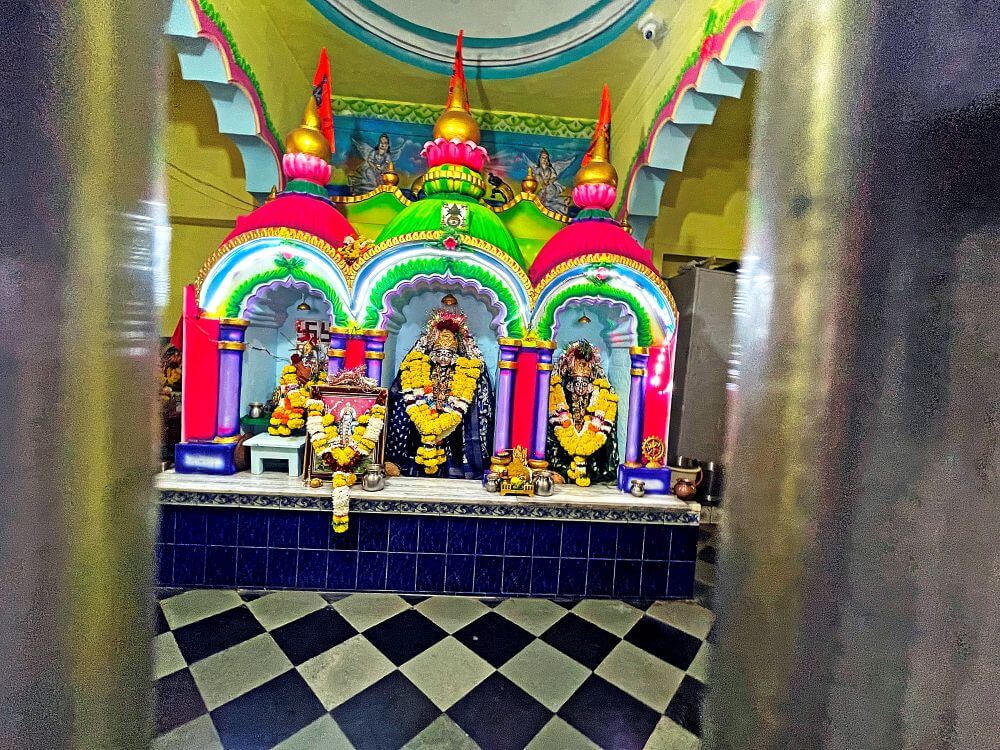
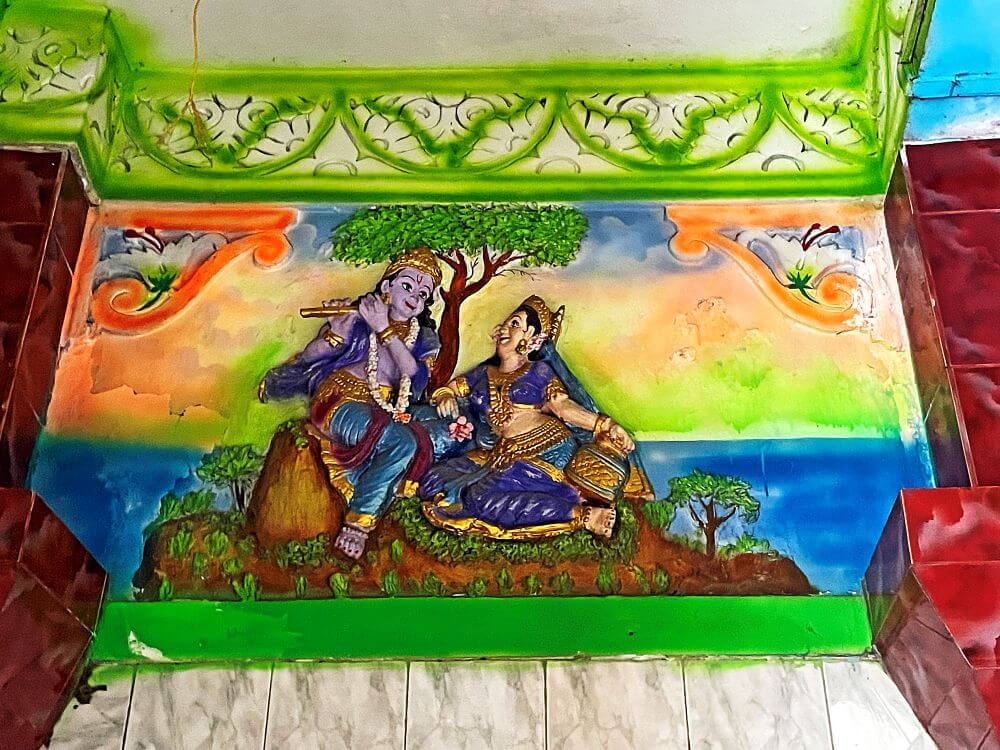
The walls of the assembly hall (sabhamandapa) here feature various mythological murals. Among them, on the wall at the entrance to the sanctum sanctorum (garbhagriha), is a depiction of Bhavani Mata bestowing the Bhavani sword upon Chhatrapati Shivaji Maharaj. Additionally, the murals include Lord Krishna preaching to Arjuna on the battlefield, a boatman ferrying Shri Ram, Lakshman, and Sita across the river in a boat, as well as Radha-Krishna and Sheshashayi Vishnu with Lakshmi. The ceiling of the assembly hall is adorned with intricate carvings and craftsmanship. In the first row, there are circular depictions of Gopis and Gopas playing with sticks (tiprya). The second row features auspicious water pots (mangalkalash), and the third row displays majestic elephants (gajaraj). At the center of the apex, a lotus flower is carved. Inside the sanctum sanctorum, upon a vajrapitha (throne), stands the idol of the adorned Kalika Mata with a silver mask in the center, framed by three arches. To the right of Kalika Mata is the idol of Ganpati, and to her left is the idol of Sheetala Devi. Near this temple, there is also a shrine dedicated to Ekvira Devi.
The villagers believe that the village has prospered due to the grace of Mother Kalika. The Goddess is worshipped here daily. Various festivals, including Hanuman Jayanti, are celebrated with great enthusiasm at this temple. The Sharadiya Navratri festival is the largest celebration held here. During Navratri, the surrounding area takes on the appearance of a fair. More than 50,000 devotees visit for darshan during this period. The temple is adorned with attractive decorative lighting throughout the festival. Many shops, including those selling puja offerings and prasad, are set up in the vicinity. During this time, various programs such as Aarti, Gondhal of the Goddess, Garba, and Homa on the day of Ashtami are organized. During this festival, the Koli community offers a puja thali and worships the Goddess. According to information in the Thane District Gazetteer, the temple received an annual grant (varshasan) of 91 rupees (9.2 pounds at the time) since the Peshwa era. However, this gazetteer from 1882, as well as the Marathi Vishwakosh, records this temple as belonging to Mother Bhavani. It is also noted that the fort houses a Trimbakeshwar temple, as well as the dargahs of two Muslim fakirs, Shah Ali and Haji Ali.
This sacred temple stands as a testament to deep spiritual devotion, ancient architectural grandeur, and rich local cultural traditions.
The sanctum sanctorum houses the divine idol consecrated according to ancient Vedic traditions, surrounded by serene courtyards and traditional temple architecture.
Navratri, Maha Shivratri, Annual Temple Jatra & Deepotsav
Compare and book flights, secure top-rated local hotels near the temple, hire reliable guides, and rent cars instantly.
Extend your pilgrimage by visiting other highly sacred temples located nearby.


Add ₹999 more to unlock FREE SHIPPING!
Your sacred cart is currently empty.
Shop Photo FramesFill in your delivery details below to place your order.
Add comment