
Add ₹999 more to unlock FREE SHIPPING!
Your sacred cart is currently empty.
Shop Photo FramesPiliv, a village that served as a jagir (fiefdom) during the Maratha era, is known for its Bhuikot (land) fort. The village is equally famous for the ancient temple of Mahalakshmi. Known as the Mahalakshmi of Piliv, the Goddess is affectionately addressed here as Lakhabai. The original abode of Lakhabai is situated on a small hill near the village. It is said that the temple of the Goddess at the foot of the hill was built about two hundred and fifty years ago. The fair held here is one of the largest in the district.
Mahalakshmi is the Adimaya (Primal Mother). According to the legend in the ‘Devi Mahatmya’, based on the ‘Durga Saptashati’ scripture, Mahalakshmi created two forms from the Tamoguna and Sattvaguna and instructed them to produce pairs of men and women suitable to their respective qualities. From this, the universe and creation were born. Thus, it is the belief of her devotees that Mahalakshmi is the Mula Prakriti (Original Nature) . This means that the Goddess is not a secondary consort of any deity like Brahma, Vishnu, or Mahesh. Rather, she is the embodiment of Brahman, the mother, nourisher, and destroyer of the universe. One of the three and a half Shakti Peethas is the Mahalakshmi temple in Kolhapur. The Goddess there is also known as Ambabai. This same Goddess is worshipped as Lakhabai in Piliv.
A legend is told here about how the Goddess, whose original seat is on the hill in Piliv, came to the foothills. According to it, there was a custom in Piliv that every full moon, women would go up the hill to seek the blessings of Lakhabai. However, it was difficult for pregnant, sick, or elderly women to climb the hill. Therefore, the women of the village once prayed to the Goddess. Moved by their devotion, the Goddess manifested at the foot of the hill in the form of a stone for the convenience of her devotees. The villagers together built a temple here. It is said that this temple was constructed in the eighteenth century . During that period, the Bhosale dynasty, associated with the Akkalkot Sansthan, held power here. Their land fort still stands in Piliv today.
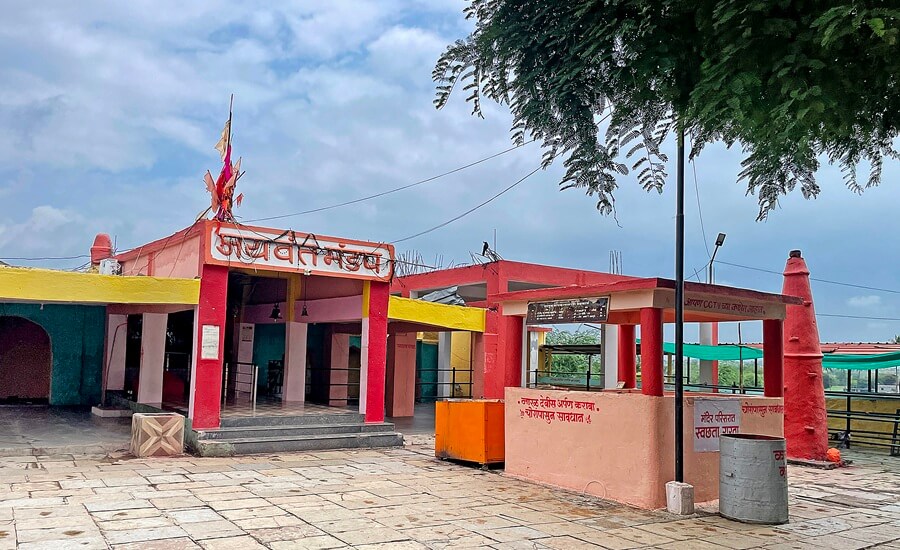
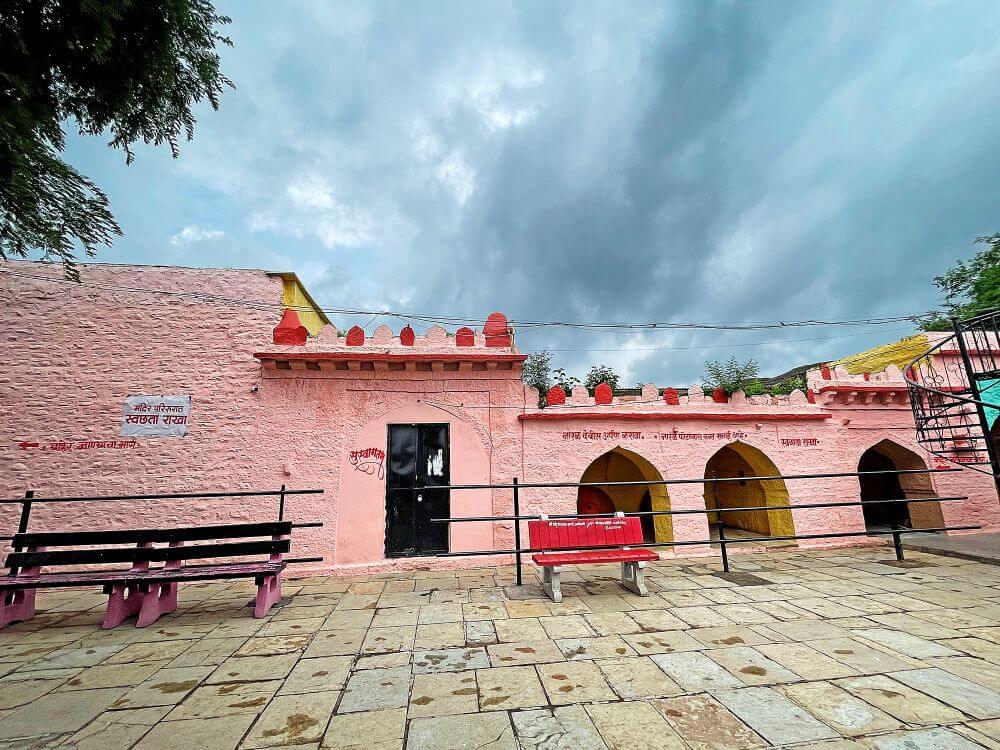
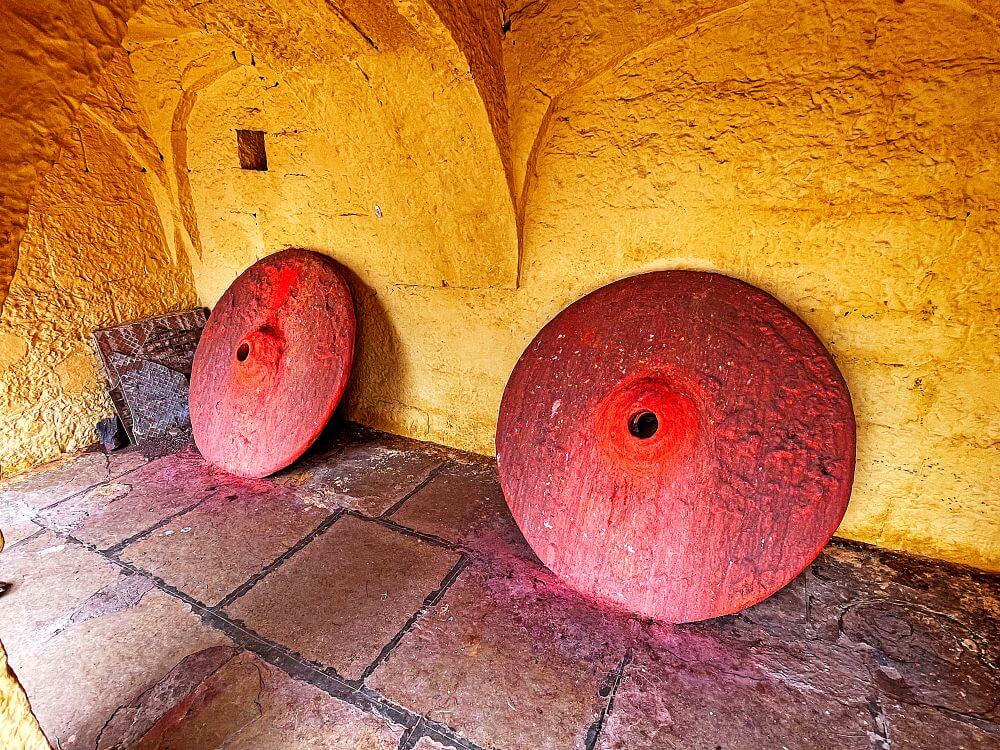
The perimeter wall surrounding the temple has a stone entrance that resembles a fort gate. Above the arched entrance, there is a hand motif and a balustrade. One enters the temple courtyard, which is elevated from the ground, by climbing a few steps from the entrance. In the paved courtyard, there is a deepastambha (lamp pillar) on the right, while on the left, along the inner side of the perimeter wall, there are stone cloisters. In one of these cloisters, there are two parts of an ancient grinding stone. Compared to traditional grinding stones, their size and weight are much greater. It is said that they were formerly used to crush lime and other construction materials required for the temple.
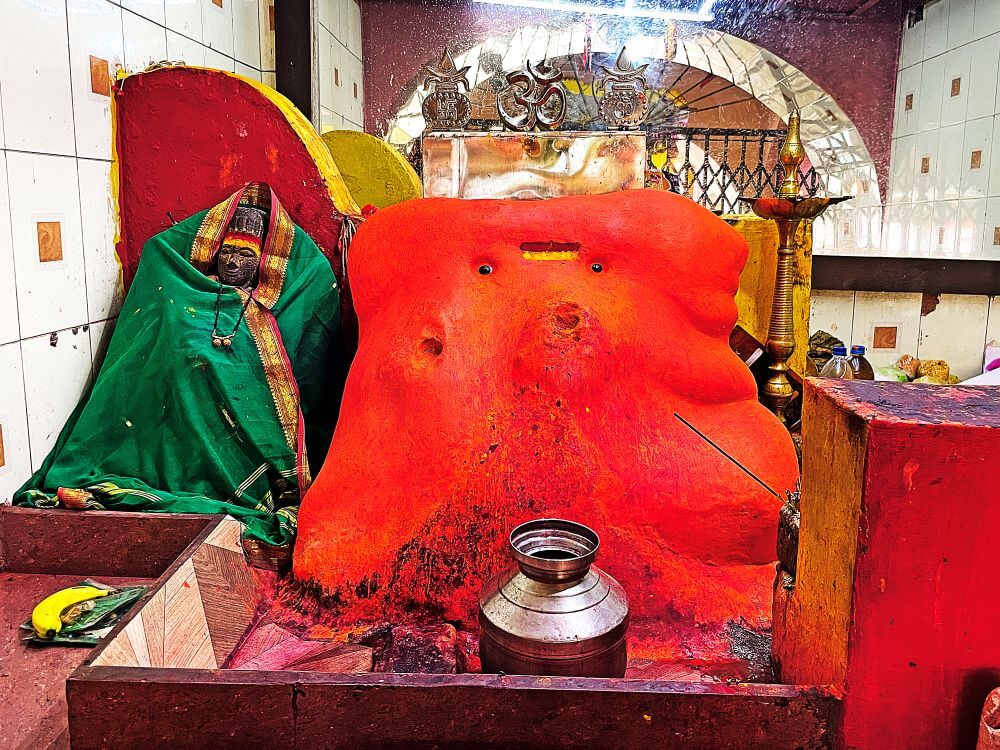
The temple structure consists of an open assembly hall (sabhamandap) and a sanctum sanctorum (garbhagriha). For the convenience of devotees , a queue system has been arranged in the assembly hall. In the sanctum, on a low pedestal, is the vermilion-smeared, rice-shaped (tandala) idol of the Goddess. The structure of sandalwood paste, eyes, nose, and mouth can be seen on the forehead of this idol. Next to this tandala idol, there is also a carved, four-armed idol of black stone holding weapons. Adorned with clothes and ornaments, this idol looks beautiful. During festivals, silver masks are placed on both these idols.
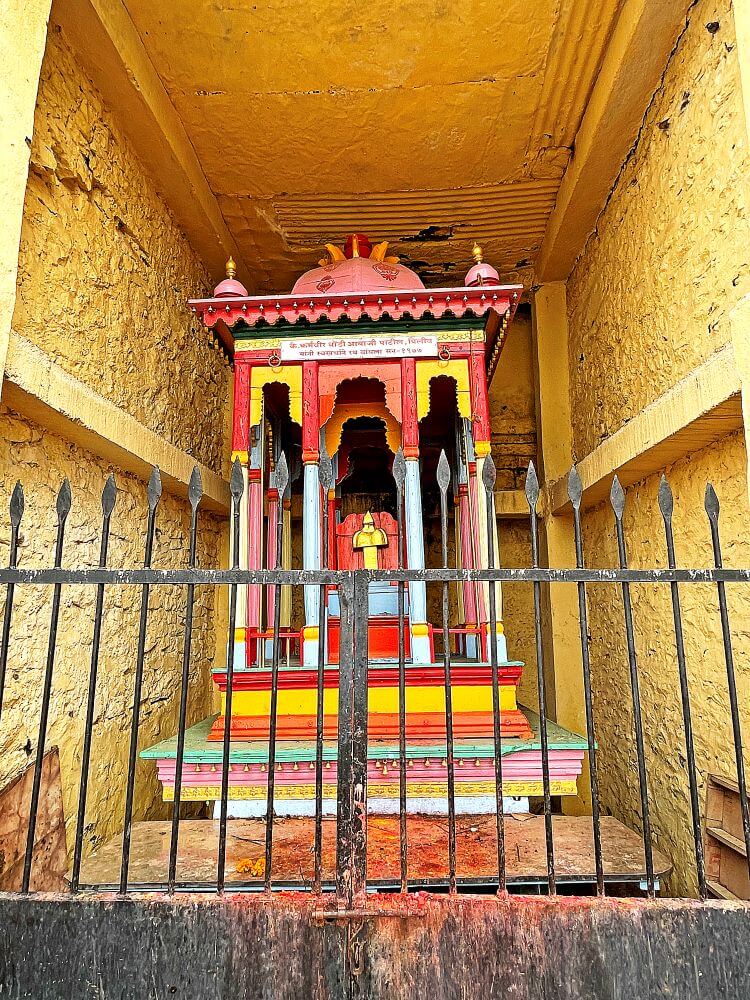
Near the perimeter wall of the temple, in a shed, is kept the large chariot in which the Goddess’s palanquin procession is taken out during festivals. The design of this entirely wooden chariot is similar to the temple. Like the temple, it has pillars, a pedestal, and five spires on top. The late Karmavir Dhondi Abaji Patil of Piliv had this chariot made at his own expense and donated it to the temple in the year 1977. Since then, the Goddess’s procession has been carried out on this very chariot.
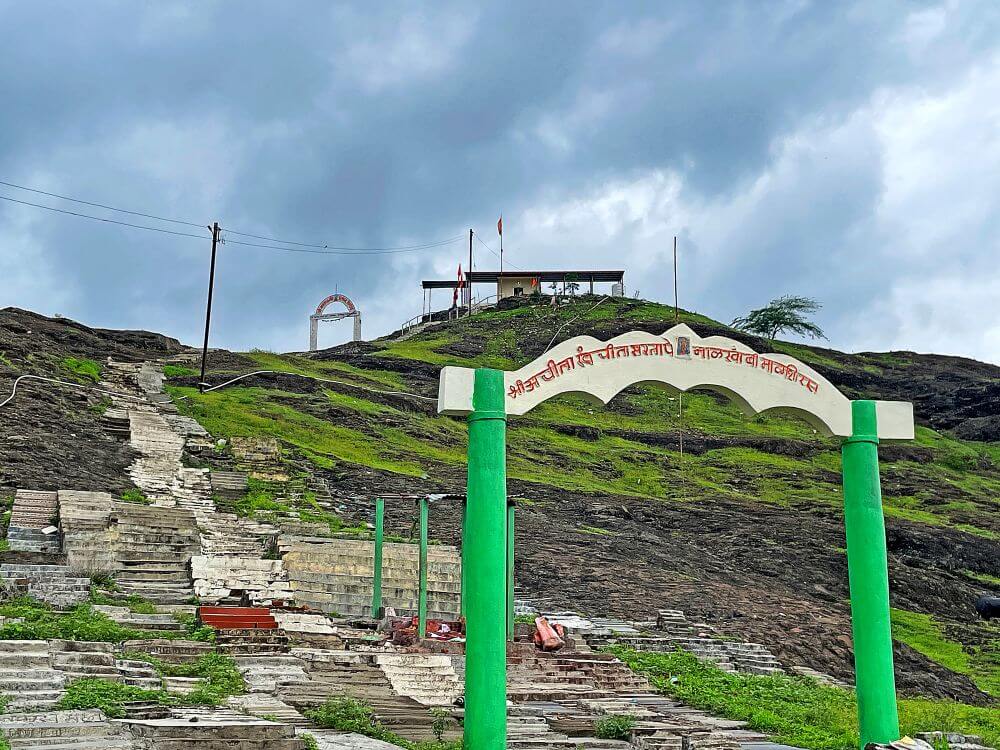
From the back of this temple at the foothills, there is a path leading to the original seat of the Goddess on the hill. There are two arches on this path. One can reach the temple in about 10 to 15 minutes via the steps. In the small temple located there, there are two tandala idols of the Goddess. It is the custom here to first seek the blessings of the Goddess on the hill and then visit the Goddess at the foothills. This order of worship is followed by the devotees who come here. However, those who cannot go up the hill due to health reasons seek the blessings of Mahalakshmi in the temple at the foothills.
According to the priests, at least ten to fifteen thousand devotees come here for the darshan of Mahalakshmi every full moon. The Navratri festival is also celebrated here on a grand scale. The fair held every year in the month of Magh is the most important festival in this temple. Devotees of Mahalakshmi from other states also come for this fair, which lasts from Magh Purnima to Mahashivratri. Like any other fair, the Goddess’s palanquin procession is taken out here as well. It begins from the Metkari Wada. The wooden chariot of Goddess Mahalakshmi is decorated and taken out in a procession amidst the sound of various musical instruments. The chariot moves forward amidst the chants of ‘Mahalakshmi Devi chya navan changbhala’ and ‘Aai Raja Udo Udo’. Walking through the main market of the village, the procession returns to the Mahalakshmi temple after circling a one-kilometer radius according to tradition, amidst the laying of carpets and fireworks.
During the fair, grand wrestling matches are held here. Bullock cart races take place. An exhibition of various tools required by farmers, livestock, and agricultural produce is held here. It is said that at least two to two and a half lakh devotees attend this fair.
This sacred temple stands as a testament to deep spiritual devotion, ancient architectural grandeur, and rich local cultural traditions.
The sanctum sanctorum houses the divine idol consecrated according to ancient Vedic traditions, surrounded by serene courtyards and traditional temple architecture.
Navratri, Maha Shivratri, Annual Temple Jatra & Deepotsav
Compare and book flights, secure top-rated local hotels near the temple, hire reliable guides, and rent cars instantly.
Extend your pilgrimage by visiting other highly sacred temples located nearby.


Add ₹999 more to unlock FREE SHIPPING!
Your sacred cart is currently empty.
Shop Photo FramesFill in your delivery details below to place your order.
Add comment