
Add ₹999 more to unlock FREE SHIPPING!
Your sacred cart is currently empty.
Shop Photo FramesIn Hindu Dharma, Lord Mahadev is as venerable as Lord Shriram. Among the Trinity of Brahma, Vishnu, and Mahesh, Shriram is considered an avatar of Lord Vishnu. Yet, Shriram himself considers Mahadev to be worthy of worship. It was by the grace of Mahadev that Shriram was able to lift the Shiva Dhanushya at Sita’s Swayamvara. When Shriram set out on his campaign to Lanka, he consecrated Shiva Lingas at many places along the way. Among these, the Rameshwar Temple in South India is the most famous. One of the renowned temples established by Shriram is in the village of Yedshi in Dharashiv district. It is believed that the living deity Mahadev here grants the wishes of his devotees.
It is said that this ancient temple dates back to the twelfth century. In the latter half of the eighteenth century, Ahilyadevi Holkar renovated this temple. In recent times, the temple’s assembly hall (Sabhamandap) has been renovated, giving the temple a modern appearance. The legend associated with this temple is that when Ravana abducted Sita, a battle took place between Jatayu and Ravana on the way. While wandering in search of Sita, Rama encountered the wounded Jatayu here. To quench Jatayu’s thirst, Rama struck the ground with an arrow, creating a water spring. After narrating the entire story of Sita’s abduction to Shriram, Jatayu breathed his last. After performing the final rites for Jatayu, Rama consecrated a Shiva Linga here. Because of this, the temple is known as Ramling.
This temple is part of the Yedshi Wildlife Sanctuary on National Highway number 52. There is a spacious parking area on the hilltop, higher than the temple. Around this parking area, there are many restaurants and shops selling worship materials. From here, there are 151 steps built of carved stone leading down to the temple nestled in the lap of the hills. At the starting point of the stairway, there is a welcome arch for the temple. There are stone railings on both sides of the stairway. In the middle of the stairway, there is an ancient lamp tower (Deepmal) in the railing on the left side. A short distance from the entrance is the Samadhi of the ascetic Mahaisurkar Maharaj.
The temple is surrounded by a strong fortification wall. There are entrances in the east and west directions of the fortification. The main entrance on the west side is two-storied. On the upper floor of the entrance, there is a Nagarkhana and a decorative parapet on the roof. Adjoining the fortification are about fifteen to twenty cells. Devotees visiting the temple use these cells as a pilgrim rest house (Dharmashala). There are stairs to go onto the fortification adjoining the cells. In the courtyard, on one side, there is a platform with a Shiva Linga. It is said that this is the site of Siddheshwar.
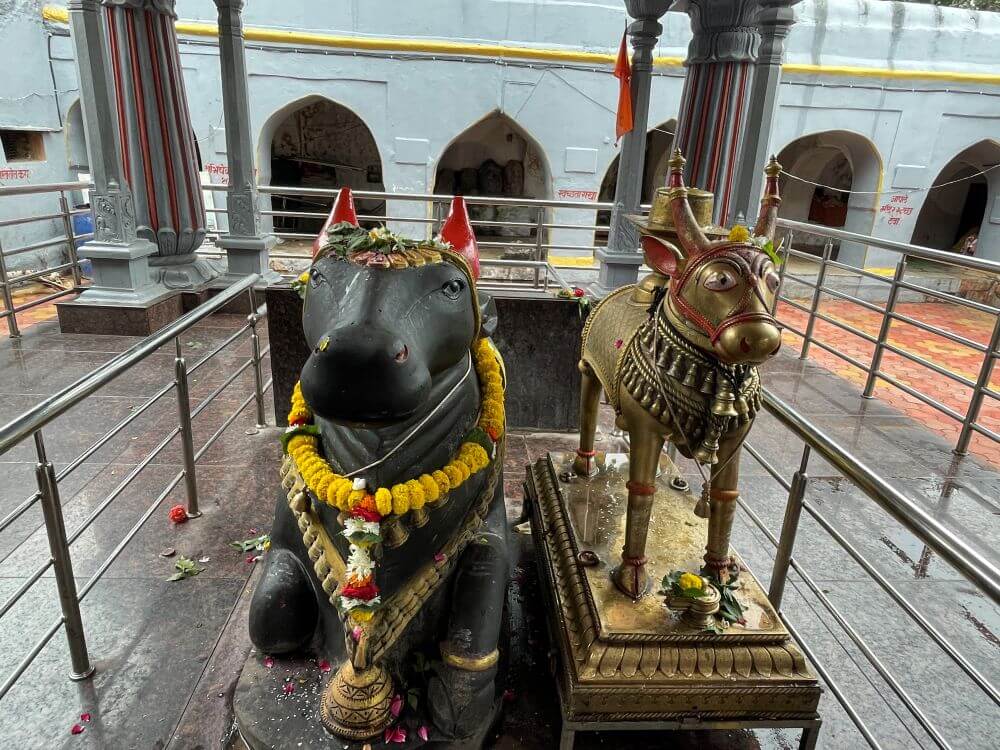
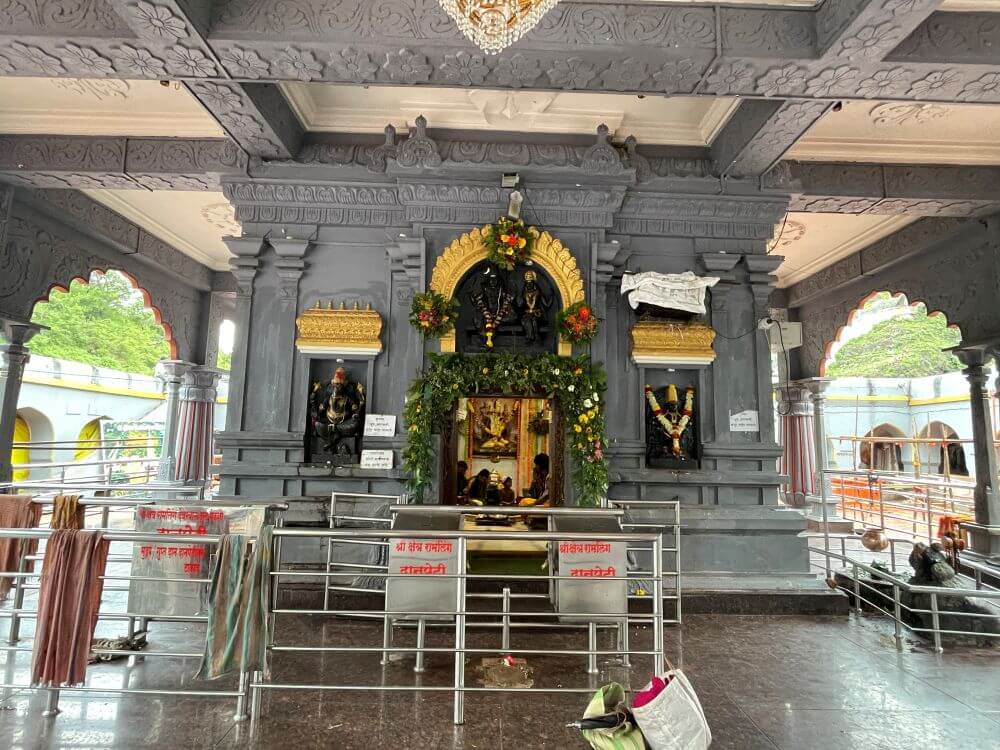
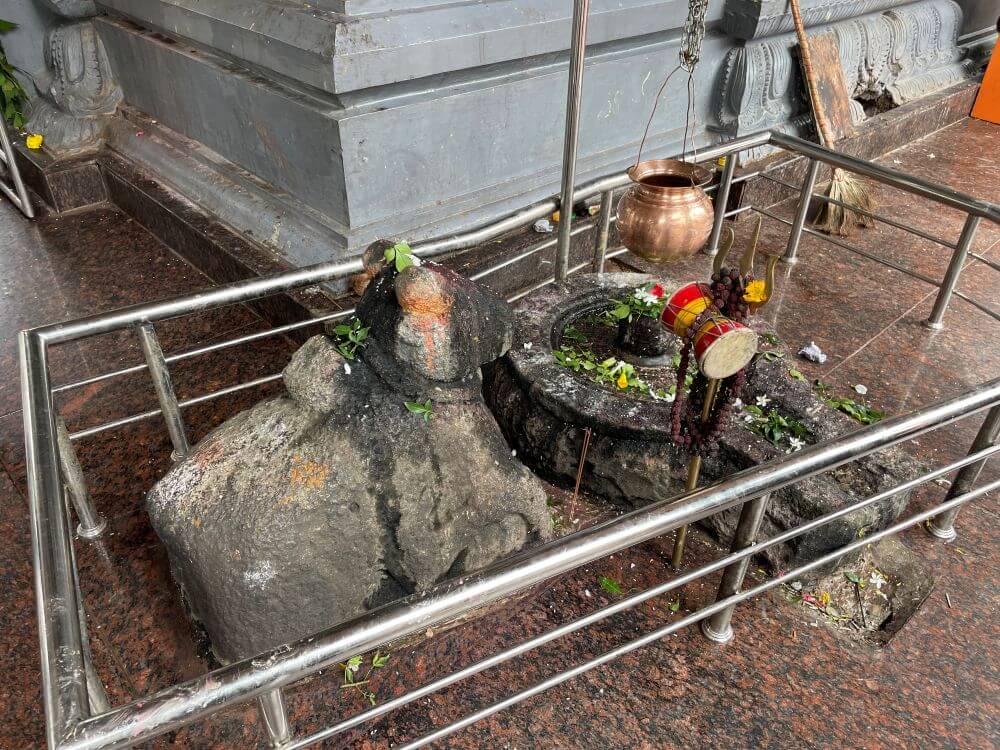
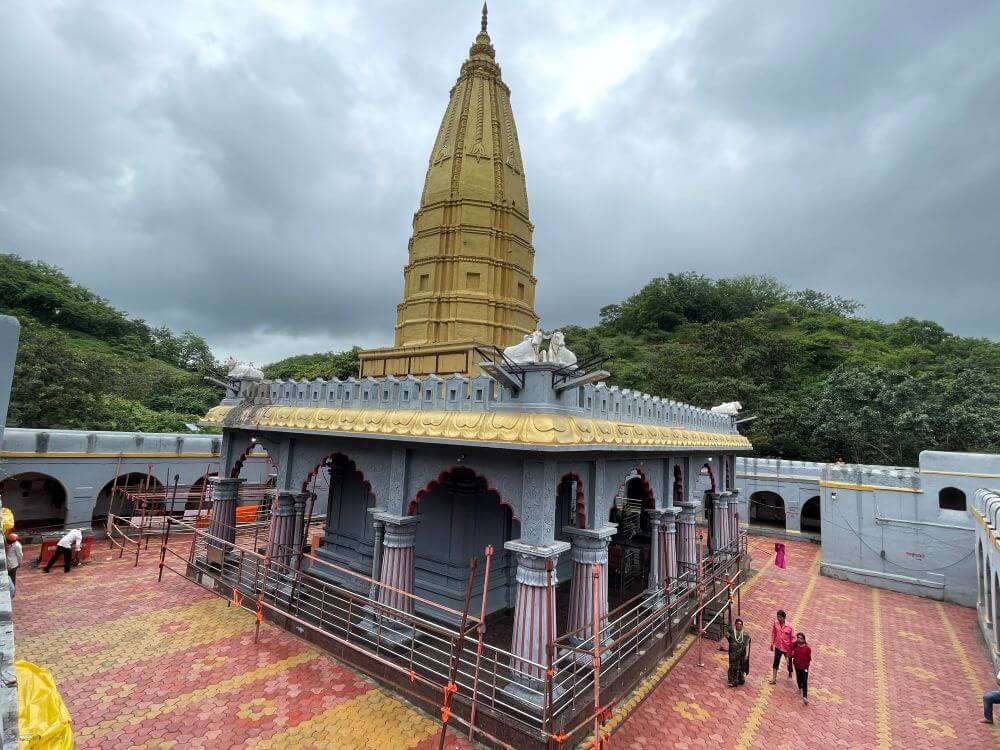
The structure of this temple consists of a front hall (Mukhamandap), an assembly hall (Sabhamandap), and a sanctum sanctorum (Garbhagriha). The temple has a total of 24 circular pillars. The outer pillars are connected to each other by arched gateways. The front hall, which has four pillars, houses the Jatayu Samadhi site. In front of it are sculptures of Shriram and Lakshman giving water to the wounded Jatayu. Further ahead in the assembly hall, on a platform, is a black stone idol of Nandi and a brass Nandi next to it. During festivals, a procession of Mahadev’s mask is taken out on the back of this brass Nandi.
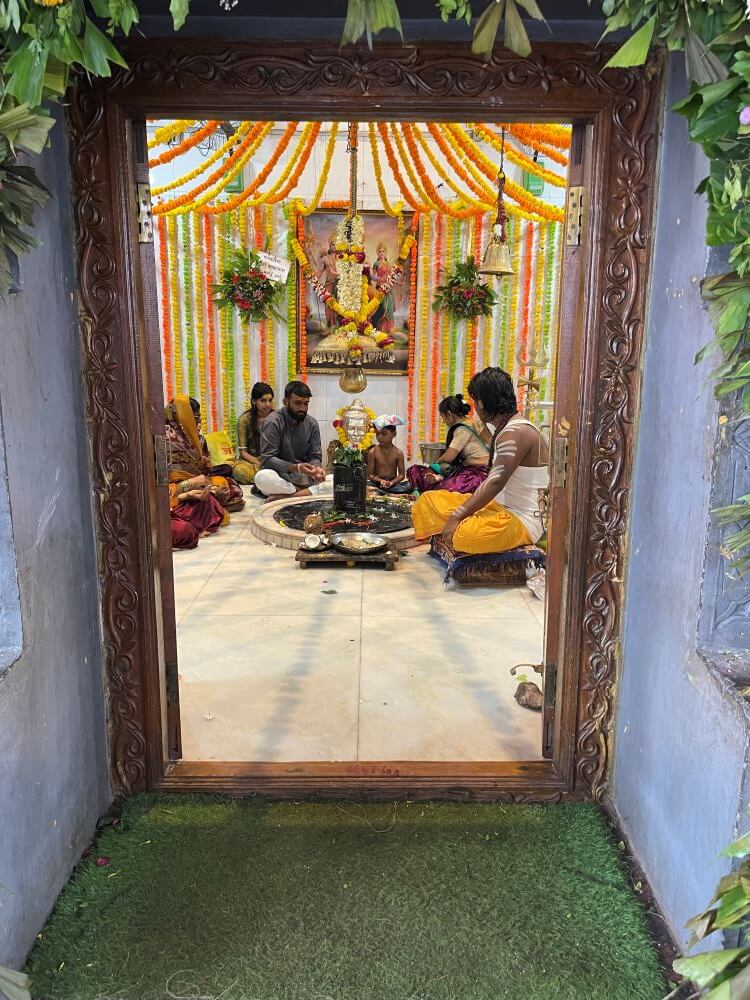
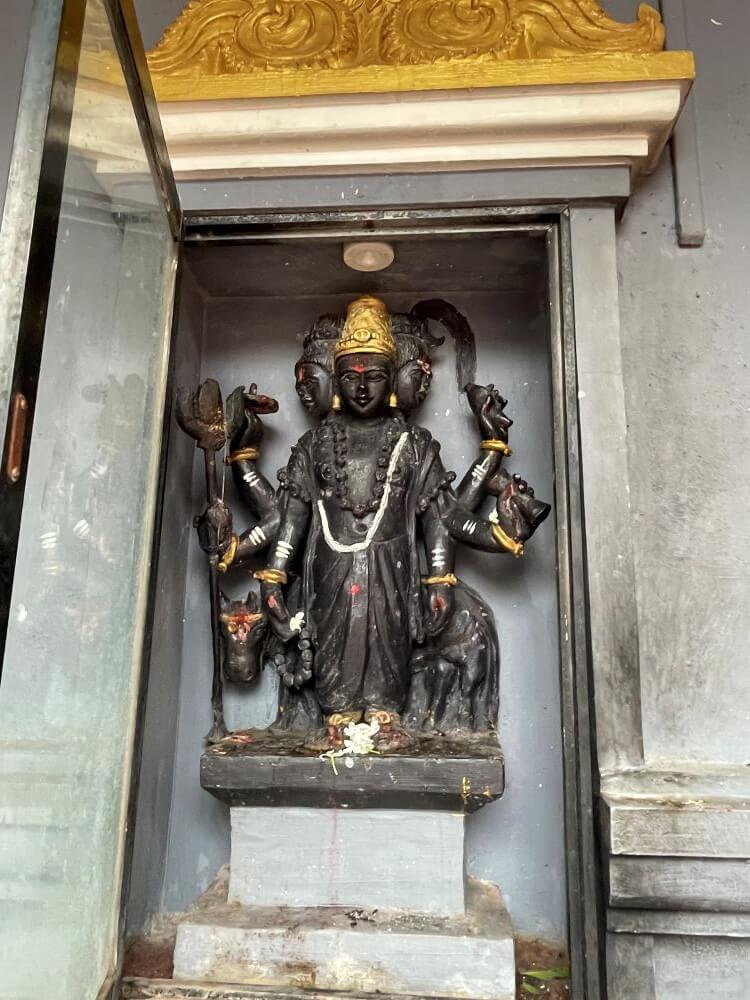
The open-style assembly hall has an arrangement for a queue for Darshan. On the front wall of the sanctum sanctorum, on both sides of the entrance, there are Bhairav guardian sculptures in the niches. In the niches above the entrance are idols of Shankar-Parvati. In the sanctum sanctorum, there is a Shiva Linga in the center on the floor, and a copper vessel for ritual bathing (Abhishek) is hung from the ceiling, dripping water onto it. There is a circumambulation path (Pradakshina Marg) around the exterior of the sanctum sanctorum.
The roof of the temple has a parapet on all four sides. On this parapet, there are sixteen Nandi idols at the eight corners. On the roof of the sanctum sanctorum, there is a square spire (Shikhara) with seven layers, about thirty feet high. In the third layer of the spire, there are eight niches. The fifth layer is taller and more tapered. At the top, there are two Amalakas one above the other, topped by a finial (Kalash). In the temple courtyard, there are some ancient idols. These include idols of Mahadev, Vishnu, Maruti, Shiva Linga, memorial stones (Virgal), and Nandi. It is said that these idols are one thousand to twelve hundred years old.
Behind the temple, in the mountains, there is a waterfall and a pond. Thousands of tourists come here to enjoy nature. A short distance from here, a continuous stream of water flows from a cow-mouth (Gomukh) in the mountain. It is believed that this is the place where Shriram struck an arrow to create the water spring. The water from this Gomukh is used for the daily ritual bathing of Mahadev. A short distance from here is Sita’s bathing area. In the temple premises, there are watchtowers built by the Forest Department. Sitting on them, one can observe the nature, animals, and birds of the area. There is a resting center for devotees in the area.
The main annual fair, Champashasthi, which lasts for five days, is celebrated with great enthusiasm at the temple. There is a special crowd at the temple on Mahashivratri. On all Mondays of the month of Shravan, more than one lakh devotees visit the temple. On Kartik Amavasya, devotees perform full-body prostrations (Dandavat) from the Siddheshwar site to the Ramling Temple as a vow. On the midnight of Margashirsha Shuddha Chaturthi at twelve o’clock, the mask of Ramling Mahadev is placed on the brass Nandi, and five circumambulations of the temple are performed with this Nandi. At sunrise, near the Jatayu Samadhi, flowers are offered, and a prophecy (Bhaknuk) is made predicting the year’s crops, water, and other events. After that, an offering of jaggery and coconut is made to the deity. The number of devotees visiting the temple is high every Monday, on full moon days, new moon days, and holidays. Devotees can have Darshan here every day from six in the morning until eight in the evening.
This sacred temple stands as a testament to deep spiritual devotion, ancient architectural grandeur, and rich local cultural traditions.
The sanctum sanctorum houses the divine idol consecrated according to ancient Vedic traditions, surrounded by serene courtyards and traditional temple architecture.
Navratri, Maha Shivratri, Annual Temple Jatra & Deepotsav
Compare and book flights, secure top-rated local hotels near the temple, hire reliable guides, and rent cars instantly.
Extend your pilgrimage by visiting other highly sacred temples located nearby.


Add ₹999 more to unlock FREE SHIPPING!
Your sacred cart is currently empty.
Shop Photo FramesFill in your delivery details below to place your order.
Add comment