
Add ₹999 more to unlock FREE SHIPPING!
Your sacred cart is currently empty.
Shop Photo FramesIn the ‘Hanuman Chalisa’ composed by the great poet Tulsidas, Hanuman is described as one who can assume both a microscopic and a formidable form. In his ‘Hanuman Stotra’, Samarth Ramdas Swami has described him as ‘Bhimrupi’ (formidable) and ‘Mahabali’ (greatly powerful). Generally, he is worshipped in this heroic form. However, in regions like Rajasthan, Uttar Pradesh, and Madhya Pradesh, Hanuman is worshipped in his childhood form, and hence he is called Balaji Hanuman. A magnificent temple of this Balaji form of Hanuman is situated at Ganganagar.
Spread over a grand campus of two lakh square feet, this temple is known as the Salasar Balaji Temple. The story behind this name is that the Balaji Hanuman here is a replica of the Balaji Hanuman of Salasar in the Churu district of Rajasthan. Salasar is considered the original abode of Balaji Hanuman. The legend states that in the eighteenth century, there lived a saint named Mohandas Maharaj in Rajasthan. Pleased by his devotion, Hanuman promised to appear before him in the form of an idol. Subsequently, in the year १७५५, an idol of Hanuman was suddenly discovered in a farmer’s field in the village of Asota in the Nagaur district. That same night, Hanuman appeared in a dream to the village Thakur and instructed him to send the idol to Salasar in the Churu district.
It is said that on the same night, another devotee of Hanuman had a dream about this idol. After he conveyed this to Mohandas Maharaj, the Maharaj immediately sent a message to the Thakur of Asota to send the idol. Seeing this, the Thakur was astonished and, following the instructions of Mohandas, sent the idol in a bullock cart. Mohandas had instructed that the idol should be installed wherever the cart’s bulls stopped. After some time, the bulls stopped on a sand dune. At that very spot, the idol was consecrated on the day of Shravan Shukla Navami in the year १७५५. Thereafter, in १७५९, the Maharaj had the temple built at Salasar by artisans named Noor Mohammad and Dau, and Balaji Maharaj was installed within it. Notably, this idol of Hanuman in the Balaji form features a beard and mustache.
The idol of Salasar Balaji in the temple located in the Ganganagar area of Akola was consecrated on the day of Hanuman Jayanti, April १५, २०१४, at the hands of Govindgiri Maharaj (Kishore Vyas) and Acharya Balakrishna Shastri (Sujangarh). In this temple, one can also have the darshan of the Ram Darbar, the Shiva family, and Radha-Krishna.
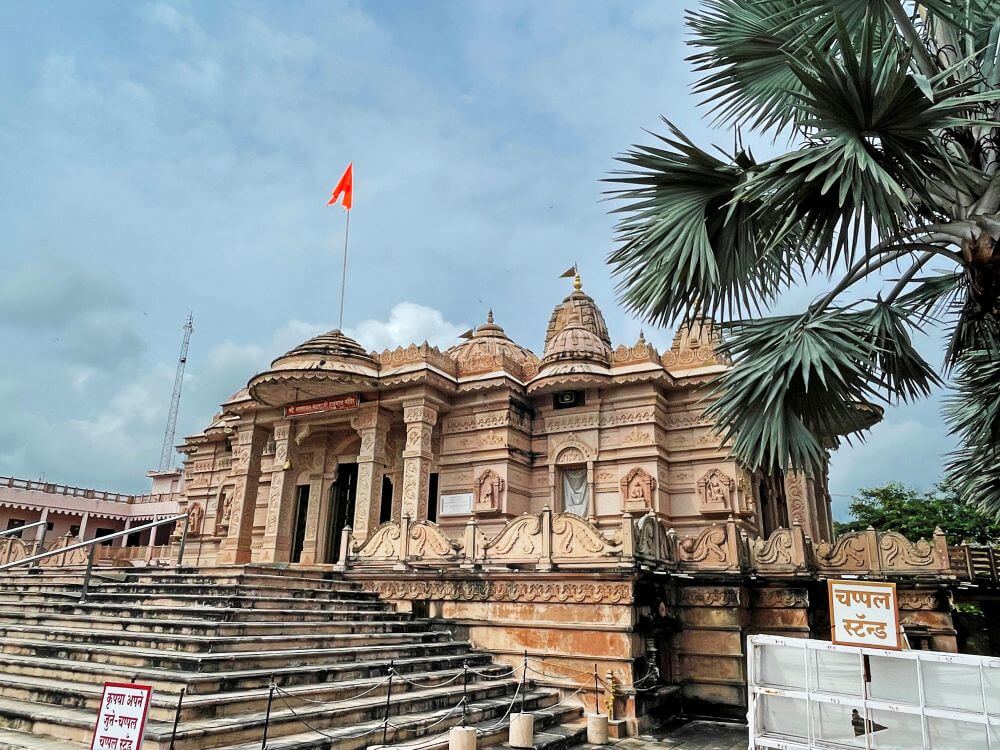
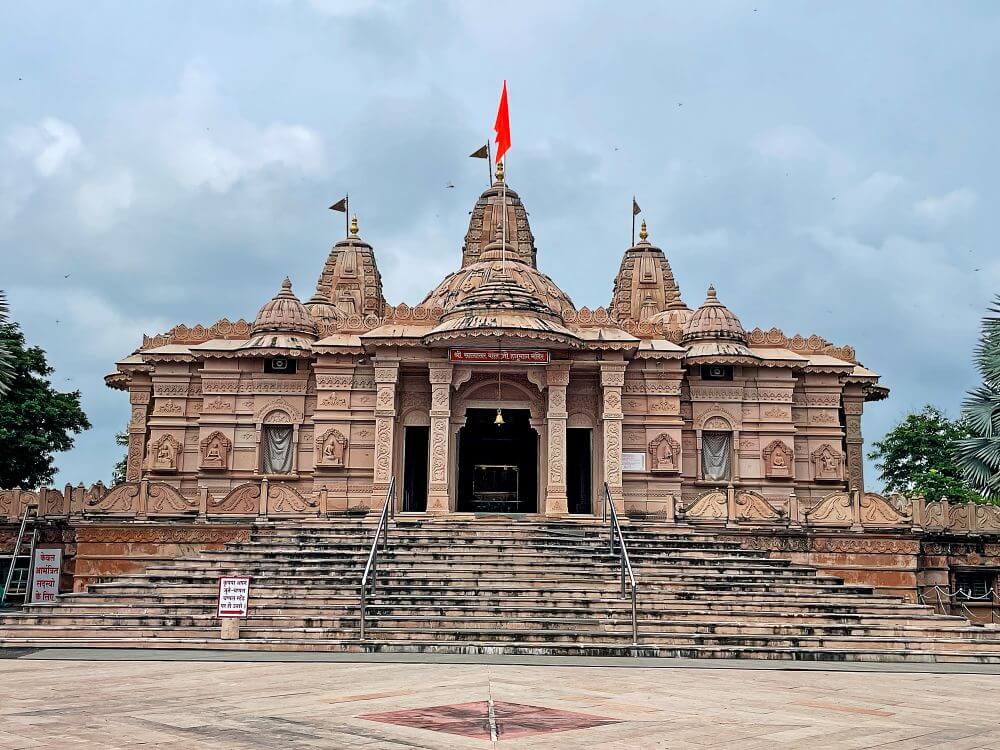
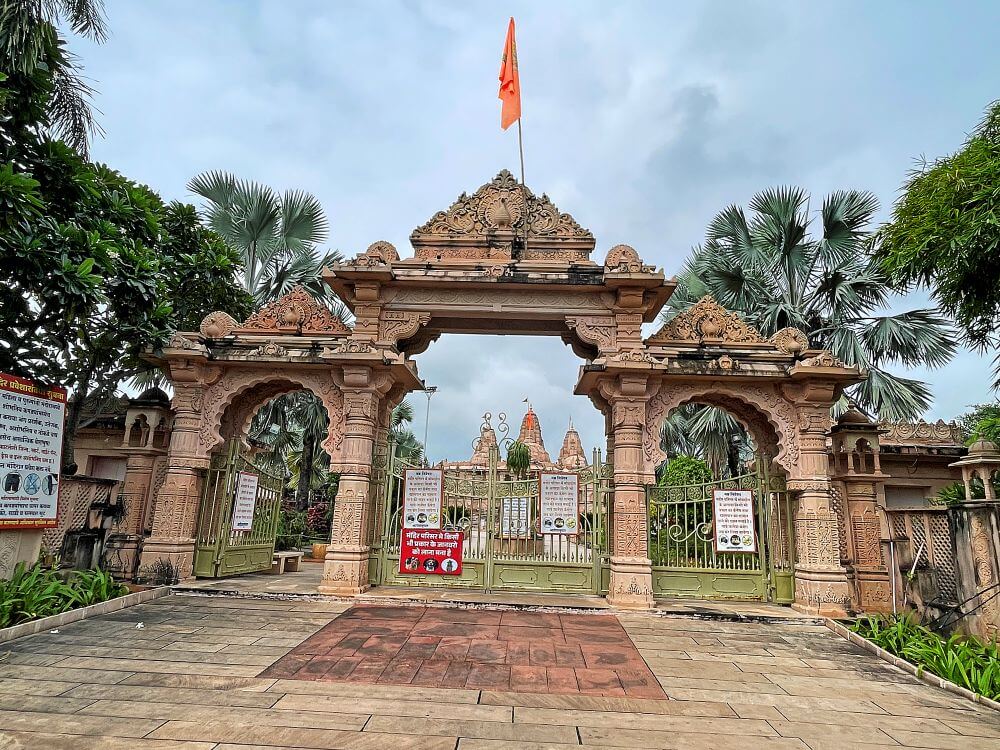
The temple premises are peaceful and serene. One enters the temple courtyard through a grand gateway in the surrounding wall. This gateway has one main entrance and two smaller doors on the sides. The entire construction of the temple, including the gateway, is done in a specific type of stone known as Rajasthani Sandstone. A beautiful garden has been developed in the courtyard. The beautiful flowering plants and fountains make the entire area appear enchanting. One can reach the temple from the entrance through the garden path.
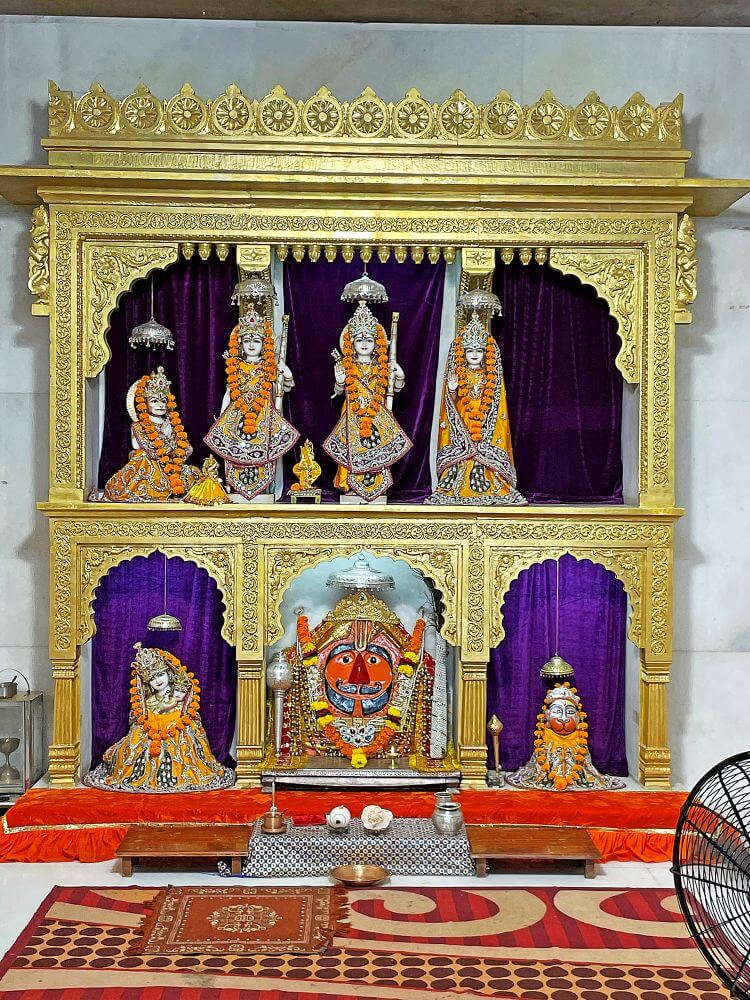
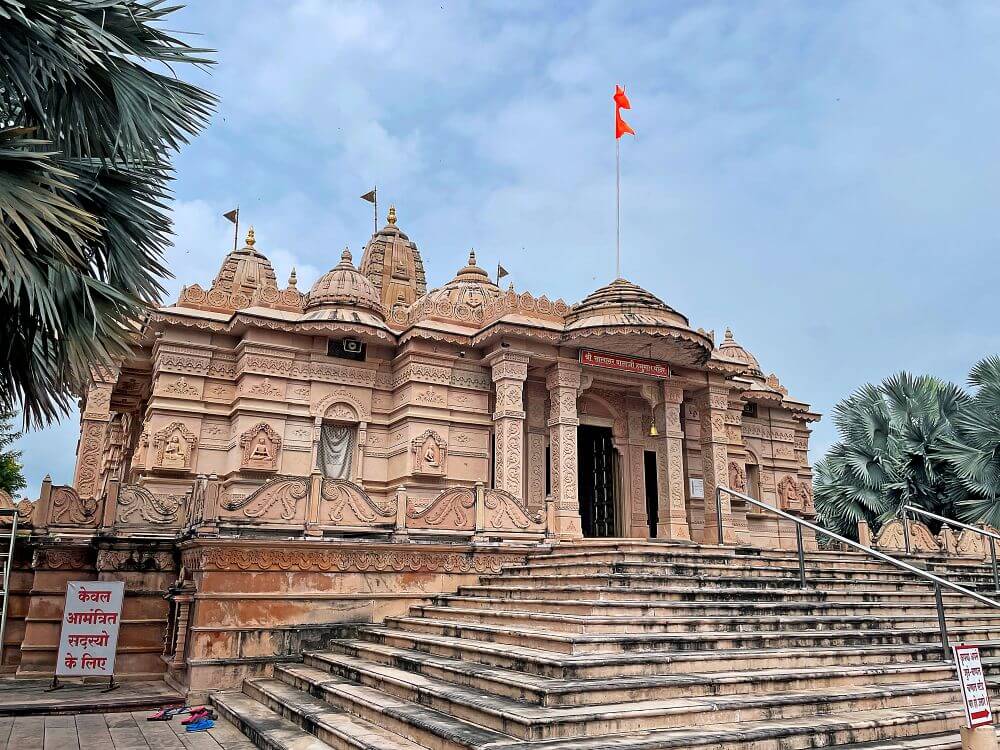
The architectural design of this temple is similar to the original Salasar Balaji Temple in Rajasthan. The structure consists of a Mukhamandapa (main porch), Ardhamandapa (half-hall), Sabhamandapa (assembly hall), and Garbhagriha (sanctum sanctorum). One enters the Mukhamandapa of this temple, which is situated on a high plinth, after climbing about १५ steps. There are four pillars on the front side of the Mukhamandapa and three doors to enter the Sabhamandapa. All these pillars are intricately carved. The spacious Sabhamandapa features carved pillars depicting musicians playing various instruments, and the ceiling is adorned with exquisite carvings. In front of the Sabhamandapa, there are three separate sanctums for Salasar Balaji, Radha-Krishna, and the Shiva family. In the main sanctum of Salasar Balaji, inside a gold-plated arch, there are marble idols of the Ram Darbar, namely Shri Ram, Lakshman, Sita, and Hanuman, at the top. Below the Ram Darbar is the beautiful and distinctive idol of Salasar Balaji Hanuman. This idol, adorned with a beard and mustache, wears a golden crown and ornaments. Above the idol is a silver umbrella, and to the right is a silver mace. To the right of this idol is an idol of child Hanuman with Anjani, and there is another idol of Hanuman to the left.
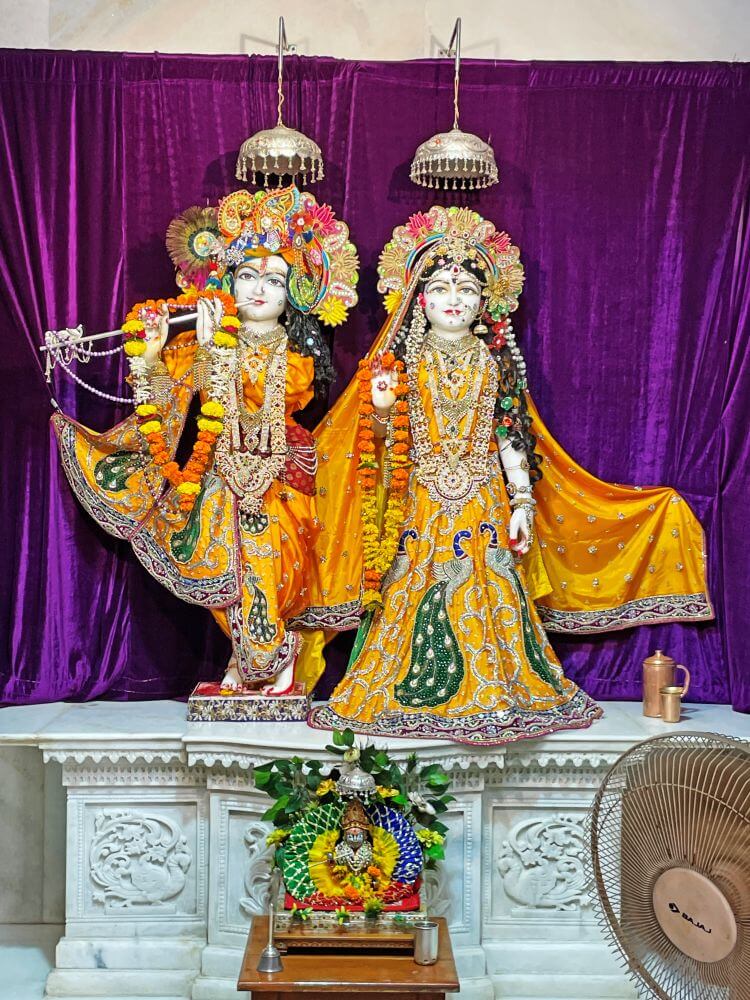
Adjacent to this main sanctum are the sanctums of Radha-Krishna and the Shiva family. In the Radha-Krishna sanctum, there are white marble idols of Krishna playing the flute and Radha on a pedestal. In the Shiva family sanctum, there is a black Shiva Linga and a white Nandi. Behind this Shiva Linga are marble idols of Ganpati, Kartikeya, and Mother Parvati. All three sanctums have Urushringa-style spires. Additionally, there is one dome-shaped spire over the Mukhamandapa and three over the Sabhamandapa. Sculptures of Saint Eknath, Swami Samarth, Saint Kabir Das, Adi Shankaracharya, Saint Dnyaneshwar, Saint Namdev, and others are carved on the outer walls of the temple.
Aarti is performed in the temple every day at ८:०० AM and ७:०० PM. In the evening, the temple premises light up with attractive, colorful electric lights. Various festivals and celebrations are held here. Hanuman Jayanti is the main festival here. Various programs are organized in the temple on this day. Attractive decorations are also set up in the temple premises for this festival. Mahashivratri, Ram Navami, Janmashtami, and Dev Diwali are celebrated here with great enthusiasm. On the day of Dev Diwali, seven to eight thousand glass lamps are lit in the temple premises. At this time, the entire area glows with the light of the lamps. Every Saturday, after the evening Aarti, verses from the Sundarkand are recited here. Many devotees are present at this time. Devotees can have darshan at the temple daily from ८:०० AM to १२:०० PM and from ४:०० PM to ९:३० PM.
This sacred temple stands as a testament to deep spiritual devotion, ancient architectural grandeur, and rich local cultural traditions.
The sanctum sanctorum houses the divine idol consecrated according to ancient Vedic traditions, surrounded by serene courtyards and traditional temple architecture.
Navratri, Maha Shivratri, Annual Temple Jatra & Deepotsav
Compare and book flights, secure top-rated local hotels near the temple, hire reliable guides, and rent cars instantly.
Extend your pilgrimage by visiting other highly sacred temples located nearby.


Add ₹999 more to unlock FREE SHIPPING!
Your sacred cart is currently empty.
Shop Photo FramesFill in your delivery details below to place your order.
Add comment