
Add ₹999 more to unlock FREE SHIPPING!
Your sacred cart is currently empty.
Shop Photo FramesShri Yogeshwari Devi, the cultural capital of Marathwada and the family deity (Kuldaivat) of many families in Maharashtra, is recognized as a radiant power in the Indian religious tradition. The temple of Yogeshwari Devi in Ambajogai, Beed district, is an excellent example of history and architecture. According to mythological references, this city is mentioned as ‘Jayanti Nagar’. The legend of the marriage of Lord Vaijanath of Parli and Yogeshwari Devi is associated with this temple. Devotees believe that because the auspicious time for the wedding passed, the Goddess turned into stone and settled here.
Scholars believe that this temple, built in the Hemadpanti style, dates back to approximately the eleventh century. The legend regarding this temple is that the form of Vaijanath of Parli captivated Yogeshwari Devi. After the marriage between the Goddess and Vaijanath was fixed, all the wedding guests arrived at Ambajogai with elephants and horses. The Lord’s condition was that the wedding should take place in the darkness of the night, before sunrise. However, the Goddess was delayed while adorning herself, and as soon as the sun rose, Vaijanath departed. Since the Goddess’s marriage did not take place, she was established here, and this became her maternal home. According to another legend, a demon named Dantasura had wreaked havoc in this region, causing great suffering to the people. At that time, devotees prayed to Yogeshwari Devi to deliver them from the demon’s torment. Responding to the call of the devotees, the Goddess slew Dantasura and settled here.
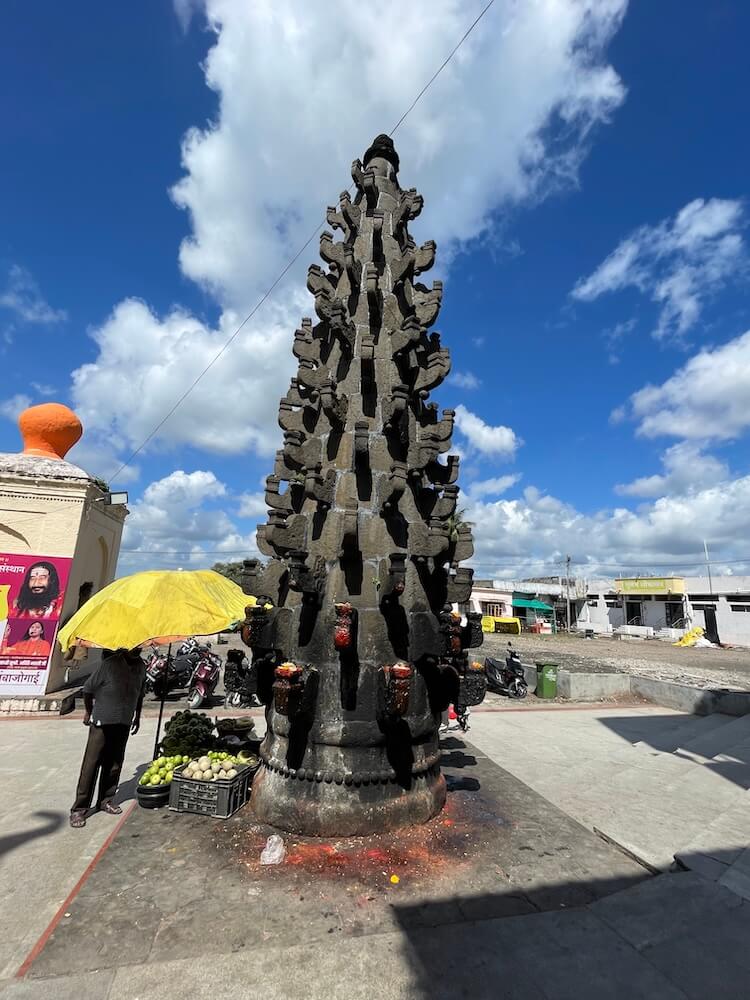
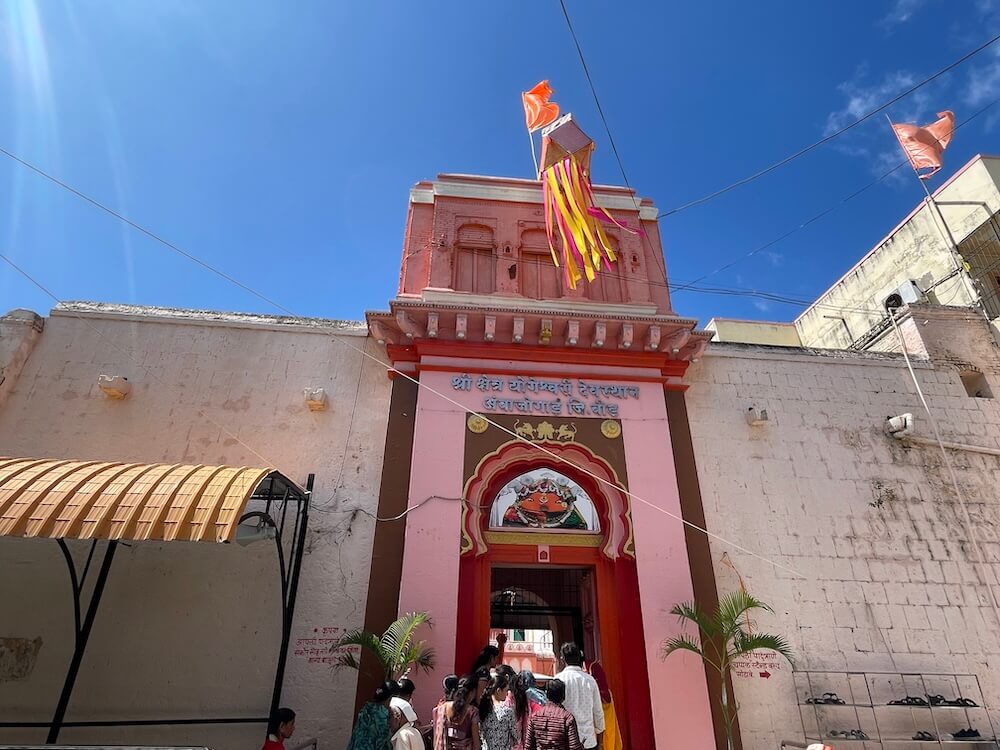
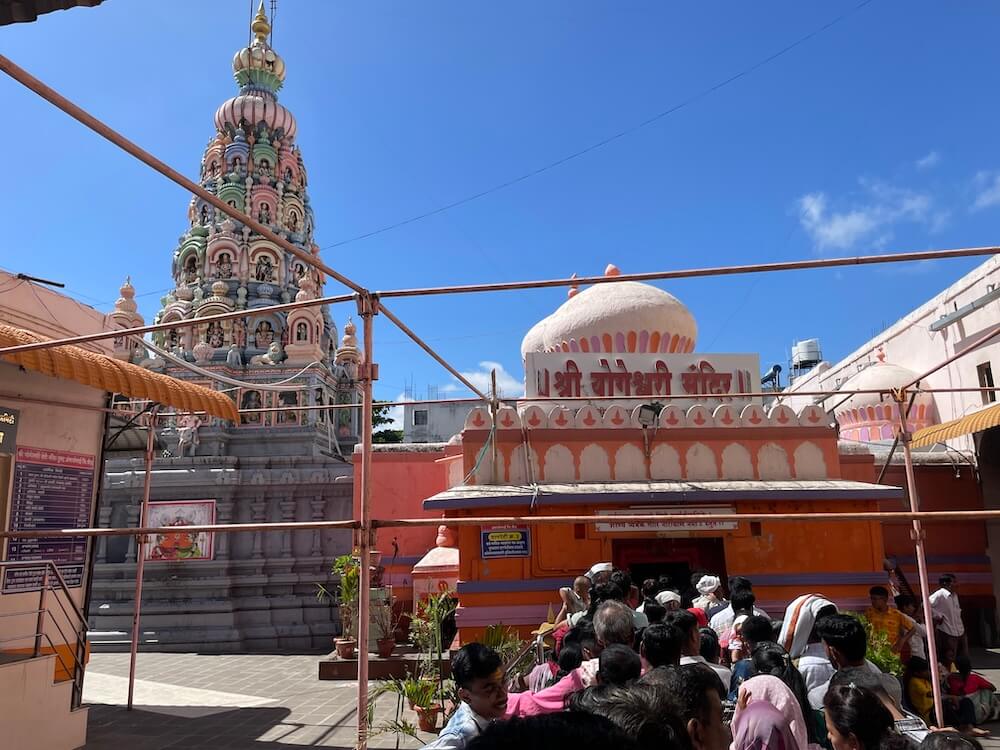
This temple stands on the banks of the Jayanti River in the city of Ambajogai. The temple has a double-layered sturdy fortification. The first fortification has three entrances in the east, west, and north directions. Among them, devotees are allowed to enter the temple through the two-story northern entrance. There are arched toranas on the pillars on both sides of the entrance. Above the torana, in the center, is the sculpture of Yogeshwari Devi, and on both sides are sculptures of lions. There is a Nagarkhana (drum house) on the floor above the entrance. Upon entering through the entrance, about fifty meters ahead, in front of the eastern entrance of the temple, there is a platform in the paved courtyard with a tapering octagonal lamp pillar (Deepmal). A similar lamp pillar is located in front of the western entrance of the temple. During festival periods, these lamp pillars are illuminated with lights. Beyond this is the second fortification of the temple. There is an entrance in this fortification. Upon entering through this gate, the temple with its high spire comes into view.
The temple structure consists of three Arthamandapas (half-halls), a Sabhamandapa (main assembly hall), an Antarala (vestibule), and a Garbhagriha (sanctum sanctorum). The entrance has sculptures of gatekeepers (Dwarpalikas) and pillar carvings. There is a sculpture of Ganapati on the Lalatbimba (lintel) and spire sculptures on the torana. Each of the Arthamandapas has four ornate pillars. All pillars stand on square pillar bases. The pillar shafts feature various geometric shapes such as squares, hexagons, octagons, and circles. At the top of the pillars are brackets (Kani) and hands (Hasta) above the brackets. The ceilings of the Arthamandapas have circular carvings.
One enters the Sabhamandapa from the Arthamandapa. The Sabhamandapa has two rows of four ornate pillars each. The design of the pillars in the Sabhamandapa is similar to those in the Arthamandapa. In the Sabhamandapa, on the left side in a niche, there is a vermilion-smeared idol of Ganapati, while on the right side, there is a high platform for keeping the Paradi (offering basket) during festivals. The black stone idol of Keshavraj and the festival idol of the Goddess are kept there. There is a tortoise sculpture on the floor in the Sabhamandapa. From the Sabhamandapa, one proceeds to the Antarala and then to the entrance of the Garbhagriha. The entrance to the Garbhagriha has five door jambs, including vine-scroll branches, leaf-scroll branches, flower-scroll branches, and pillar branches. On the lower side, there are sculptures of Dwarpalikas, Dwarpalas, Ganga, and Yamuna. The sculpture of the presiding deity is on the Lalatbimba. There are spire sculptures on the upper part.
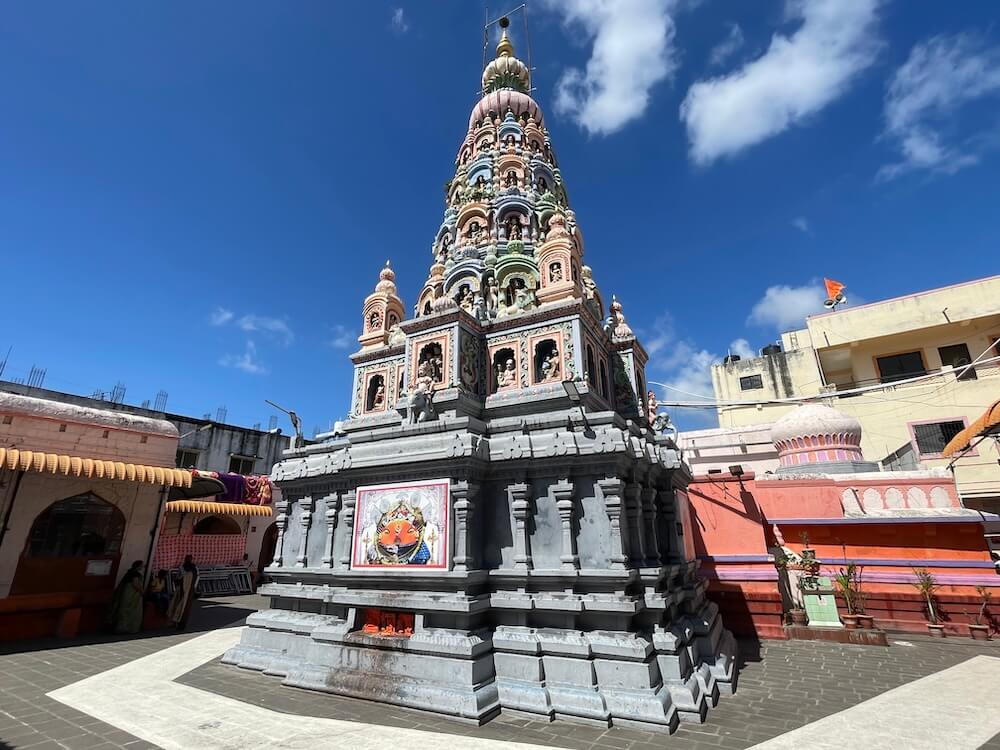
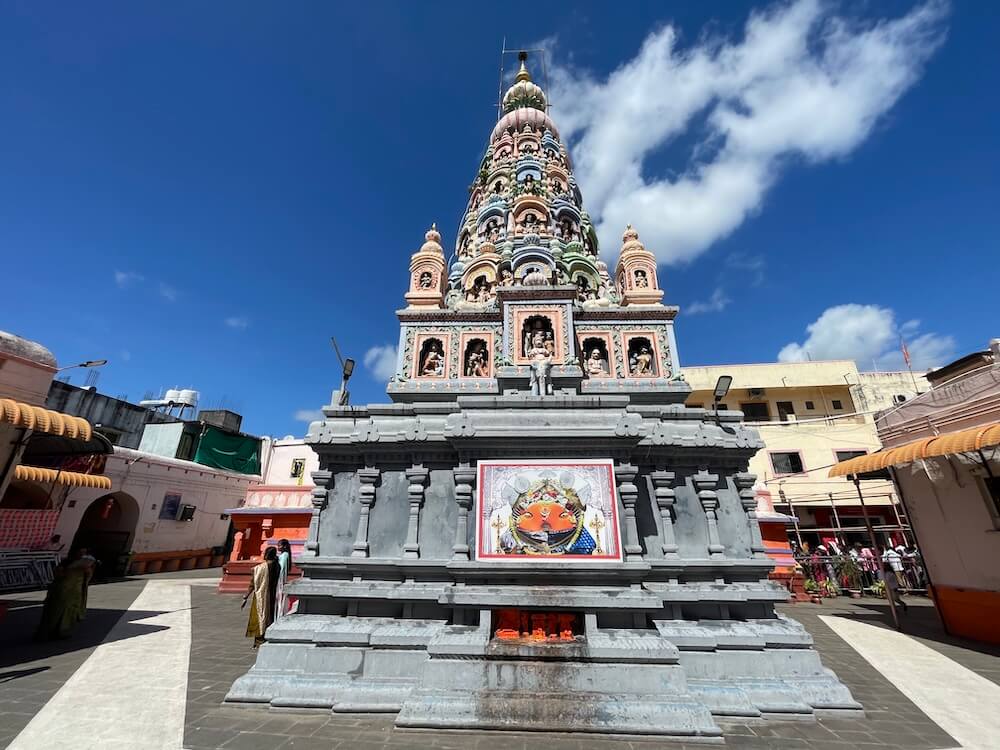
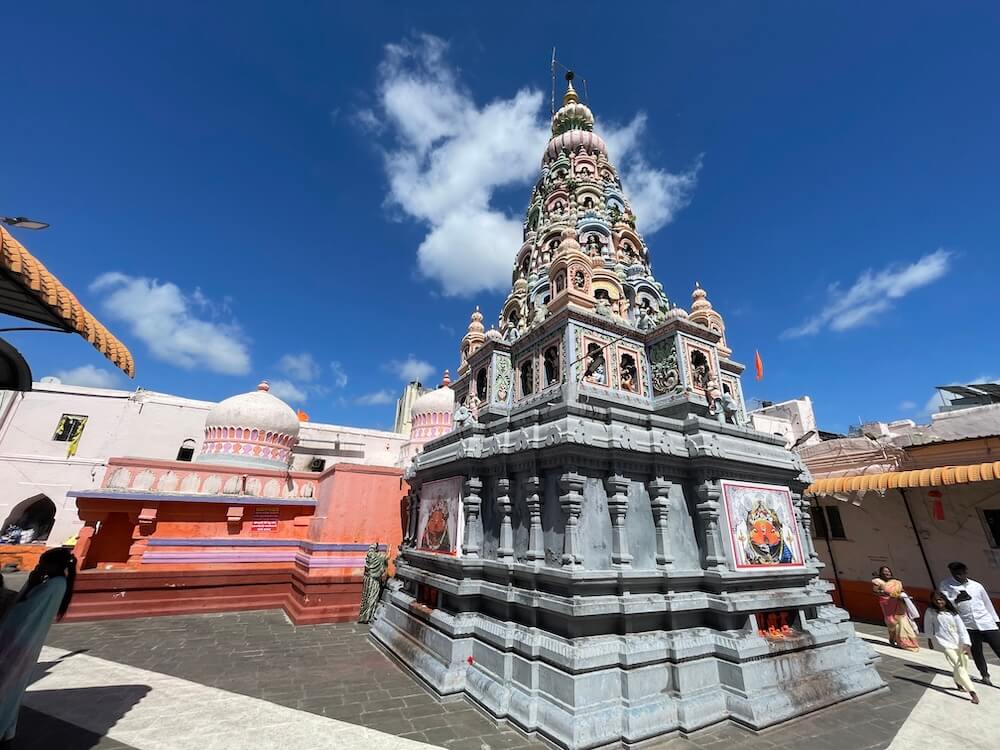
In the Garbhagriha, the self-manifested (Swayambhu) stone of the Goddess is placed in a silver ornate shrine on a Vajrapitha. The Goddess’s face, eyes, and nose are made of silver. There is also a silver crown on her head and a silver tilak on her forehead. In the silver ornate Prabhavali (halo) behind, there are umbrellas, whisks, flags, and banners. In the Garbhagriha, on the right side in a niche, are the idols of Mahakali and Tulja Bhavani. On the roofs of all three Arthamandapas of the temple, there are round dome-shaped spires with finials (Kalash) on top. The roof of the Garbhagriha has a five-tiered spire. In the square tier below the spire, there are five niches on each of the four sides. On the front side, in the center, is a sculpture of a mahout riding an elephant. Above the square tier, there are four sub-spires on all four corners. The second, third, and fourth tiers of the spire are circular. In all these tiers, there are eight niches each, containing idols of various deities. These include sculptures of the Dashavatara of Vishnu, Yoginis, and Matrukas. Among these, the eighteen-armed Matru-Ganesha sculpture is special. This idol of Ganesha in a female form is rare and unique. At the top of the spire, there are two Amalakas placed one above the other. On the Amalaka, there is a finial and a flag banner.
In the temple courtyard, in front of the northern entrance, there is a vast Yajna Mandapa. It contains a sacrificial fire pit (Yajnakunda). A Shatachandi Yajna is organized here on Dussehra and Margashirsha Purnima. The Yajnakunda is surrounded by iron pillars and covered with a roof. In the courtyard, in front of the temple, there is a hall for cultural programs. Programs like Bhajans, Kirtans, music, and discourses are organized here.
There is an idol of Dantasura in the courtyard. In the courtyard, along the fortification on the east and north sides, there are galleries (Ovari). These are used as Bhaktaniwas (pilgrim accommodation) and Dharmashalas (rest houses) for devotees. Some of these galleries were built by Dinkarrao Rajwade, the Prime Minister of the Gwalior State. There is a ‘Peacock Gallery’ here. The author Krishnadayarnava stayed here while composing the ‘Harivarda’ scripture. The idol of Renuka Devi is installed in the gallery in the southwest direction. Opposite the northern entrance of the temple, beyond the lamp pillar, is the Sarveshwar Tirtha Kund (sacred water tank). The water from here is used for the ritual bathing (Abhishek) of the Goddess. On the banks of the tank are three small temples of the deities Sarveshwar, Maharudra, and Bhairava. In the courtyard, there is the Samadhi temple of Dorge Buwa and Aba Buwa Dubarge Maharaj. Further ahead is the spacious building of the Dharmashala.
Margashirsha Purnima is the main annual festival of the Goddess. It is celebrated with great enthusiasm. During the Sharadiya Navratri festival, the festivities begin with the Ghatasthapana of the Goddess on the first day of the bright fortnight of Ashvin. From the fifth to the tenth day, the Goddess is worshipped with ornaments. During the twilight period of Ashtami and Navami, the Shatachandi Yajna concludes with a final offering, and a grand feast is offered to the Goddess on Navami. On the day of Dussehra, the palanquin procession of the Goddess is taken out for a circumambulation of the village. At this time, the servants of the Goddess dance and sing while carrying flaming torches. During all festivals, thousands of devotees from across the state come to seek the blessings of the Goddess and to fulfill their vows. Hundreds of devotees visit the temple daily for the darshan of the Goddess. Every afternoon, Mahaprasad is distributed here to the visiting devotees.
This sacred temple stands as a testament to deep spiritual devotion, ancient architectural grandeur, and rich local cultural traditions.
The sanctum sanctorum houses the divine idol consecrated according to ancient Vedic traditions, surrounded by serene courtyards and traditional temple architecture.
Navratri, Maha Shivratri, Annual Temple Jatra & Deepotsav
Compare and book flights, secure top-rated local hotels near the temple, hire reliable guides, and rent cars instantly.
Extend your pilgrimage by visiting other highly sacred temples located nearby.
Add ₹999 more to unlock FREE SHIPPING!
Your sacred cart is currently empty.
Shop Photo FramesFill in your delivery details below to place your order.
Add comment