
Add ₹999 more to unlock FREE SHIPPING!
Your sacred cart is currently empty.
Shop Photo FramesAmbajogai, Taluka Ambajogai, District Beed
The great saint known as ‘Aadya Kavi Mukundraj’ (the primordial poet) is the one who adorned the goddess of Marathi literature with her first anklet and provided the Marathi language with its first foundational literary work. About one hundred years before Sant Dnyaneshwar, in the twelfth century, Mukundraj laid the cornerstone of Marathi literature. In that era (1188 AD), when the Sanskrit language held dominance, he authored the ‘Viveksindhu’. This is considered the first literary work in Marathi. The Samadhi of Mukundraj is located three kilometers from the city of Ambajogai. This sacred site is a place of inspiration for all who cherish Marathi literature.
It is said that this Samadhi temple is about nine hundred years old. A legend regarding the Samadhi of Mukundraj states that King Jaitpal of Ambajogai was an atheist. He commanded all sages, ascetics, and Brahmins to either “show me God or work for your food,” forcing them into manual labor. For twelve consecutive years, the sages and ascetics of the kingdom lived in fear of the King and performed menial tasks. This news reached Mukundraj, who was then pursuing his studies in Kashi. Seeking his Guru’s permission, he arrived in Ambanagari and told the King that he would show him God. He took the King along with his horse to a field and struck the horse with a whip. The horse galloped away at full speed. The King entered a state of Brahma-Samadhi. When he emerged from this meditative state on the eighth day, the King released all the sages and ascetics and told Mukundraj that he wished to experience this state of divine consciousness again. At that moment, Mukundraj asked the King to follow him and jumped off a mountain cliff. Following Mukundraj, the King also jumped into the valley along with his horse, and all three attained union with the Divine (Brahma-leen).
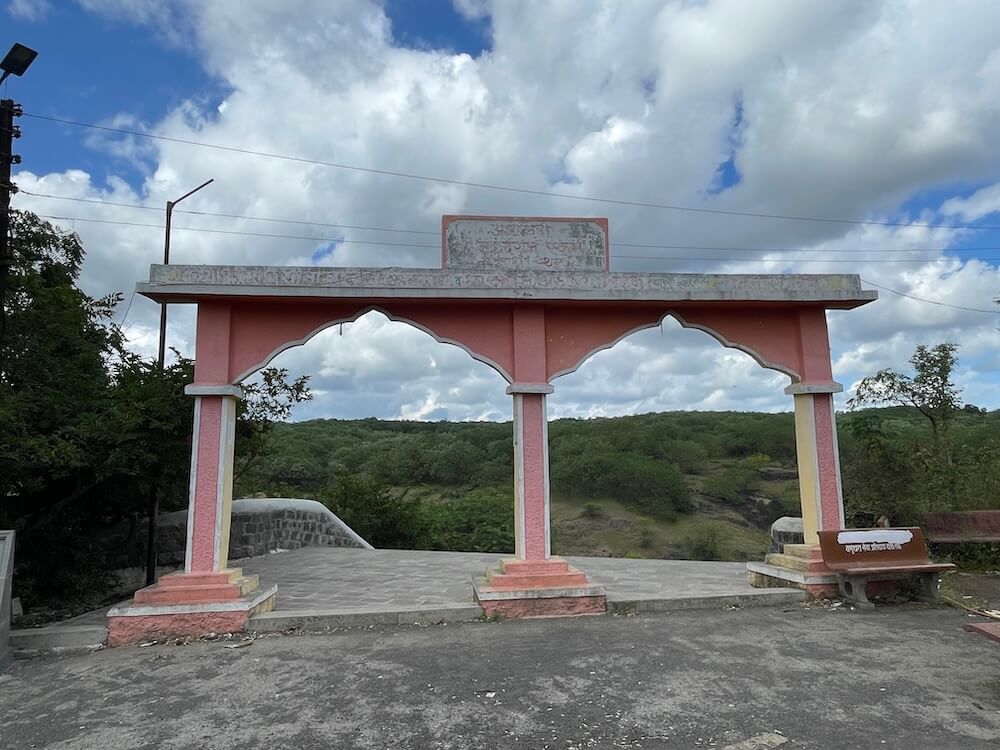
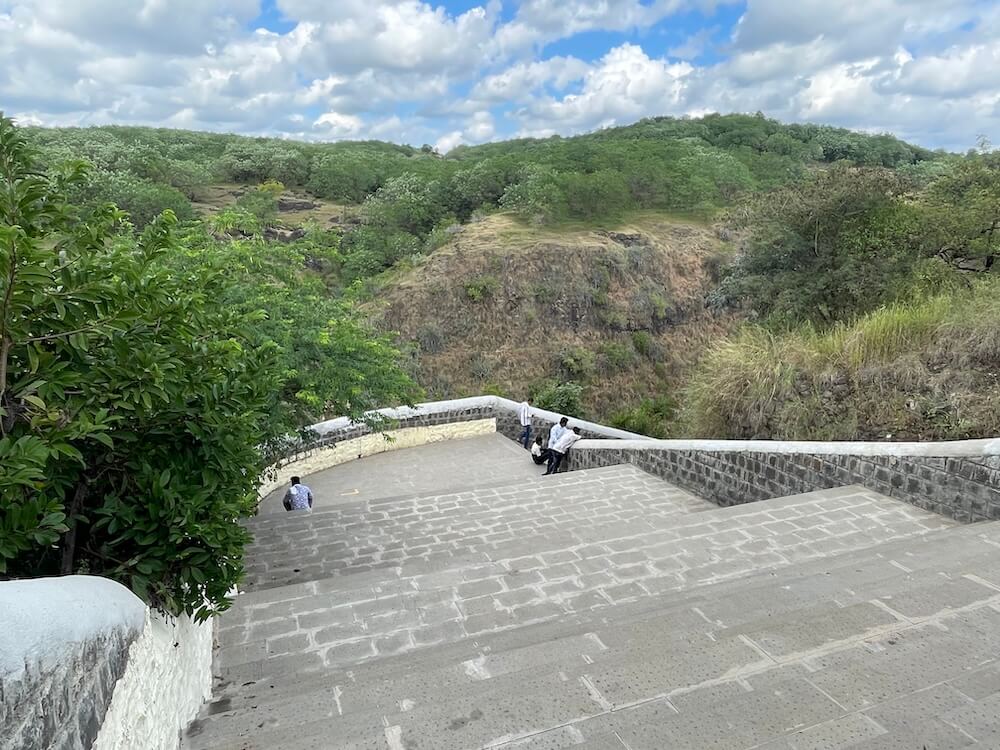
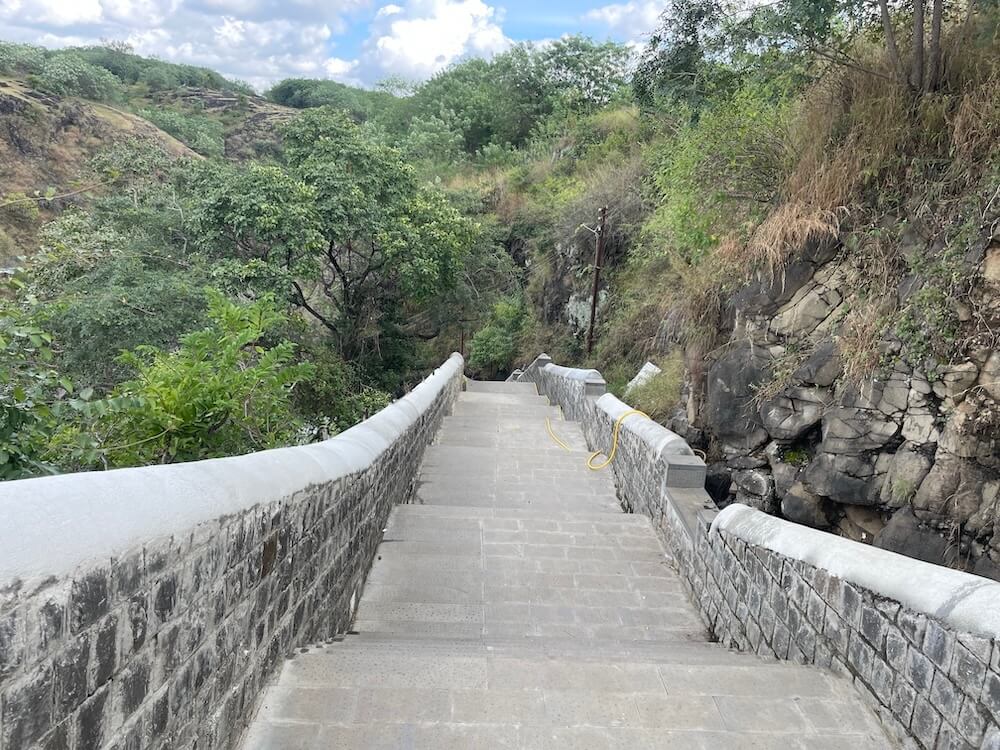
There is a welcome arch on the road leading from Ambajogai city to the Mukundraj Samadhi. The Samadhi site is situated adjacent to a mountain cliff. A road leads from here to the parking area on the hilltop. From there, steps lead down to the Samadhi. There is a second welcome arch at the beginning of the stairway. The arch consists of three square pillars at the base with a balcony structure on top. These pillars are connected by arched gateways. From here, one descends 130 steps to reach the courtyard of the Samadhi temple. On one side of the stairway is a high mountain cliff, and on the other is a safety railing. The office of the Samadhi Temple Trust is located in the courtyard beside the steps.
In front of the Samadhi temple, there is a deep valley on one side and a high mountain cliff on the other. Here, there is a semi-open assembly hall (Sabhamandap) with a tin roof supported by iron pillars. The assembly hall has a stone railing on the side facing the valley. Further ahead is the Tulsi Vrindavan, followed by the sanctum sanctorum (Garbhagriha). Since the sanctum is at a higher level than the assembly hall, one must climb about ten steps to reach it. There are safety railings on both sides of the steps, which also feature lamp niches.
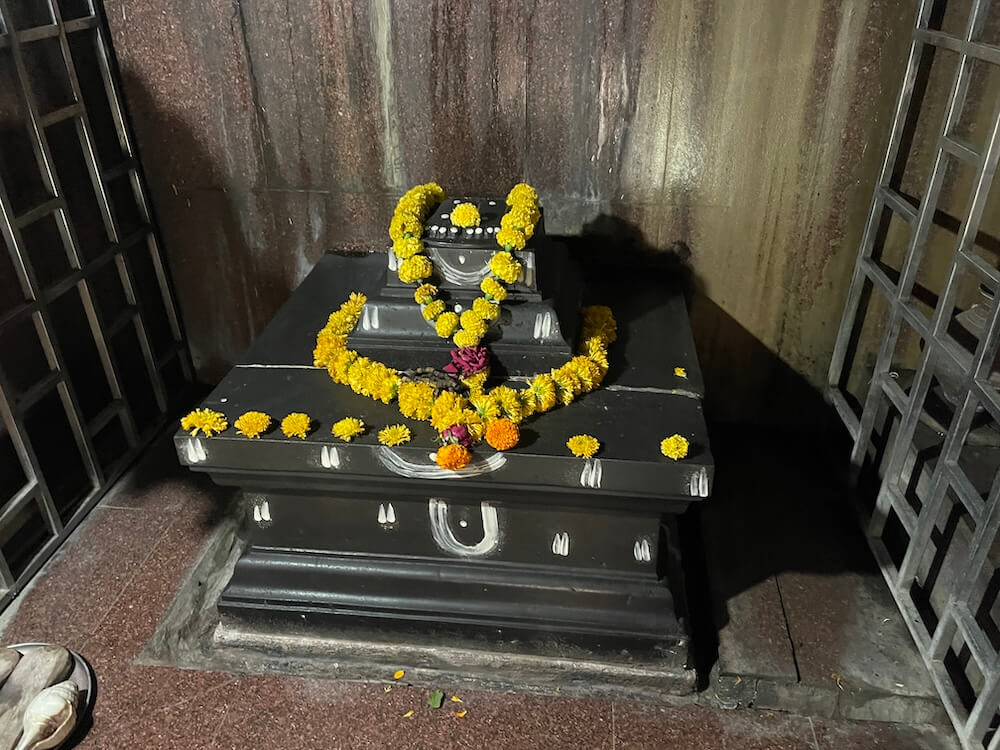
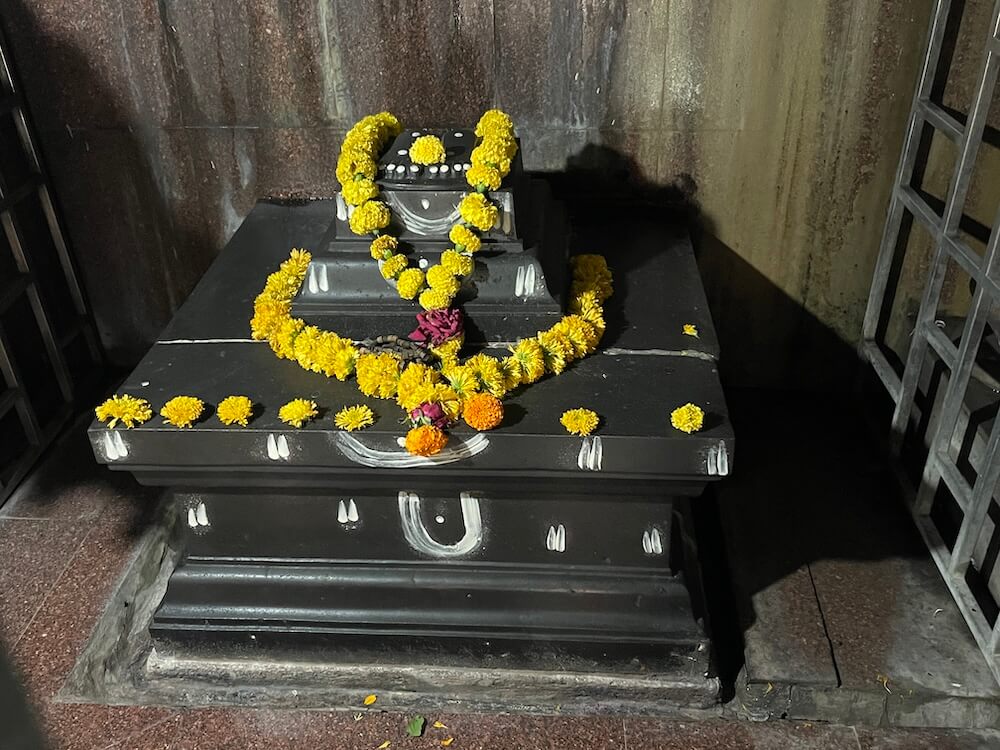
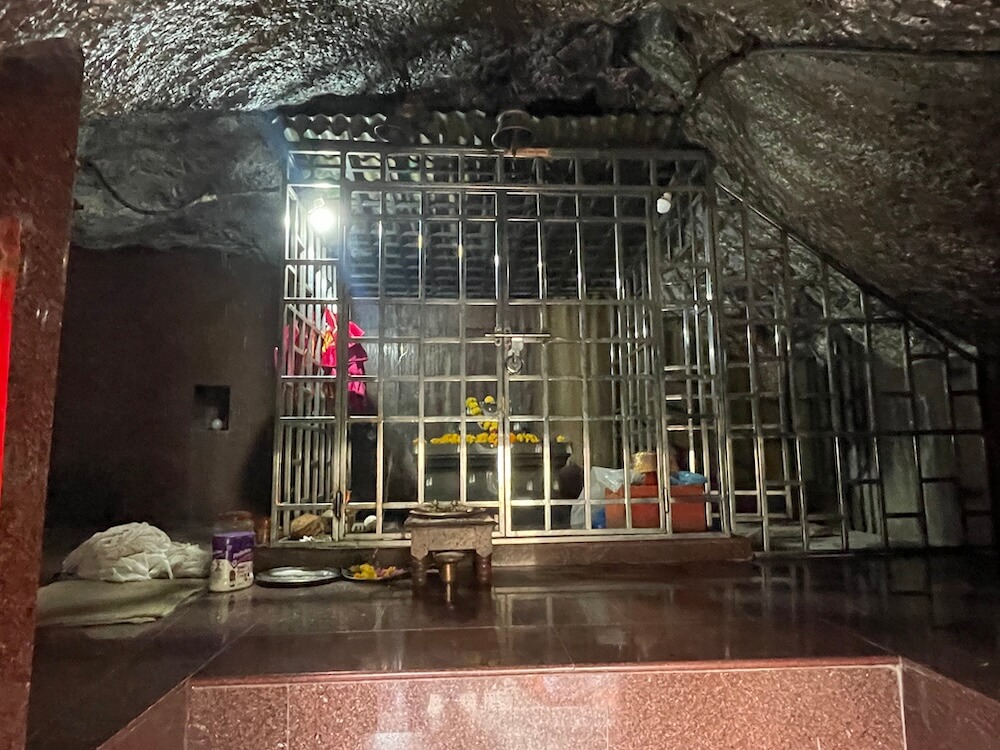
In the front wall of the stone-built sanctum, there are lamp niches on both sides of the entrance. The entrance has ornate pillars on both sides and an arched lintel above. The entrance has carved wooden doors. In the back of the sanctum, within a natural cave in the mountain cliff, lies the pedestal of Mukundraj’s Samadhi. The pedestal is higher than the entrance, and one must climb five steps to reach it. On the pedestal, the Shiva-Pashan (sacred stone) of the Samadhi is housed within a stainless steel latticed shrine. The Shiva-Pashan is adorned with garments and ornaments. Brass bells are hung from the ceiling of the sanctum.
In the temple premises, near the parking area, is the residence of the priests. On this same side, in a small shrine, are stone footprints (Paduka). It is said that these are the Paduka of Sant Dnyaneshwar. A legend suggests that Sant Dnyaneshwar Maharaj had come to visit Mukundraj Swami. There are some ancient Samadhis here, as well as a large building for the Mukundraj Bhajan Mandal, which houses a Vitthal-Rukmini temple. There are also three stone-built cloisters and a two-story pilgrim residence (Bhaktiniwas). In this same ground, there is a hall for cultural programs. A stream flows from the mountain here, and its picturesque beauty can be seen only during the monsoon season. The temple premises are surrounded by dense greenery and various types of trees.
Although no special festivals are organized at the Mukundraj Samadhi site, programs such as Bhajans, Kirtans, and music are held on special occasions. As the primordial poet of Marathi, Mukundraj is held in high esteem by Marathi speakers. Many devotees, tourists, and language scholars from across the state visit the Samadhi for darshan.
This sacred temple stands as a testament to deep spiritual devotion, ancient architectural grandeur, and rich local cultural traditions.
The sanctum sanctorum houses the divine idol consecrated according to ancient Vedic traditions, surrounded by serene courtyards and traditional temple architecture.
Navratri, Maha Shivratri, Annual Temple Jatra & Deepotsav
Compare and book flights, secure top-rated local hotels near the temple, hire reliable guides, and rent cars instantly.
Extend your pilgrimage by visiting other highly sacred temples located nearby.
Add ₹999 more to unlock FREE SHIPPING!
Your sacred cart is currently empty.
Shop Photo FramesFill in your delivery details below to place your order.
Add comment