
Add ₹999 more to unlock FREE SHIPPING!
Your sacred cart is currently empty.
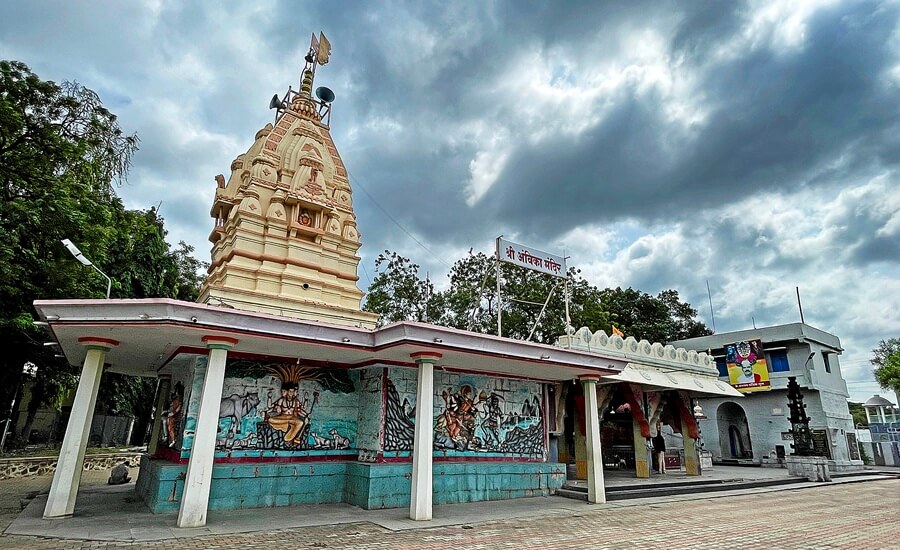
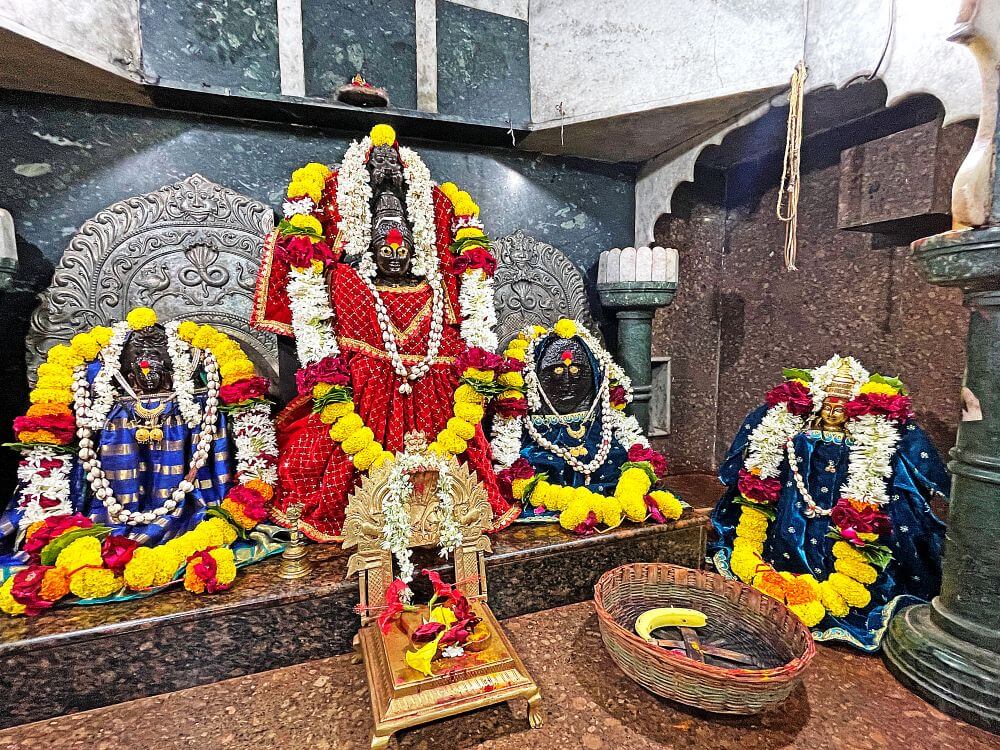
Shop Photo FramesAmbika Mata is the revered Gramdevata (village deity) of Sangola, a historically renowned town known in ancient times as ‘Sangoliya’, ‘Sangoli’, and ‘Sanghole’. It is said that the Ambikadevi temple here dates back to the Yadava period. The most significant feature of this temple is that Ambika Mata, Tukai (also known as Tuljabhavani), and Yamai of Aundh, all three divine forms, are enshrined together on a single sacred throne (simhasana). This bestows immense religious significance upon the temple. The Ambika Temple is also recognized as the sacred site where the crucial ‘Treaty of Sangola’ in Maratha history was concluded.
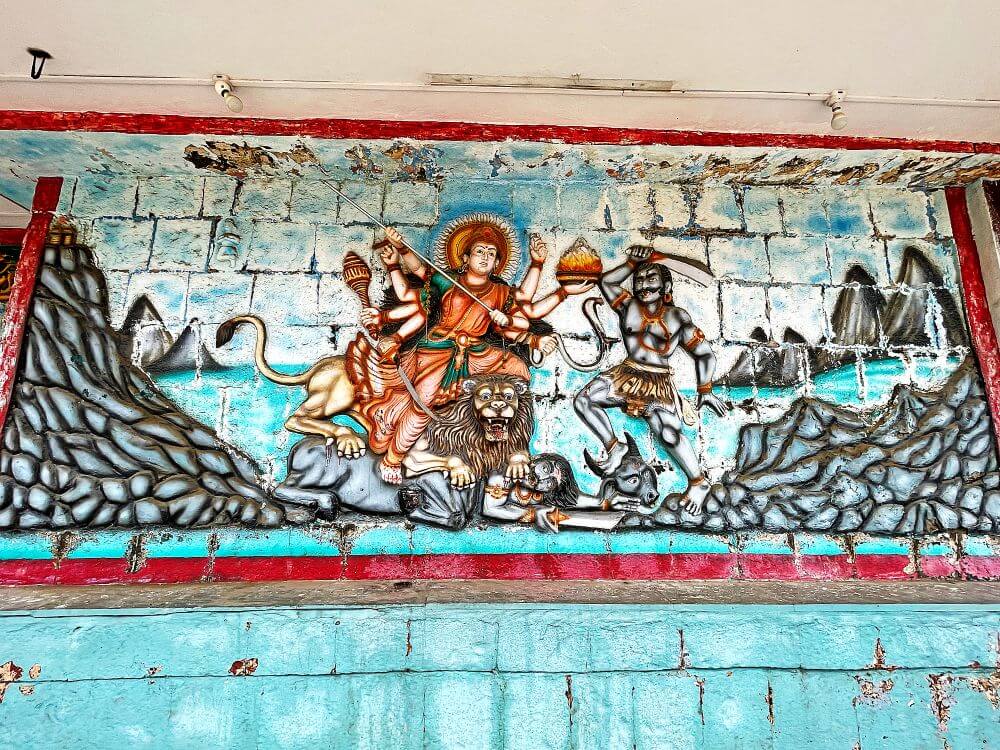
According to Puranic (mythological) texts, Ambika Devi is a form of Goddess Parvati. As per the 7th chapter of ‘Devi Mahatmya’ in the ‘Markandeya Purana’, the demons Shumbha and Nishumbha conquered the kingdom of Trilokya (the three worlds) from Lord Indra. At that time, the Devas (gods) sought refuge in Adishakti Bhagawati. While they were praying to Bhagawati, Goddess Parvati arrived there. From her divine body-sheath, Ambika Devi manifested. Chanda and Munda were the servants of Shumbha and Nishumbha. Shumbha and Nishumbha dispatched Chanda and Munda to capture Ambika. It was then that Kali, who emerged from Ambika’s body, slew Chanda and Munda. Because Kali Devi vanquished Chanda and Munda, Devi Bhagawati bestowed upon her the name Chamunda. In Maharashtra, especially in Western Maharashtra, this Goddess is worshipped in various forms such as Kalamma, Kalika, Yamai, Ambabai, Ambika, and Chamunda.
It is believed that the divine abode of the Goddess in Sangola dates back to the fourteenth century. After the Chalukyas of Kalyan and the Kalachuris, the Yadava dynasty of Devagiri established its rule in this region. Historical records indicate that after the slaying of Afzal Khan, Netoji Palkar’s army, acting on the orders of Chhatrapati Shivaji Maharaj, plundered Sangola and its surrounding areas. This town also holds a significant place in Maratha history. Chhatrapati Shahu Maharaj, son of Chhatrapati Sambhaji Maharaj, passed away in Satara on December 15, 1749. As his successor, Ramraje, the grandson of Tarabaisaheb and son of Shivaji Raje II, was enthroned in Satara. Before his demise, Chhatrapati Shahu Maharaj had entrusted the responsibility of the state’s administration to the Peshwas. Consequently, the Peshwas began to wield power in the state instead of Ramraje. This led to a power struggle between Tarabaisaheb and Nanasaheb Peshwa. During this period, the Peshwas annexed a significant portion of the territory held by Jagjivanrao Pratinidhi, who was allied with Tarabai. Sangola was among these annexed territories. To facilitate the transfer of this region, the Pratinidhi sent his representative (mutalik), Yamaji Shivdev, to Sangola. However, upon arriving there, Yamaji Shivdev rebelled against the Peshwas. At that time, Nanasaheb Peshwa won over Chhatrapati Ramraje and dispatched an army to Sangola under his leadership. Within 15 days, the Peshwas conquered the fort of Sangola. Subsequently, the Peshwas obtained written new resolutions from Chhatrapati Ramraje regarding the state’s administration and governance. This arrangement is also known as ‘Sangola Vyavastha’ or ‘Sangola Bandobast’ (the Sangola Settlement). Through this treaty, the position of Chhatrapati became nominal, and the state’s power shifted to the Peshwas. It is said that this treaty was concluded in the Ambikadevi Temple.
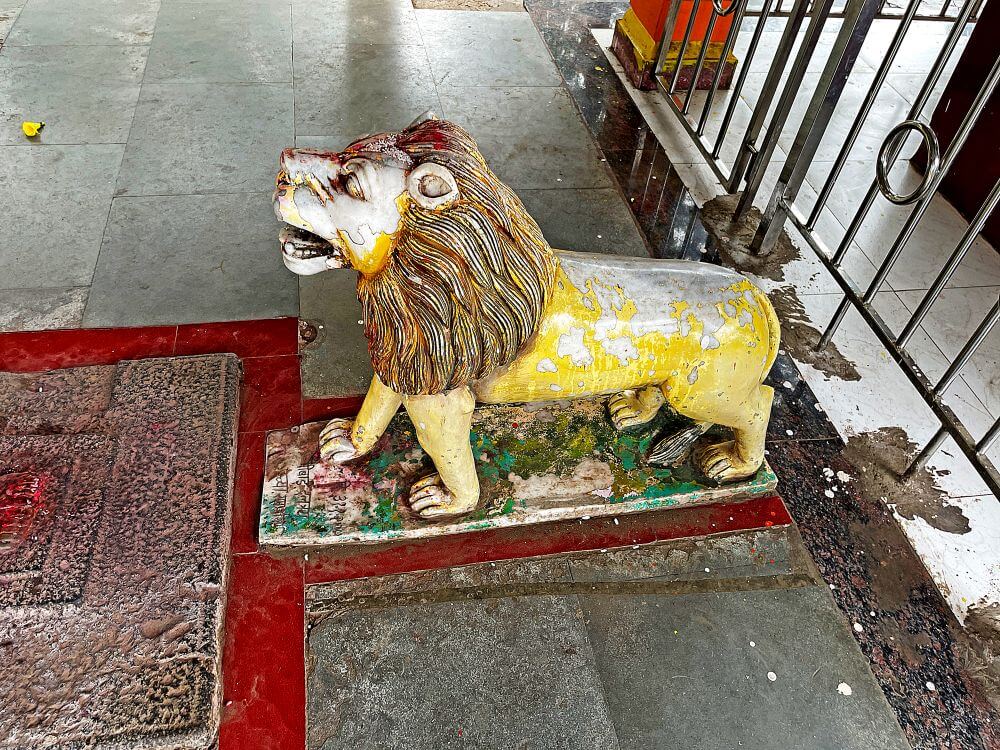
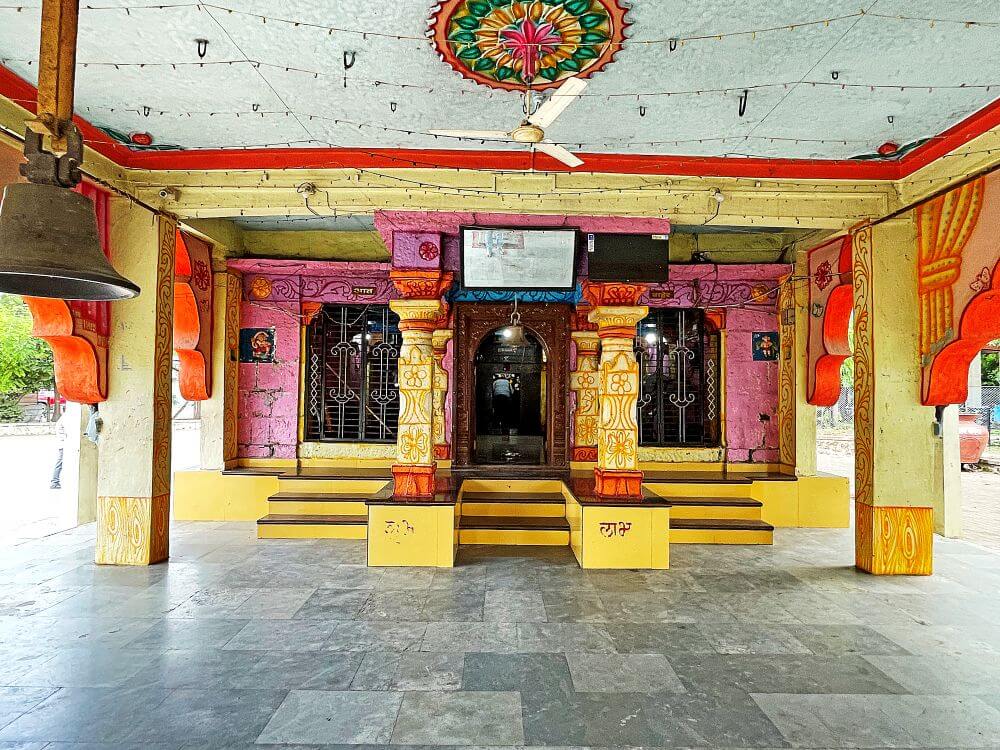
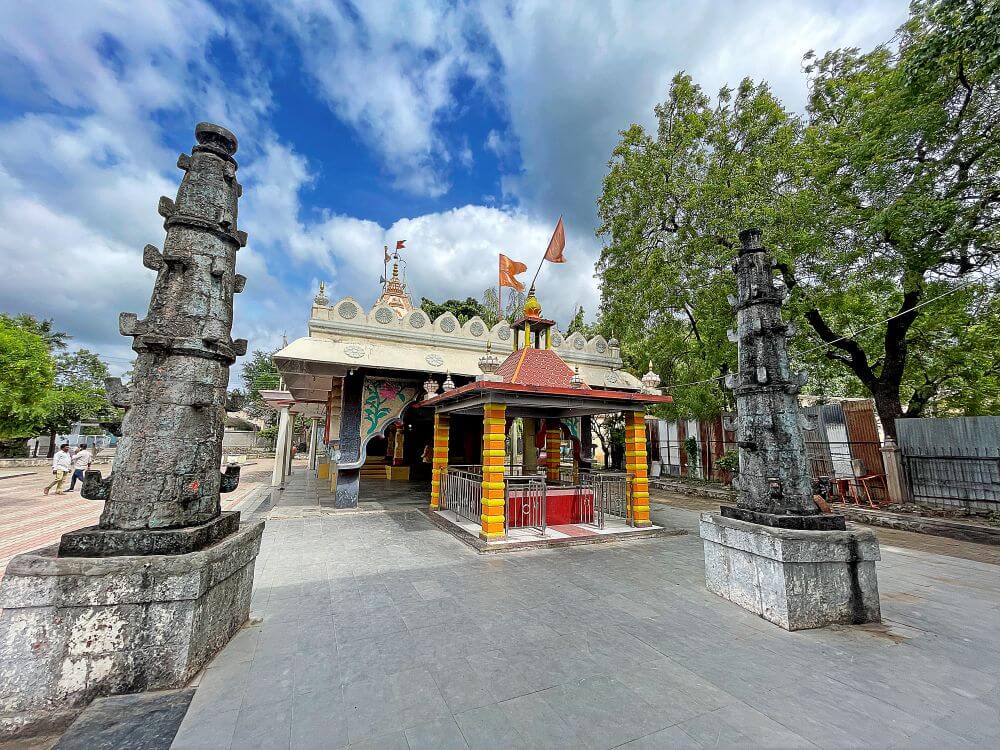
The Ambika Temple, situated in the heart of Sangola town, features a two-storied stone entrance gate. Inside this gateway, there are guard rooms. Passing through the entrance, one enters the temple courtyard. In this courtyard, in front of the main temple, stand two large stone Deepmalas (lamp towers). To the front of the temple, there is a Dhunimandap (sacred fire pavilion). During the Sharadiya Navratri festival, a Hom (fire ritual) is performed here at midnight on Ashtami. This tradition has been observed for hundreds of years. The temple’s structure comprises an open pavilion, a Darshanmandap (viewing hall), a Sabhamandap (assembly hall), and the Garbhagriha (sanctum sanctorum). The open pavilion in front of the temple has been constructed in recent years. This pavilion houses an idol of a lion, the vehicle (vahana) of the Goddess. From this pavilion, one enters the Darshanmandap of the temple. This Darshanmandap, supported by four stone pillars, provides seating arrangements for devotees.
The door jambs (dwarshakhas) at the entrance of the Sabhamandap are adorned with intricate carvings of leaves, flowers, and vines. Within the Sabhamandap, a darshan marg (viewing path) has been arranged to manage the flow of devotees. On the lalatabimba (lintel) above the Garbhagriha entrance, there is an idol of Ganesha. Inside the Garbhagriha, on a Vajrapitha (diamond pedestal), Tuljabhavani is enshrined in the center, Yamai of Aundh to the right, and Ambikadevi, the Gramdevata of Sangola, to the left. The outer walls of the temple are embellished with relief sculptures (uthavashilpe) depicting scenes from ancient Puranic times. In the temple premises, at the rear, on a platform (chauthara), there are two idols of Goddesses, Kharjai and Khoklai, which resemble stone chariot wheels. It is believed that worshipping these deities cures chronic ailments such as cough, scabies, and ringworm.
Puja-Aarti (worship rituals) are performed at the Ambika Devi Temple every Tuesday and Friday. Annually, the festival of Tripurari Pournima is celebrated here with great splendor, illuminating the entire temple premises with lamps. Ramnavami and Durgashtami are also celebrated with immense enthusiasm at the temple. During Sharadiya Navratri and Shakambari Navratri in the month of Paush, a multitude of religious programs are organized. The annual Yatra (fair/pilgrimage) of Ambikadevi, held on Rathsaptami, is renowned throughout the Panchkroshi (surrounding five kos area). During the Yatra, a grand procession of the Goddess is carried out with musical instruments (savadyamiranuk). Mahapuja (grand worship), Mahanaivedya (grand food offering), and Bhajan (devotional singing) are celebrated with great fervor. The spectacular wrestling matches held annually are a major attraction of the Yatra. During this period, a market for goats and sheep is also held. The Yatra concludes with a display of fireworks (darukama).
This sacred temple stands as a testament to deep spiritual devotion, ancient architectural grandeur, and rich local cultural traditions.
The sanctum sanctorum houses the divine idol consecrated according to ancient Vedic traditions, surrounded by serene courtyards and traditional temple architecture.
Navratri, Maha Shivratri, Annual Temple Jatra & Deepotsav
Compare and book flights, secure top-rated local hotels near the temple, hire reliable guides, and rent cars instantly.
Extend your pilgrimage by visiting other highly sacred temples located nearby.


Add ₹999 more to unlock FREE SHIPPING!
Your sacred cart is currently empty.
Shop Photo FramesFill in your delivery details below to place your order.
Add comment