
Add ₹999 more to unlock FREE SHIPPING!
Your sacred cart is currently empty.
Shop Photo FramesThe Ayyappa Temple is situated in the Bangur Nagar area of Goregaon West, Mumbai. This temple is considered an excellent example of South Indian temple architecture and cultural tradition. It is revered as one of the oldest and most prominent Ayyappa temples in Mumbai. The temple’s design adheres to the traditional ‘Thachushastra’ principles of Kerala. The consecration of the deities was performed by Brahmasri Kandararu Maheswararu Thanthri, the chief priest of the original Sabarimala temple. Due to its architectural design, disciplined worship rituals, and the ‘Mandala-Makaravilakku’ festivals, this temple has become a principal place of devotion for devotees in Mumbai.
The original grand temple of Bhagwan Ayyappa is in Sabarimala, Kerala. It is said that the name Sabarimala is derived from Shabari of the Ramayana. According to Puranic legends, Ayyappa, also known as Sastha, Hariharaputra, and Manikandan, is considered the son of Shiva and Vishnu in His Mohini form. Mohini is the only female avatar of Vishnu. Vishnu assumed the Mohini avatar to slay Bhasmasura. Thereafter, Mohini enchanted Lord Shiva with Her beauty, and from their union, Ayyappa was born. This is why Bhagwan Ayyappa is also known by the names Hariharaputra, Ayyappa Sastha, and Manikandan. A Puranic tale is told about Bhagwan Ayyappa. Once, King Rajasekhara, the Vaishnava ruler of the Pandalam kingdom in Kerala, went hunting. He heard the cry of a small child on the banks of the Pampa River. The child wore a jewel necklace (manimala) around his neck, and a divine aura emanated from his face. The king was childless. Doubt arose in the king’s mind about adopting the child. Then, Sage Agastya, who was present there, advised the king to accept the child as he was divine. Since the child wore a jewel necklace, he was named Manikanta. After some time, King Rajasekhara’s queen gave birth to a son. The king considered Manikanta his elder son and decided to anoint Manikanta as the crown prince. However, Manikanta had no interest in enjoying the royal position. Meanwhile, some wicked ministers in Rajasekhara’s court poisoned the queen’s mind, and they conspired to eliminate Manikanta. They told the king that the queen was suffering from stomach pain and needed tigress’s milk as a remedy. Manikanta accepted the task of bringing the tigress’s milk and went into the forest. In the forest, Manikanta encountered the demoness Mahishi. Mahishi was the sister of Mahishasura. After Devi Durga slew Mahishasura, Mahishi had obtained a boon from Brahma. The boon was that no one could kill her except a son born of Shiva and Vishnu. Believing that a son of Shiva and Vishnu was impossible, she became arrogant, and her atrocities increased. Vishnu had assumed the Mohini form during the Samudra Manthan (churning of the ocean). In that form, Vishnu decided to marry Shankara and entrust their child to the childless king of Pandalam. Since Ayyappa was the son of Shiva and Vishnu, He was able to slay Mahishi. Thereafter, He returned to the palace with the tigress’s milk. At that point, everyone was convinced that He was a divine avatar. Having completed His life’s mission of slaying Mahishi, He decided to leave the palace. Before doing so, He instructed the king to build His temple in Sabarimala.
Considering the history of the establishment of this temple in Goregaon, in the year nineteen fifty-three, some Ayyappa devotees in the area came together and began communal bhajans and worship in a small room. In the initial period, these devotees collectively formed a temporary committee and started organizing special religious programs during the annual Mandala Puja period. As the number of South Indian and other community members grew in Goregaon and its surrounding areas, the scope of these religious activities also expanded. With the increase in devotees, the need for a larger and permanent temple arose. For this purpose, all the devotees decided to come together and establish an official organization. Accordingly, in the year nineteen seventy-three, the ‘Ayyappa Seva Sangham Bombay’ organization was founded. After the official registration of the organization, the search for a suitable location for the temple began. The Bangur Nagar area in Goregaon West was quiet and centrally located, so the decision was made to purchase land there for the temple. This land was acquired with the financial assistance of local devotees, businessmen, and donors. After acquiring the land, guidance for the temple’s construction was sought from the highly renowned and experienced temple architecture expert from Kerala, Brahmasri Kanippayyur Krishnan Namboodiripad. The design of temples in Kerala is based on the very strict rules of ‘Thachushastra’ architecture. According to this science, the direction, height, and size of every part of the temple are determined. While planning this temple in Goregaon, all these ancient rules were meticulously followed, so that even in a modern city like Mumbai, one could experience the same sanctity and peace as in the original temples of Kerala.
After the actual construction of the temple began, special artisans and stone sculptors were brought to Mumbai from Kerala. The main feature of this temple is that its five main sanctum sanctorums, known as ‘Sreekovil’, are entirely carved from granite, that is, black stone. This granite stone was specially selected from quarries in Kerala and Tamil Nadu and brought to Mumbai. The five separate sanctum sanctorums in the temple were designated for different deities. Among these, the main sanctum in the center is dedicated to Bhagwan Ayyappa. The design of this main sanctum incorporates traditional Kerala roof architecture and wooden carvings. The temple’s architecture includes various parts such as the sanctum sanctorum, antarala (vestibule), and mandapam (hall). The other four sanctum sanctorums surrounding the main sanctum house the idols of Bhagwan Krishna, Bhagwan Ganesha, Amme Devi, and Bhagwan Kartikeya. After the completion of the construction, the consecration (Prana Pratishtha) and Kumbhabhishekam ceremonies of the temple were organized.
The consecration ceremony, known as Prana Pratishtha, for the deities in this temple was performed by the chief priest of the world-renowned Sabarimala Temple in Kerala, Brahmasri Kandararu Maheswararu Tantri. This sacred ritual was accompanied by the chanting of the puja mantra: ‘Shribhootanatha Sadananda Sarvabhoota Dayaparah. Rakshah Rakshah Mahabaho Shaste Tubhyam Namonamah.’ Many eminent pundits and Vedic scholars from Kerala were invited to grace this auspicious occasion. The principal idol of Bhagavan Ayyappa was installed here according to Tantric and Vedic rites. The design of this idol closely resembles the original idol at Sabarimala. Within the Sreekovil, the idol of Ayyappa Swami is seated upon a high Vajra Peetham. Numerous lamps glow around the idol, their radiance spreading across the deity’s divine countenance. On this very day, the Prana Pratishtha of the idols of Bhagavan Shri Krishna, Ganapati, Amme Devi, and Kartikeya was also performed. Following this consecration, this temple has become a central hub for all Ayyappa devotees in Mumbai.
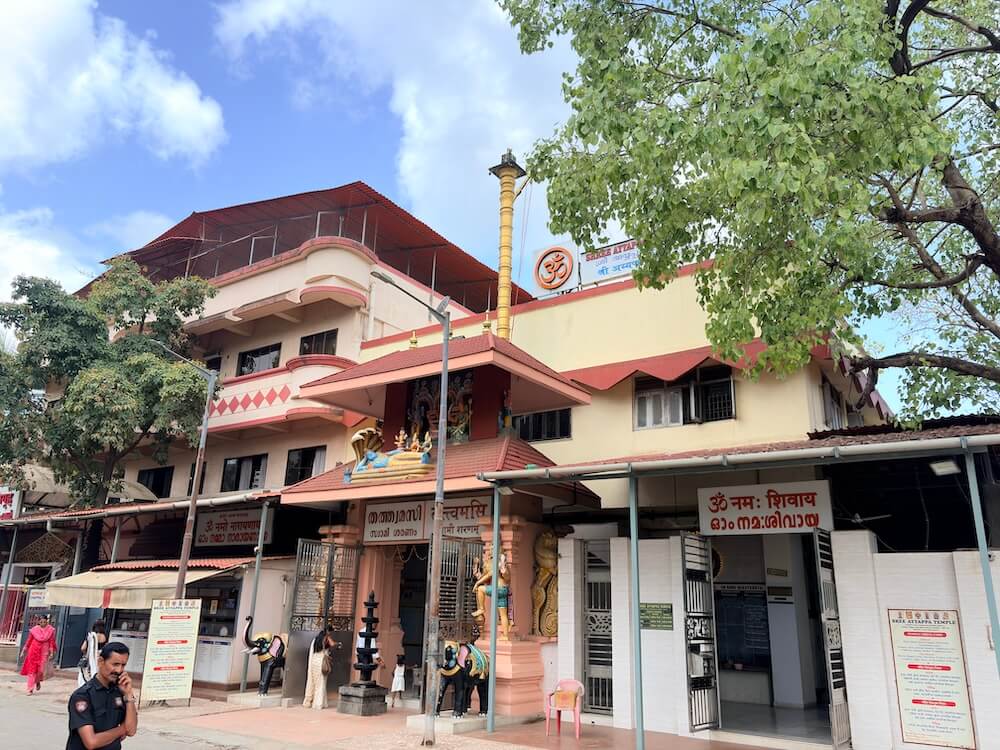
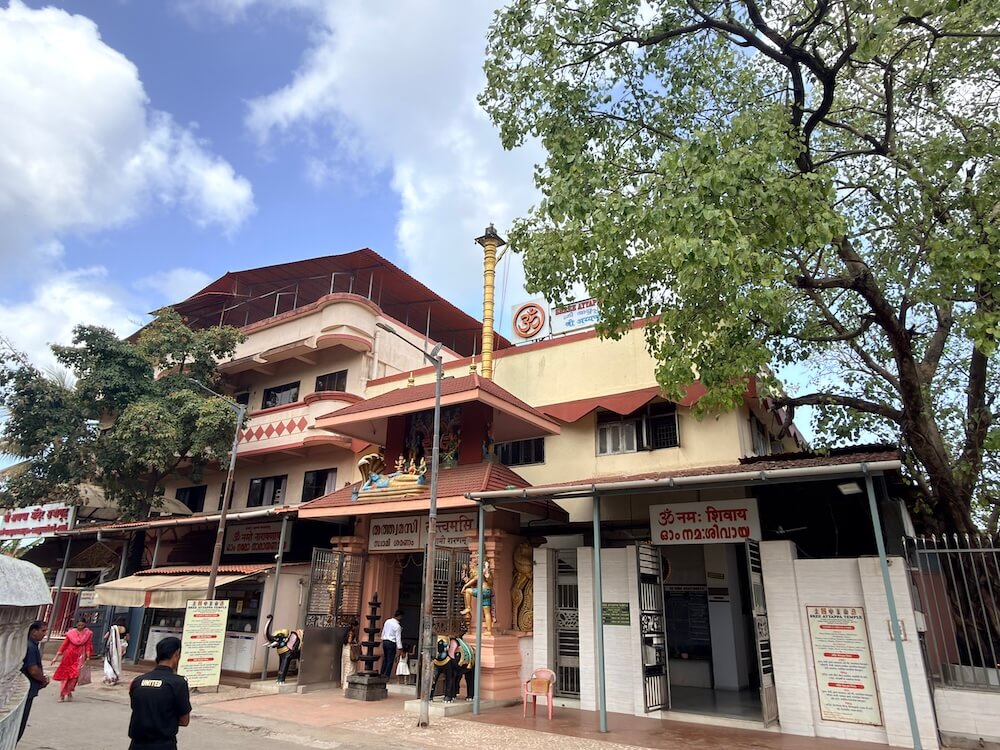
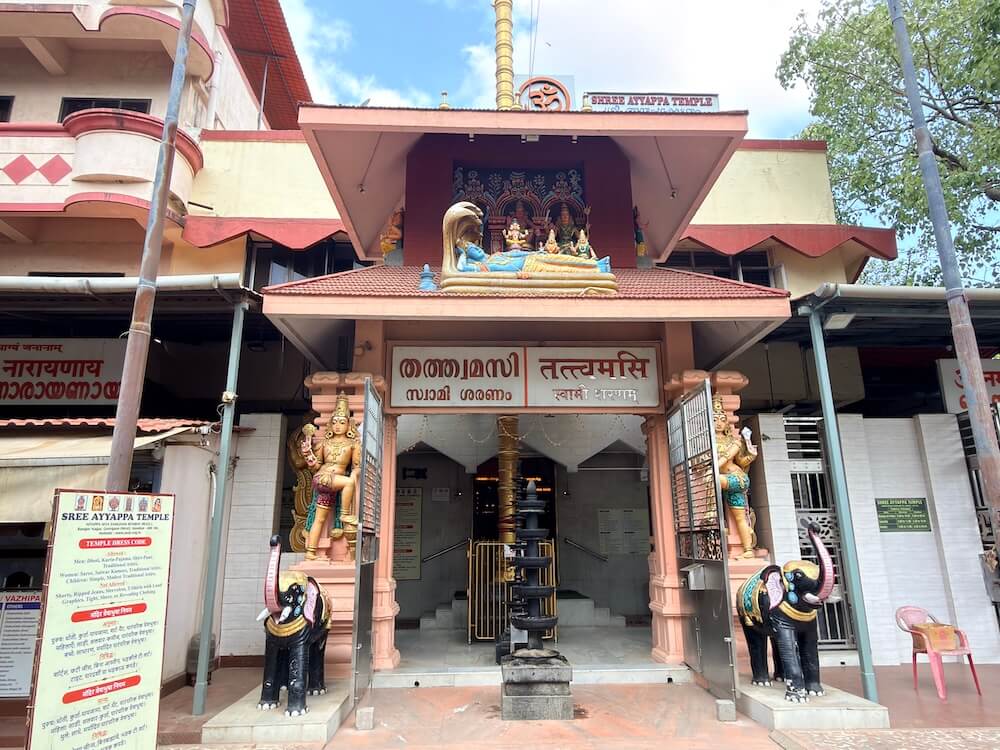
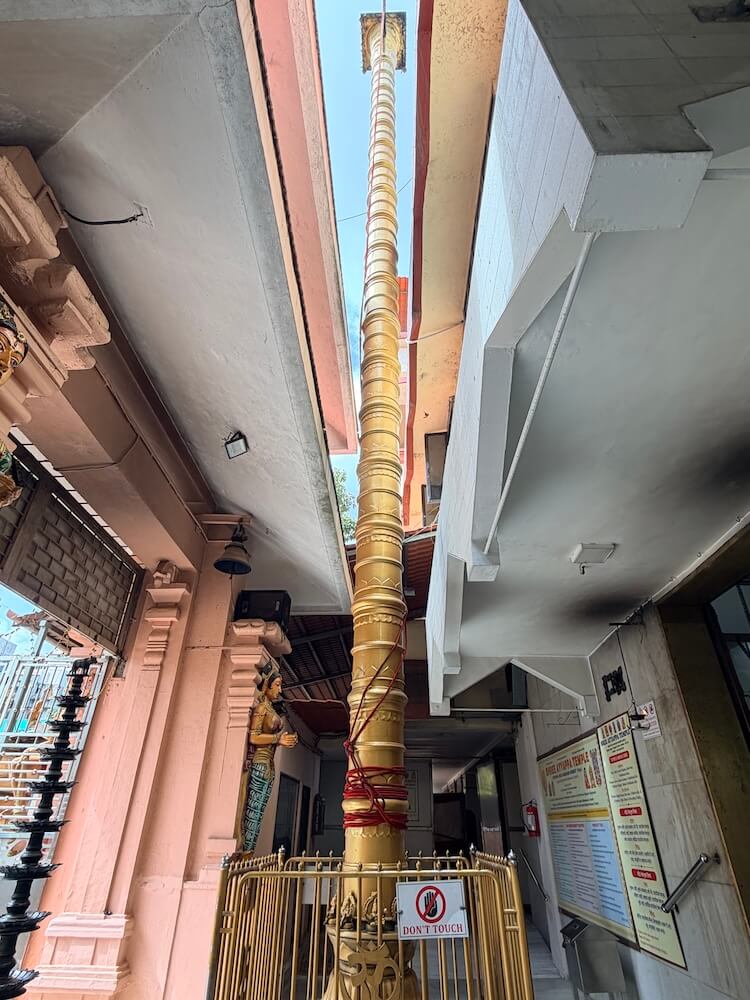
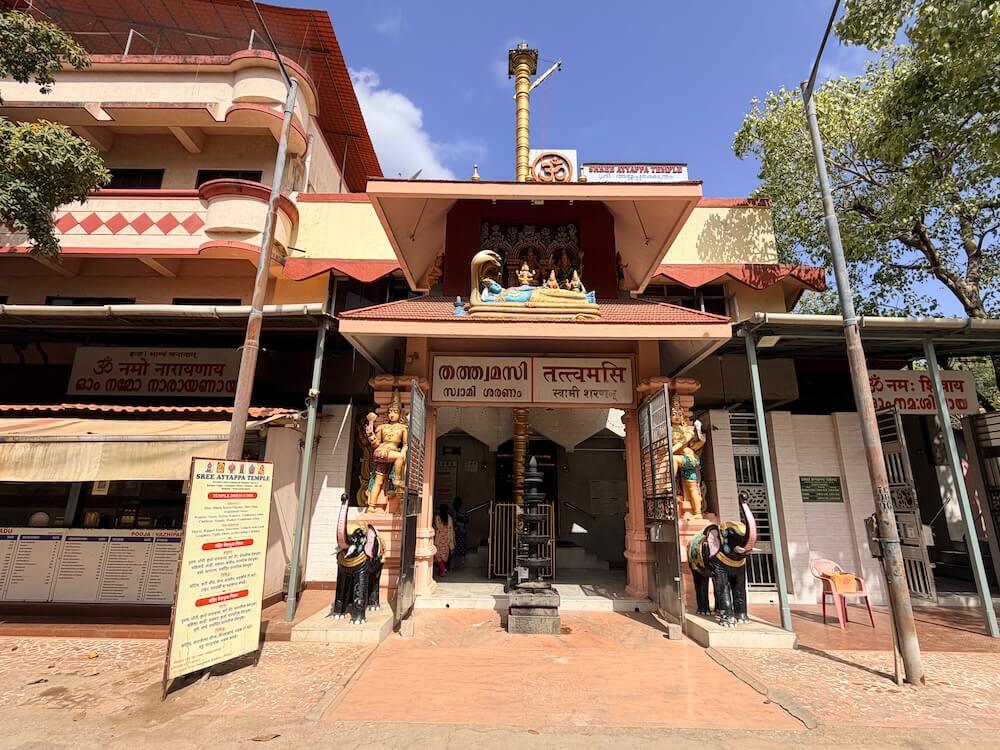
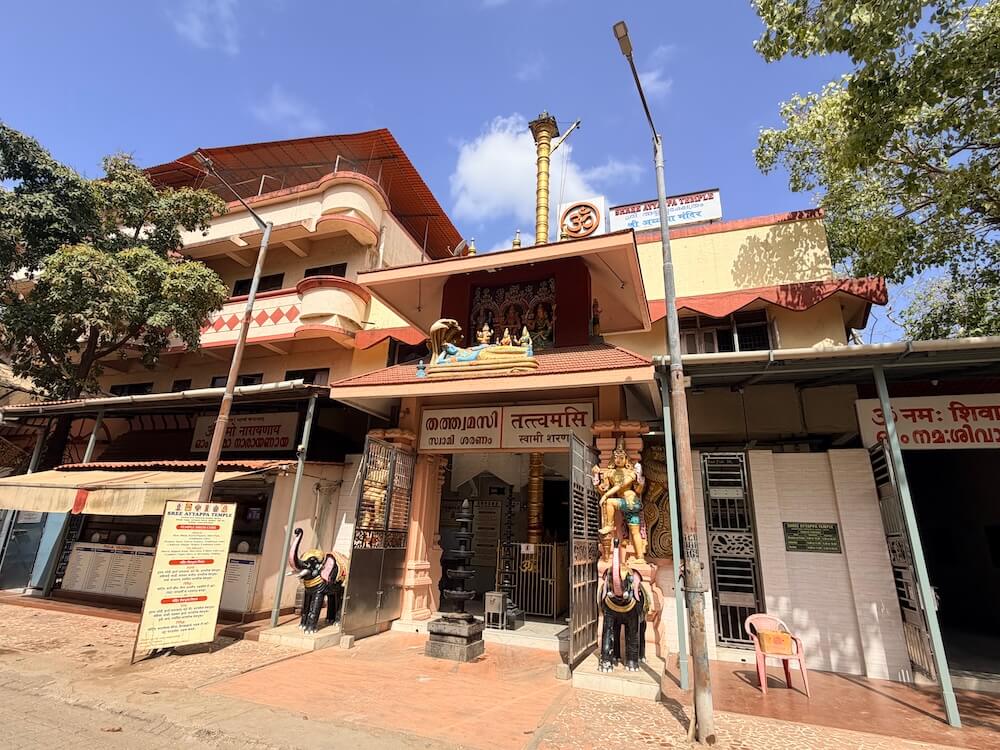
This temple, centrally located in Bangur Nagar, Goregaon, is primarily based on South Indian, especially Kerala, temple architectural style. On both sides of the temple’s two-storied entrance, there are sculptures of Gajraj (elephants). Sculptures of Dwajapalakas (gatekeepers) are carved on the pillar branches of the entrance. The sacred message ‘Tat Tvam Asi Swami Sharanam’ is inscribed on the main frame of the entrance in both Malayalam and Devanagari scripts. Above the entrance, there is an idol of Bhagavan Vishnu in a reclining posture on Sheshnaga. In the middle of the entrance, on the inner side, stands a traditional multi-tiered lamp pillar. The most significant part of the temple’s architecture is its flagstaff, known as the ‘Dhwajastambham’. This Dhwajastambham is installed directly in front of the Sabhamandapam (assembly hall) and is completely covered with a brass layer. To the left in the Sabhamandapam is the shrine of the Devi, and to the right are the idols of the Navagrahas.
Here, the temple doors open every day at dawn. The puja performed at dawn is called ‘Nirmalya Darshanam’. In this puja, the previous day’s ornaments and flowers are removed, and the deity is beheld in pure form. This is followed by the rituals of Naivedyam (offerings) and Abhishekam (ablution). Each of the five deities in the temple holds independent significance. The principal deity, Bhagavan Ayyappa, is considered the bestower of boons in Kali Yuga. Devotees primarily pray for peace and prosperity before the idol of Bhagavan Shri Krishna, also known as Guruvayurappan. Bhagavan Ganesha is worshipped at the commencement of any new undertaking. Amme Devi is a symbol of Shakti (divine power), and her special puja is performed during Navaratri. Bhagavan Subramanyam, also known as Kartikeya or Murugan, is primarily worshipped for the removal of obstacles. The puja methods for all these five deities are performed according to Kerala traditions. Ayyappa puja is a unique confluence of Shaiva, Vaishnava, and Shakta traditions. Strict celibacy, abstinence from alcohol and non-vegetarian food, and a rigorous code of conduct are considered essential for His devotion.
Among the annual festivals, the ‘Mandala-Makaravilakku’ festival, which runs from November to January, is considered the largest and most important. During these forty-one days, hundreds of devotees visit this temple. Devotees who are unable to undertake the pilgrimage to the original Sabarimala temple come to this Goregaon temple to complete their vows. During this period, devotees are given a special ‘Irumudi’, a two-compartment bag. This bag contains puja materials and a ghee-filled coconut. At the beginning of the annual festival, an official flag-hoisting ceremony is performed on the Dhwajastambham. This ritual is called ‘Kodiyettu’. On Makar Sankranti, the special festival of ‘Makaravilakku’ is celebrated here. On this day, the temple is specially illuminated with lamps. Additionally, the temple’s annual Pratishtha Utsavam (consecration festival) is celebrated every year in March or April. This festival lasts for eight to ten consecutive days. This festival features various cultural programs, classical music, and traditional Kerala instrumental music, known as ‘Chenda Melam’. On the last day of the festival, a grand procession of the deity’s idol is taken out, followed by ‘Arattu’, a sacred bath, concluding the festival. Photography and mobile phone usage are strictly prohibited in this temple. Devotees can have Darshan here from Monday to Friday, from five o’clock in the morning to ten thirty in the morning, and from five thirty in the evening to nine o’clock at night. On Saturdays, the temple is open for Darshan from five o’clock in the morning to eleven o’clock in the morning, and from five thirty in the evening to ten o’clock at night. On Sundays, the timings are also from five o’clock in the morning to eleven o’clock in the morning, and from five thirty in the evening to nine o’clock at night.
This sacred temple stands as a testament to deep spiritual devotion, ancient architectural grandeur, and rich local cultural traditions.
The sanctum sanctorum houses the divine idol consecrated according to ancient Vedic traditions, surrounded by serene courtyards and traditional temple architecture.
Navratri, Maha Shivratri, Annual Temple Jatra & Deepotsav
Compare and book flights, secure top-rated local hotels near the temple, hire reliable guides, and rent cars instantly.
Extend your pilgrimage by visiting other highly sacred temples located nearby.


Add ₹999 more to unlock FREE SHIPPING!
Your sacred cart is currently empty.
Shop Photo FramesFill in your delivery details below to place your order.
Add comment