
Add ₹999 more to unlock FREE SHIPPING!
Your sacred cart is currently empty.
Shop Photo Framesis an ancient shrine dedicated to the great rebel saint, eminent Kannada poet, fervent social reformer, and enlightened yogi, the Mahamanava Basaveshwara, who was born at the beginning of the twelfth century of the Christian era. This temple is situated in the village of Hitni, on the border of Karnataka and Maharashtra. Basaveshwara is revered as the founder of the Lingayat or Veerashaiva sect, which holds significant influence in North Karnataka and South Maharashtra. Also known as Basavanna, Basaveshwara is believed to be an incarnation of Nandi, a Shiva Gana. As in many temples, here too, Basaveshwara is worshipped in the form of Nandi.
According to the biographical work ‘Makers of Indian Literature – Basaveshwara’ (H. Tipperudraswamy, translated by Rohini Tukdev, Sahitya Akademi, २००३), Basaveshwara was born in the year ११३१ CE in the village of Ingaleshwar-Bagewadi in the Bijapur district of Karnataka, into a respected Brahmin family. Some scholars, however, suggest his birth year as ११०५ CE. His father, Madiraj, also known as Madaras, was the head of the Bagewadi Agrahara. Basaveshwara’s mother was named Madalamba, and she was a devout worshipper of Nandi, the village deity of Bagewadi. Legend has it that Madalamba once dreamt that Lord Mahadeva commanded Nandi to take avatar for the welfare of humanity. Accordingly, Nandi assumed a form of light and entered Madalamba’s womb. Thereafter, Madalamba became pregnant. Thus, Basaveshwara is considered an incarnation of Nandi.
After Basaveshwara’s birth, he received the auspicious Linga Diksha from the great Shaiva saint Jatavedamuni, also known as Ishanya Guru, at Kudalasangama. As he had undergone the Upanayana ritual through Linga Dharana at birth, he opposed his thread ceremony. However, when his father insisted on the thread ceremony, he left home. At that time, he was ८ years old. From there, he went to the study centre of Jatavedamuni at Kudalasangama. Jatavedamuni was a guru of the Kalamukha sect of the Shaiva faith. Basaveshwara received his religious education from him. At the insistence of his guru, he married in his youth. His maternal uncle, Baladeva, was the treasurer of Bijjala, a feudatory of the Kalachuri dynasty. Basaveshwara married both Gangambika, Baladeva’s daughter, and Nilambika, Bijjala’s adopted sister. After his marriage, he resided in Mangavada (Mangalwedhe), Bijjala’s capital. In due course, Bijjala rebelled and seized the kingdom of the Chalukya dynasty of Kalyana. At Bijjala’s insistence, Basaveshwara assumed the responsibility of minister (treasurer) in his kingdom. During this period, he undertook significant religious and social work. Basaveshwara performed the crucial task of opening up equal social and religious opportunities for all, without discrimination based on caste, sect, or gender. He liberated women from religious shackles. He vehemently opposed the rituals of the Vedas. By criticizing the worship of hundreds of deities, he propagated monotheism. Basaveshwara, the prophet of the Veerashaiva Dharma, attained ‘Lingaikya’ (passed away) in ११६७ CE.
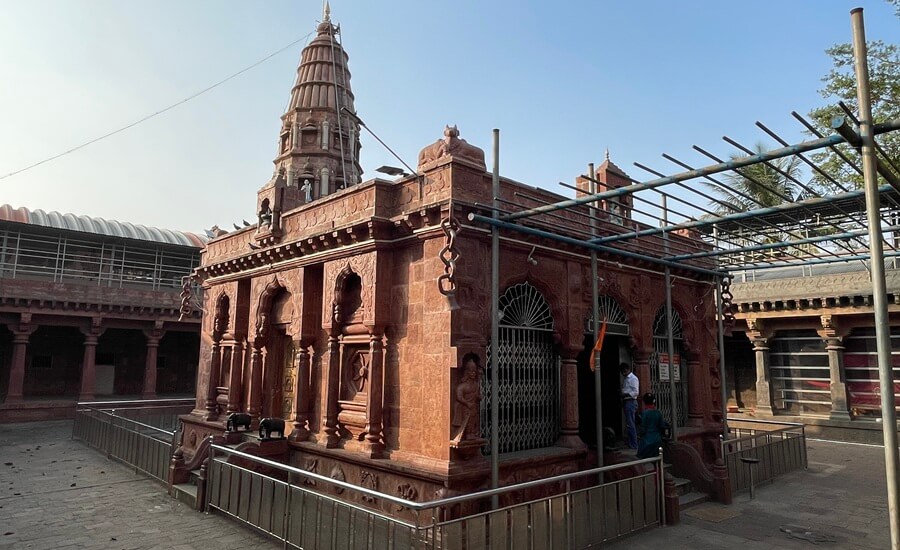
In Hitni, on the banks of the Hiranyakeshi River, stands a magnificent temple of Basaveshwara in the form of Nandi. This temple, said to be २०० years old, is an exquisitely artistic construction in the Dravidian architectural style. In front of the entrance to the temple, which has strong fortifications, there is a platform with an octagonal Deepamala (lamp pillar) of three tiers. The platform is adorned with floral designs on all four sides. Above this platform is another smaller platform, with elephant sculptures at all four corners. Additionally, there is an idol of Hanuman here. This Deepamala has separate arms for lighting the lamps. The tiers of the Deepamala are separated by circular rings. Beyond this is the three-storied stone entrance of the temple. To the left of the entrance, a large painting of Lord Shankara in meditation is depicted.
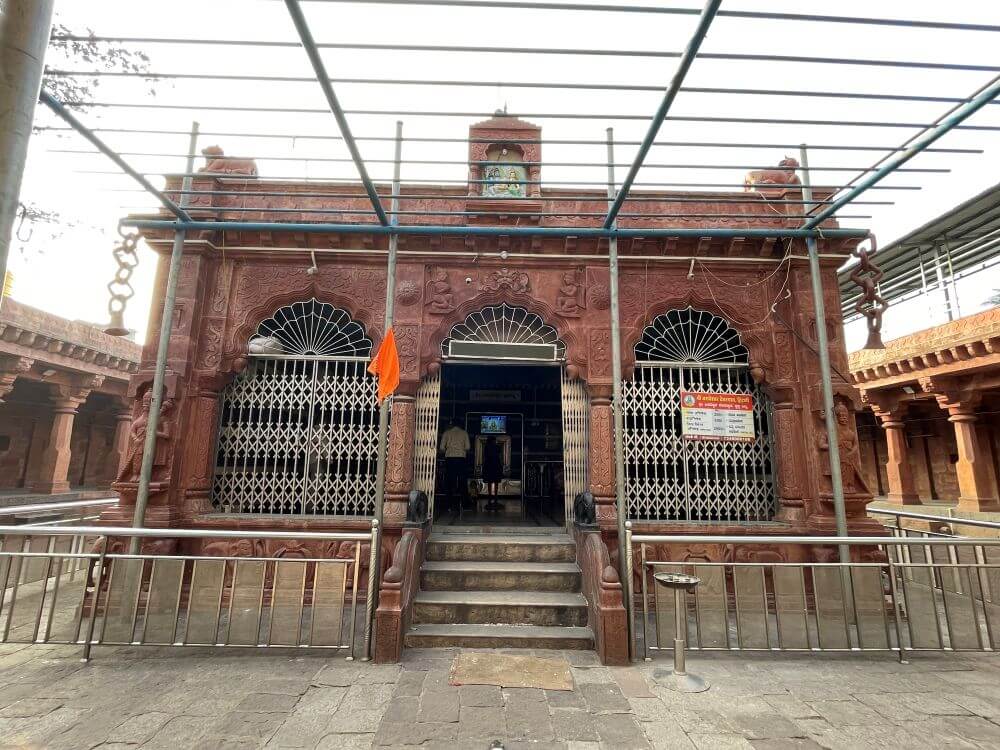
The door jambs feature lotus flower designs at the bottom and foliage designs at the top. Lord Ganesha is seated on the Lalatabimba (lintel). On both sides of the entrance are ornate octagonal pillars with an arched gateway above them. A Kirtimukha is at the centre of the arch. Adjacent to the octagonal pillars are square pillars with lamp niches. Above the entrance is a Nagarkhana (drum house). On the floor above it, in a balcony with four pillars and three arches, are idols of Shiva, Parvati, and Ganesha in the centre. To their left are idols of Vishnu, and to their right, idols of Lord Brahma. Above the balcony are three Meghadambari (canopies) with four ornate pillars each, topped with Shikharas (spires).
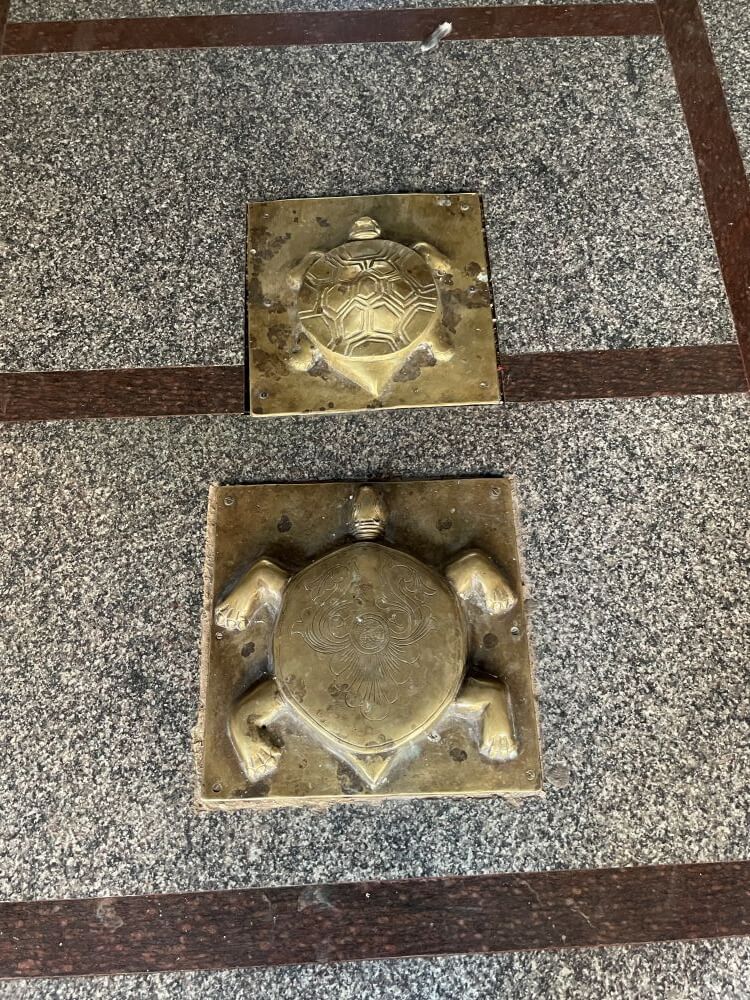
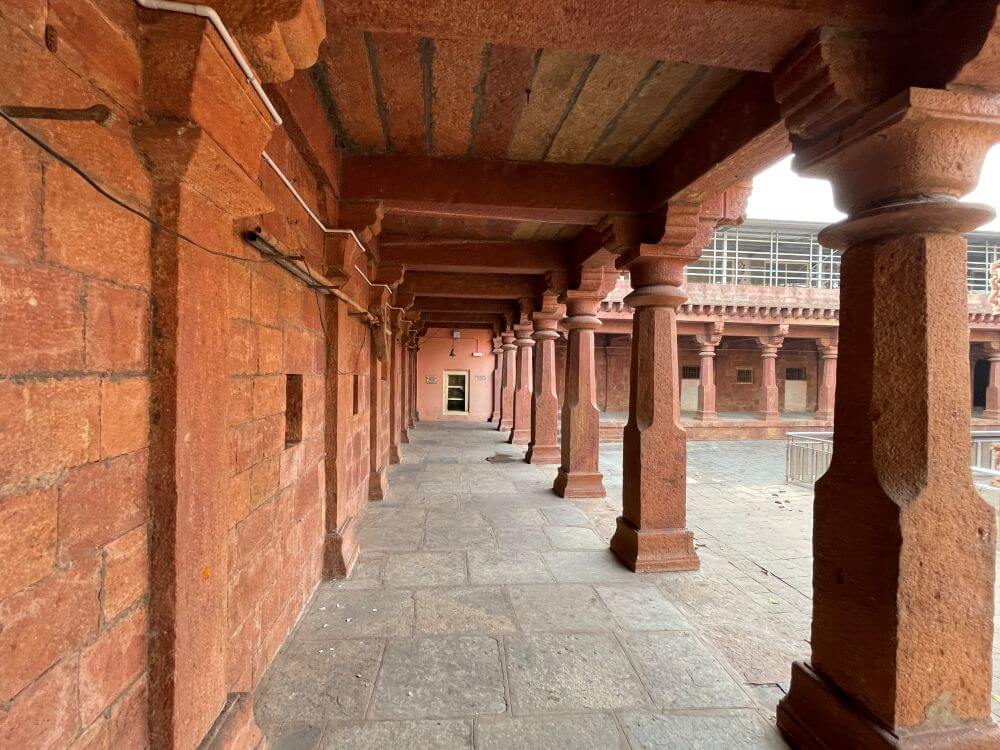
Inside the entrance, on both sides, are guard rooms. From here, one enters the stone-paved courtyard of the temple. Adjacent to the fortification in the courtyard is a Dharmashala (rest house). In the centre is the ancient structure of the temple. The temple is built on a high plinth. There are four steps to enter the temple. In front of these steps, on the ground, is a brass tortoise. On the balustrades of the steps, on both sides, are two elephant sculptures carved from black stone. The entrance has four octagonal pillars with three arched gateways. On the central arch, on both sides, are Garuda and Hanuman, with a Kirtimukha in the centre. In the deity niches near the ceiling of the entrance are idols of Shankara, Parvati, and Ganesha. In the deity niches on the pillars on both sides are Dvarapalas (gatekeepers). The lower part of the outer walls of the Sabhamandapa (assembly hall) is carved with elephants.
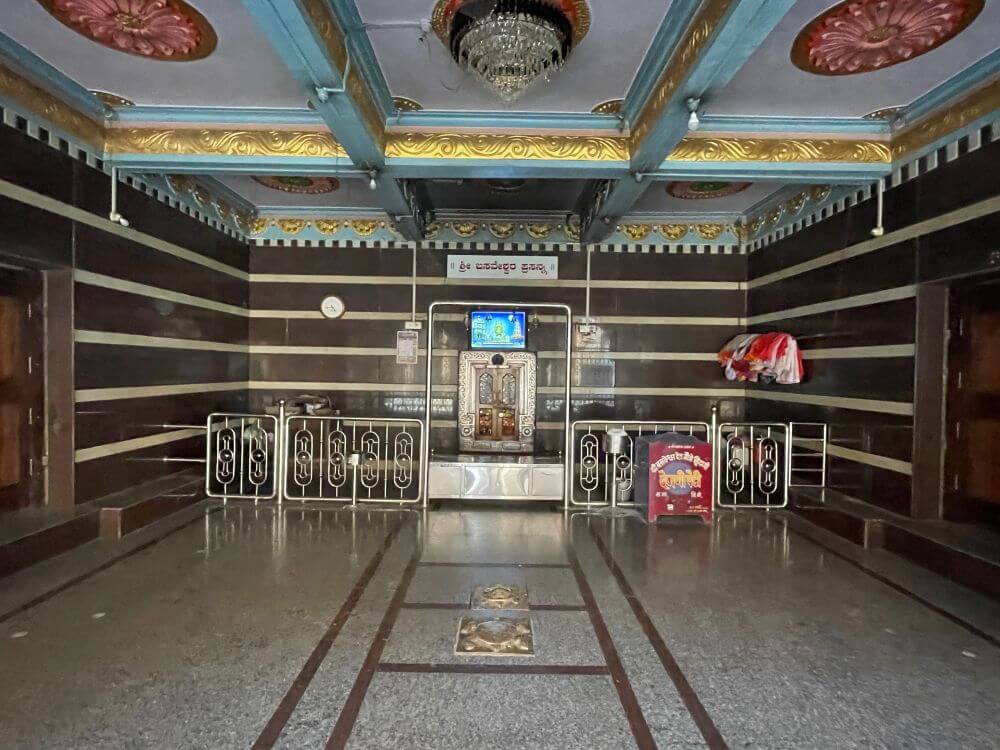
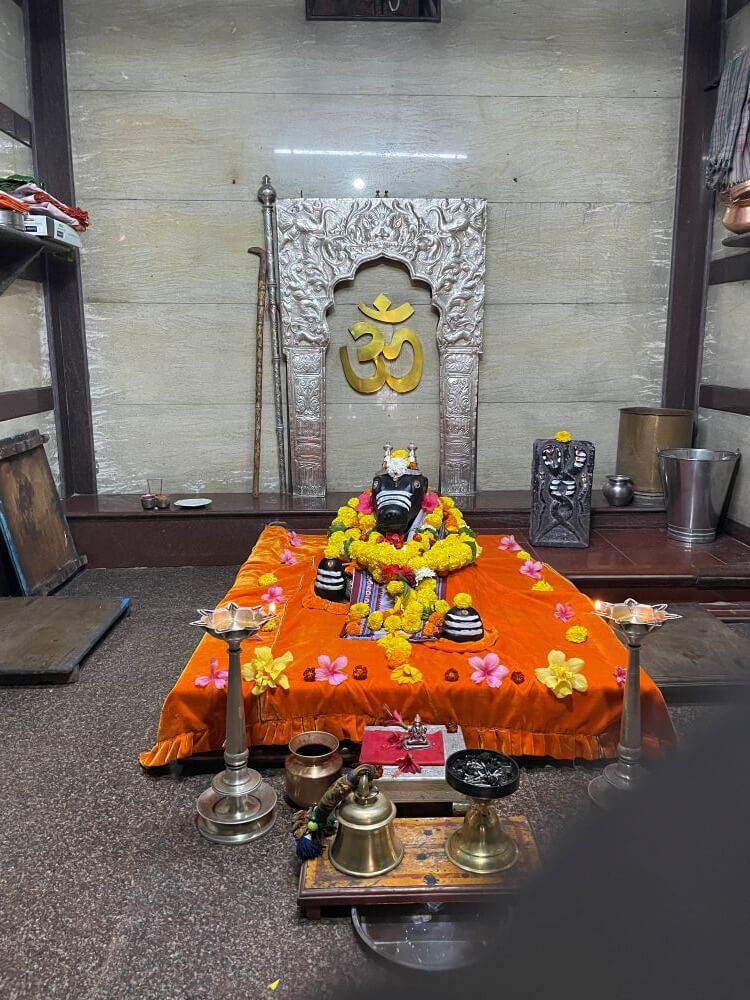
The temple structure comprises a Sabhamandapa and a Garbhagriha (sanctum sanctorum). The Sabhamandapa here is enclosed. Its ceiling is adorned with lotus flower designs. Besides the main entrance, the Sabhamandapa has two other doors. The entrance to the Garbhagriha is covered with a silver sheet. The door jambs feature lotus flowers at the bottom, peacock designs, and creeper motifs at the top. On the Mandaraka (threshold) is a Swastika, and on the Lalatabimba is Lord Ganesha. In the centre of the Garbhagriha, on a Vajra Peetha (diamond pedestal), is a magnificent black stone idol of Nandi. Nandi’s horns are adorned with silver horn caps, and behind the idol is an ornate silver Prabhavali (halo). Adjacent to the Prabhavali is a Nagamaithuna sculpture.
Upon the outer walls of the temple, there are divine niches adorned with shikhara and kalasha. On the outer walls to the right and left of the sabhamandapa, on both sides of the entrances, stand intricately carved pillars surmounted by arches. From the temple ceiling, stone-carved chains hang in all four corners, holding bells within them. This is considered a distinctive feature of temples belonging to the Veerashaiva tradition. The ceiling is bordered by a parapet, with Nandi sculptures in all four corners. The garbhagriha is crowned by a seven-tiered shikhara. In the lowest tier of the shikhara, there are eight semi-elephant sculptures and lotus flower motifs. The tier above features a replica of a lotus flower, while the two uppermost tiers each contain eight divine niches, housing idols of various Rishis and deities. Each divine niche is topped with a shikhara and a kalasha. The divine niches and the adjacent pillars are also crowned with kalashas. The three upper circular tiers each comprise एकवीस circular pillars. The topmost tier features an amalaka, surmounted by a kalasha.
At this temple, a grand yatra is held on Mahashivaratri. On this sacred day, thousands of devotees, carrying kalashas upon their heads, proceed in a palanquin procession to the ghats of the Hiranyakeshi River. There, after performing Ganga Pujan and Aarti, they fill their kalashas with water and return to the temple. The Nandi is then bathed with the river water. Following this, a procession is taken out from the temple, featuring a living Nandi along with the Utsava Murti of Nandi seated in a palanquin. This procession includes a five-tiered chariot, approximately पन्नास feet tall. Devotees pull this chariot with their own hands. The procession resonates with the thunderous sound of drums and taashas. Flags are danced, and gulal is showered. Lakhs of devotees who have come for Darshan of the Lord participate in the Rath Yatra and the palanquin ceremony.
This sacred temple stands as a testament to deep spiritual devotion, ancient architectural grandeur, and rich local cultural traditions.
The sanctum sanctorum houses the divine idol consecrated according to ancient Vedic traditions, surrounded by serene courtyards and traditional temple architecture.
Navratri, Maha Shivratri, Annual Temple Jatra & Deepotsav
Compare and book flights, secure top-rated local hotels near the temple, hire reliable guides, and rent cars instantly.
Extend your pilgrimage by visiting other highly sacred temples located nearby.


Add ₹999 more to unlock FREE SHIPPING!
Your sacred cart is currently empty.
Shop Photo FramesFill in your delivery details below to place your order.
Add comment