
Add ₹999 more to unlock FREE SHIPPING!
Your sacred cart is currently empty.
Shop Photo FramesThe famous temple of the folk deities Jari and Mari Mata is situated near a lake, close to Bandra railway station. This temple is a major center of faith for the Kshatriya Maratha Parit community and the Koli community of this region. It is said that the deity’s shrine here is about 300 years old. Devotees believe that the Jari Mari Mata here is ‘Jagrut’ (awakened/manifest). It is believed that this Goddess cures various ailments, which is why the temple is always bustling with devotees. Navratri Utsav is the biggest festival celebrated here, during which the temple premises take on the appearance of a fair.
In primitive communities, various elements of nature were considered divine and worshipped. It was a common belief among people that natural disasters and epidemics were caused by divine wrath. Consequently, a tradition began of conceptualizing these disasters or diseases as deities and attempting to appease them. In the past, every village had a village-protecting deity (Gram-rakshak Devata). Similarly, deities of diseases were also installed on the borders of villages. Jari and Mari are among such folk deities. According to entries in the Marathi Vishwakosh, Jari and Mari are considered fierce, minor deities. Jari is believed to be the goddess of fever epidemics, while Mari is the goddess of cholera and smallpox epidemics. Depending on the region, this Goddess is known by various names such as ‘Mariamman’, ‘Mari’, ‘Marimay’, and ‘Maribhavani’.
The shrine of Jari-Mari is usually located in a corner of the village or under a tree outside the village. Her priest is called a ‘Potraj’ or ‘Poturaja’. These priests carry the ‘Devara’ (shrine) of Mariaai on their heads and travel from village to village. In Maharashtra as well as in South India, neem leaves hold special significance in the worship of Mariaai. The Potraj is a devotee or ‘Bhagat’ of Mariaai. It is a widespread belief that Mariaai can be appeased through him. To appease the goddess and end an epidemic in the village, the Potraj is required to lead the Mariaai chariot to the village border. In some places, he is also called ‘Kadaklakshmi’. There is a folk belief that by satisfying Mariaai, the crisis of disease in the village is averted.
Some mythological legends regarding Mariaai are given in the seventh volume of the ‘Bharatiya Sanskritikosh’ by Pt. Mahadevshastri Joshi. According to one story, a sage named Piruh had a wife named Nagavali. She was extremely beautiful and famous for being a devoted wife (Pativrata). Hearing of her fame, Brahma, Vishnu, and Mahesh decided to test her virtue. When the gods arrived, Nagavali, not recognizing them, used the power of her devotion to transform the three gods into infants. This angered the gods, and they cursed her, saying, “Your beauty will be destroyed, and you will become ugly.” Under the influence of this curse, Nagavali lost her beauty, and marks similar to smallpox scars appeared on her face. When Sage Piruh returned home and saw his wife disfigured, he angrily cast her out of the house and cursed her again, saying, “You will be born as a demoness and will plague people with diseases, making them as ugly as yourself.” As a result of this curse, Nagavali was born in the form of ‘Mariamman’ (Mariaai), and people began to fall victim to her displeasure.
According to another legend, there was a beautiful Brahmin girl. A Chandala set his eyes on her. He went to Kashi, learned the Vedas and Brahminical customs, returned, and asked the Brahmin for his daughter’s hand in marriage. The Brahmin did not realize his deception and gave him his daughter. Later, they even had children. After some time, the girl realized his true nature. She told her parents about the incident and, in her anger, cursed both her husband and herself. Due to that curse, she became ‘Mari’ and her husband became a buffalo. Her children turned into a chicken and a goat. In another legend, the birth of Mari Mata is linked to the Renuka narrative. At the behest of Sage Jamadagni, Parashurama beheaded his mother, Mariamman. At that time, he also beheaded a woman of the Paria (Matang) caste who had come in his way. Pleased with Parashurama’s obedience, Jamadagni told him to “ask for any boon.” Parashurama asked for his mother to be brought back to life. Jamadagni then gave him some sanctified water and a wand, saying, “Join your mother’s torso and head, sprinkle this water on them, and touch them with the wand; your mother will come back to life.” However, in his excitement, Parashurama mistakenly joined his mother’s head to the Matang woman’s torso and the Matang woman’s head to his mother’s torso. Both came to life. The woman who came to life from the combination of the Brahmin woman’s head and the Paria woman’s torso became known as ‘Mariamman’, while the other became ‘Yellamma’. Through such legends, these folk deities have been elevated. This has also led to the prevalence of stories where Mari Mata is considered the sister of Krishna, and Jari-Mari is considered an avatar of the primordial mother, Parvati.
Much like the seven islands of Mumbai, there are many temples of Jari and Mari Mata in the villages of Salsette (Sashti) island. The Jari Mari Mata temple near Bandra lake is one of them. The original inhabitants of Bandra, which is part of the Salsette islands, were Kolis. In 1534 AD, Portuguese sailors and pirates led by Diogo da Silveira captured Bandra. The Portuguese referred to this village as ‘Bandora’. In the Portuguese language, this means ‘port’. It is said that the name Bandra or Vandre originated from this. In the post-Portuguese era section of the ‘Mahikavatichi Bakhar’, this village is mentioned as ‘Vandre’.
According to a legend regarding the Jari Mari Mata Temple here, in the first half of the 17th century, some people from the Kshatriya Maratha Parit community lived in this area. They used to go to the Bandra lake to wash clothes. Once, some people suddenly discovered self-manifested (Swayambhu) idols of Jari and Mari Mata along with their traditional symbols in that lake. That day was Margashirsha Vadya Dwadashi, the date being 9 January 1696. This day is celebrated here as the manifestation day (Prakat Din) of Jari-Mari. In later times, the influence of the Portuguese in Bandra diminished, and this area came under British rule. Consequently, the local citizens installed these idols near the lake. Over time, a temple was built there. Gradually, the number of devotees coming for the Goddess’s darshan began to increase, and a large shrine was established. Later, in 1996, on the occasion of the temple’s tercentenary jubilee year, the temple was renovated and given its current beautiful form.
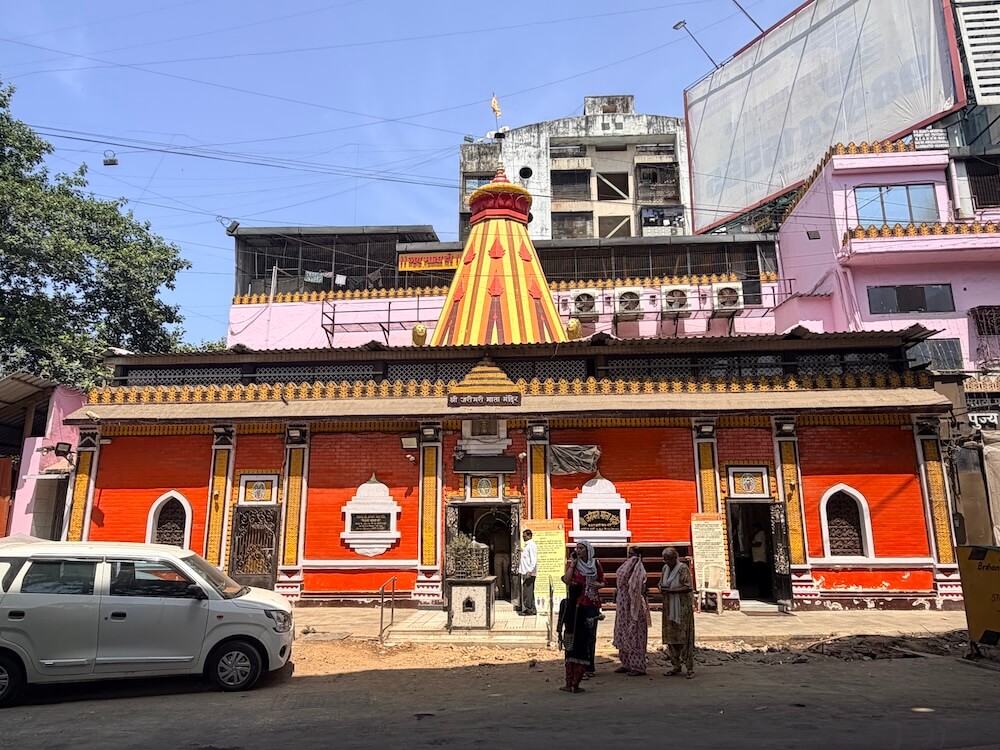
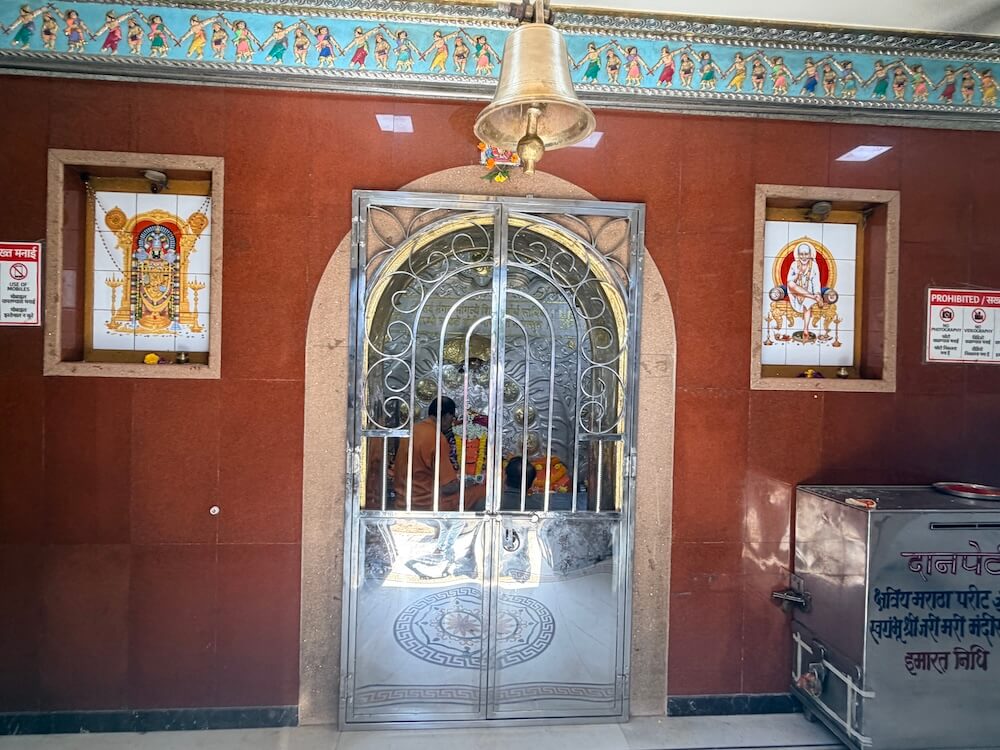
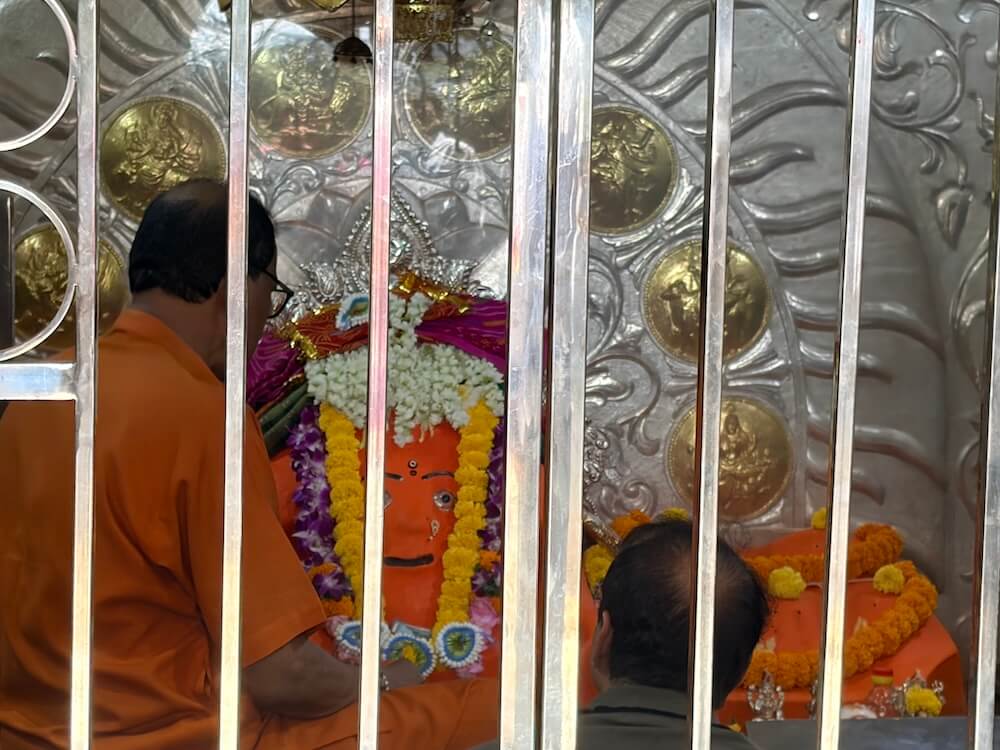
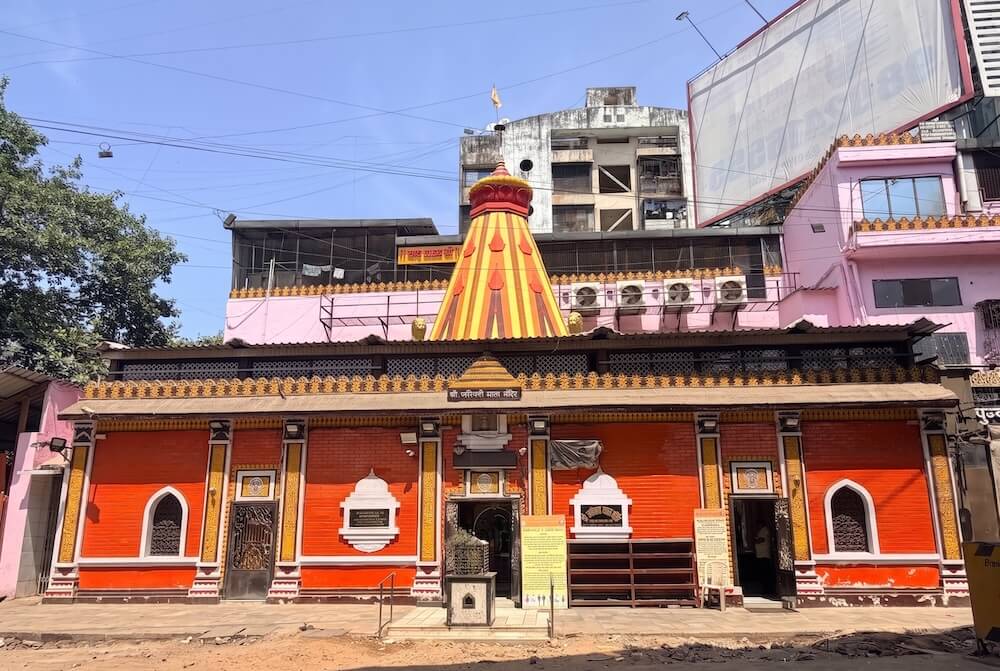
This temple of the Goddess stands right along the main road passing by Bandra lake. The temple is of modern construction. Its structure consists of a horizontal assembly hall (Sabhamandap) with three entrances, and the sanctum sanctorum (Garbhagriha) of the Goddess within it. The assembly hall has a tin roof. In the center, above the sanctum, there is a conch-shaped spire (Shikhara). On the spire, there is a circular Amalaka and a Kalash atop it. As one enters through the main door of the assembly hall, the sanctum sanctorum with marble flooring is directly in front. Tiles depicting Sai Baba and Bhavani Mata are fixed on its outer walls. On the ceiling side, there is a row of paintings of Gopis and Gopas playing Ras-Garba. Inside, the unhewn stone idols of Jari and Mari Mata are seated on a throne (Makharvedi) inlaid with silver sheets and a halo resembling the Sun God (Suryanarayan). This vermilion-anointed idol is adorned with floral ornaments. Beside the Goddess are the vermilion-anointed stones of her sisters and brothers. There is a circumambulation path (Pradakshina Marg) around the sanctum from the assembly hall. To the right, at the back of the sanctum, is an image of Saptashrungi Mata. Additionally, in this assembly hall, a Shiva Linga is enshrined in a square pit-like space on the right.
Devotees can seek darshan in the temple from 8:00 AM to 12:30 PM and from 3:00 PM to 8:30 PM. It is said that many prominent leaders such as former Prime Minister Atal Bihari Vajpayee, Shiv Sena Chief Balasaheb Thackeray, and Jagannath Joshi have visited this temple to worship the Goddess. Aarti is performed here daily at 8:30 AM and 7:40 PM. Devotees believe that the Jari Mari Mata here fulfills their vows (Navas). Many devotees come here to seek the Goddess’s guidance (Kaul) before undertaking any important task. The ritual of seeking Kaul is performed on Mondays, Wednesdays, Thursdays, Saturdays, and Sundays between 9:00 AM to 12:00 PM and 3:00 PM to 5:30 PM. However, the Kaul ritual is not performed during the nine days of Chaitra and Sharadiya Navratri. Similarly, Jalabhishek or Dugdhabhishek (offering of water or milk) is performed on the Shiva Linga here only between 9:00 AM and 12:00 PM. Pregnant women beyond five months are not permitted to enter this temple. Festivals like Chaitra and Sharadiya Navratri, as well as Shivratri and Holikotsav, are celebrated with great enthusiasm in the temple. During Navratri, the atmosphere here is like a fair. During this time, special adornment, Abhishek, Puja, and Homa-Havan of the Goddess are performed. Thousands of devotees from Bandra and other parts of Mumbai come here during these nine days for the Goddess’s darshan and to fulfill their vows. In this celebration, along with the Parit and Koli communities, Gujarati, Sindhi, Parsi, and Muslim brethren also participate in large numbers. This festival begins after the Yatra of the Jari Mari Mata of Madh commences in the bright fortnight (Shukla Paksha) of Ashadha. This Yatra lasts for fifteen days.
This sacred temple stands as a testament to deep spiritual devotion, ancient architectural grandeur, and rich local cultural traditions.
The sanctum sanctorum houses the divine idol consecrated according to ancient Vedic traditions, surrounded by serene courtyards and traditional temple architecture.
Navratri, Maha Shivratri, Annual Temple Jatra & Deepotsav
Compare and book flights, secure top-rated local hotels near the temple, hire reliable guides, and rent cars instantly.
Extend your pilgrimage by visiting other highly sacred temples located nearby.


Add ₹999 more to unlock FREE SHIPPING!
Your sacred cart is currently empty.
Shop Photo FramesFill in your delivery details below to place your order.
Add comment