
Add ₹999 more to unlock FREE SHIPPING!
Your sacred cart is currently empty.
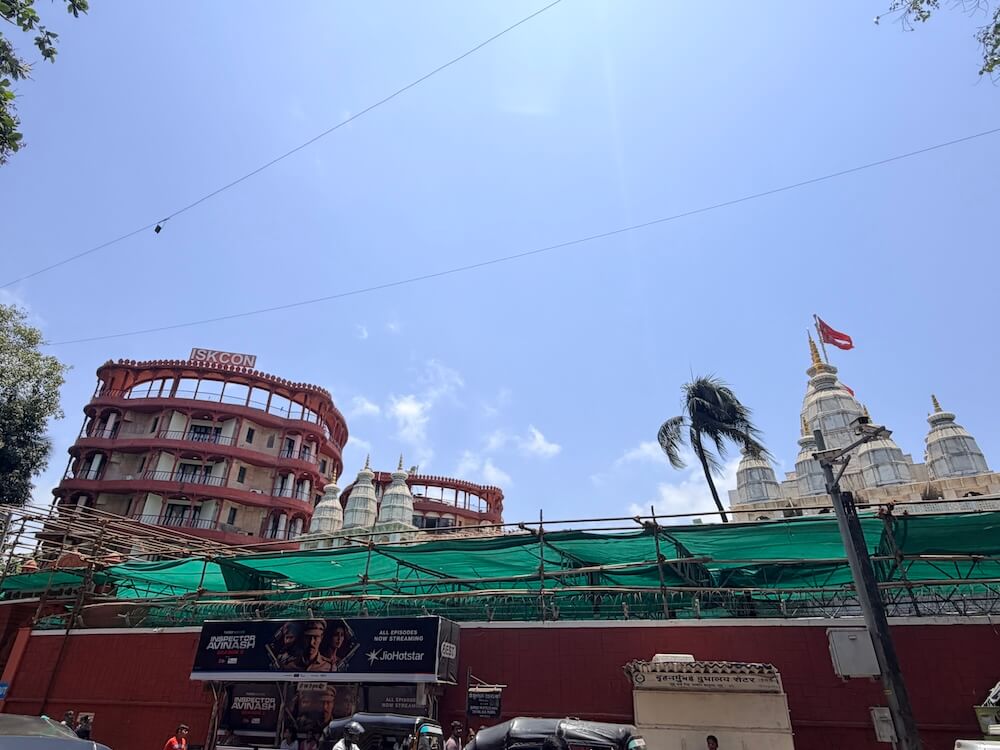
Shop Photo FramesThe Radha Rasabihari Temple, located in Juhu, was established by the International Society for Krishna Consciousness (ISKCON), an organization founded by Abhay Charanaravinda (A.C.) Bhaktivedanta Swami Prabhupada to propagate the Krishna mantra and ‘Krishna Consciousness’ across the globe. Attracting millions of devotees and tourists every year, this temple is a significant center on the religious and cultural map of Mumbai. Approximately seven to eight lakh devotees participate in the Krishna Janmashtami celebrations at this temple, which is popularly known as the ‘ISKCON Juhu Temple’.
Devotion to the Lord is superior to mere intellectual knowledge. Chaitanya Mahaprabhu, the transcendental Vaishnava saint from Bengal, established the glory of the Holy Name by teaching that the Supreme Lord can be attained through the path of devotion, which is accessible to all. Following the Gaudiya Vaishnava philosophy taught by him, and dedicated to the propagation of Krishna devotion worldwide, ISKCON was founded in 1966 in New York City by A. C. Bhaktivedanta Swami Prabhupada. He is also known as ‘Srila Prabhupada’. The Swami was born on 1 September 1886 in Kolkata. His original name was Abhay Charan De. His father, Gour Mohan De, and mother, Rajani, were religiously inclined. From them, the Swami imbibed the values of Krishna devotion from his childhood. He received his education at the ‘Scottish Church College’ in Kolkata, where he mastered English, Sanskrit, and various other subjects. In 1922, Prabhupada met Bhaktisiddhanta Saraswati Thakur, a saint in the Gaudiya Vaishnava tradition. In 1933, Prabhupada received formal initiation from Bhaktisiddhanta Saraswati and became a preacher of the Vaishnava tradition. For some time, he worked in the pharmaceutical business to support his family; however, after 1950, he retired from worldly life and dedicated himself full-time to Krishna devotion and spiritual preaching. In 1959, he accepted the order of Sannyasa. In this ashram, he adopted the name ‘Abhay Charanaravinda Bhaktivedanta Swami’.
It was the desire of his guru, Bhaktisiddhanta Saraswati, that Swami Prabhupada should take the teachings of Lord Krishna into the English language and carry these lessons to the Western world. Accordingly, Swami Prabhupada wrote the commentary ‘Bhagavad Gita As It Is’. He also translated the ‘Srimad Bhagavatam’ and other Vaishnava scriptures. In 1965, at the age of 69, overcoming many hardships and two heart attacks during his journey, Swami Prabhupada went to America. It was through his vision that ISKCON was established there. The primary objectives of this movement are to spread the teachings of the ‘Bhagavad Gita’ and ‘Srimad Bhagavatam’ to every corner of the world, to unite society by forgetting caste distinctions, and to promote simple living and high thinking. To fulfill these objectives, Swami Prabhupada wrote over 70 books. These include commentaries on the ‘Bhagavad Gita’ and ‘Srimad Bhagavatam’, as well as the major work ‘Chaitanya Charitamrita’. On 14 November 1977, he departed from this world at the ‘Krishna Balaram’ temple in Vrindavan. Today, hundreds of temples, agricultural centers, and educational institutions of this movement are active worldwide. Among these, the ISKCON temple in Juhu is considered one of the most famous and influential ISKCON centers in the country.
The history of this temple is directly linked to the expansion period of ISKCON. The idea of building a grand ISKCON center in Mumbai was that of ‘Srila Prabhupada’ himself. In the early 1970s, he came to Mumbai with his foreign disciples. At that time, he selected this vast plot of land in Juhu for the temple. The area was then undeveloped and marshy. In 1972, Srila Prabhupada took possession of this land, but the entire process proved to be extremely complex. The project moved forward through land deals, ownership rights, financial difficulties, and legal struggles. Major court cases arose regarding land ownership rights. Overcoming all legal and social obstacles, the ground-breaking ceremony for the temple was performed here on 31 December 1975. Over the next two years, a magnificent temple structure was built, and on 14 January 1978, on the auspicious occasion of Makar Sankranti, this Radha Rasabihari Temple was officially inaugurated.
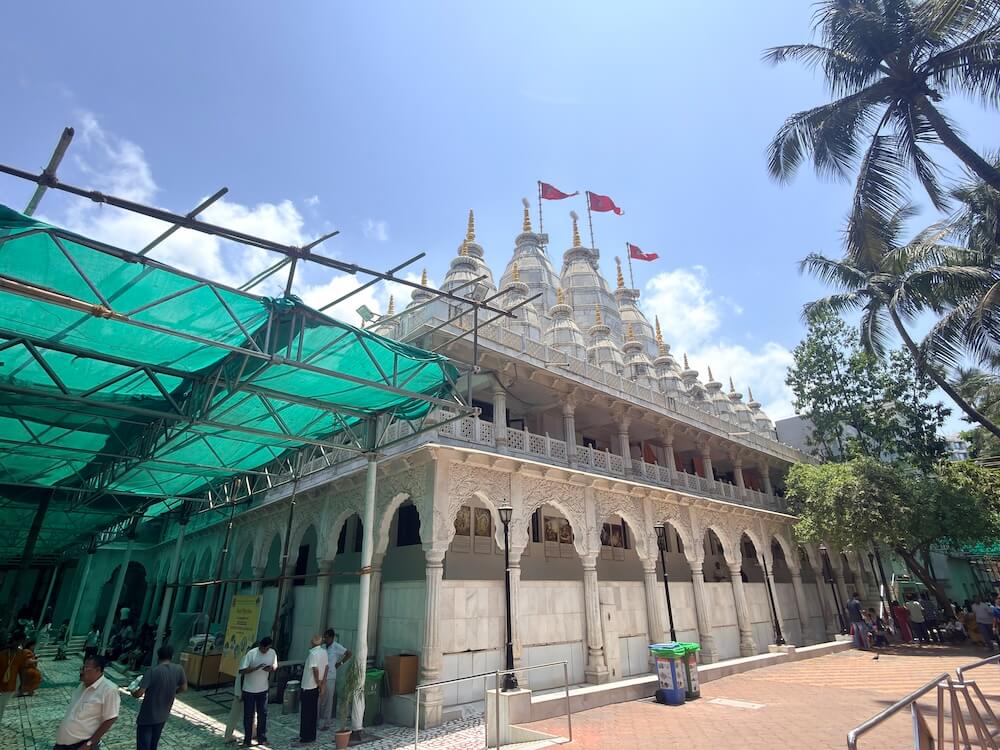
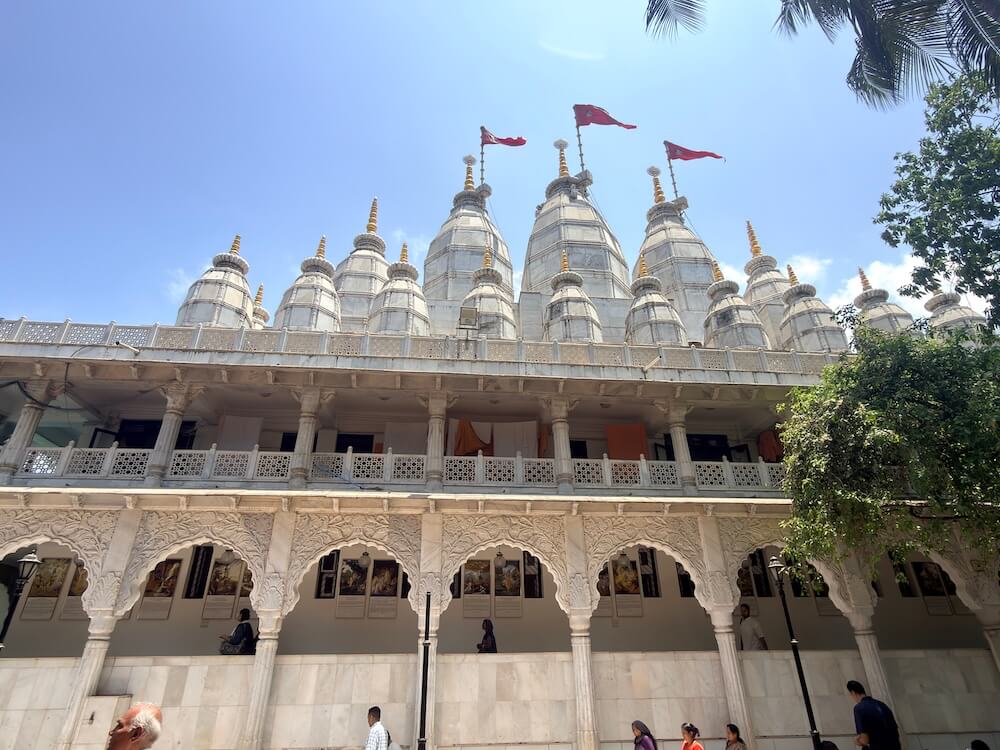
As one enters the vast premises of the ISKCON temple from the main Juhu road, one experiences the grandeur and architectural beauty of this structure. The entire temple complex is designed by blending ancient temple architecture, specifically the Nagara style, with modern urban needs. The temple has an arched entrance. Inside the high boundary walls lies the spacious courtyard of the temple. In front stands the magnificent temple palace, clad in pristine white marble. High-quality Makrana marble brought from Rajasthan has been used in the construction of the temple. The walls and pillars of the temple are adorned with intricate carvings. The temple features various arches, frames, and pillars that reflect the ornamental style of the Vaishnava tradition. A notable feature of this temple palace is its grand shikhara (spires). The temple has tall, pointed, and proportionate spires in the North Indian style. Built in a multi-layered fashion, these spires taper towards the top. At the summit of the spires are the kalash (finial) and the flagstaff. Intricate carvings are done on the various levels of the spires. The walls and windows of the temple building feature latticed arches and jharokhas (balconies) influenced by Rajasthani and Mughal architectural styles.
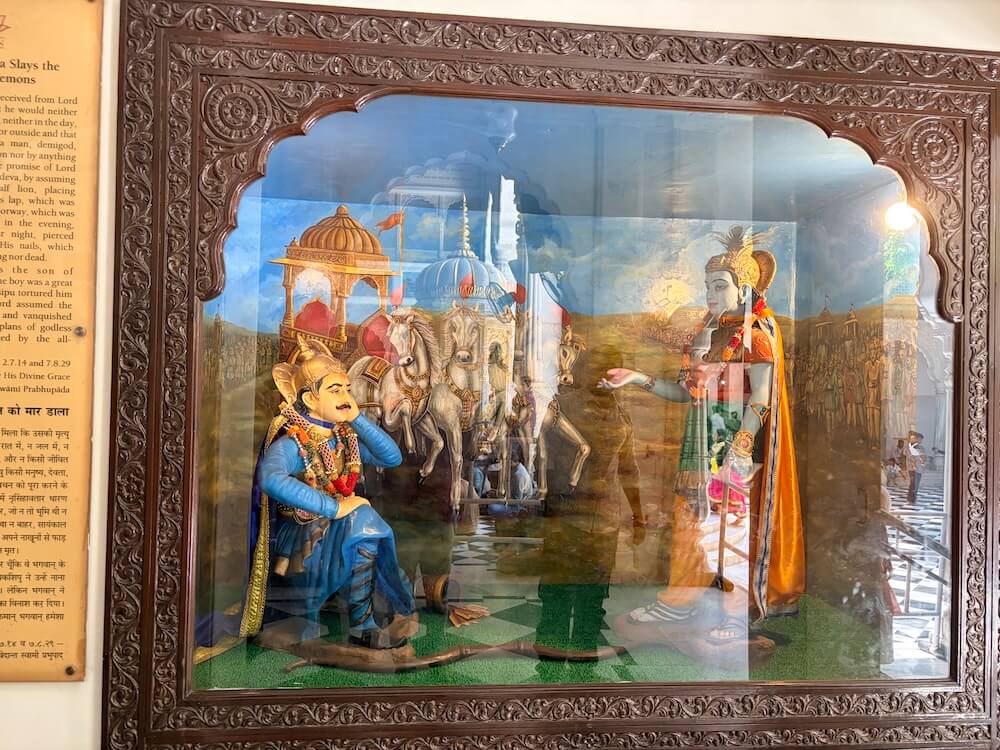
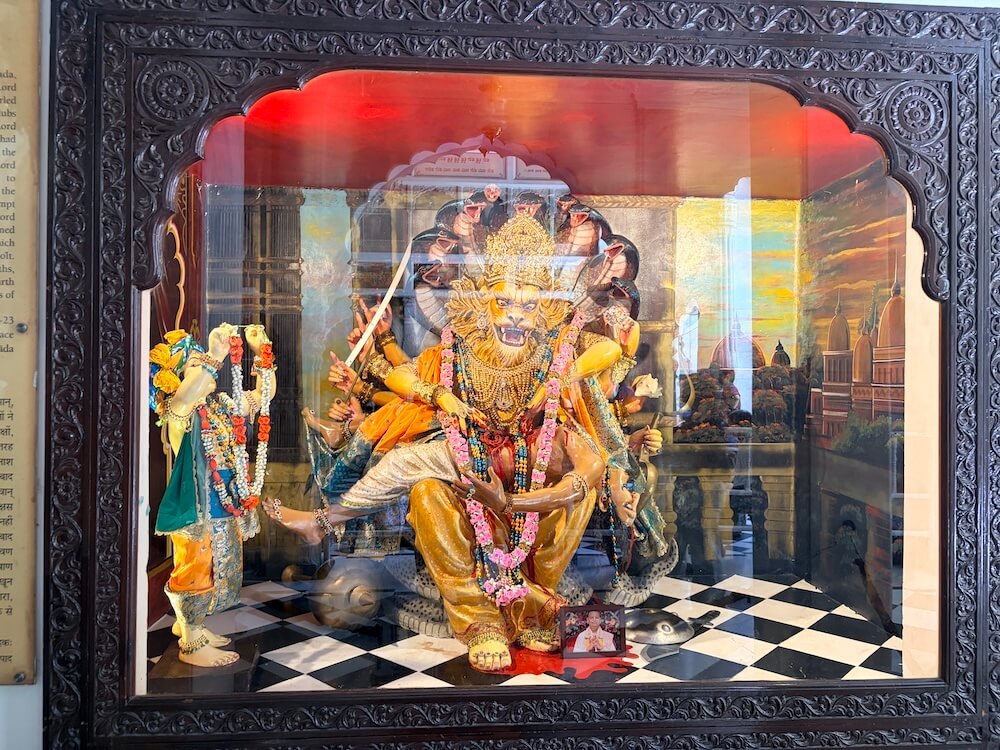
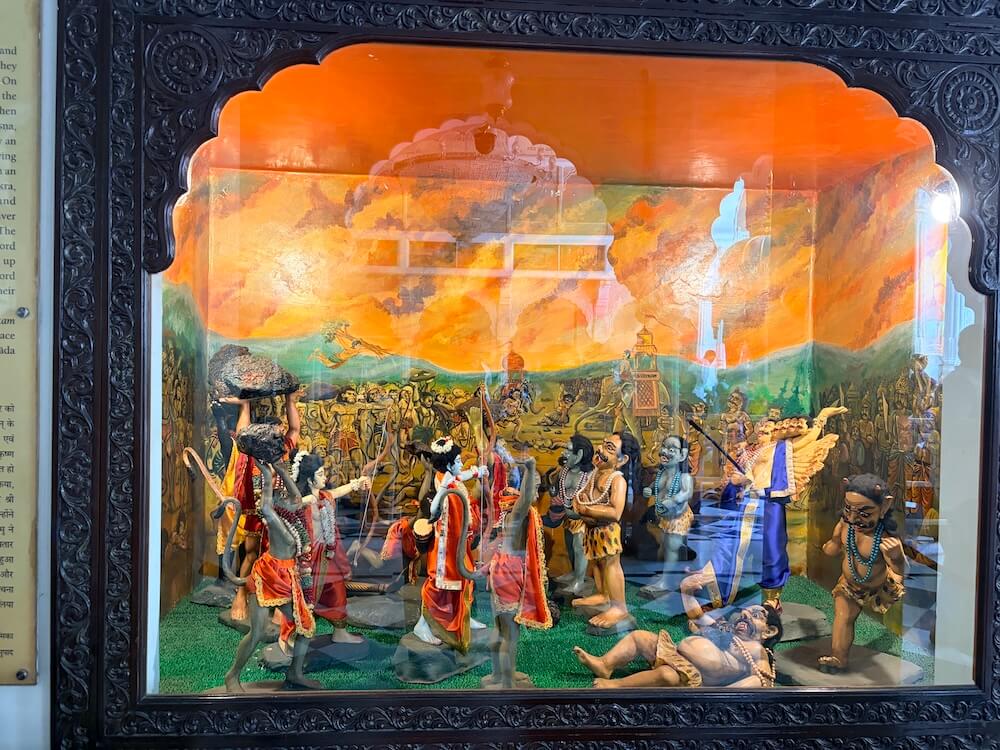
The temple has a vast sabhamandapa (assembly hall). Hundreds of people can stand here at once. The pillars and flooring of the assembly hall are entirely made of marble. The ceiling of the assembly hall is high, and a grand chandelier is hung from it. Various murals in the assembly hall depict different episodes from the life of Lord Krishna, the Rasa Lila, as well as scenes from the life of Chaitanya Mahaprabhu.
In accordance with the ISKCON tradition, the murti of A.C. Bhaktivedanta Swami Prabhupada is consecrated on a high altar within a beautiful marble canopy in the assembly hall, directly facing the sanctum sanctorum. The exterior marble walls of the sanctum also feature intricate carvings. There are three sanctums situated side by side, each with large doors crafted from teak wood, adorned with silver and gold filigree work. Above the frames of these entrances, there is a design featuring peacock sculptures surrounded by beautiful engravings. In the central sanctum, the murtis of Radha and Rasbihari are seated on a high altar within a magnificent, gold-plated wooden shrine. These beautiful murtis, carved from white marble, are adorned with exquisite garments and ornaments. The adornment of these murtis changes daily. Similarly, decorations and floral arrangements are made according to the seasons. In the sanctum to the left of the main sanctum, there are ashtadhatu (eight-metal) murtis of Gauranga-Nitai (Chaitanya Mahaprabhu and Nityananda Prabhu). These images, with both arms raised, are considered symbols of the philosophy of Namasankirtana in the Gaudiya Vaishnava tradition. In the sanctum to the right, the murtis of Shri Rama, Sita, Lakshmana, and Hanuman are consecrated. All these murtis in the temple were installed by Prabhupada himself.
Devotees can have darshan in this temple from 4:30 AM to 1:00 PM and again from approximately 4:30 PM to 9:00 PM. The schedule of daily rituals is also very well-planned. Mangala Arati takes place here at 4:30 AM. This is followed by Shringar Darshan Arati at 7:15 AM, Rajbhog Arati at 12:30 PM, Sandhya Arati/Gaura Arati at 7:00 PM, and Shayan Arati at 8:30 PM. Hundreds of devotees participate in these Arati ceremonies. Janmashtami is considered the biggest festival in this temple. This celebration includes the midnight birth ceremony, Maha-Abhishek, Kirtan, and special darshan. It is said that about seven to eight lakh devotees participate in the Janmashtami day and the subsequent Nandotsav celebrations. Notably, while modern technology is used for crowd control, security, and food distribution, hundreds of young men and women work here voluntarily as sevaks. Festivals like Ram Navami, Jagannath Rath Yatra, Radhashtami, Govardhan Puja, Gaura Purnima, and Narasimha Jayanti are also celebrated on a grand scale. The Rath Yatra festival of the temple is famous. During the Jhulan Yatra, the tradition of placing the Utsava-murtis of Radha-Krishna on a decorated swing is followed. Special floral decorations, Abhishek, and collective Kirtans are organized during the Radhashtami and Janmashtami celebrations. Within the temple premises, there is a modern vegetarian restaurant named Govinda’s. Additionally, thousands of poor people are provided with free meals daily by the organization.
This sacred temple stands as a testament to deep spiritual devotion, ancient architectural grandeur, and rich local cultural traditions.
The sanctum sanctorum houses the divine idol consecrated according to ancient Vedic traditions, surrounded by serene courtyards and traditional temple architecture.
Navratri, Maha Shivratri, Annual Temple Jatra & Deepotsav
Compare and book flights, secure top-rated local hotels near the temple, hire reliable guides, and rent cars instantly.
Extend your pilgrimage by visiting other highly sacred temples located nearby.


Add ₹999 more to unlock FREE SHIPPING!
Your sacred cart is currently empty.
Shop Photo FramesFill in your delivery details below to place your order.
Add comment