
Add ₹999 more to unlock FREE SHIPPING!
Your sacred cart is currently empty.
Shop Photo FramesThere is an inseparable bond between rivers and Shiva temples. Mahadeva is considered the revered deity of Shaivite devotees, and the Shiva Linga is regarded as the primary symbol of creation. It is a firm, ancient belief among the common people that the holy water flowing over the Shiva Linga enhances the fertility of the land. For this very reason, it is observed that sacred Shiva temples have been established along the banks of various rivers since ancient times. Such historical Shiva temples have been established on the banks of almost all small and large rivers in India. Many of these religious and sacred sites have gained fame as renowned pilgrimage centers across the entire country. The famous Nangartas Shiva Temple in the Jalna district, which possesses a rich historical heritage, is also considered one of the most sacred and significant places of this unique tradition.
According to official records by the organization “Jaha Jaha Ram Charan Jai” based in Delhi, this is considered the १४८th sacred site on the path taken by Lord Shriram during his exile. The Mahants here state that this temple dates back to the Ramayana era and is approximately five thousand years old. On the other hand, experts in the fields of history and archaeology estimate that this temple is likely six hundred to seven hundred years old. A local legend is told regarding the construction of this temple. It is said that Lord Shriram stopped here for a stay during his exile. At that time, he established a sacred Shiva Linga here for his daily Sandhya rituals. While Shriram was residing in this area, he keenly observed that the local inhabitants or villagers lacked proper knowledge of agriculture. He then instructed his brother Lakshmana to teach the local subjects, or Praja, the lessons of farming and agriculture, and he himself guided the people by personally operating a plough. Because Lord Shriram himself ploughed the land here, a deep furrow, or ‘Taas’, was etched into the rock along the riverbank. Due to this specific religious reason, this entire region came to be known as Nangartas.
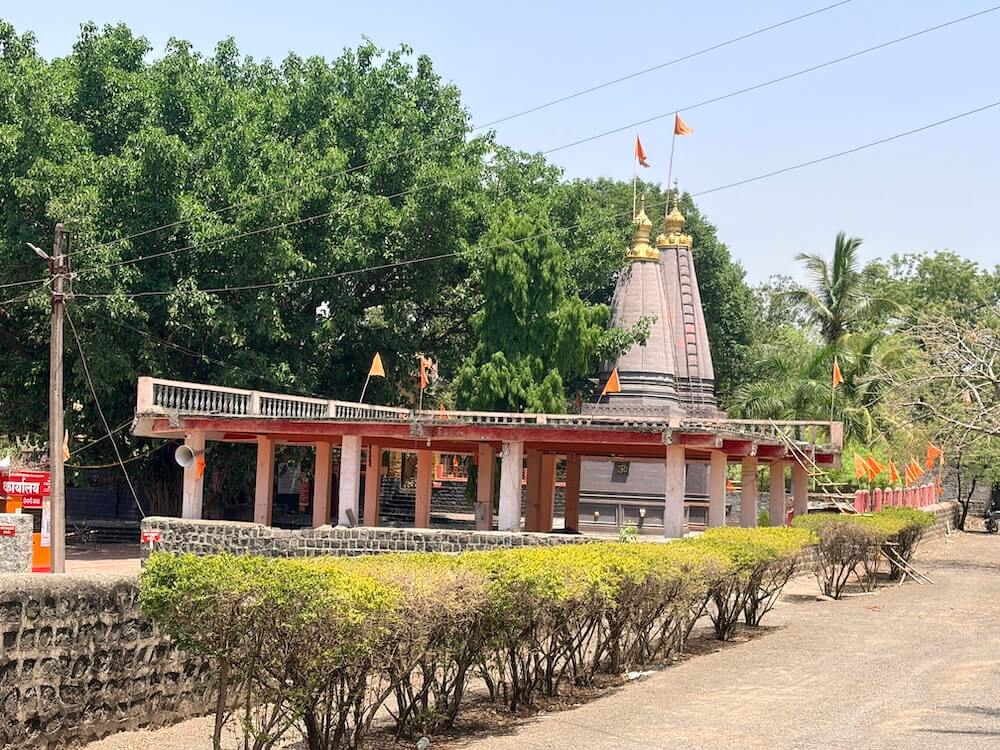
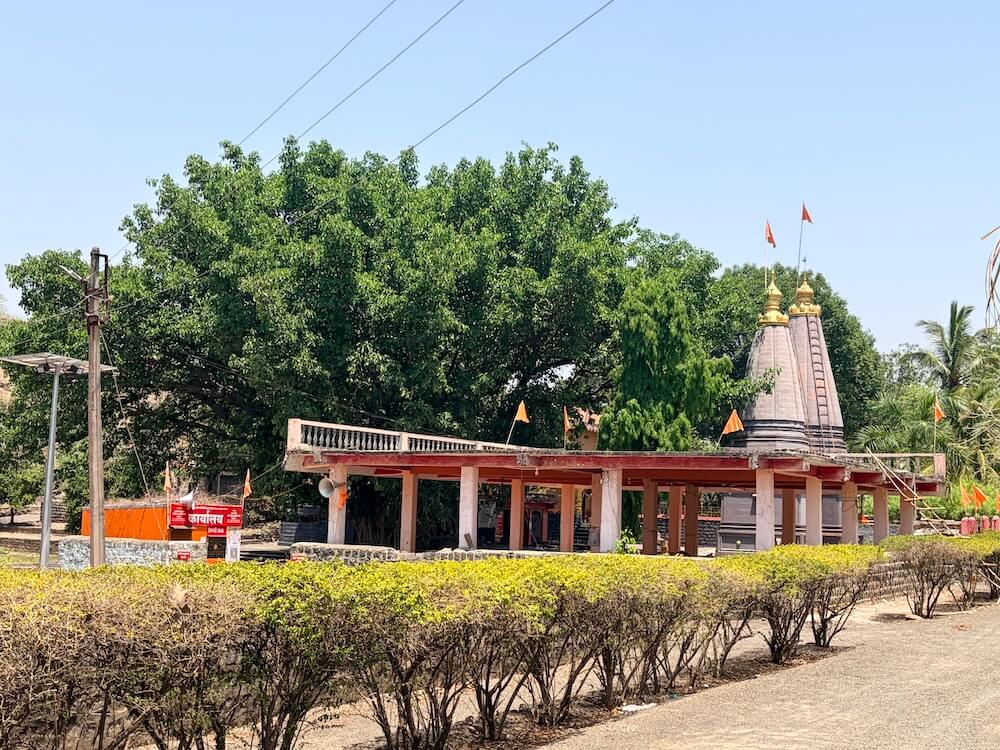
Nestled in the lap of the hills, this place is also known as ‘Prati Mahabaleshwar’ in the region due to its natural beauty. The main temple is situated on the bank of a river near the village. A spacious parking area has been provided in front of the temple for the vehicles of devotees. A strong fortification wall has been built on all sides for the security of the main temple, and the main entrance is within this fortification. A large pavilion has been erected in the spacious courtyard of the temple for the rest and shelter of devotees coming for Darshan. Devotees visiting for Darshan use it for organizing their vowed food offerings as well as religious Mahaprasad.
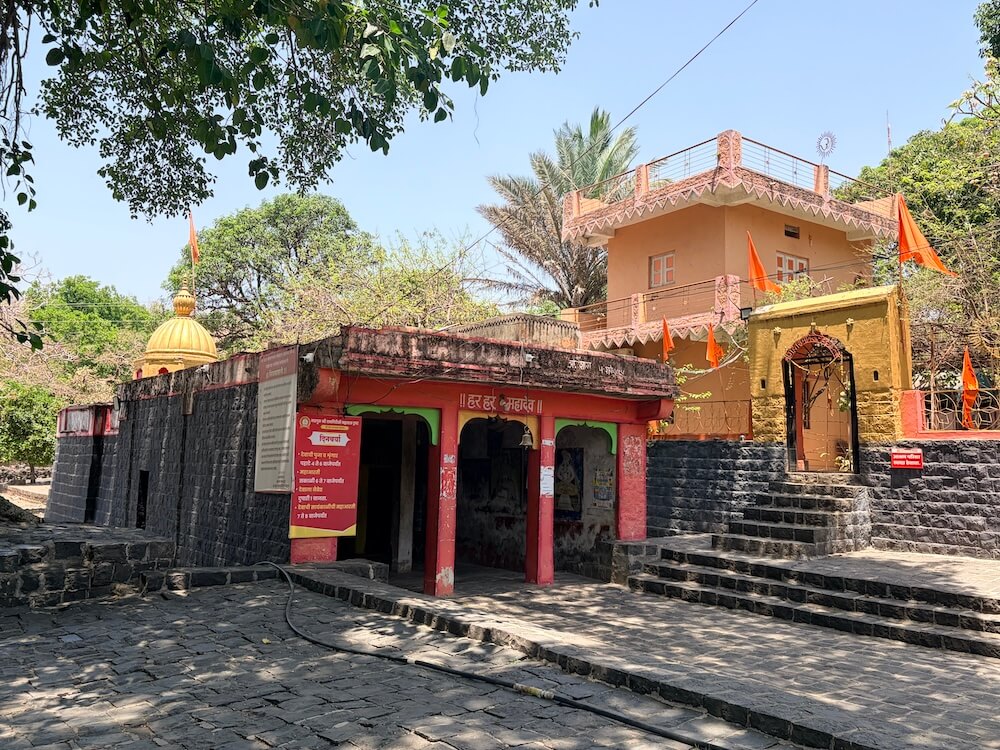
Moving forward from the courtyard, the main structure of the ancient Mahadeva temple comes into view. A Nandi sculpture is installed in the courtyard in front of this temple. There is a firm belief among devotees that Lord Shriram himself established the main Shiva Linga here. The structure of this entire temple is primarily divided into four parts: the Sabhamandapa, the main Sabhamandapa, the Antarala, and the Garbhagriha. The design of the main entrance to the Sabhamandapa features four sturdy square pillars. Square pillars are also seen inside this Sabhamandapa. The entire roof of the Sabhamandapa is supported by horizontal beams on these pillars and the side walls. Paintings of various gods, goddesses, and saints are depicted on the interior walls. Beyond the Sabhamandapa are the main Sabhamandapa and the Garbhagriha. This part of the temple is excellently constructed according to the ancient Hemadpanti architectural style by stacking stones one upon another. Attractive, beautifully carved vertical grooves are seen on the main door frames of the main Sabhamandapa, while a beautiful sculpture of Shri Ganapati is carved on its lintel according to traditional custom.
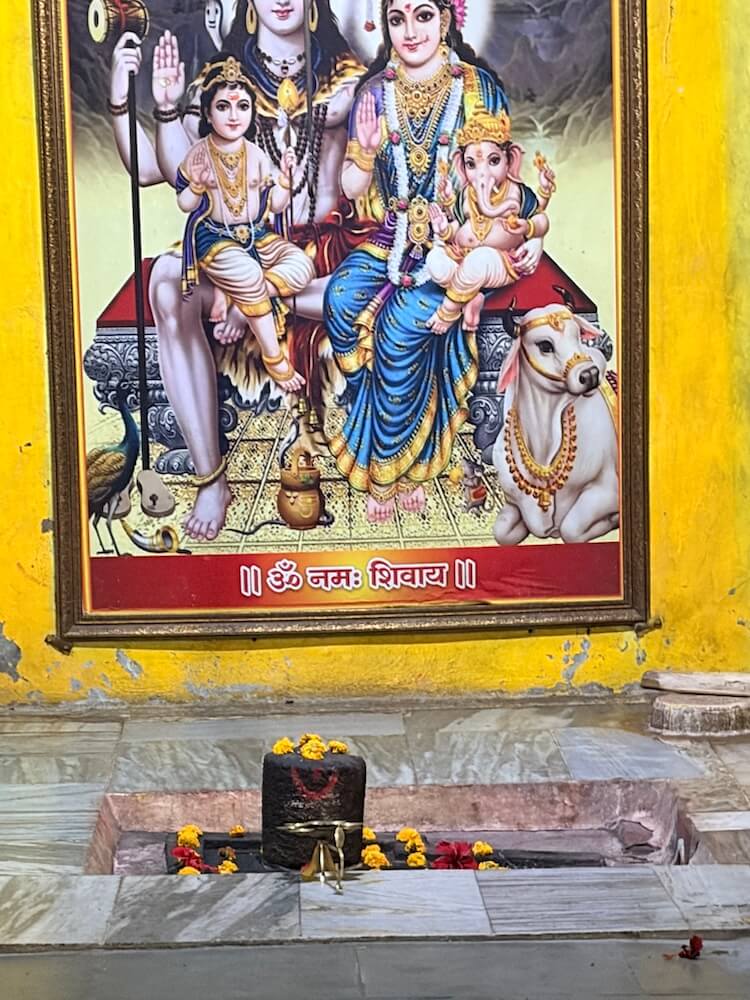
In the main Sabhamandapa, four separate rows of four ornate pillars each are arranged very systematically. All these stone pillars are erected on strong, square pillar bases. Observing the shaft, or the middle part of these pillars, various geometric shapes such as squares, hexagons, octagons, and circles are seen carved into them. Extremely delicate and diverse types of composite carvings are visible on the various square panels on the surface of the pillars. Beyond the main Sabhamandapa is the Garbhagriha. Inside the Garbhagriha, there is a Shiva Linga in the center on the floor. On the roof of this Garbhagriha, there is a beautiful two-tiered Shikhara above. The lower tier of the Shikhara is octagonal, and the upper tier is round and dome-shaped. At the apex of the Shikhara is a stone Amalaka, and above it is the Kalasha.
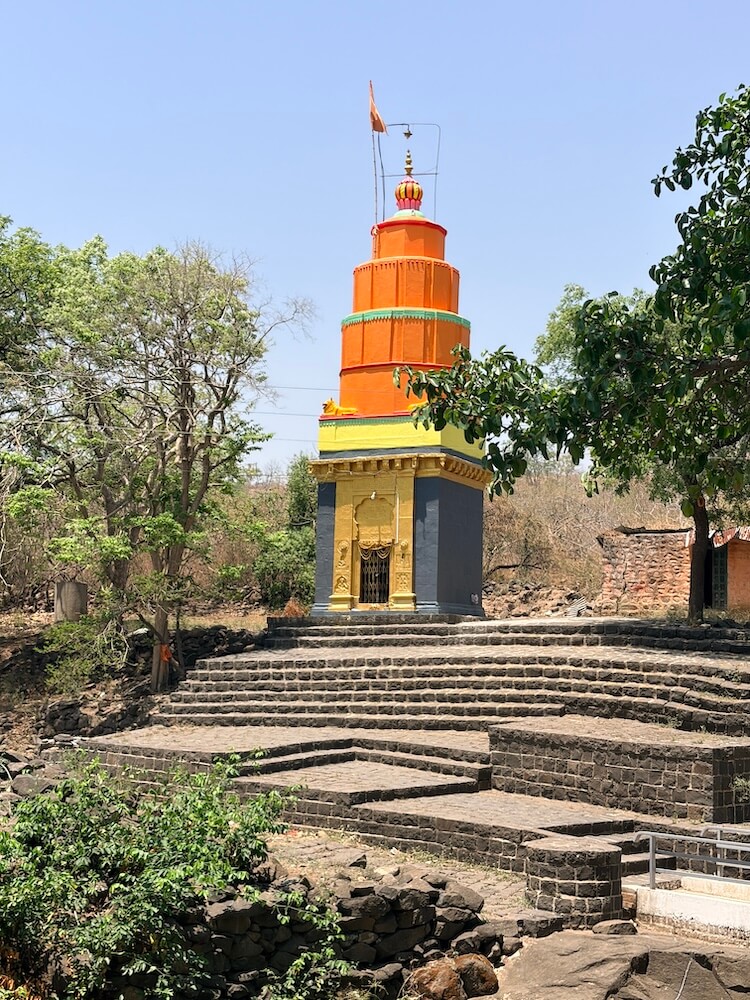
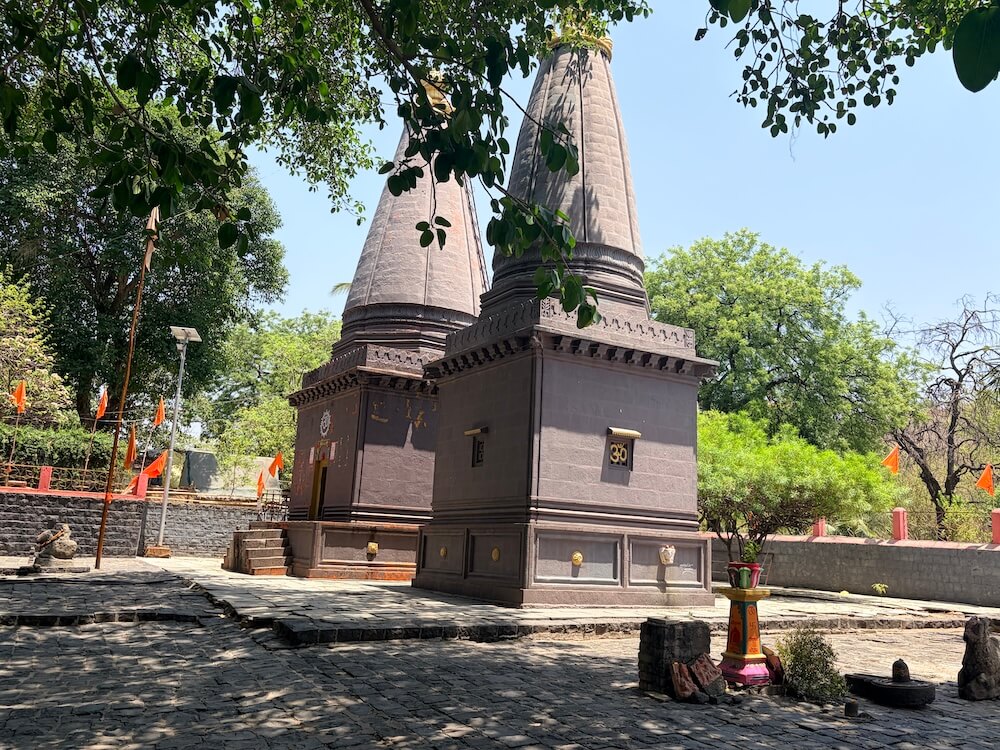
In the open courtyard in front of the temple, some extremely ancient idols, old Nandi sculptures, and Shiva Lingas are seen kept in a scattered manner. On one side of this same courtyard, two sacred Samadhi temples are built; a separate small fortification has been erected for the protection of both these Samadhi temples. The Samadhi temple of Mahant Ramgiri Maharaj is situated here. The main entrance of this temple is about four feet above the ground. For those climbing up to the entrance, a structure of five steps each has been built on the right and left sides in the front area. This main entrance has artistic, carved door frames. An attractive arched Torana is carved right above the entrance, and a Kirtimukha is seen carved on its lintel. Two other entrances with an identical structure are also present in the right and left side walls of this Samadhi temple. In the central part inside the temple, a high stone pedestal for the Samadhi of Mahant Ramgiri Maharaj has been built. A unique, beautiful cone-shaped Shikhara has been erected on the roof of the temple. At the highest peak of this Shikhara is an Amalaka, and above it is a Kalasha. Behind this Samadhi temple of Mahant Ramgiri Maharaj is the Samadhi temple of Mahant Sevagiri Maharaj. The entire internal and external structure of this temple is exactly like that of the Samadhi temple of Ramgiri Maharaj. A unique feature of this Samadhi temple is that a small window has been created within the structure of the steps in the area in front of its entrance. Devotees coming for Darshan from outside can view the Samadhi inside the temple through this special window.
A new pedestrian bridge has recently been constructed over the riverbed to allow easy access to the opposite bank of the river flowing near the temple. Upon crossing this bridge to the other side, one can see a beautiful temple of Lord Dattatreya, built in the year 1977, situated on a high hill. In the open courtyard in front of this temple lies the Samadhi shrine of Laxman Kale, the supreme disciple of Mahant Sevagiri Maharaj.
Mahashivratri and the month of Shravan are considered the biggest annual festivals in this entire region. On the occasion of these special religious festivals, thousands of devout pilgrims not only from Jalna district but from across the entire Marathwada region visit this place to seek the blessings of Mahadeva and to fulfill their vows.
During these major festivals, various religious and cultural programs such as collective Bhajans, Kirtans, spiritual discourses, Haripath recitation, Ramkatha readings, and distribution of Mahaprasad are organized within the temple premises.
Apart from these festivals, celebrations such as Vijayadashami, also known as Dussehra, Deepavali, Chaitra Padwa, Shri Ram Navami, Kartik Purnima, Vaikuntha Chaturdashi, and Guru Purnima are celebrated with great enthusiasm in the traditional manner.
Furthermore, on sacred days such as Mondays, Thursdays, Pradosh Kaal, Purnima, and Amavasya, there is a large crowd of devotees in the temple for the Darshan of Mahadeva. Devotees can have Darshan here every day from six o’clock in the morning until eight o’clock in the evening.
This sacred temple stands as a testament to deep spiritual devotion, ancient architectural grandeur, and rich local cultural traditions.
The sanctum sanctorum houses the divine idol consecrated according to ancient Vedic traditions, surrounded by serene courtyards and traditional temple architecture.
Navratri, Maha Shivratri, Annual Temple Jatra & Deepotsav
Compare and book flights, secure top-rated local hotels near the temple, hire reliable guides, and rent cars instantly.
Extend your pilgrimage by visiting other highly sacred temples located nearby.


Add ₹999 more to unlock FREE SHIPPING!
Your sacred cart is currently empty.
Shop Photo FramesFill in your delivery details below to place your order.
Add comment