
Add ₹999 more to unlock FREE SHIPPING!
Your sacred cart is currently empty.
Shop Photo FramesThere is a large number of Shiva temples in Maharashtra as well as across the country. Each of these temples has a distinct name. Furthermore, there are various types of Shiva Lingas within them. Among these temples, those dedicated to the guardian deity Bhairava are relatively more numerous. Temples dedicated to Shiva incarnations such as Nataraja or Pashupati are not frequently found in Maharashtra. The Pashupati temple in Kathmandu and Badrinath is famous. A rare and ancient temple of Pashupatinath, belonging to that same tradition, is located in the village of Rethare Harnaksh, situated on the banks of the Krishna River in Sangli district. The design of the underground chamber located beneath the Shiva Pindi in the sanctum sanctorum of this temple is unique.
According to the ninth chapter of the Rudra Samhita in the Shiva Purana, all the gods requested Mahadeva to slay the demons of Tripura. For that battle, Vishwakarma created a divine chariot. While proceeding to the war seated upon it, Shankara said to Brahma, “The beastliness within the demons Tarakaksha, Kamalaksha, and Vidyunmali has increased. Therefore, to destroy them, I require the power of beasts as well. Let all the gods increase the beastliness within themselves and grant me its sovereignty.” Hearing this, the gods became worried. Then Shankara said, “Do not think that you will fall because of the beastliness entering you. If you observe the Pashupata Vrata with a pure heart, you will be liberated from beastliness.” Hearing this, all the gods increased the beastliness within themselves, and Mahadeva, who liberates one from the shackles of beastliness, came to be known as Pashupati.
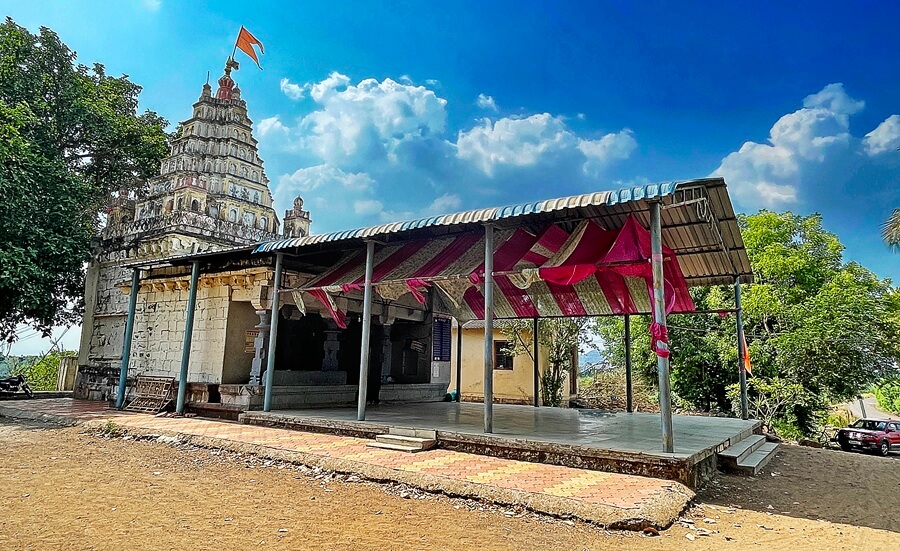
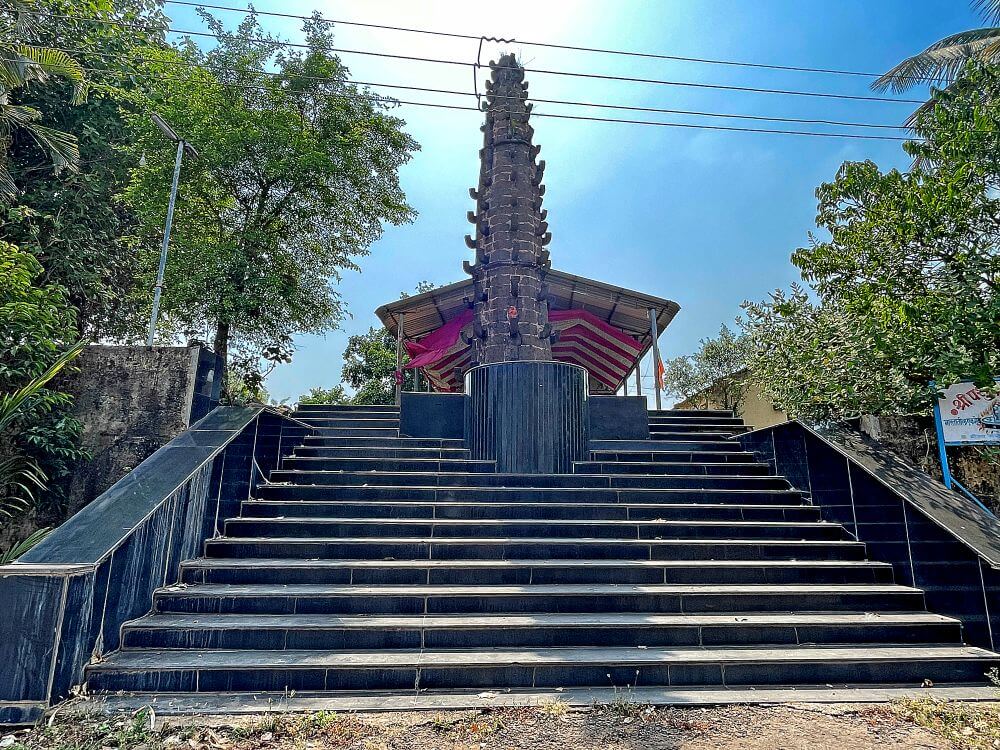
In the village of Rethare Harnaksh, there is an ancient temple of Pashupatinath. The legend associated with this temple is that Lord Shri Ram visited this temple during his exile. At that time, he encountered the demon Bisur. Lord Shri Ram severed the head of the demon Bisur with an arrow, and that head fell in the village of Shirte. After the destruction of the demon, Lord Rama bathed in the waters of the Krishna River behind the temple, worshipped Lord Pashupatinath, and then continued on his journey. It is said that later, in the thirteenth century, King Bhoja (the Second) constructed a grand temple at this ancient site. He was a valiant king of the Shilahara dynasty. His kingdom flourished in this region during the twelfth and thirteenth centuries. The stone masonry of this temple, the magnificent lamp tower (Deepmala) in front, and its architectural style easily reveal the antiquity of this temple.
Situated on the border of Rethare Harnaksh village, this temple stands at a slight elevation from the road. One enters the temple courtyard by ascending twenty steps. In front of the temple’s main hall, right in the middle of the stairway path, stands a tall, ancient lamp pillar (Deepmal) on a circular base. This five-tiered lamp pillar features individual arms for lighting lamps and a pinnacle at the top. The tiers of the lamp pillar are separated by circular rings. On the lower section of the lamp pillar, figures of Garuda, Hanuman, and Shri Krishna are carved, reminiscent of the lines from the Aarti, “Garuda, Hanumanta pudhe ubhe rahati…” A new open-style Darshan Mandap has been constructed in front of the original temple.
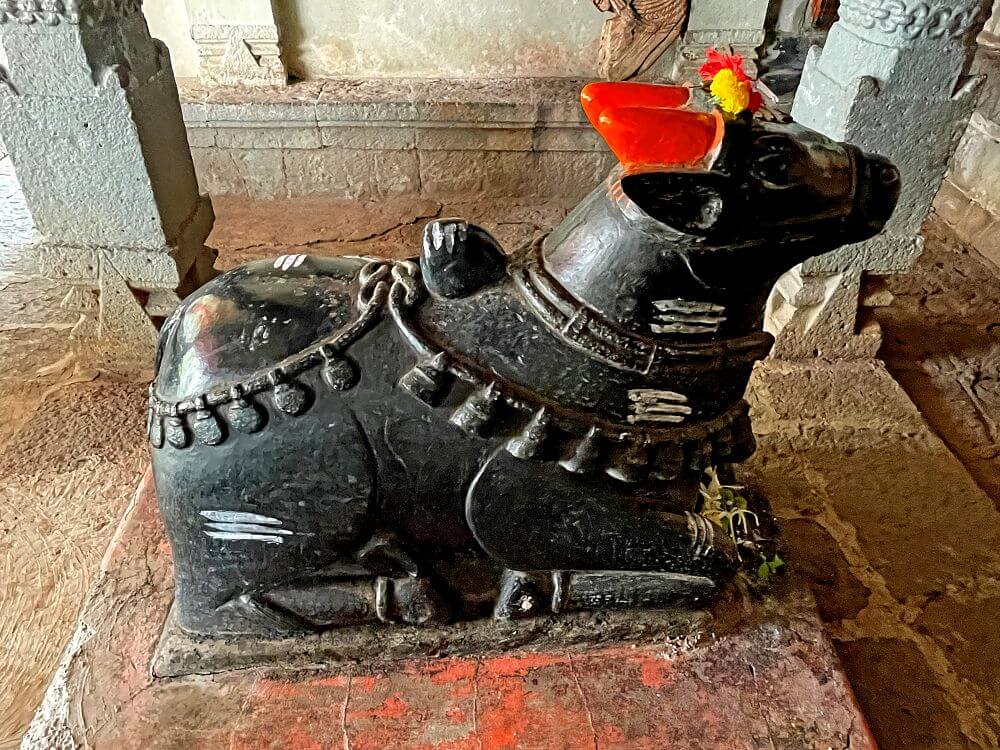
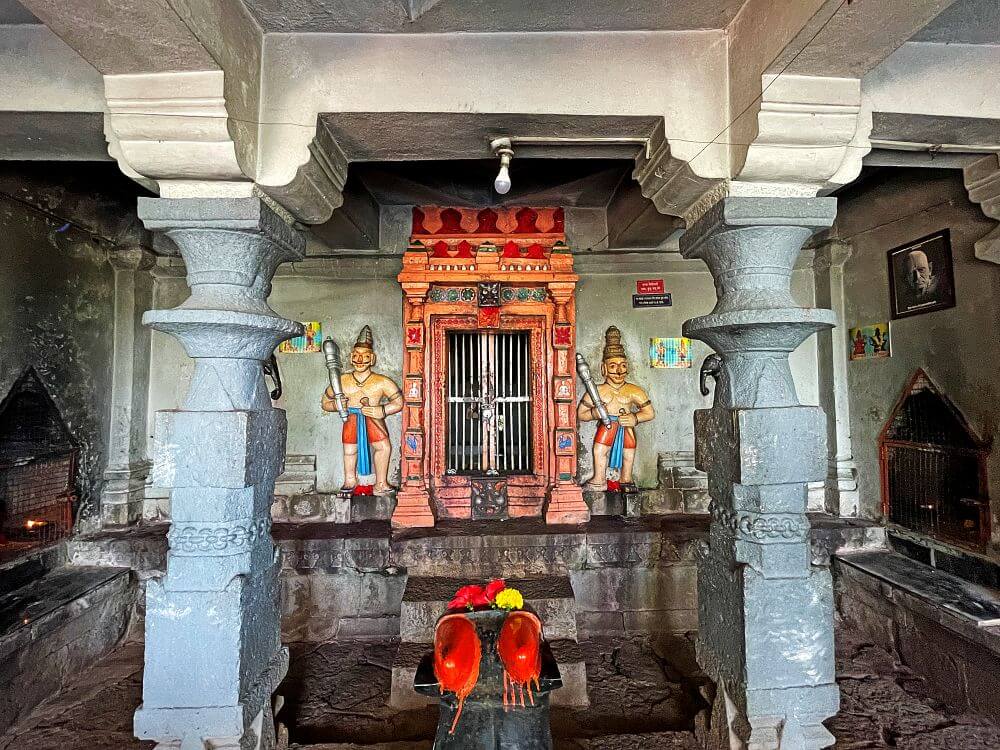
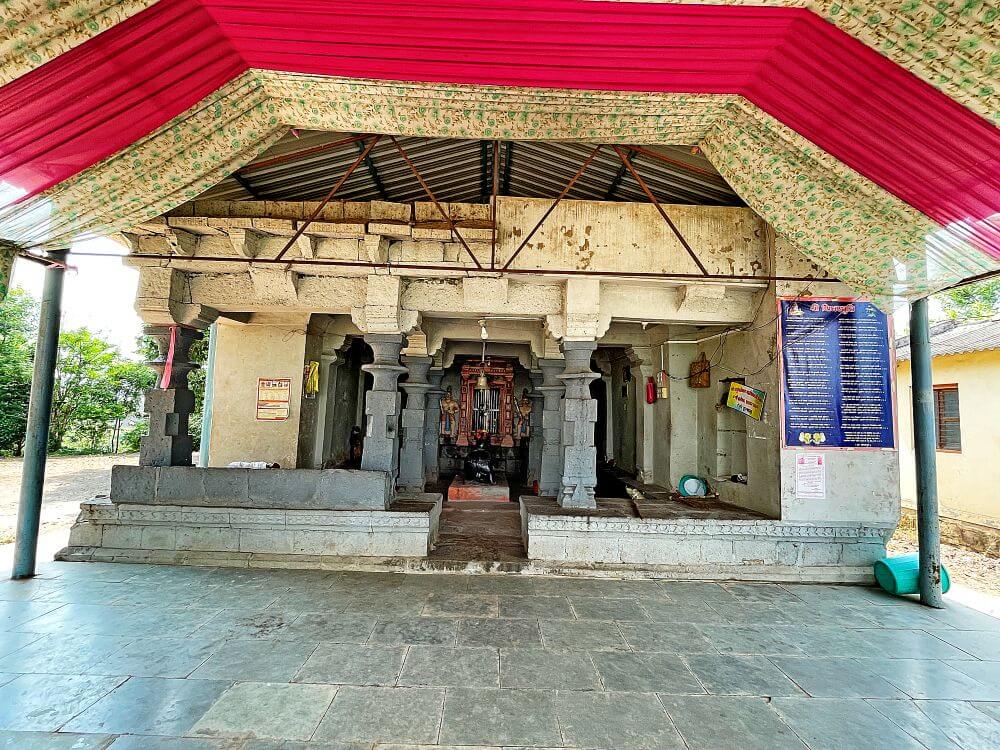
The structure of this temple consists of a Sabhamandapa (assembly hall) and a Garbhagriha (sanctum sanctorum). There are three steps to enter this Sabhamandapa, which is situated on a raised platform (Jagati) above the ground level. Along the sides of the steps, there are Kakshasanas (stone benches) within the Sabhamandapa. The Sabhamandapa features eight intricately carved stone pillars. Among these, a black stone idol of Nandi is placed on a pedestal between the four central pillars. On the wall to the right in the Sabhamandapa, there is a Devakoshta (niche) containing a four-armed black stone idol of Ganapati. Ganapati holds a Parashu (axe), an Ankusha (goad), and a Modaka in his hands. In the Devakoshta on the right side, there is a four-armed black stone idol of Mahishasuramardini. The Goddess has placed her foot on the back of the buffalo and is holding the buffalo’s mouth and tail with two of her hands. With the third hand, the Goddess is striking with a Trishula (trident), and in the fourth hand, she holds an Agnipatra (fire vessel).
On the front wall of the sanctum sanctorum, on both sides of the entrance, there are relief-style sculptures of royal elephants with howdahs and mahouts on their backs. On the first doorjamb of the sanctum sanctorum, there is foliage ornamentation; on the second doorjamb, there is floral vine ornamentation; and on the pillar section, there are various sculptures such as peacocks, meditating ascetics, and Lord Ganesha. On the lintel block, there is Lord Ganesha, and above it, there is a Kirtimukha. On the architrave, there is a lotus flower design, and on the Mandaraka, there is a Kirtimukha. On both sides of the entrance, there are sculptures of gatekeepers holding a sword in their right hand and a dagger in their left hand.
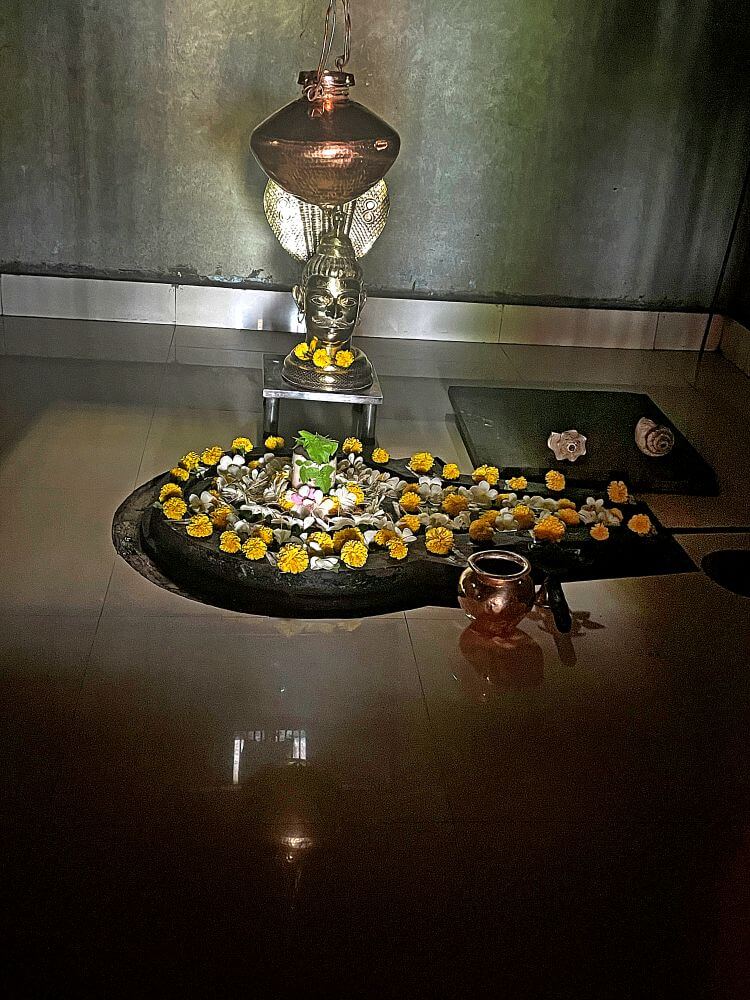
In the sanctum sanctorum, the Shiva Linga is situated on the floor. The base of the Shiva Linga (Shalunka) is made of black stone, while the Linga itself is white in color. This is considered a unique feature of this Shiva Linga. Beside the Shiva Linga, there is a brass mask of Lord Mahadeva, depicted with a five-hooded serpent canopy over his head. During festivals, this mask is placed upon the Shiva Linga. Next to the Shiva Linga, there is the entrance to an underground chamber covered with stone. There are stairs built of carved stone to descend into this underground passage, which leads to a chamber below. This underground chamber is used for meditation and spiritual practice. It is said that it should be so.
Various mythological sculptures are carved on the exterior walls of the temple. The temple roof features a parapet on all sides, with decorative pavilions at the four corners, topped by spires and finials. In the center, there is a six-tiered, pyramid-shaped main spire. On the first tier of the spire, there are three niches on each side, while the decorative panels of the second tier feature sculptures of animals and deities. The third and fourth tiers each contain three niches, and the fifth and sixth tiers contain two and one niche respectively. All the niches house idols of various deities. At the apex of the spire, there are smaller spires on all four sides, with a central ribbed stone disc, topped by a finial and a flag. In the temple courtyard, there are some ancient relics carved in stone.
Maha Shivaratri and Shravani Somvar are the main festivals celebrated at the temple. During the annual festivals, Laghurudra and Maha Abhisheka are performed in the temple. Throughout the days of the festivals, programs such as Bhajan, Kirtan, Pravachan, and music are organized in the temple. On Maha Shivaratri, the temple premises take on the appearance of a fair due to the various shops set up in the area. At this time, thousands of devotees come for the Darshan of the Deity and to fulfill their vows. Apart from this temple, the village of Rethare Harnaksh is also well-known as the birthplace of the great Shahir Patthe Bapurao, also known as Shridhar Krishna Kulkarni, who famously said, “Shreshthavarna mi brahmana asuni sovale thevle ghaluni ghadi. Mashal dharli hati tamashachi laaj lavli deshodhadi.”
This sacred temple stands as a testament to deep spiritual devotion, ancient architectural grandeur, and rich local cultural traditions.
The sanctum sanctorum houses the divine idol consecrated according to ancient Vedic traditions, surrounded by serene courtyards and traditional temple architecture.
Navratri, Maha Shivratri, Annual Temple Jatra & Deepotsav
Compare and book flights, secure top-rated local hotels near the temple, hire reliable guides, and rent cars instantly.
Extend your pilgrimage by visiting other highly sacred temples located nearby.


Add ₹999 more to unlock FREE SHIPPING!
Your sacred cart is currently empty.
Shop Photo FramesFill in your delivery details below to place your order.
Add comment