
Add ₹999 more to unlock FREE SHIPPING!
Your sacred cart is currently empty.
Shop Photo FramesSaptakoteshwar, revered as the state deity of Gomantak, was the family deity of the Kadamba dynasty. Narve, located on Divar Island in the Mandovi River north of Tiswadi, is considered the original seat of Saptakoteshwar in Goa. There is also an ancient temple of Saptakoteshwar at Fatorpa. It has been recently renovated. During the renovation, the temple was designed in the Kadamba architectural style. It is said that Saptakoteshwar is originally Khandoba or Martand. In this temple, he is worshipped in the form of Shiva. Mahashivratri is the main festival celebrated here. On that day, many devotees come here for darshan.
The legend of this temple is linked to the penance of the Saptarishis. According to the story, seven sages performed penance for seven crore years to Lord Shiva here. Pleased by their devotion, Lord Shankar appeared before the sages and asked them to seek a boon. The sages requested Mahadev to reside at the place where they had performed penance for seven crore years. Shankar granted their prayer. Thus, the Mahadev here came to be known as Saptakoteshwar. He was also called Saptanath, meaning the Lord of the seven sages. According to another legend, Lord Shri Krishna had to migrate from Mathura due to the invasion of Jarasandha. At that time, Krishna worshipped Saptakoteshwar here and later established his kingdom at Dwarka.
According to the Goa Gazetteer, the deity Saptakoteshwar is a form of Khandoba of Jejuri in Maharashtra. The deity Martand-Bhairav in the form of Ravalnath has been popular in Goa since ancient times. Ravalnath is seen included among the family deities in many temples of Goa. The Gazetteer states that it is possible that since the time of Shivchitta Kadamba (AD 1155), the Kadambas adopted this very Ravalnath in the form of Saptakoteshwar. In the book ‘Cultural and Religious Traditions in Temples of Goa’ (2004), published by the Publications Division of the Ministry of Information and Broadcasting, Government of India, Kamala Mankekar states that in Goa, Khandoba is worshipped in the form of a Linga as Martand Bhairav or Saumya Bhairav. When his idol is crafted, it is four-armed (Chaturbhuj). The hands hold a damaru, trishul, sword, and a vessel. Saptakoteshwar is a form of this Khandoba. Renowned Goan historian P. P. Shirodkar has also proposed this concept.
The Kadamba dynasty, which ruled Goa from AD 1000 to 1237, had deep devotion to Saptakoteshwar. Kadamba King Shivchitta Permadidev and his queen Kamaladevi were devotees of Saptakoteshwar. The Degamve inscription of AD 1174 in Karnataka mentions that Kamaladevi offered holy water at the feet of Saptakoteshwar and granted an agrahara to Brahmins. Permadi’s nephew Jayakeshi III ascended the throne in 1187. His gold coins bore the title ‘Saptakoteshwaralabdhavaraprasada’, meaning ‘one who has received the grace of Saptakoteshwar’. Mentions of Saptakoteshwar are found on other inscriptions, copper plates, and coins of the Kadamba dynasty from the 12th century to the first half of the 13th century. A king of this dynasty built the Saptakoteshwar temple at Narve on Divar Island. Information regarding exactly when and by whom it was built is unavailable. However, the Degamve inscription makes it clear that the temple existed there in AD 1174.
Later, Divar Island faced severe distress from Bahmani rule. They caused damage to the Saptakoteshwar temple. The text ‘Konkanakhyan’ states that fearing the desecration of Saptakoteshwar by the Mlechhas, people took the Shiva Linga from the temple and buried it in a paddy field. Later, under the orders of Vijayanagara Emperor Harihara II, his minister Vir Vasant Madhav alias Malappa Odayar ‘destroyed the Turushkas and rebuilt this temple along with other temples for Saptanath’, as recorded. Saptanath is Saptakoteshwar. This temple was erected here between 1380 and 1390. Later, during the Portuguese period, around 1567, the Shiva Linga of Saptakoteshwar was moved to the present-day Narve in Bicholim taluka.
Among the temples on Divar Island at that time was the temple of Shantadurga Devi. During the Bahmani raids, in AD 1365, the idol of the goddess from this temple was moved to Morpipala. Later, in AD 1500, it was shifted to Fatorpa, and a temple for the goddess was built there. At the same time, to preserve the memory of their beloved deity from Divar, the villagers also built a temple of Saptakoteshwar near the Shantadurga Devi temple.
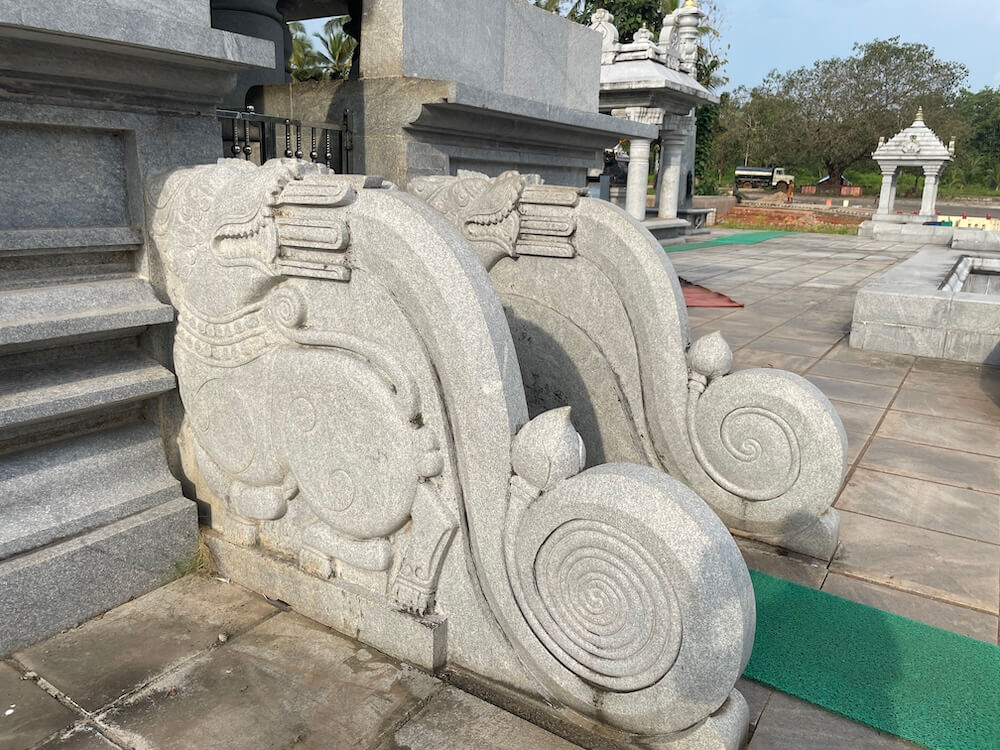
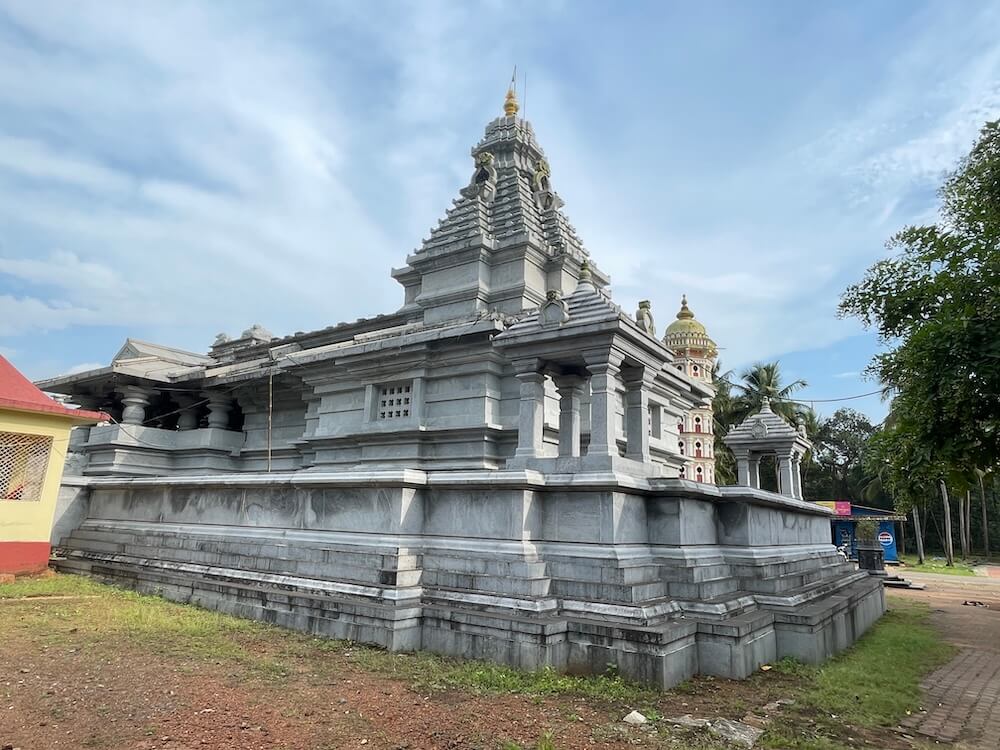
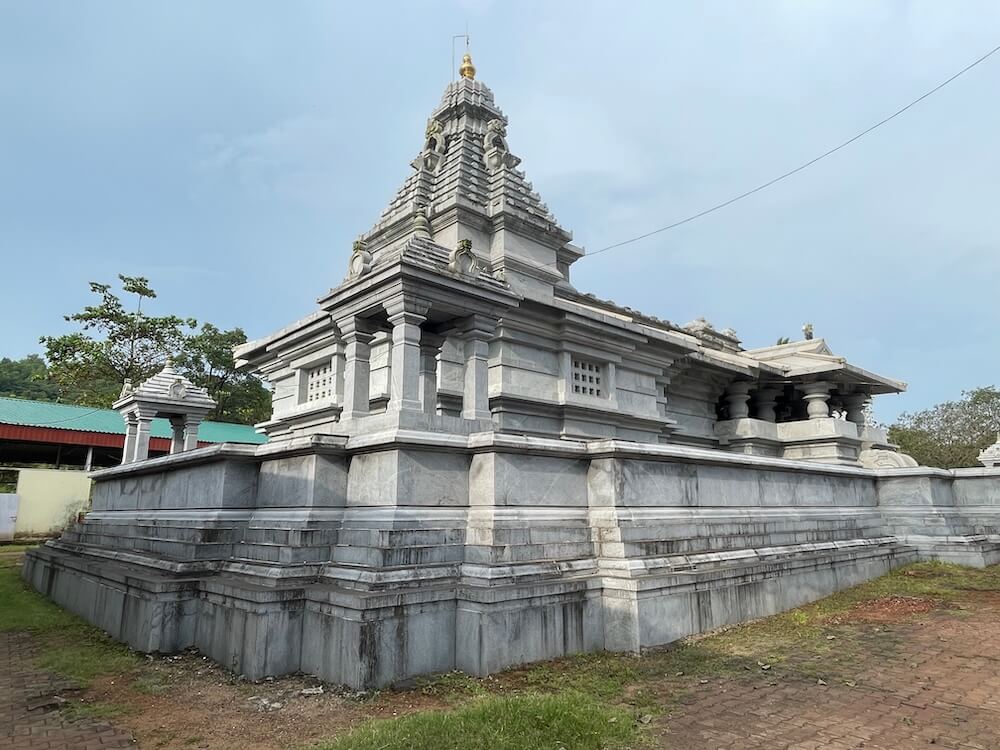
After the liberation of Goa, the renovation of the temples here began. Through this, the Shantadurga Devi temple was rebuilt in 1992, while the Saptakoteshwar temple was planned in 2004, and its Bhumipujan took place in 2005. Since Saptakoteshwar is the family deity of the Kadamba dynasty, it was planned that this temple should be like the one built by the Kadambas. This style is a blend of Dravidian and Nagara styles. One of the features of this style, which is a mixture of local Goan and Karnatak traditions, is its stone sculptures, balanced structure, and architecture in harmony with nature. Currently, the only temple in the Kadamba style standing in Goa is the Mahadev temple at Tambdi Surla. The architecture of that temple was used as a reference for the construction of this temple. The consecration ceremony of this grand renovated temple took place from 4 to 8 March 2025.
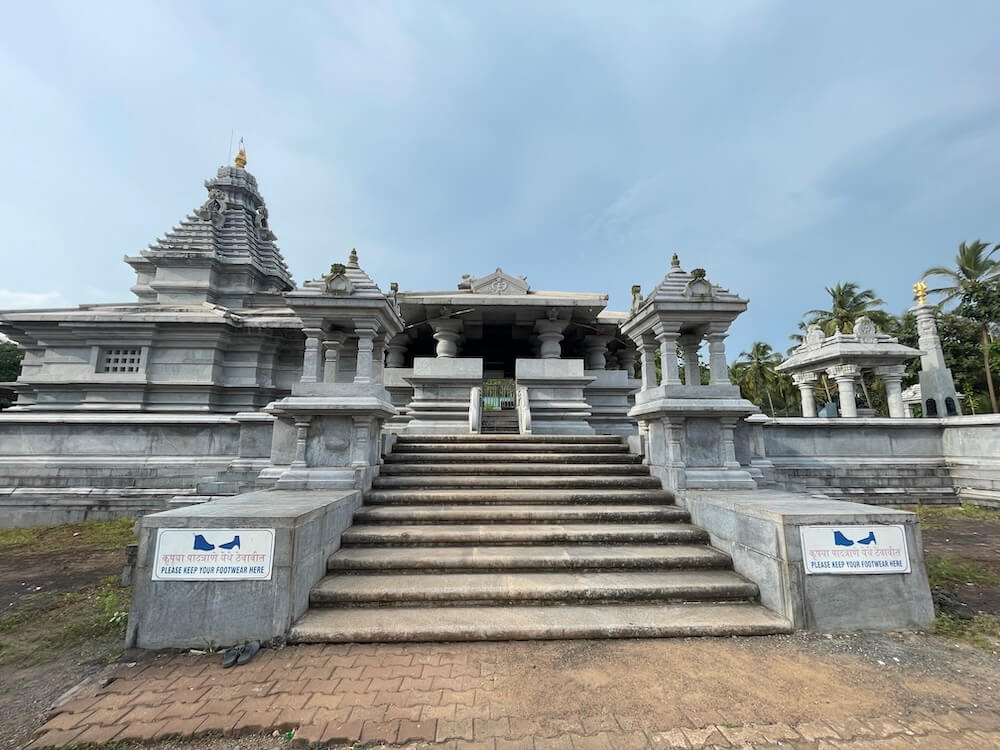
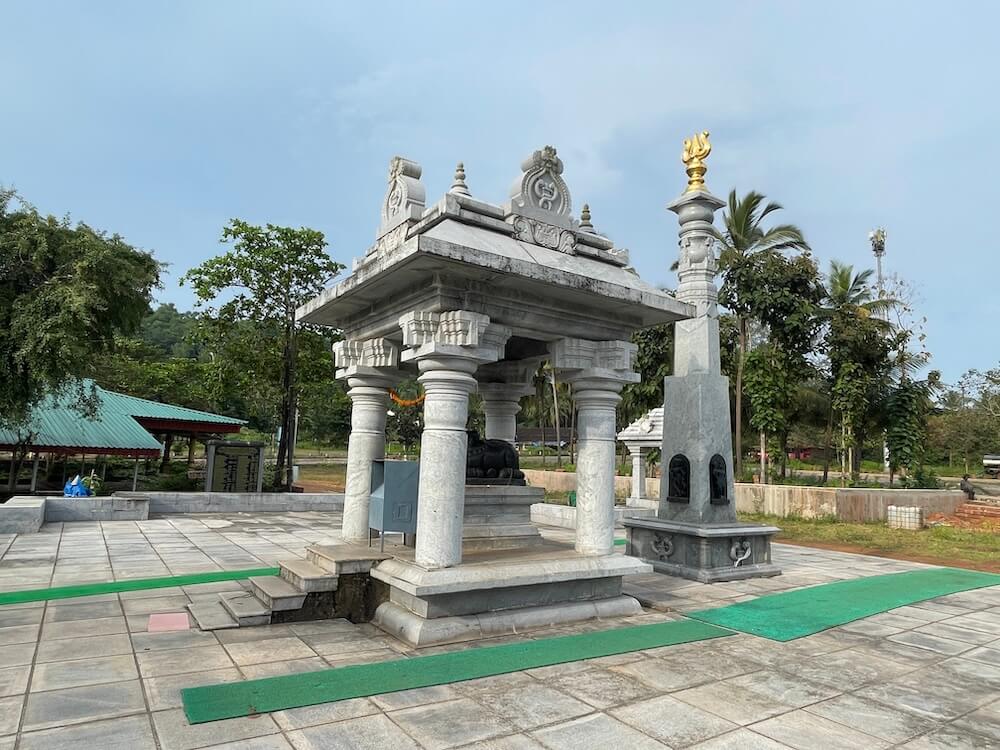
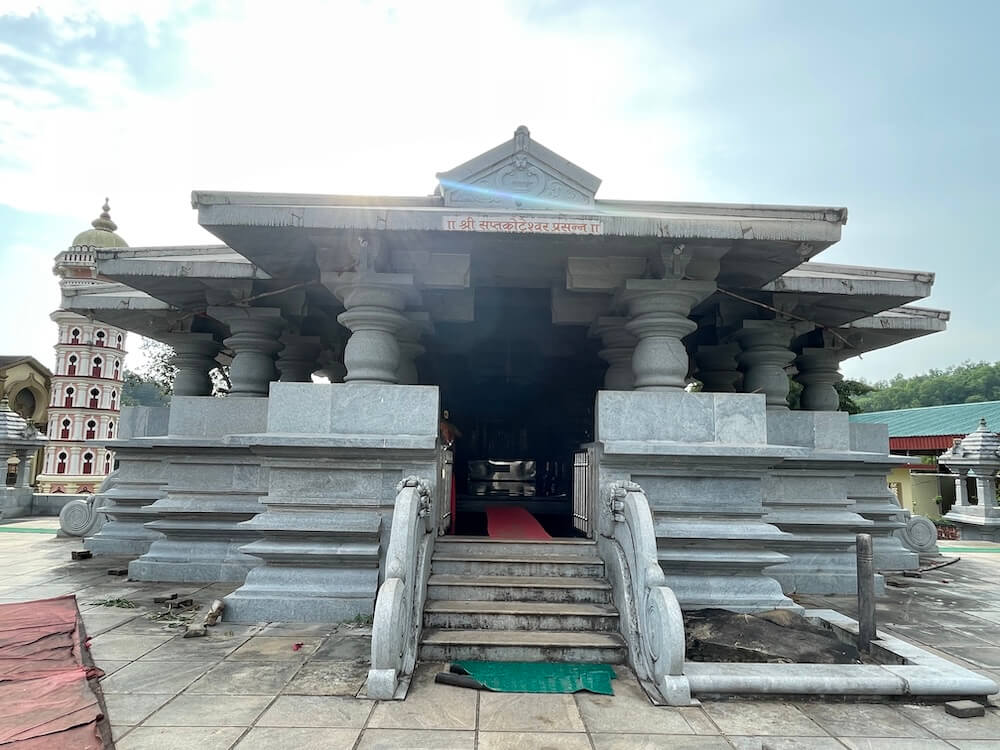
Near the Shantadurga temple at Fatorpa, this stone temple is built on a high plinth covering an area of 250 square meters. The structure of this temple consists of a Sabhamandapa, Antarala, and Garbhagriha. One enters the courtyard of this temple by climbing five steps. On both sides of these steps are tall ornamental canopies. Directly ahead in the courtyard stands the ‘Ayudha Purusha Stambha’ (Pillar of Divine Weapons), approximately २३.५ feet in height. This pillar, carved from a single stone, symbolizes the Shiva principle within the five weapons borne by Lord Shiva. At its pinnacle is a copper Trishula. Further ahead is a large Nandi Mandapa. Surrounding the temple are small canopies dedicated to the Ashta-Pratihara (guardians of the eight directions).
From here, one climbs another five steps to enter the semi-open Sabha Mandapa (assembly hall) of the temple. There are stairways on all three sides of the Sabha Mandapa. The hall features sloping stone roofs, with a square structure in the center of the ceiling. Nandi idols are installed on all four sides of this structure. In the Sabha Mandapa, which is supported by a total of २४ carved stone pillars, there is a Rangashila (performance stage) in the center, designed according to ancient traditions. The ceiling above it is shaped like a lotus. The Garbhagriha (sanctum sanctorum) has a large stone entrance, fitted with a wooden door featuring a wooden bolt. The lintel of the intricately carved door frame also features artistic engravings, with a sculpture of Lord Shiva in the center and a Kirtimukha above it.
Inside the Garbhagriha, the idol of Saptakoteshwara, in the form of a large silver mask, is consecrated on a high Vajrapitha (diamond pedestal). Behind the idol is a beautifully carved silver Prabhavali (halo). Adorning it are a silver umbrella, banners, and other religious symbols. The Shikhara (spire) above the Garbhagriha has a stepped design at the base, followed by a somewhat square structure, a small Amalaka at the top, and a golden-colored Kalasha crowning it. The Shikhara features leaf-shaped niches on all four sides.
The annual Jatrotsava (fair) is celebrated at this temple institution from December ३१ to January ३. This includes processions, fireworks, and various religious rituals. Every Monday, the Palkhi (palanquin) of Saptakoteshwara is taken out, during which the deity is adorned and worshipped. In the month of March, the Chhatrotsava and Pindikotsava are celebrated, where the umbrellas of the deities are danced. These festivals also include Navagraha Homa, Vastu Homa, and Shibikotsava. Maha Shivaratri is the major festival celebrated here with great enthusiasm, during which the premises are bustling with crowds of devotees.
Within the temple premises, which is the main part of the Shantadurga Bhumipurusha Sansthan, there are temples dedicated to Shantadurga and other subordinate deities. The Sansthan provides a guest house and a hall for Mahajans and devotees.
This sacred temple stands as a testament to deep spiritual devotion, ancient architectural grandeur, and rich local cultural traditions.
The sanctum sanctorum houses the divine idol consecrated according to ancient Vedic traditions, surrounded by serene courtyards and traditional temple architecture.
Navratri, Maha Shivratri, Annual Temple Jatra & Deepotsav
Compare and book flights, secure top-rated local hotels near the temple, hire reliable guides, and rent cars instantly.
Extend your pilgrimage by visiting other highly sacred temples located nearby.


Add ₹999 more to unlock FREE SHIPPING!
Your sacred cart is currently empty.
Shop Photo FramesFill in your delivery details below to place your order.
Add comment