
Add ₹999 more to unlock FREE SHIPPING!
Your sacred cart is currently empty.
Shop Photo FramesMany temples in Goa share a history of Portuguese harassment and displacement. However, the Sri Nagesh Maharudra Sansthan in Bandivade is an exception. According to mythological legends, the abode of Nagesha has existed here for about three thousand years, while historical records indicate that this temple has been situated here for about seven hundred years. This temple, a revered center of the Shaiva and Nath traditions in Gomantak, is dedicated to Lord Mahadeva. Along with its religious significance, its grandeur, architectural beauty, wood carvings, magnificent lamp tower (Deepstambh), and the beautiful lake in front of the temple make it a center of attraction for devotees as well as tourists.
The mythological legend regarding the Nagesh Temple is associated with Lord Parashurama. It goes like this: Lord Parashurama, the sixth avatar of Lord Vishnu, obtained a tract of land measuring twelve kos in width and four kos in length, stretching from the Sahyadri mountains to the sea, from Sagaradevata (the deity of the ocean) and made it habitable. Thereafter, Parashurama performed a Digvijayartha Yajna at this holy site. Since many scholarly Brahmins were required for its successful completion, Parashurama brought ascetic and scholarly Saraswat Brahmins belonging to the Bharadwaja, Kaushika, Vatsa, Kaundinya, Kashyapa, Vasishtha, Jamadagni, Vishwamitra, Gautama, and Atri lineages from Trihotrapura in the north to Gomantaka. According to the Marathi Vishwakosh (Marathi World Encyclopaedia), the land of Mithila had a total of twelve names. One of those names was Tairabhukti, which later corrupted into Tihotra. The region north of the Ganges in the present-day state of Bihar is known as Tirahut Kshetra. There were sixty-six clans of these Brahmin sages who arrived from here.
These clans brought along with them their family deities such as Mangeshi, Mahalaxmi, Mangirish Mahadev, Shantadurga, Saptakoteshwar, and Mahalasa. This has been described in the Uttararahasya of the Sahyadri Khanda. In the book ‘Parashuram Charitra va Panchanav Hindusamaj’ written by Shri. M. Mate in nineteen thirty-seven, the era of the primal Parashuram has been stated to be around seven thousand years ago. Meanwhile, historian V. K. Rajwade, in nineteen fourteen, in ‘Bharat Itihas Samshodhak Mandal, In the essay published in the Second Conference Proceedings of Pune, the opinion has been expressed that “the 14 primal ancestors of the Chitpavans settled in Konkan 3088 years ago.” Keeping this in mind, it becomes clear that the abode of Nagesh in Bandivade has been in existence for at least three thousand years.
An important historical evidence regarding this temple has been obtained from an inscription within the temple itself. Currently, this inscription, carved in black stone in Sanskrit and Marathi languages, is mounted on the wall of the office near the Deepstambha (lamp tower) of the temple. This inscription belongs to the reign of the Vijayanagara Empire king, Veera Pratapa Devaraya Maharaya. It bears the chronological record as ‘Shri Shalivahana Shake 1335 Pausha Bahula 30’ (December २४, १४१३). The inscription mentions that in this year, ‘while Nanjan Gosavi was the representative in Gomantak, Main Shenvi Vagle donated the lands—the grove of Ved Khandika, the field of Nagzhari Malo, and the grove of Ruvo in Golti wadyal—to the deities Shri Nagesh and Shri Mahalakshmi of Bandivade.’ In this, Nanjan Gosavi has been described as ‘skilled in judging righteousness and unrighteousness.’ He was a feudatory of Devaraya during his reign and was ruling over the throne of Goa. On the day of Kartik Pournima, the Deepmala should be illuminated in the Nagesh temple and at night the deity should be offered sandalwood paste, incense, The inscription commands that a lamp and an offering of rice should be dedicated every year, and an unceasing flame should be lit in the presence of both deities. From this, it is evident that the Nagesh shrine existed in the village of Bandivade prior to the year 1413 CE. That the renown of this shrine existed even before this time is also proved by a copper plate. In a copper plate available in the village of Savai Verem in Ponda taluka, Bandwad village (Bandivade) and Naganath (Nagesh) are mentioned. This copper plate bears the date ‘Shake 1270, Sarvadharinama Samvatsara, Shravana Bahula Ashtami’, which corresponds to August 18, 1348. From this, it is established that this shrine was famous in the early period of the fourteenth century. 162 years after this, the Portuguese invaded Goa.
The wada in Bandivade village where this temple is situated is known as Nageshi. According to the book ‘Devbhumi Gomantak’ by temple researcher Vinayak Narayan Shenvi Dhume, until the year 1710, this sacred shrine was in a very small form. Its administration was looked after by Narayan Phonde Kamat from Kumbharjuve. After his passing, on behalf of his wife and daughter-in-law, a gentleman bearing the surname Vadiye managed the affairs of the temple. He built the present Nagesh temple in the year 1780 with the help of these two women. Thereafter, from time to time, through donations given by various philanthropists, this temple attained its present magnificent form.
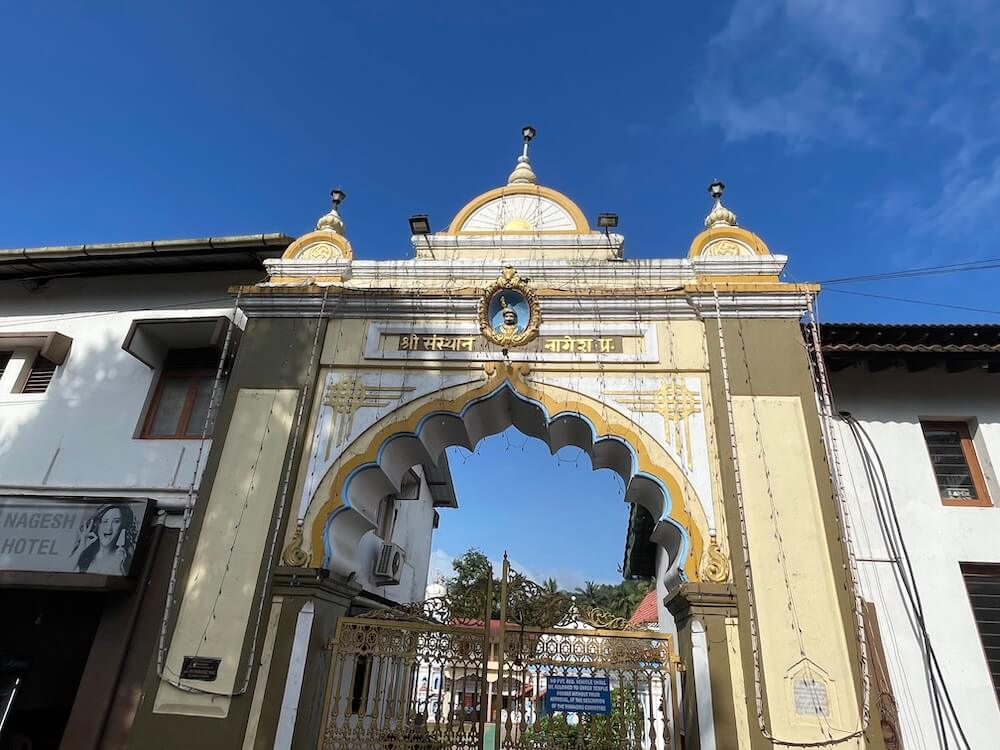
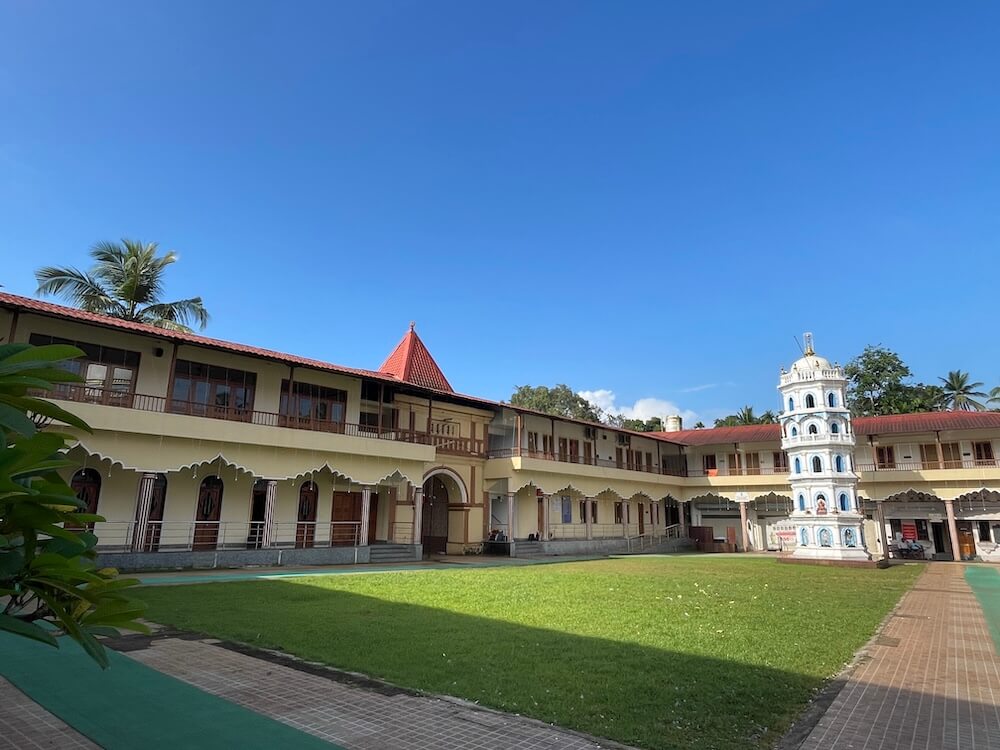
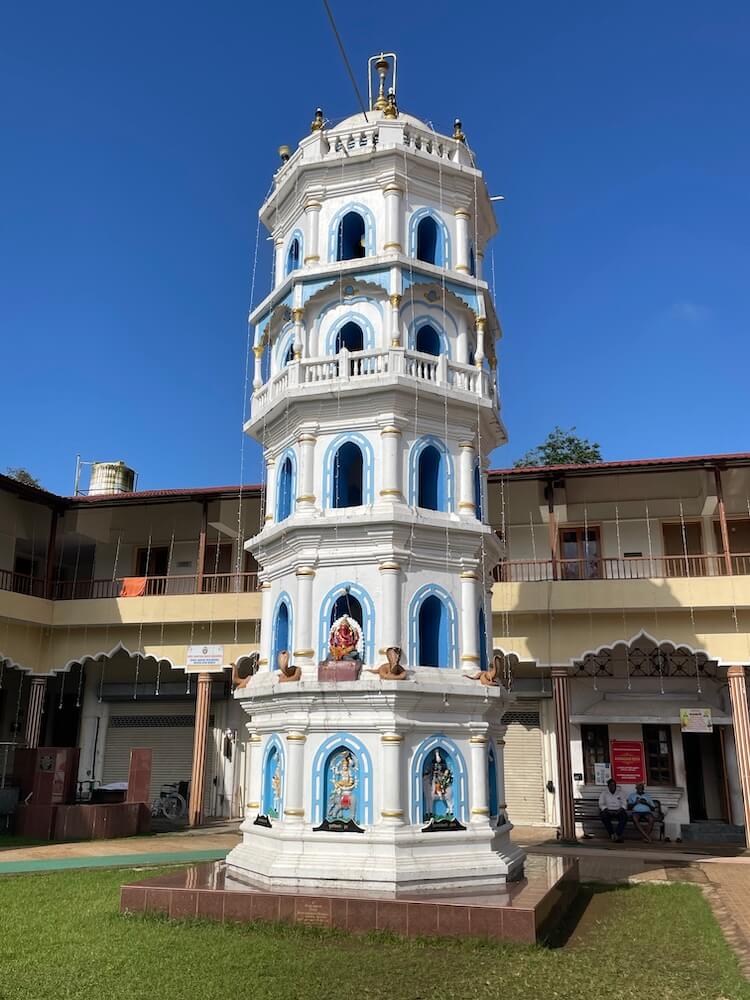
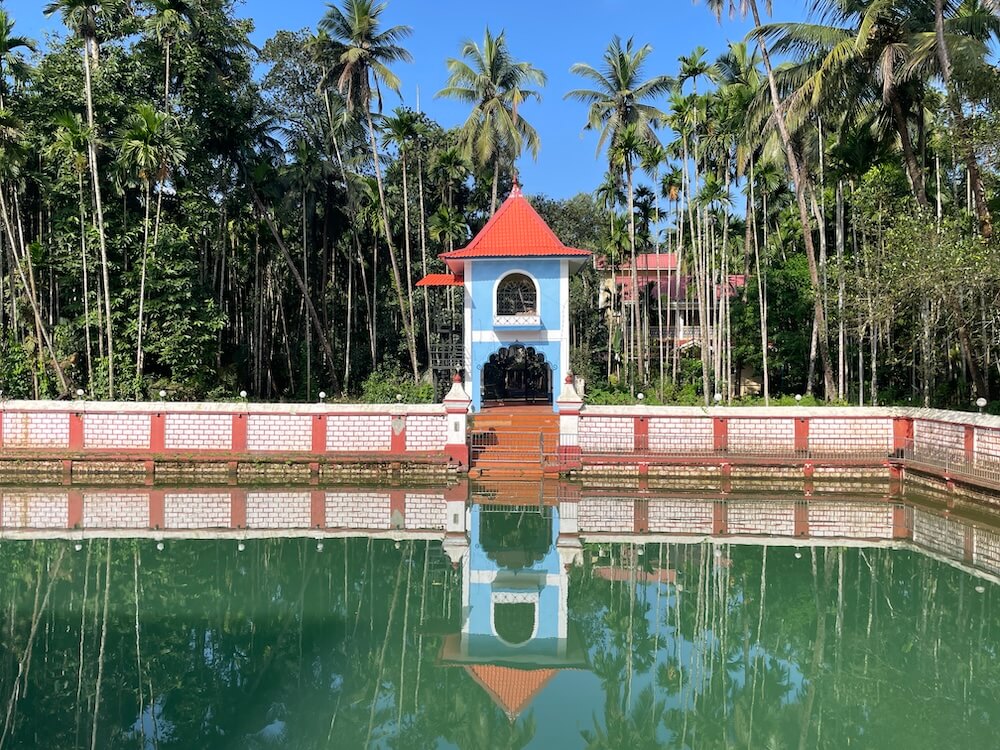
This temple stands on the bank of a large built-up lake in Nageshi. Its unique feature is that during the season when the water in this lake is calm and clear—especially in the months of Kartika and Margashirsha—the reflection of the idol of Lord Nagesha from the sanctum sanctorum of the temple, as well as the lamps there, can be clearly seen in the water. This is considered an architectural marvel. This west-facing temple has grand main gateways facing the lake as well as at the back of the temple. Inside stands the grand temple structure, painted in sky-blue and white colours. Upon entering through the main gateway on the side of the lake, there is a magnificent Deepstambha (lamp tower) on the right side. The Deepstambha in front of the temple is mentioned in a Vijayanagara-era stone inscription from 1413 CE. Over time, it collapsed. That void was filled in 1975. The grand Deepstambha currently present in the temple was inaugurated on 13 November 1975. Navso Mukund Naroji of Morjim, Pernem, is the architect of this Deepstambha. This Deepstambha is thirty-five feet in height and has five octagonal tiers. Sculptures of the deities of the respective directions, namely the Ashta Dikpalas—Indra (East), Agni (Southeast), Yam (South), Nirriti (Southwest), Varun (West), Vayu (Northwest), Som (North), and Ishan (Northeast)—are carved on its lower tier. In ancient inscriptions, there was a command that “four hundred earthen lamps should be lit along with the Deepmala to illuminate the Deepmala.” Accordingly, it is said that provision has been made on this new Deepstambha to light four hundred earthen lamps. Nearby, some remnants of the wall of the ancient temple have been preserved. From the elephant sculpture, the half-moon moonstone, and the rangoli carved in the front portion, it is evident that these are the remnants of a Mandaraka. Local people refer to it as Kshetrapal.
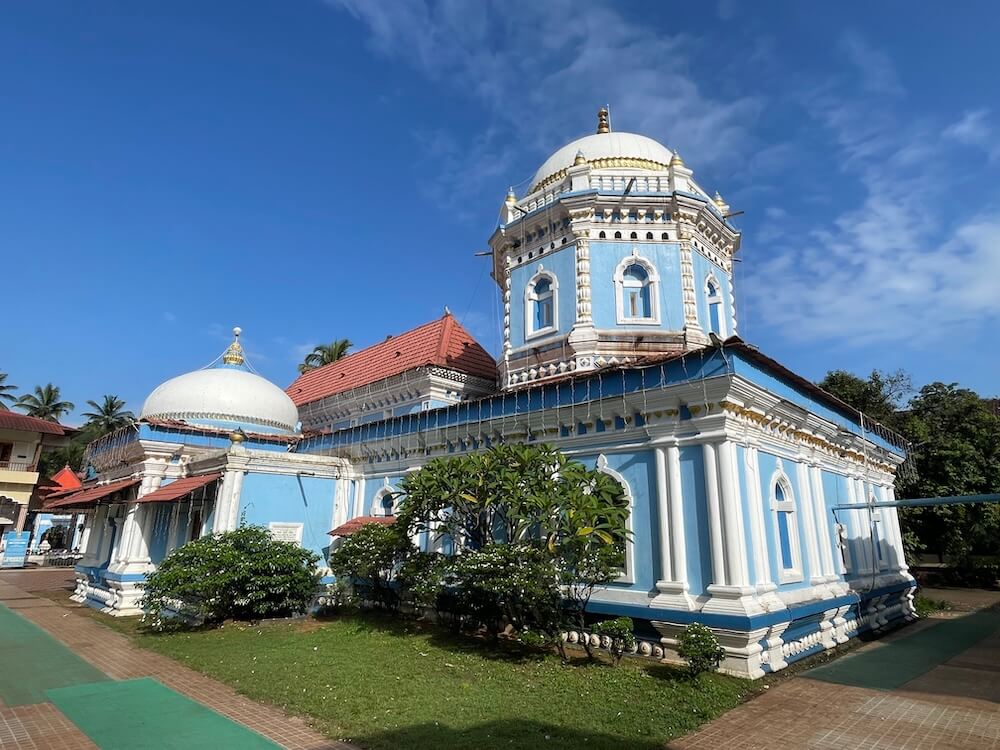
This shrine of Lord Nagesha is considered a fine exemplar of Goan temple architecture. The temple’s structural layout comprises a front porch (mukhamandapa), a main assembly hall (sabhamandapa) flanked by porches on both sides, an intermediate chamber (antarala), and the sanctum sanctorum (garbhagriha). The sabhamandapa features a sloping tiled roof, while the porches flanking it are crowned with dome-shaped spires. The sanctum sanctorum, however, is topped by a spire featuring a dome set upon an octagonal, squat, tower-like structure, culminating in a golden pinnacle (kalasa). Built upon a high platform (jagati), the temple is entered through its front porch by ascending five semi-circular steps. Inside the front porch stands a stone sculpture of Nandi. Hanging lamps and chandeliers are suspended from the ceiling of the porch. From here, one enters the sabhamandapa, which is referred to in Goan architectural terminology as the chowk. The entrance to the sabhamandapa is stone-built and arch-shaped. Both sides of the entrance feature vyala (mythological guardian beast) sculptures carved in stone. The lintel bears a colorful Kirtimukha (auspicious demonic face). Above it, in the central portion towards the ceiling, is a large serpent image, while a row of small serpent hoods (naganphana) runs along all four sides of the hall. The sabhamandapa of this temple is adorned in an exceedingly captivating manner. This spacious hall is characterized by wide, round marble-tiled pillars, beams carved with vine motifs, a wooden ceiling, hanging lamps, crystal chandeliers, brass bells, colorful paintings of various deities in the alcove-like sections, and—most importantly—the wooden relief panels here. The wooden relief panels within the sabhamandapa depict sculptures of numerous deities as well as mythological narratives. Temple scholars and tourists alike make it a point to visit and behold these sculptures.
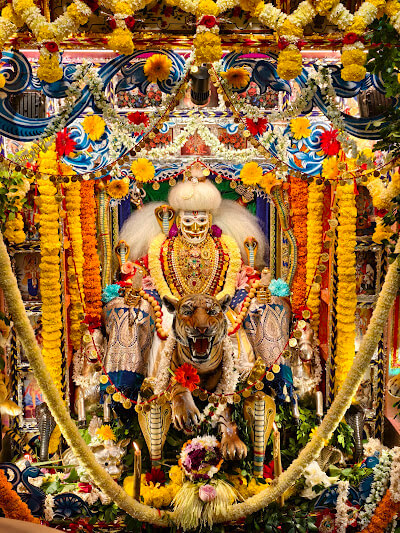
The front wall of the temple’s antarala and its five-fold entrance (panchakshiya praveshdvara) are sheathed in intricately embossed silver plating. The upper section of the entrance features images of deities such as Nagesha and Ganesha. On both sides, within silver alcoves (makhara), stand large sculptures of the door-guardians (dwarapalas) Jaya and Vijaya, holding conches and maces. It is a unique feature that the door-guardians of this Shaivite temple are Vaishnavite. To the left inside the sanctum sanctorum lies the divine resting chamber (shayanagriha) of the Lord. In the center within sits the Shiva linga of Lord Nagesha, complete with its pedestal (pindika). The spout of this pindika faces north. The pindika is clad in a silver covering. At the back stands a silver prabhavali (auspicious halo) adorned with a Kirtimukha. Over the Shiva linga rests the serpent-crowned (sheshadhaari) mask of Lord Nagesha Mahadeva. On both sides of the Shiva linga are two large silver serpent sculptures, while directly in front sits a small silver sculpture of Nandi. Tall oil lamps (samai) stand ablaze on all four sides of the pindika. In the large silver shrine-cabinet (devara) directly behind it resides the anthropomorphic, seated-form idol of Lord Nagesha. Adorned with opulent garments, jewelry, and flower garlands, this idol has numerous serpent sculptures carved onto its halo. Atop the idol’s head rests a distinctive, triangular, turban-like crown.
Apart from the sanctum of Lord Nagesha, there are two adorned sub-sanctums here. In one sanctum, Lord Lakshminarayana is consecrated, while in the other, Lord Ganesha is installed. Formerly, Lakshminarayana had a separate shrine to the left of the Nagesha temple. In due course, the idol in that shrine was damaged. Consequently, a new idol carved from pristine white marble was crafted and consecrated within the main temple on the auspicious occasion of Margashirsha Shukla Dashami in the year १९२९. A separate temple dedicated to Ganpati also existed here; the idol from that temple was likewise consecrated in the main temple on this very same auspicious occasion.
Behind the temple lies a sacred well. It is with this water that ritual ablutions (abhisheka) are performed for the Shiva linga here. The temple is surrounded on all quarters by buildings that house facilities including an office, an assembly hall, a scriptural school (agrashala), residential quarters for the Mahajanas (temple trustees/patrons), and a canteen for devotees.
At this temple, devotees may take darshan from ५.३० AM to ११ PM. From morning until ११.३० AM, daily and occasional religious rites such as abhisheka are performed. Pradosha worship is conducted in the evening from ६ PM to ७ PM. Thereafter, rituals including panchopacha worship and aratis take place. Every Monday from ८.३० PM to ९.३० PM, the palanquin festival (shibikotsava) is held here. A grand festival takes place from Chaitra Shukla Ekadashi to Chaitra Vadya Pratipada. This festival concludes with the grand chariot festival (maharathotsava). On Kartik Purnima (Tripurari Purnima), a grand fair is held here, which is known as the Tonkyachi Jatra. Given that this is a shrine of Lord Shiva, the Mahashivaratri festival is also celebrated here with immense zeal and devotion.
This sacred temple stands as a testament to deep spiritual devotion, ancient architectural grandeur, and rich local cultural traditions.
The sanctum sanctorum houses the divine idol consecrated according to ancient Vedic traditions, surrounded by serene courtyards and traditional temple architecture.
Navratri, Maha Shivratri, Annual Temple Jatra & Deepotsav
Compare and book flights, secure top-rated local hotels near the temple, hire reliable guides, and rent cars instantly.
Extend your pilgrimage by visiting other highly sacred temples located nearby.


Add ₹999 more to unlock FREE SHIPPING!
Your sacred cart is currently empty.
Shop Photo FramesFill in your delivery details below to place your order.
Add comment