
Add ₹999 more to unlock FREE SHIPPING!
Your sacred cart is currently empty.
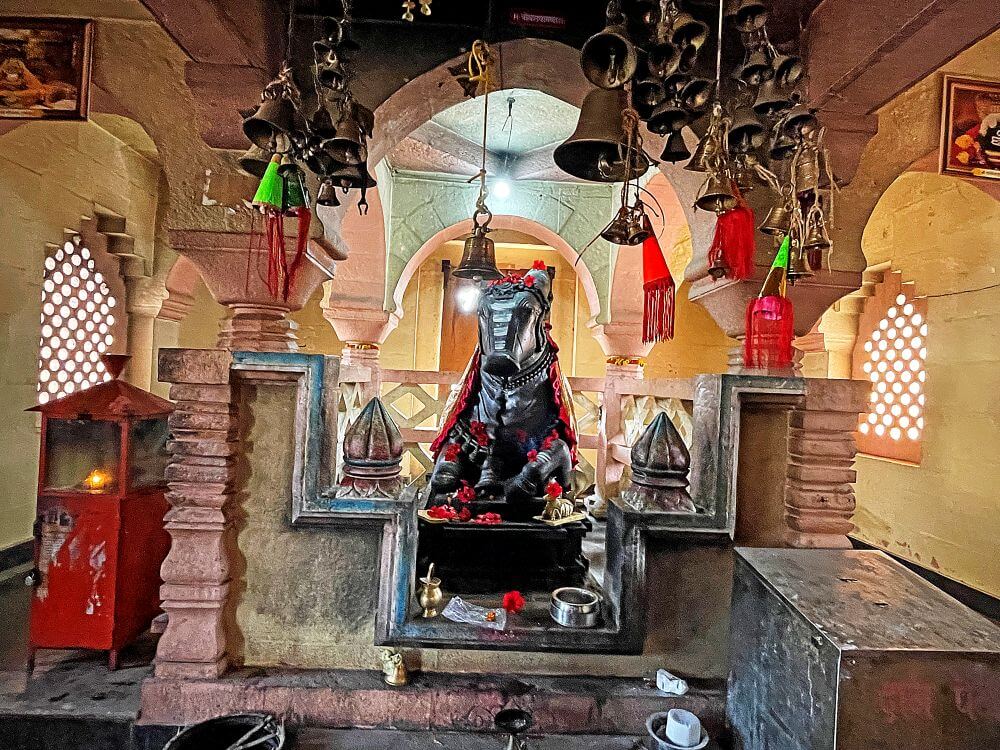
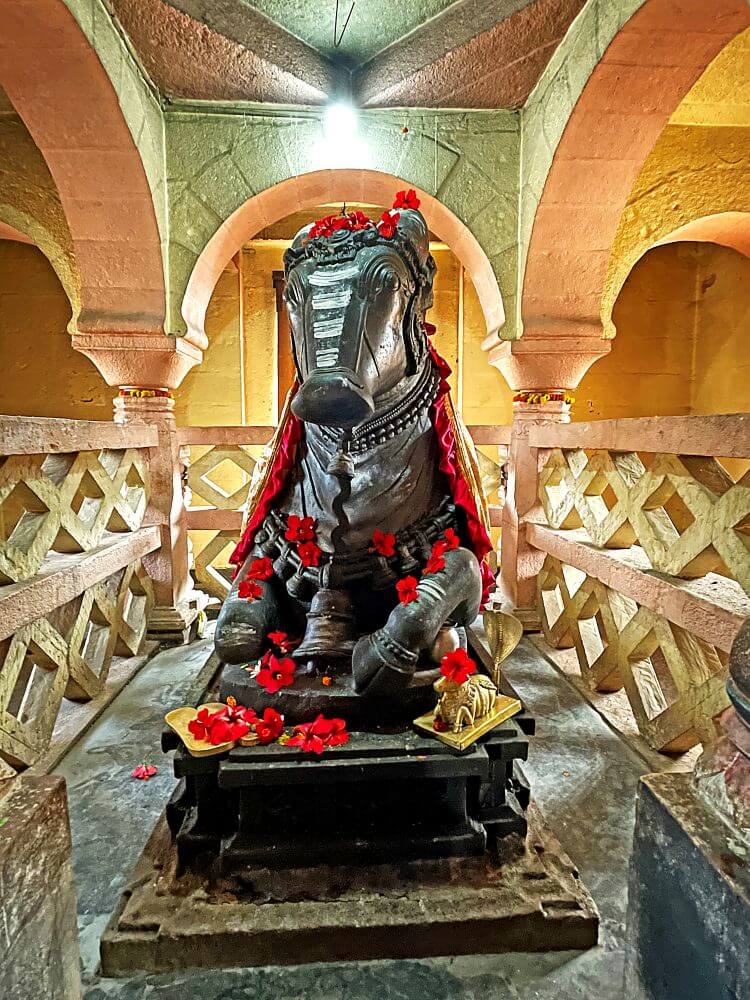
Shop Photo FramesThe temple of Mahatma Basaveshwara, the revered founder of the Veerashaiva or Lingayat tradition, which holds great influence in South Maharashtra and North Karnataka, and his beloved deity, the Shiva Lingam, is situated in Ningudage. Mahatma Basaveshwara is also known as Basavanna. He is believed to be an incarnation of Nandi, a divine attendant of Lord Shiva. In this temple, he is worshipped in the form of Nandi. The idol of Nandi here stands seven feet tall and is eight feet long. This magnificent Nandi idol makes this 13th-century Basavanna and Amrutheshwar Temple renowned.
Basaveshwara was born in Ingaleshwar-Bagewadi, in the Bijapur district of Karnataka. His father, Madiraja, was the ‘Puravaradhishwara’ there, meaning the head of twelve villages. According to Lingayat religious scholars, Basaveshwara was born in 1131 CE, while some researchers record his birth year as 1105 CE. A legend about his birth states that Basaveshwara’s mother, Madalamba, was a devout devotee of Nandi Ishwara, the village deity of Bagewadi. She once had a dream in which Lord Shiva commanded Vrishabha, or Nandi – one of Shiva’s Ganas, along with Renuka, Daruka, Bhringi, and Skanda – to incarnate for the welfare of humanity. Accordingly, Nandi assumed a form of light and entered Madalamba’s womb. Thereafter, Basaveshwara was born to her. Hence, he is considered an incarnation of Nandi.
In the preface to the biographical work ‘Krantikari Yugapravartak Mahatma Basaveshwara’ (Revolutionary Pioneer Mahatma Basaveshwara), authored by Dr. Ashok Menkudale, co-author of the Veerashaiva Encyclopedia, the profound scholar of saint literature, Dr. U. M. Pathan, has elucidated the divine personality of Basaveshwara. In it, he states, ‘The foundation of Mahatma Basaveshwara’s philosophical world is equality. For this very reason, he re-evaluated traditional religious thoughts. He constantly pondered how the worldly and spiritual welfare of people from all strata of society could be achieved.’Dr. Menkudale has further stated that Basaveshwara ardently advocated for the worship of one God. Furthermore, he expounded devotion to the Ishtalinga, which is a replica of the Shiva-form of the universe and grants whatever the heart desires.
Bijjala, a military commander, rebelled against King Tailapa III of the Chalukya dynasty of Kalyana and seized control of the kingdom. Basaveshwara was married to Nilambika, who was considered Bijjala’s sister. At Bijjala’s insistence, he accepted the position of minister (treasurer). During this period, his religious and social work flourished. Consequently, the orthodox elements in the kingdom tried to turn Bijjala against Basaveshwara, seeking to eliminate him. Under pressure from the royal priests, Bijjala committed some cruel acts. Therefore, Basaveshwara ultimately resigned from his ministerial post and left the kingdom of Kalyana. A few days later, in 1167 CE, he attained Nirvana (Lingaikya) at Kudalasangama.
Many temples dedicated to Basaveshwara in the form of Nandi are found in Maharashtra as well as Karnataka. Among these, one ancient and magnificent temple is situated in Ningudage. It is said that this temple dates back approximately seven hundred years. The Hemadpanthi style of construction with carved stones and the ancient Veeragals (hero stones) found here attest to its antiquity. It is said that during Diwali Padwa, the Nandi idol here is given an oil bath (locally known as ‘Mhadan’). At that time, approximately three kilograms of oil are absorbed by the Nandi idol. Devotees believe that this Nandi is alive.
The temple has a spacious courtyard paved with paver blocks. In the courtyard, on a raised platform, stands a tapering Deepamala (lamp tower) with five tiers. It has separate projections for lighting lamps. On the ornate square platform, at the lower level, there are four Gajamukha (elephant-faced) sculptures at its four corners. Images of lotus flowers are carved on all four sides of the platform. Additionally, above the platforms and at the base of the Deepamala, there are four lion sculptures at the four corners. In the lower part of the Tulasi Vrindavan (sacred basil plant enclosure) in the courtyard, there is a replica of a lotus flower. On the square section above it, there are Gajamukhas facing the four directions. The water tank here is shaped like a lotus flower.
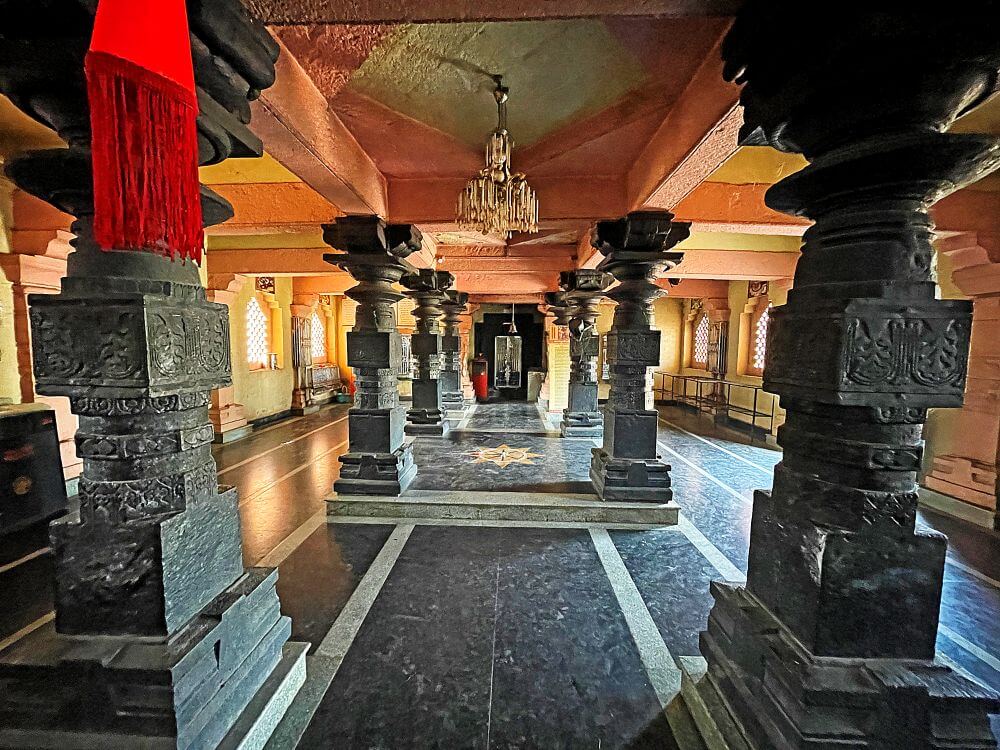
This temple, structured with a Sabhamandapa (assembly hall) and a Garbhagriha (sanctum sanctorum), has three entrances. The main entrance is adorned with five door jambs (dwarashakhas). The first two door jambs feature floral and foliage creeper designs, and the third door jamb has an ornate pillar image carved upon it. The fourth and fifth door jambs display vertical ridge patterns, and Gajalakshmi is seated on the lintel (lalatabimba). On the Mandaraka (architrave), there are lotus flower designs on both sides, and a mysterious image is carved in the center. On both sides of the entrance stand Dvarapalas (gatekeepers), holding a mace in one hand and resting the other on their hip. On the ceiling side of all three entrances, there are Devakoshthakas (niches for deities) containing idols. In the Sabhamandapa, there are four rows, each with eight pillars. The pillars incorporate various geometric shapes such as squares, hexagons, and circles. In the center of the ceiling are the Ashtadikpalas (deities of the eight directions). Indra, mounted on Airavata; Agni, mounted on a ram (Chhagarudha); Yama, mounted on a buffalo (Mahisharudha); Nirruti, mounted on a man (Purusharudha); Varuna, mounted on a crocodile (Makara); Vayu, mounted on a deer (Mrugarudha); Kubera, mounted on a horse (Ashvarudha); and Ishana, mounted on a bull (Vrishabharudha), are depicted holding their respective attributes: Vajra (thunderbolt), Shakti (spear), Pasha (noose) and Danda (staff), Khadga (sword), Nagapasha (serpent noose), Dhvaja (banner), Gada (mace), and Trishula (trident).
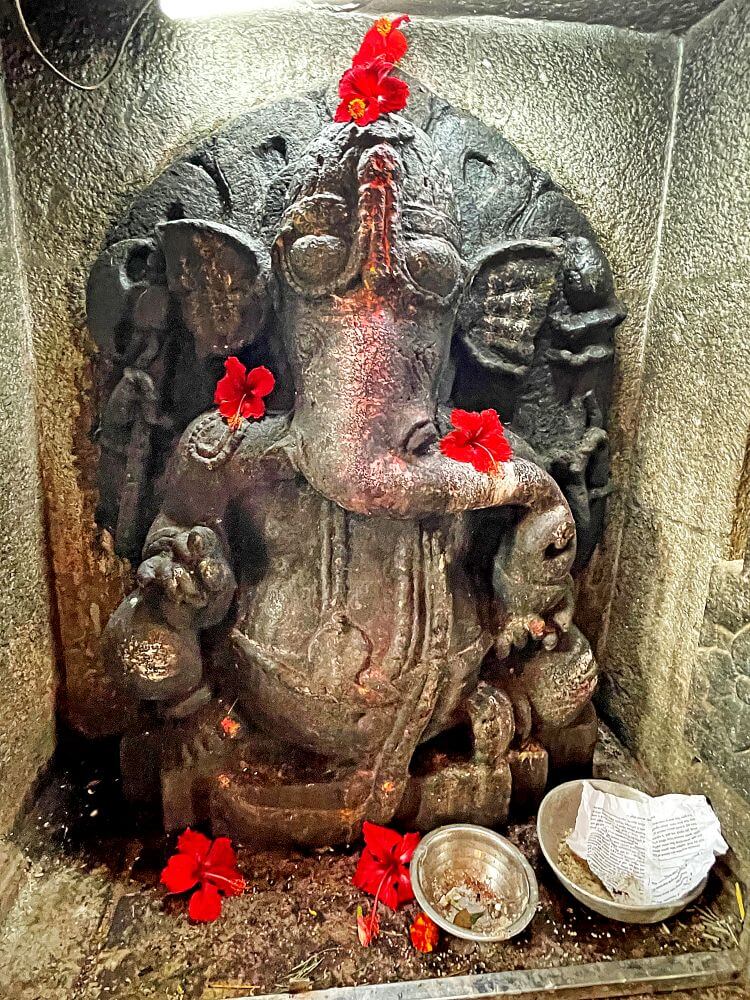
The Sabhamandapa here is enclosed (Gudhamandapa) and features latticed windows (gavakshas) for air and light. In the niches of the Sabhamandapa, to the left of the Garbhagriha, are black stone idols of Mayurarudha Trimukhi Kartikeya Swami (Lord Kartikeya with three faces, mounted on a peacock), and to the right, Shakti Ganesha. Beside Ganesha, there is a panel depicting the Ashtamatrikas (eight divine mothers) mounted on their respective vehicles. Additionally, there are black stone idols of Shankha, Chakra, Gada-dhari Vishnu (Vishnu holding conch, discus, and mace), Virabhadra, and Simharudha Ashtabhuja Mahishasuramardini (eight-armed Durga, mounted on a lion, slayer of Mahishasura).
In the assembly hall, between four ornate stone pillars in front of the Amrutheshwar Lingam, there is a seven-foot-tall and eight-foot-long monolithic, adorned idol of Basavanna (Mahanandi) seated on a Vajra Peetha. Surrounding the idol is an ornate stone railing. On the door jambs of the Garbhagriha entrance, there are pillar-like designs, and Lord Ganesha is seated on the lintel (lalatabimba). The frieze (lalatapatta) features foliage creeper designs, with an ‘Om’ symbol carved in the center. On the Shiva Lingam in the Garbhagriha, there is a five-hooded brass serpent holding a canopy, and a Shivamukha (face of Shiva). The walls of the enclosed Garbhagriha have latticed windows (gavakshas).
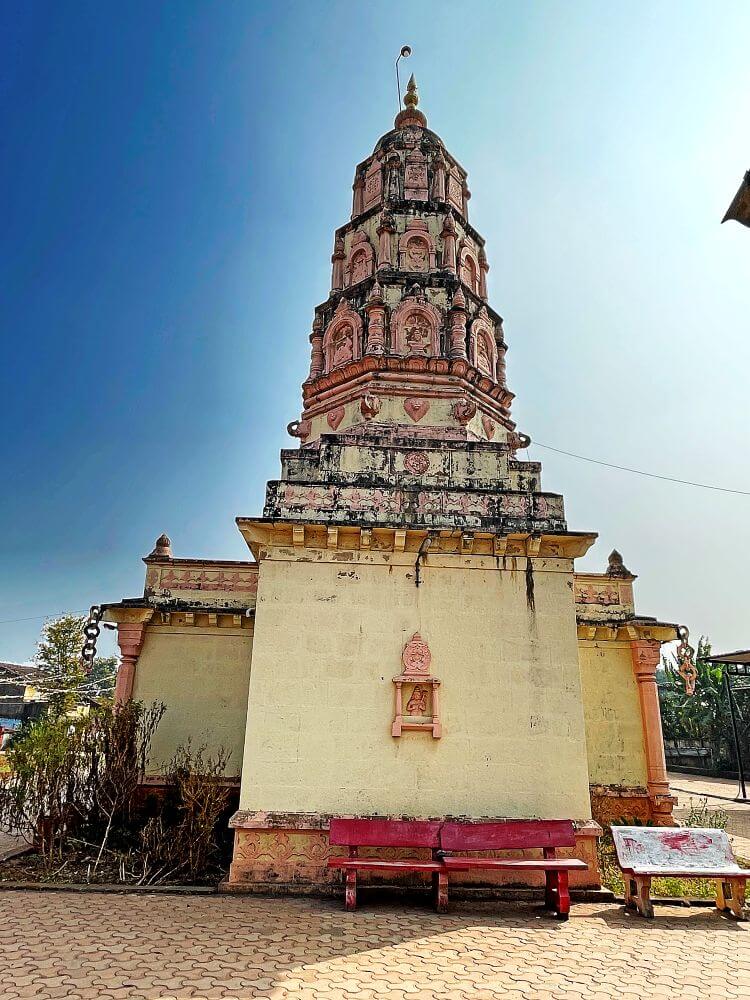
Columns are attached to the outer walls of the temple. Observing the intricately carved stone chains, with bangles interlinked one within another, suspended from the four corners of the ceiling, which is supported by decorative hands on the walls, one can truly appreciate the exquisite artistry of skilled sculptors. The parapet of the roof features relief carvings of various animals. Small spires adorn all four corners of the parapet. The square *shikhara* (spire) above the *Sabhamandapa* (assembly hall) is of the *Urusringa* type, comprising five smaller spires. The main octagonal *shikhara* above the *Garbhagriha* (sanctum sanctorum), consisting of five tiers, stands approximately 20 feet tall. The first two tiers of the *shikhara* are square, adorned with *Gaja Keshari* face sculptures, and the tier above them features a circular design of lotus petals. The *Devakoshthakas* (niches for deities) in the upper three tiers contain sculptures of various deities. An *Amalaka* (fluted stone disc) crowns the *shikhara*, topped by a *Kalasha* (finial) and a *dhvaja pataka* (flag).
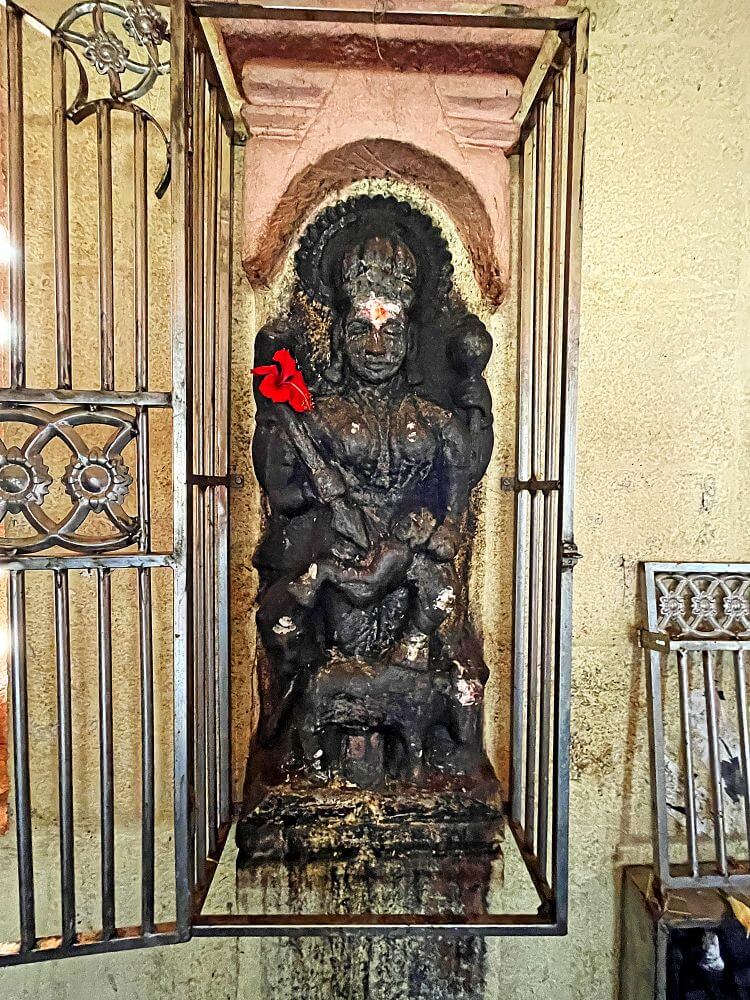
In the temple courtyard, adjacent to the walls, are ancient broken idols and *Veergal* (hero stones). Nearby is an idol of Bhavashwari Devi, carved from black stone. In the courtyard, there is a temple dedicated to Vitthal Rakhumai. On the *Vajrapeetha* (diamond throne) within the *Garbhagriha* of this temple, an idol of Ganapati is enshrined between Vitthal and Rakhumai.
Diwali Padwa marks the annual *Jatrotsava* (fair festival) of Basavanna, also known as Nandi, which is celebrated with great enthusiasm. On this day, at dawn, there is a tradition of performing *Mhadan*, an oil bath, for Nandi. On this occasion, wrestling matches are held. On Kartik Pournima, there is a significant presence of women devotees for *Darshan* (sacred viewing) at this temple. Women from the surrounding *Panchkroshi* (five-mile radius) specifically visit here, as this is the only day they are permitted to have *Darshan* of the idol of Kartik Swami enshrined in this temple. Additionally, annual festivals such as Mahashivratri, Ashadhi Ekadashi, and Kartiki Ekadashi are celebrated at the temple.
This sacred temple stands as a testament to deep spiritual devotion, ancient architectural grandeur, and rich local cultural traditions.
The sanctum sanctorum houses the divine idol consecrated according to ancient Vedic traditions, surrounded by serene courtyards and traditional temple architecture.
Navratri, Maha Shivratri, Annual Temple Jatra & Deepotsav
Compare and book flights, secure top-rated local hotels near the temple, hire reliable guides, and rent cars instantly.
Extend your pilgrimage by visiting other highly sacred temples located nearby.


Add ₹999 more to unlock FREE SHIPPING!
Your sacred cart is currently empty.
Shop Photo FramesFill in your delivery details below to place your order.
Add comment