
Add ₹999 more to unlock FREE SHIPPING!
Your sacred cart is currently empty.
Shop Photo FramesAccording to traditional belief, a Shivalinga is a symbol of origin or reproduction, and the water flowing over the Shivalinga enhances productivity. This is why Shivalingas established on riverbanks or within riverbeds can be seen in many places. Shivalൈngas, meaning Shiva temples, have stood on almost all riverbanks in India for thousands of years. One such famous Lakmeshwar Shiva Temple is situated on the banks of the Hiranyakeshi River in Gajargao, within the Ajra taluka. Because of it being a vibrant, living shrine and its ancient architectural style, this temple attracts scholars and devotees alike.
It is said that this temple is about ५०० to ६०० years old. This is confirmed by the ancient idols and hero stones (Viragals) found in the temple premises. The legend of this temple goes that a farmer named Lakamaji from the village had a cow that would release her milk at a specific spot in a wild karvand (carissa carandas) thicket in the forest. As this became a daily occurrence, Lakamaji grew curious and informed the villagers about it. With the cooperation of the villagers, Lakamaji cut down the bushes in the thorny karvand thicket and searched, upon which a Shivalinga was revealed there. While cutting the bushes, one stroke of Lakamaji’s axe accidentally hit the Shivalinga. Filled with deep remorse, as penance, he gave up food and water and laid down his life. Ever since, the name of the devotee of Shiva, Lakamaji, became associated with the deity, and this shrine came to be known as Lakmeshwar.
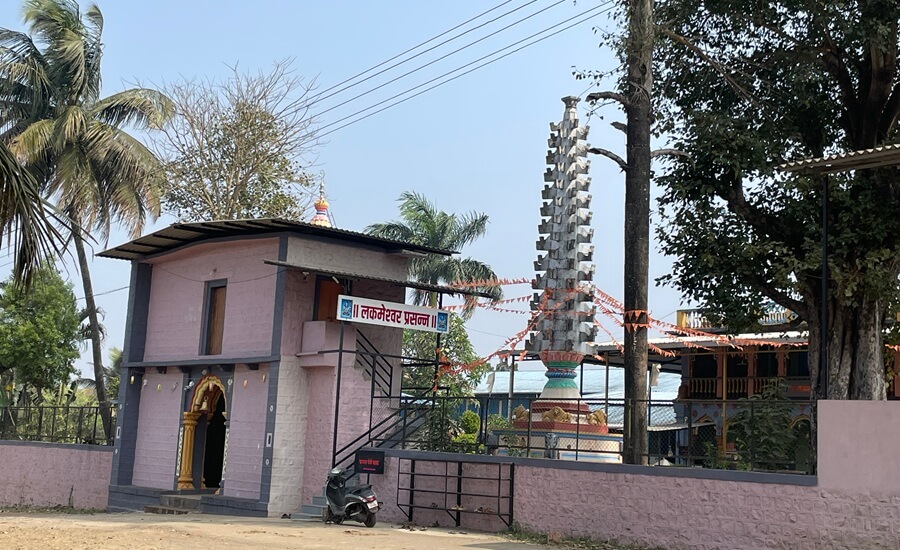
While proceeding from the banks of the Hiranyakeshi towards the Lakmeshwar Temple, the first thing that catches the eye is the double-storeyed entrance gate of the temple. On both sides of the entrance are lamp niches (deepkoshtakas), with relief carvings of lotus flowers above and below them. A brass bell hangs from the ceiling in the middle of the entranceway. There are cusped arches resting on ornate pillars on both sides. Inside, on both sides, there are guard rooms with ornate pillars, and a nagarkhana (drum house) on the upper floor.
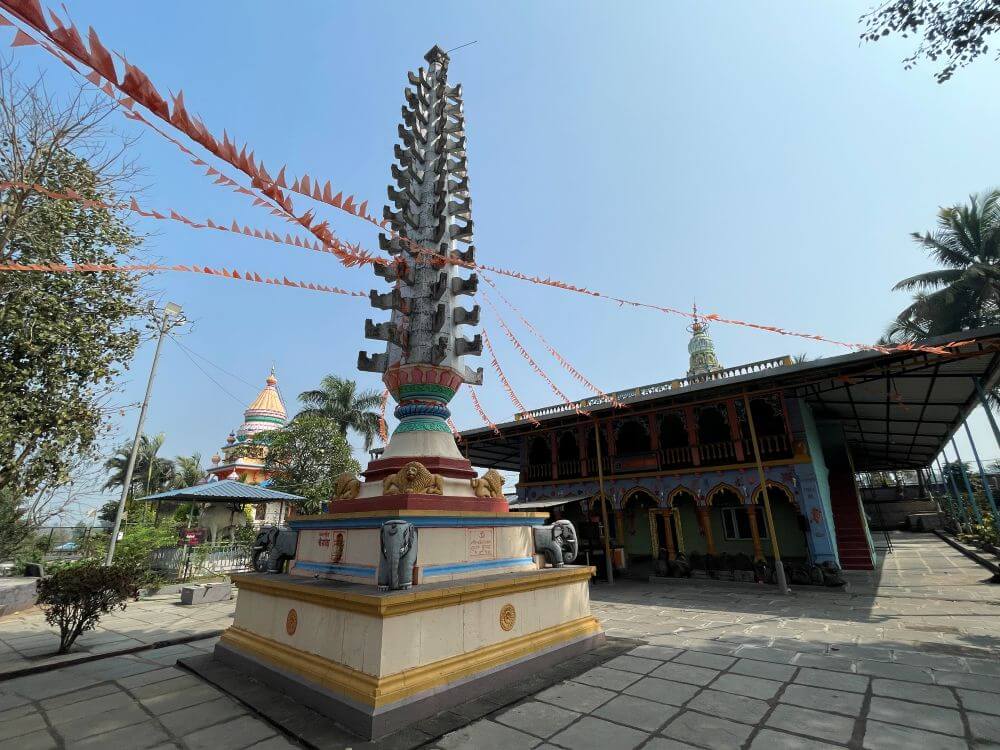
Upon entering the temple courtyard through the gateway, one’s attention is immediately drawn to a distinctive deepmala (lamp tower) standing on a large platform. This platform has two tiers. On the first larger tier, there are elephant sculptures in all four corners, and on the second smaller tier, there are lion sculptures. The four sides of the platform feature relief carvings of lotus flowers. The base of the deepmala on the platform is shaped like a mortar (ukhali), and the lamp tower tapers from bottom to top. Sculptures of animals such as the bull, turtle, boar, and horse are carved on the lamp-brackets (deepahastas) of the deepmala. An inscription on the deepmala mentions that it was built by local artisans between the years १९३६ and १९३८. Further ahead on the platform is a square Tulasi Vrindavan, with a record stating that its construction was completed in the year १९०८. In the courtyard, there is a pushkarani (stepwell) built in the shape of a lotus flower. An idol of Lord Shiva is located within the pushkarani.
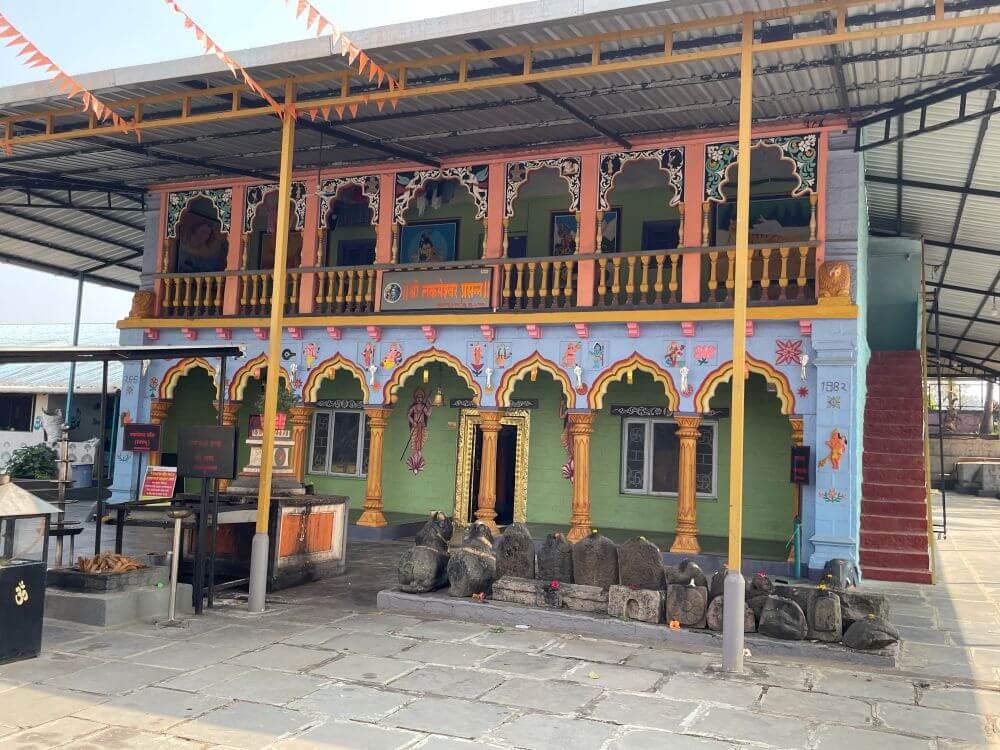
Further ahead in the facade of the temple are ८ pillars followed by a verandah (osari). At the lower part of the circular pillars, which stand on square bases, is the shape of an auspicious kalasha (pot). Above this are fluted vertical carvings. All the pillars are connected to one another by cusped arches. On the upper part are relief carvings of lotus flowers and depictions of various deities. On top of the pillars are brackets, above which is the projecting balcony (sajja) of the upper floor. The sajja has a railing containing ८ square pillars. The pillars are connected to one another by cusped arches, which are adorned with floral and foliate carvings. On both sides of the entrance to the sabhamandapa (assembly hall) is a verandah. The temple entrance is made of wood, and its door jambs are carved with floral and foliate patterns.
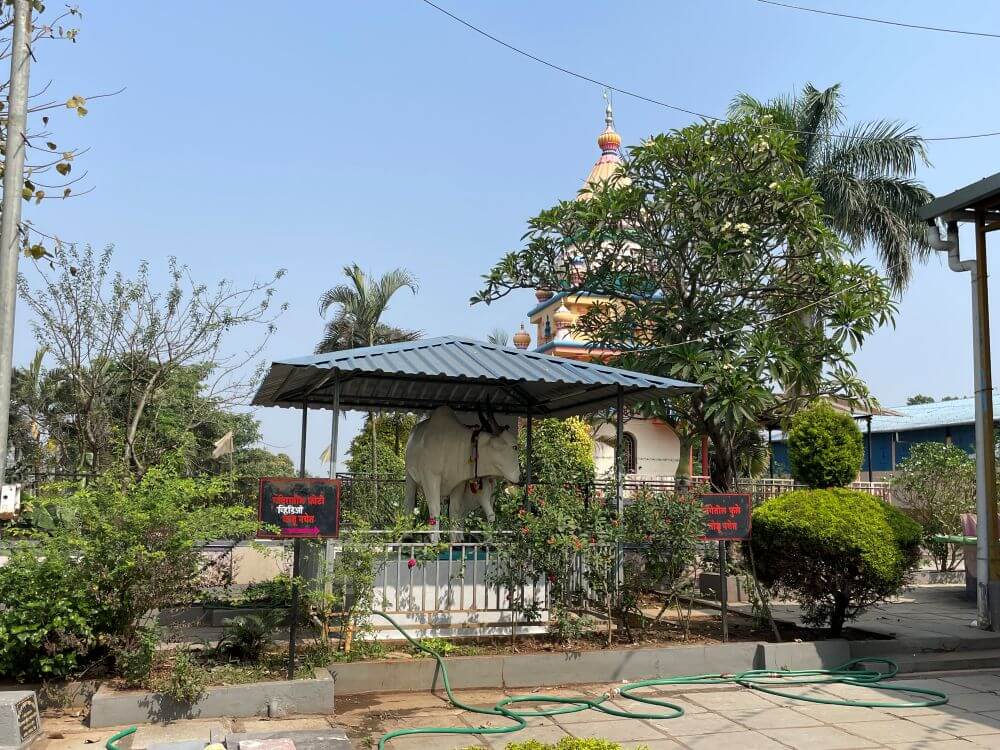
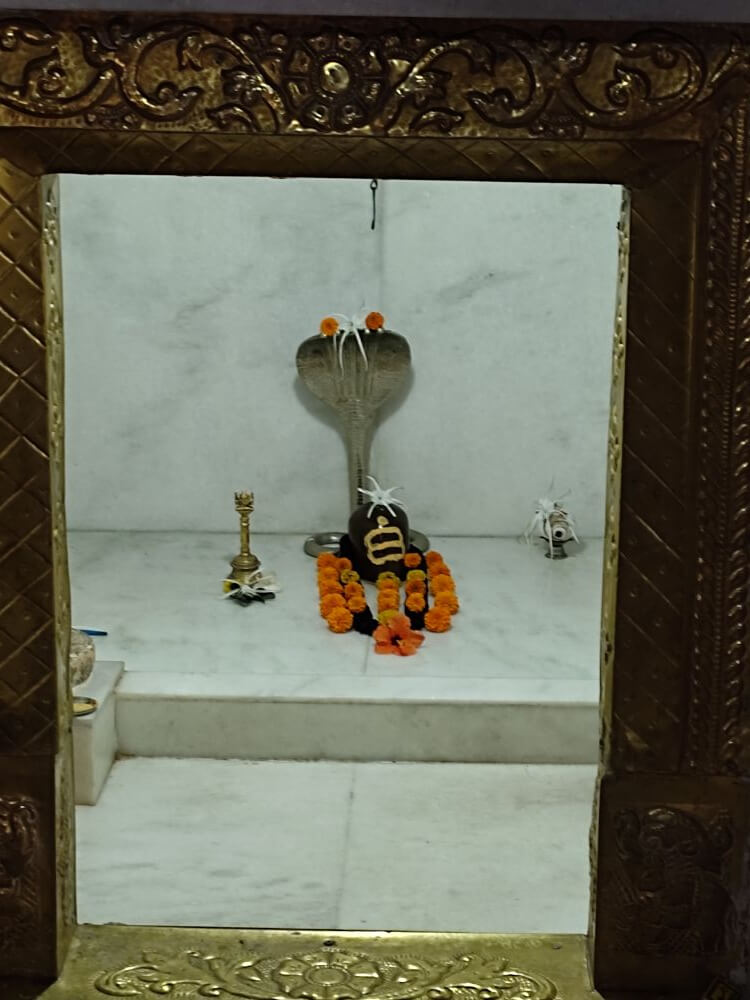
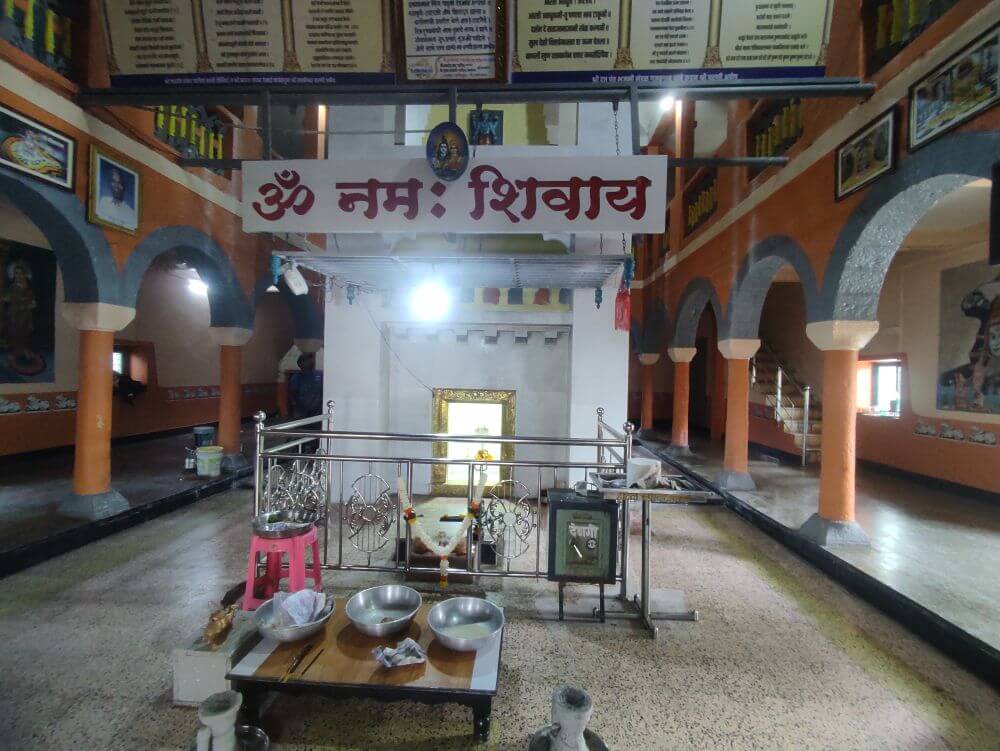
Inside the sabhamandapa, there are a total of २२ cylindrical pillars standing on square bases. All the pillars are interconnected by cusped arches. The sabhamandapa is enclosed in nature (Gudhamandapa) and has small windows (gavaksha) for ventilation and light. From the entrance, the floor level amidst the pillars is about one foot lower. Right in the middle of this sunken area lies the garbhagriha (sanctum sanctorum) of the temple. Inside the garbhagriha is a swayambhu (self-manifested) Shivalinga with a brass serpent sheltering it with its hood. There is a pradakshina marga (circumambulation path) around the garbhagriha and doors on both sides to exit the temple. On the temple roof, there is a parapet wall all around and a shikhara (spire) in the middle. The lower three tiers of the five-tiered shikhara are octagonal. Their niches (devakoshtakas) contain images of various deities. On the third tier is a ring of lotus-petal carving, topped by a dome. Atop the dome are the amalaka, kalasha, and flag banner.
On the right side in the temple courtyard are the ruins of a Chalukya-era Shiva temple. Here, one finds a Shivalinga and several ancient stone sculptures. On the outer side, within damaged niches, are idols of Ganesha, Shiva, and Vishnu. Beside this temple, on a stone slab, the images of the Saptamatrikas (Seven Divine Mothers)—Brahmani, Kaumari, Maheshwari, Vaishnavi, Varahi, Mahendri, and Chamunda—are carved. Bearing various weapons, these Saptamatrikas are seated upon their respective mounts: the swan, peacock, bull, garuda, buffalo, elephant, and horse. In the courtyard stands a recently built Shri Ram-Janaki temple housing the idols of Shri Ram, Lakshmana, Sita, and Maruti. Additionally, there is a Parshvanath temple adjacent to the main temple. During the recent restoration work of the Lakmeshwar Temple, an idol of Parshvanath was found buried in the ground, which is now installed in this temple. A smaller idol of Parshvanath, located right next to this one, was found in a field near the temple. In front of the temple is a ghat on the river, where the Hiranyakeshi River flows towards the south.
Maha Shivaratri is the main annual festival celebrated in the temple. On this day, thousands of devotees arrive for the darshan of the deity. The day begins in the early hours of dawn with Laghurudra Abhisheka and worship. Throughout the day, programs such as bhajana and kirtana are organized. The palanquin of the deity is taken in a procession around the village. On this occasion, Mahaprasada is distributed to the visiting devotees. Apart from this, countless devotees also flock here on Tripurari Purnima, Shravani Somwar, Vaikuntha Chaturdashi, Dussehra, and Diwali.
This sacred temple stands as a testament to deep spiritual devotion, ancient architectural grandeur, and rich local cultural traditions.
The sanctum sanctorum houses the divine idol consecrated according to ancient Vedic traditions, surrounded by serene courtyards and traditional temple architecture.
Navratri, Maha Shivratri, Annual Temple Jatra & Deepotsav
Compare and book flights, secure top-rated local hotels near the temple, hire reliable guides, and rent cars instantly.
Extend your pilgrimage by visiting other highly sacred temples located nearby.


Add ₹999 more to unlock FREE SHIPPING!
Your sacred cart is currently empty.
Shop Photo FramesFill in your delivery details below to place your order.
Add comment