
Add ₹999 more to unlock FREE SHIPPING!
Your sacred cart is currently empty.
Shop Photo FramesWhen Sati sacrificed her life in the yajna of Prajapati Daksha, Virabhadra was created from the body of the enraged Mahadeva. To increase the power of Virabhadra, many deities merged into his body. Twarita Devi is one of them. Adorned with garments made of peacock feathers, tree leaves, and serpents, Twarita Devi and her original form are associated with medicinal properties, Ayurveda, and antidotes for poisons. In later times, the Goddess began to be worshipped in the forms of Durga, Tulja Bhavani, and Mahalakshmi. There are only a few temples of this Goddess in Maharashtra. The ancient temple at Talwada in Georai taluka is one of them.
The history of the temple at Talwada is linked to the medieval history of Maharashtra, especially the Shiv-kaal (era of Chhatrapati Shivaji Maharaj). According to available information, this temple is estimated to have been built in the 16th or 17th century. This was a period of great upheaval in the history of the Deccan. In the 16th century, the Deccan was dominated by the Nizamshahi, Adilshahi, and Qutubshahi sultanates, while in the latter half of the 17th century, Chhatrapati Shivaji Maharaj established Swarajya.
This temple is situated on the only hill in a vast, flat area. Geographically, it is called an ‘inselberg’ (a solitary hill). Devotees believe that this hill, which rises suddenly amidst vast stretches of farmland and flat plateaus, is a miracle of nature. This Goddess is a form of Bhavani Devi of Tuljapur. To this day, the Goddess has promptly fulfilled the wishes of many devotees. There is a local belief that she is known as ‘Twarita’ because she responds quickly to prayers (navas).
There are two options to reach the temple from the foothills: a paved road for vehicles and a staircase built of carved stone for pedestrians. The staircase is about six feet wide. There are stone safety railings on both sides of the path. At the beginning of the staircase, there is a temple of Shri Ganesha. In the sanctum sanctorum, there is a vermilion-smeared stone idol of Ganesha on a vajra-peetha (diamond pedestal). There are about 180 steps from the foothills to the temple.
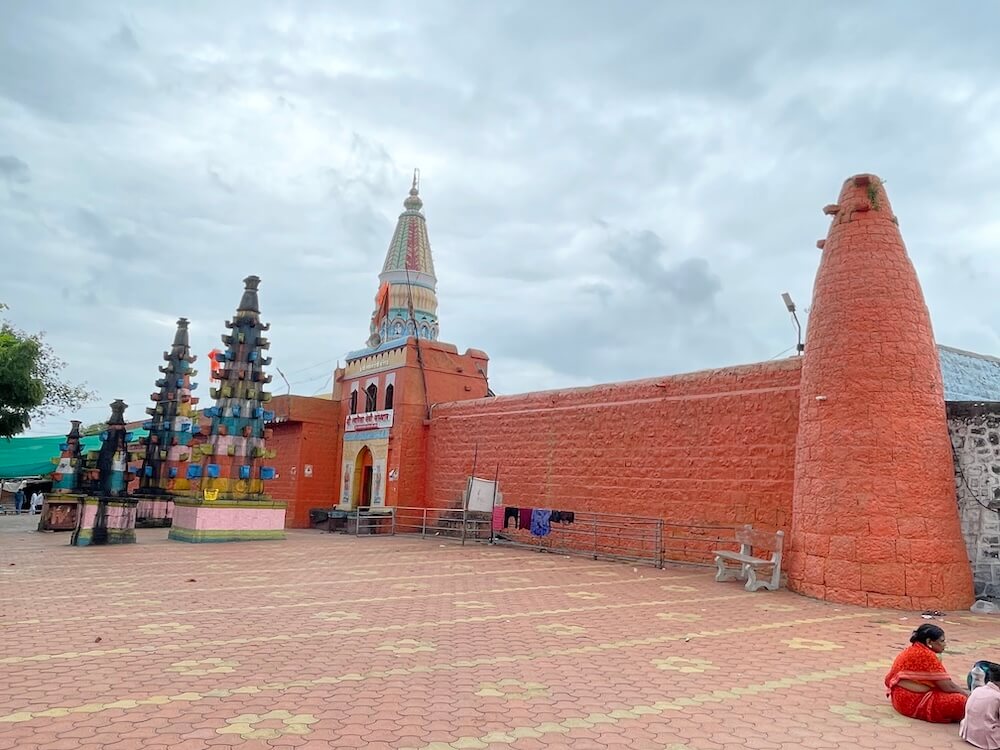
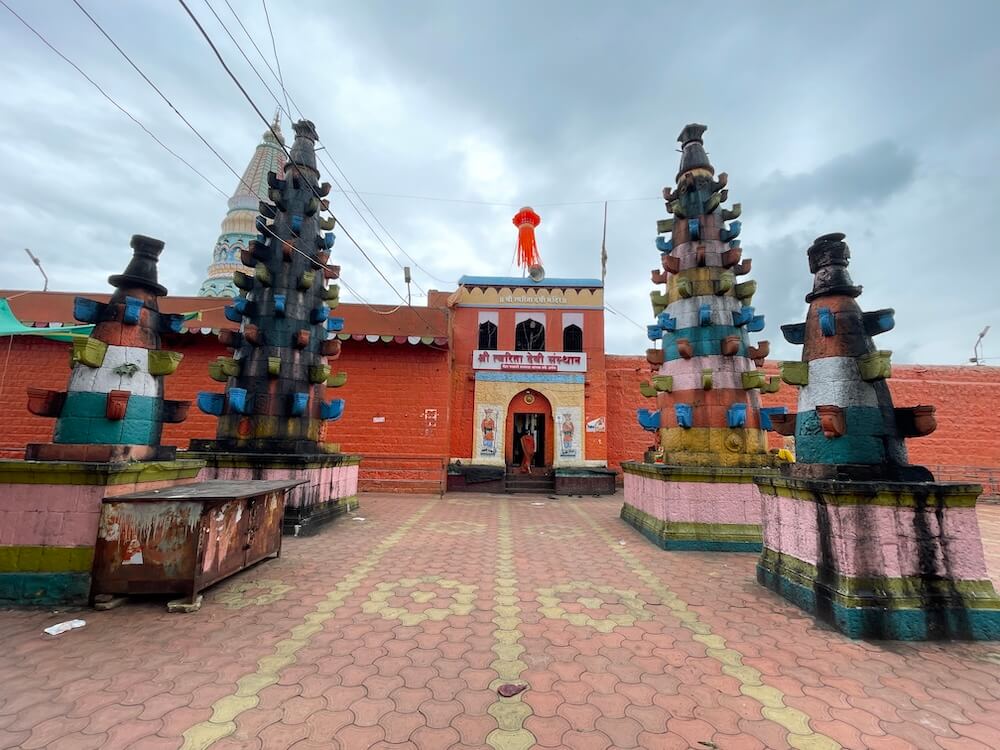
The hilltop around the temple is covered with paver blocks. There are many trees here, as well as seats for devotees to rest. In front of the temple entrance, there are four large and small platforms with tapering circular lamp towers (deepmalas). Some of these lamp towers have inscriptions. According to them, these lamp towers were erected between 1701 and 1704 AD. The temple has a strong stone fortification about twelve feet high. In one corner of the fortification, there is a turret-like lamp pillar. Nearby is a freshwater stepwell (barav). It is said that the water in this well never dries up. There is another lamp tower next to this well.
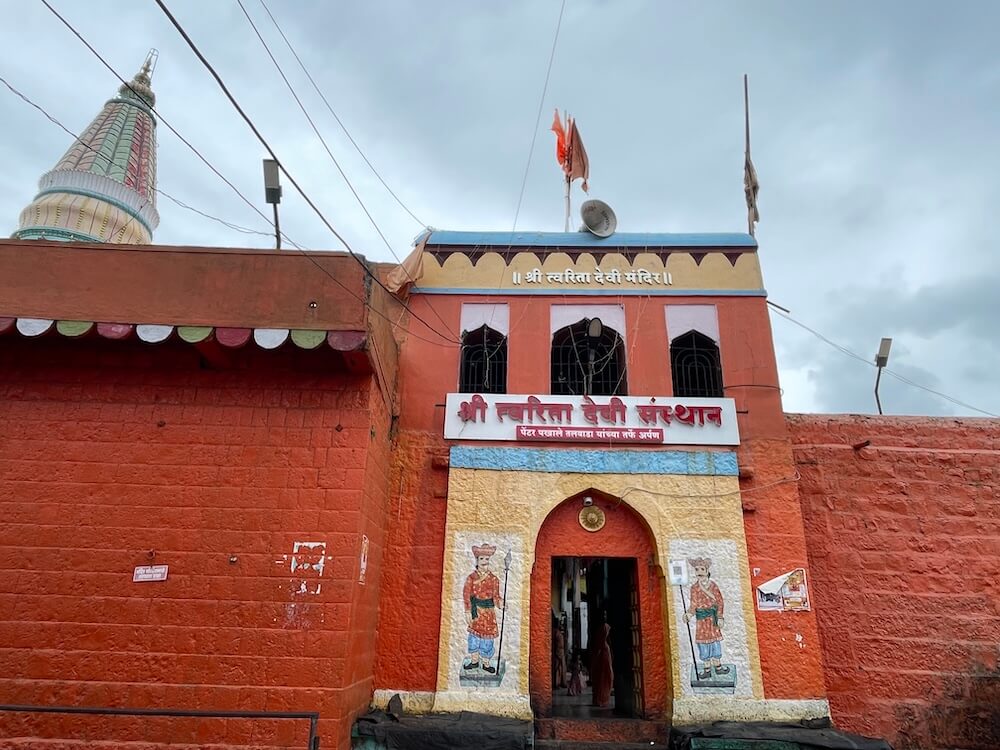
The fortification has two entrances. The main entrance is two-storied. Since the entrance is higher than the ground level, one has to climb three steps. There are platforms on both sides of the steps. The door frames of the entrance are flat, and there is a triangular arch above. Below the arch is a relief sculpture of a chakra. The entrance has ornate wooden doors. Inside, there are guard rooms on both sides. From here, there is a staircase leading to the second floor of the entrance. On the upper floor of the entrance is the Nagarkhana (drum house). The Nagarkhana has eight pillars connected by triangular arches and a roof above. There is a safety railing on the roof. The path from the entrance to the temple is very narrow. It leads directly in front of the ardha-mandapa (half-hall) of the temple.
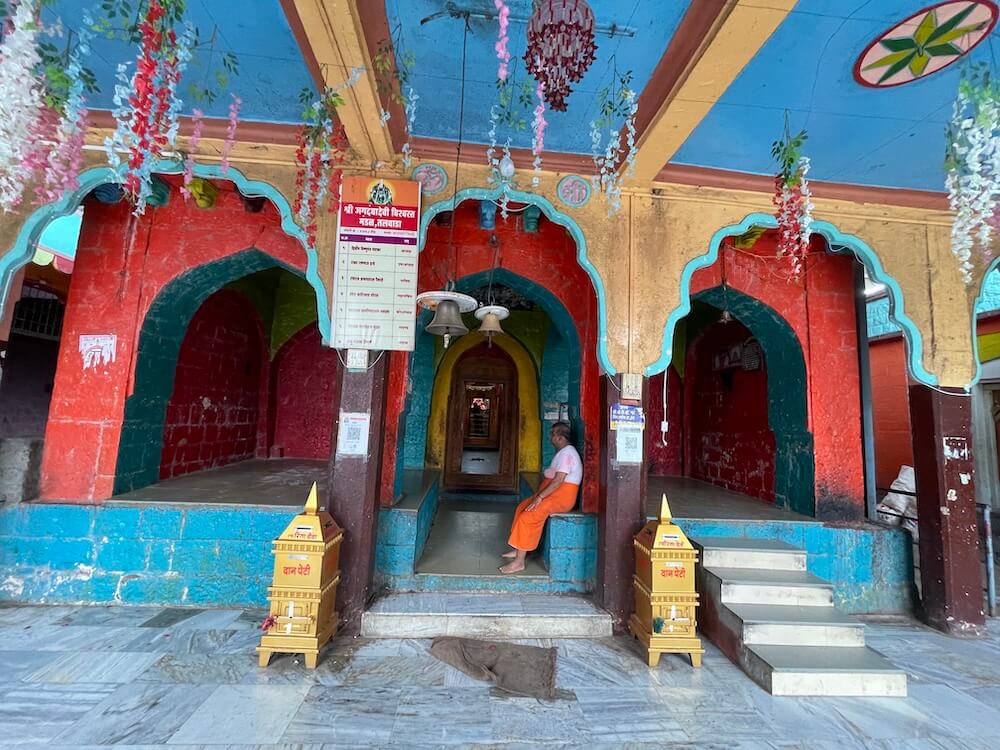
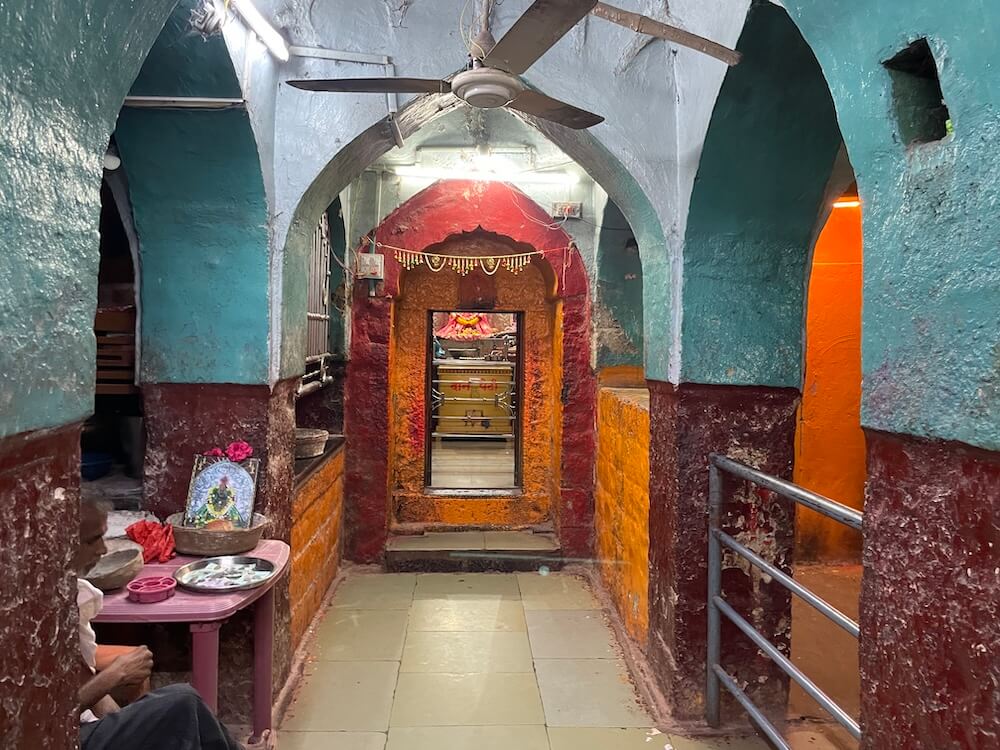
The temple has a distinctive structure consisting of an ardha-mandapa, a narrow sabha-mandapa (assembly hall), and a spacious garbha-griha (sanctum sanctorum) beyond it. In front of the ardha-mandapa, there is a tortoise sculpture on a marble-tiled floor. In the ardha-mandapa, in front of the entrance to the sabha-mandapa, there are platforms about two feet high on both sides. Further ahead is the entrance to the sabha-mandapa. On the wooden door frames installed inside the stone and flat door frames, as well as on the lintel and the architrave, there are carvings of leaves and flowers. There is a Ganesha sculpture on the lalata-bimba (central lintel). The entrance has ornate wooden doors. There are platforms on both sides in the sabha-mandapa. There is a narrow passage between the platforms. The entrance to the garbha-griha is similar to the entrance of the sabha-mandapa. There is a circular design in the center of the ceiling.
In the garbha-griha, on a vajra-peetha, is the four-armed idol of Twarita Devi in black stone. The Goddess holds a mace, lotus, conch, and discus in her hands. Adorned with garments and ornaments, the Goddess wears a golden crown on her head. The silver prabhavali (halo) behind the idol has carvings of leaves and flowers. There is another door on the left side to exit the garbha-griha. There is a circumambulation path (pradakshina marga) outside the garbha-griha. On the roof of the garbha-griha, there is a four-layered circular shikhara (spire) that tapers towards the top. In the lower two layers of the shikhara, there are twelve niches each, containing divine images. The upper two layers have pillar carvings. All layers of the shikhara are separated by lotus petal rings. At the top of the shikhara, there are two amalakas placed one above the other, topped by a kalasha.
In front of the temple is a small temple of Bhairavnath. The temple houses idols of Bhairavnath, Bhavani Devi, and Jogai Devi on a vajra-peetha. Behind the temple, there is a yajna-kunda (sacrificial fire pit) on a spacious platform. During the Navratri festival, homa-havan (fire rituals) are performed here for nine days and throughout the month of Chaitra. In the temple courtyard, there are cloisters (ovaris) along the fortification on all three sides. They are used as a pilgrim residence and dharmashala. During festivals, the Goddess’s offerings are kept in these cloisters.
The month-long Chaitra fair and the Sharadiya Navratri festival are the main annual festivals celebrated here with great enthusiasm. At this time, thousands of devotees come for the darshan of the Goddess and to fulfill their vows. During the festival, programs like homa-havan, yajna, bhajans, kirtans, discourses, jagran, gondhal, and maha-prasad are organized in the temple. Apart from this, a large number of devotees visit during festivals like Makar Sankranti, Kojagiri Purnima, Chaitra Padwa, Dussehra, Diwali, and the month of Ashadh. The temple sees a special rush of devotees on Tuesdays, Fridays, Purnima (full moon), Amavasya (new moon), and Ashtami.
This sacred temple stands as a testament to deep spiritual devotion, ancient architectural grandeur, and rich local cultural traditions.
The sanctum sanctorum houses the divine idol consecrated according to ancient Vedic traditions, surrounded by serene courtyards and traditional temple architecture.
Navratri, Maha Shivratri, Annual Temple Jatra & Deepotsav
Compare and book flights, secure top-rated local hotels near the temple, hire reliable guides, and rent cars instantly.
Extend your pilgrimage by visiting other highly sacred temples located nearby.

Add ₹999 more to unlock FREE SHIPPING!
Your sacred cart is currently empty.
Shop Photo FramesFill in your delivery details below to place your order.
Add comment