
Add ₹999 more to unlock FREE SHIPPING!
Your sacred cart is currently empty.
Shop Photo FramesIn India, temples dating back to the Mahabharata era or those established by the Pandavas can be seen in many places. Legends are prevalent that the Pandavas established several temples while wandering through various regions during their exile. Most of these temples are dedicated to Lord Shiva. On the battlefield of Kurukshetra, Lord Shri Krishna imparted the teachings of the Shrimad Bhagavad Gita to Arjuna. Therefore, from a spiritual perspective, Arjuna’s position is considered extremely significant compared to the other Pandavas. Despite this, independent temples dedicated to the archer Arjuna are considered extremely rare across India. Against this backdrop, the ‘Parth Mandir’ located in the village of Patharwala in the Ambad taluka of Jalna district, Maharashtra, holds special significance. Unlike other temples, it does not worship a single deity; instead, it features the joint worship of Arjuna and Lord Shri Krishna, both mounted directly upon a chariot.
The structure of this temple and its idols bear witness to the architectural style of the Yadava period of Devagiri. According to scholars, this historic temple was likely built in the twelfth or thirteenth century. Historical records link the history of this region to the name of Kholeshwar, a famous general of the Yadavas of Devagiri. He had commissioned several ancient structures in this area, including the Kholeshwar Mahadev temple. As the temple has been renovated in recent times, a new idol has been installed in the sanctum sanctorum in place of the original one. Nevertheless, for history enthusiasts and devotees, the original ancient idol has been safely preserved in the temple’s assembly hall (Sabhamandap).
A local legend is told regarding the establishment of this temple. It is said that the great archer Arjuna had become proud, believing that there was no other warrior in the world as great as himself. To dispel this ego, Lord Shri Krishna told him that Queen Champavati of the then Champavati Nagari—the city now known as Beed—was a greater archer than Arjuna. Hearing this, Arjuna decided to test the Queen. He requested Shri Krishna to drive his chariot toward Champavati Nagari. As soon as Arjuna’s chariot reached the borders of the city, Queen Champavati stood before him, bow and arrow in hand. The first arrow released by the Queen after pulling the bowstring was so powerful that the impact threw Arjuna’s chariot, along with his charioteer Shri Krishna, sixteen yojanas backward. The chariot came to a halt on the outskirts of Patharwala village. The mighty Hanuman, seated on the chariot’s flag, steadied the chariot there. Today, a temple dedicated to Hanuman stands at the spot where he stabilized the chariot. The place where Arjuna and Shri Krishna stepped down from the chariot to rest is where the ‘Parth Mandir’ was later built. Because Arjuna, or Parth, rested here, the village was first named ‘Parthpur’. Over the course of time, this name was corrupted and became ‘Patharwala’.
This temple is situated on the banks of the Godavari River, a short distance from Patharwala village. A well-paved road is available to reach the temple. There is a spacious parking area for devotees’ vehicles in front of the main temple. For the security of the temple, a stone fortification wall has been built around it in recent times. There is a grand entrance gate within this wall. Upon entering the premises, one can see an ancient stone wheel lying on the ground in front of the temple. The villagers believe this wheel belongs to Arjuna’s chariot. On the other hand, archaeological scholars believe this stone wheel was likely used in ancient times for crushing lime for temple construction, serving as a millstone.
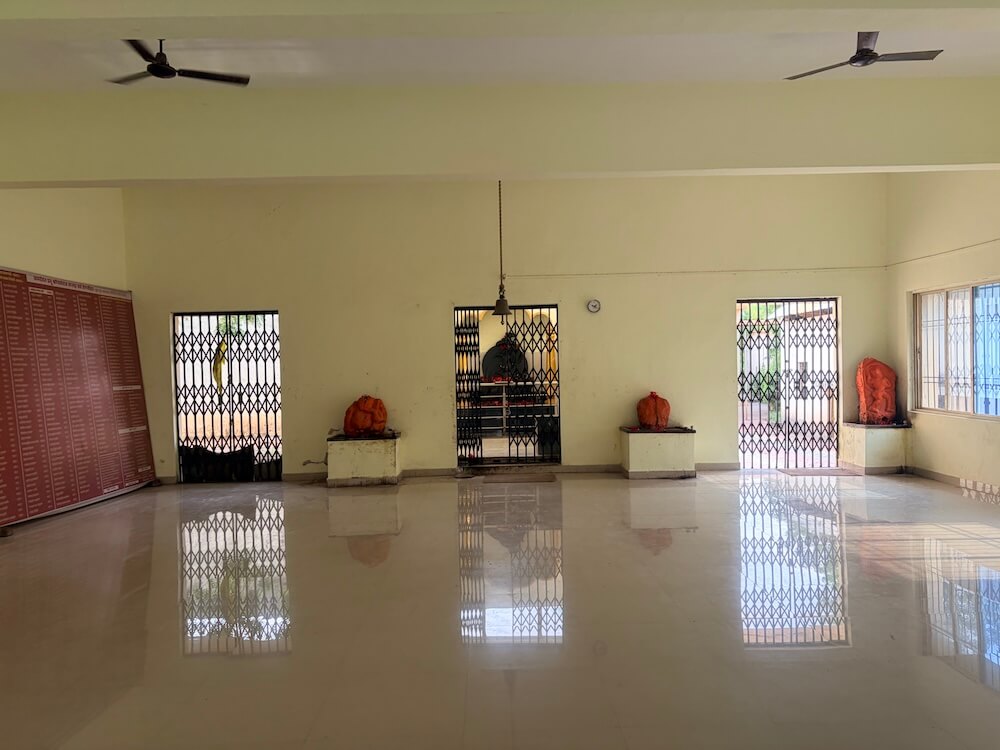
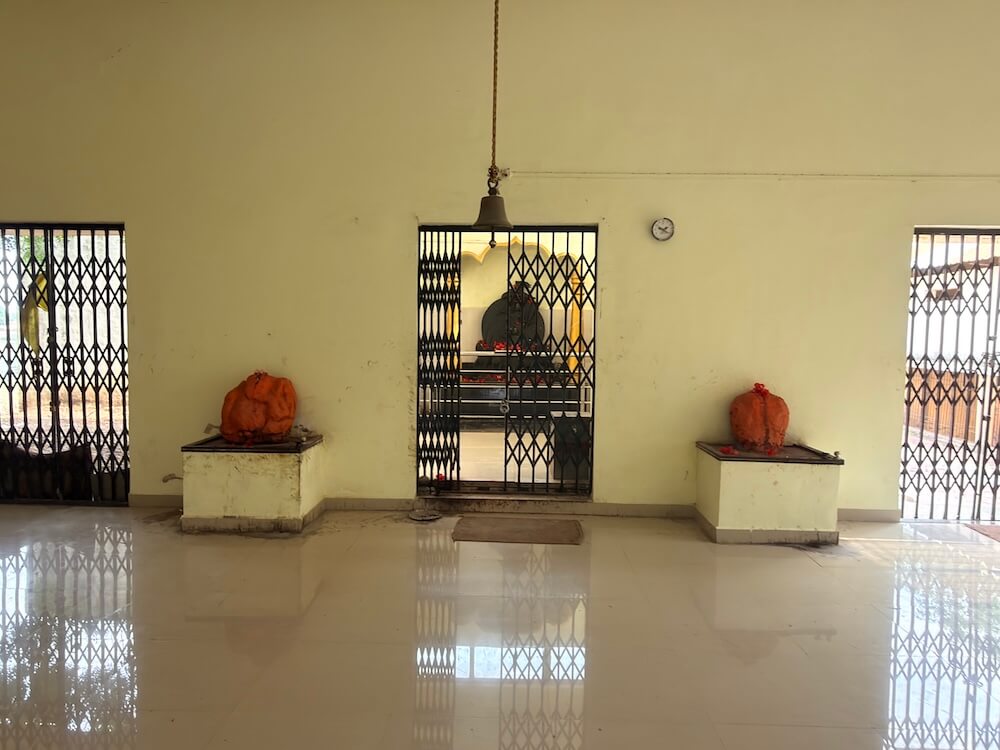
Regarding the architecture, the temple is primarily composed of three sections: the Ardh-mandap (entrance hall), the Sabhamandap (assembly hall), and the main Garbhagriha (sanctum sanctorum). The entrance to the Ardh-mandap is at a level about five feet higher than the courtyard ground. Therefore, eight steps have been built to ascend to this level. The design of these square steps in front of the entrance resembles a pyramid. The Ardh-mandap here is semi-open in nature. On its outer side, there is a railing with small pillars. Additionally, circular pillars are erected in the front section. Moving forward from this Ardh-mandap, one reaches the entrance of the main Sabhamandap. Upon entering the Sabhamandap, one can see the ancient idol of Shri Krishna and Parth placed against the right-side wall. The chief priest here explains that because this original idol had worn down over time, it was removed from the main sanctum sanctorum and placed here in the assembly hall. Beside this ancient idol, one can see an idol of Shri Krishna and Parth made of white marble. A decision had been made to replace the original stone idol with this marble one in the sanctum sanctorum. However, during its consecration, a crack appeared in the idol. The priest informs that because of this, the idol was not placed in the sanctum sanctorum but was brought and kept in the assembly hall. From this assembly hall, two separate doors are provided on the left and right sides of the sanctum sanctorum to exit the temple. In the assembly hall, on both sides of the main entrance to the sanctum sanctorum, two stone pedestals have been prepared. The idol of Ganpati is seated on the right-side pedestal, and the idol of Maruti is seated on the left.
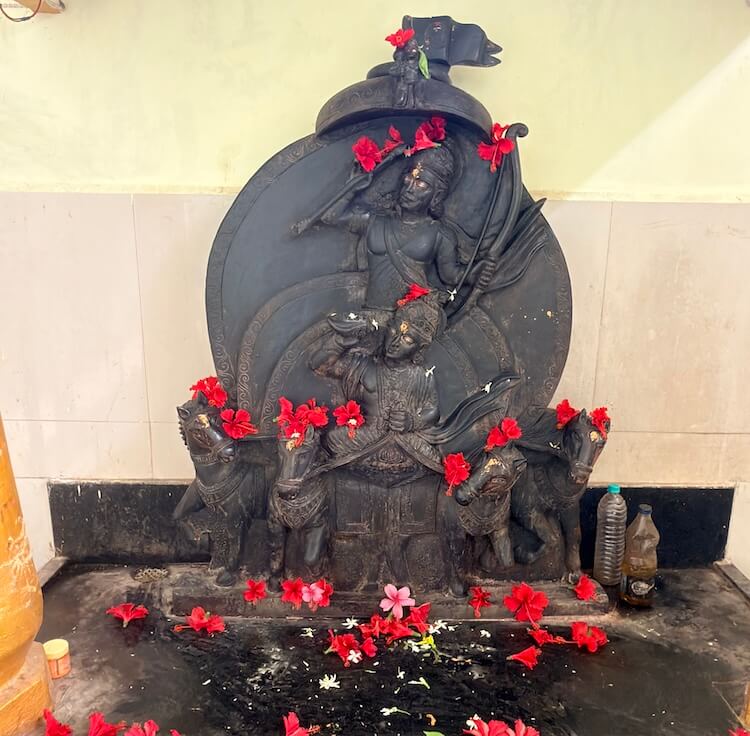
On the main pedestal inside the sanctum sanctorum, within a marble arch, is the idol of Parth and Shri Krishna mounted on a chariot drawn by four horses (Chaturashwa Rath). In this, Lord Shri Krishna is holding the reins of the horses and driving the chariot, while behind him, the archer Arjuna is carved in a battle-ready posture, holding a bow in one hand and drawing an arrow from the quiver on his back with the other. On the canopy above this chariot, the figures of Maruti and a flag emblem can be seen. The temple’s tapering shikhara (spire) is built over the roof of the sanctum sanctorum.
Behind the Parth Temple lies an ancient temple of Goddess Khandeshwari. A legend is shared among the local devotees regarding the establishment of this Goddess. In the past, a devotee from the village of Parthpur used to visit the Khandeshwari Devi temple in Beed regularly for darshan. Later, due to old age, it became physically impossible for him to undertake the long journey to visit the Goddess. To find out why her devotee was not coming for darshan, the Goddess came to this place from the city of Beed. Seeing the devotion of her follower, she established her abode here according to his wish. In front of this temple stands an
ancient stone lamp pillar (Deepmala). The structure of this temple is also divided into a Sabha Mandap (assembly hall) and a Garbhagriha (sanctum sanctorum). The Sabha Mandap here is semi-open in nature. On its outer side, there is a railing with pillars erected within it. The roof of the temple rests on wooden or stone beams placed upon these pillars. In the main sanctum, on the Vajrapitha, one can see the traditional stone idol of Goddess Khandeshwari in the form of a Tandala (a naturally formed stone). This idol is adorned with garments and traditional ornaments. On the ceiling of the sanctum, there is a circular carved Shikhara (spire). An Amalaka is placed on its upper part, topped with a Kalasha.
Since this is the place of Lord Krishna and Arjuna, ‘Krishna Janmashtami’ is considered the main annual festival of this temple. On this occasion, an Akhand Harinam Saptah (uninterrupted week of chanting the Lord’s name) is organized every year from the first day (Pratipada) of the dark fortnight of Shravan until the eighth day (Ashtami). During this seven-day period, kirtans and discourses by various kirtankars based on spirituality and the teachings of saints are presented. Bhajan groups from the surrounding areas attend the temple to offer their musical service. On the day of Krishna’s birth, i.e., Ashtami, the Dahi Handi is broken to celebrate the Gopal Kala. On this occasion, a Mahabhojan, or Mahaprasad, is organized for the devotees coming for darshan. Apart from this main festival, various types of religious programs and Abhishekas are organized in the temple during Ashadhi and Kartiki Ekadashi, Dussehra, Diwali, the entire month of Shravan, and the Purushottam month, also known as the Dhondya month. Devotees can visit this temple daily from early morning until late at night.
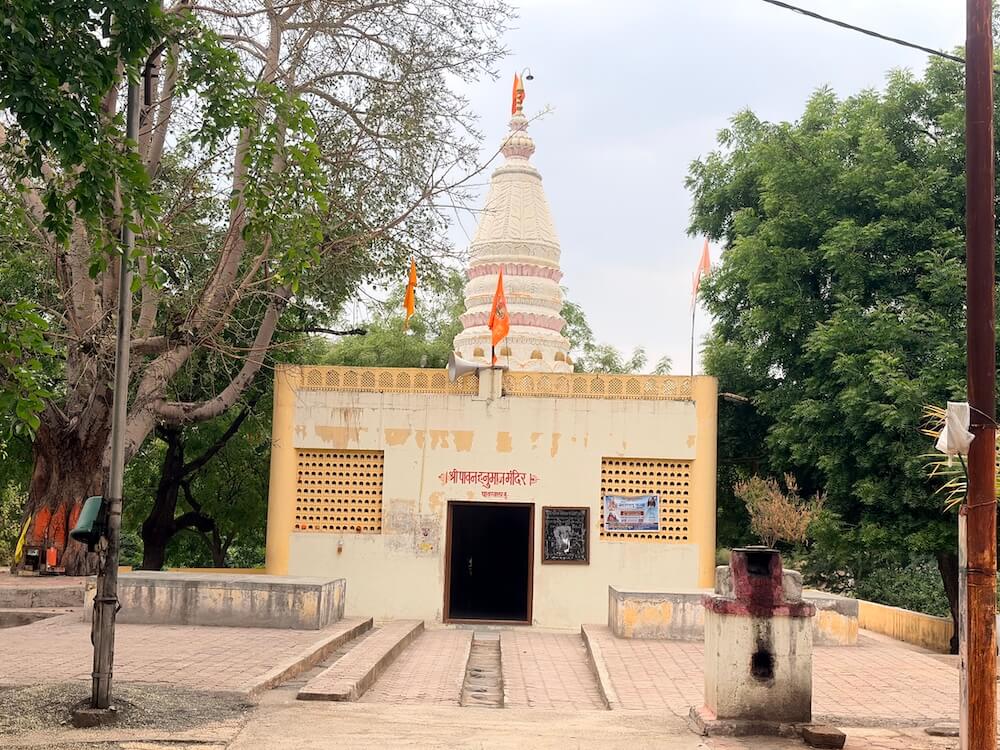
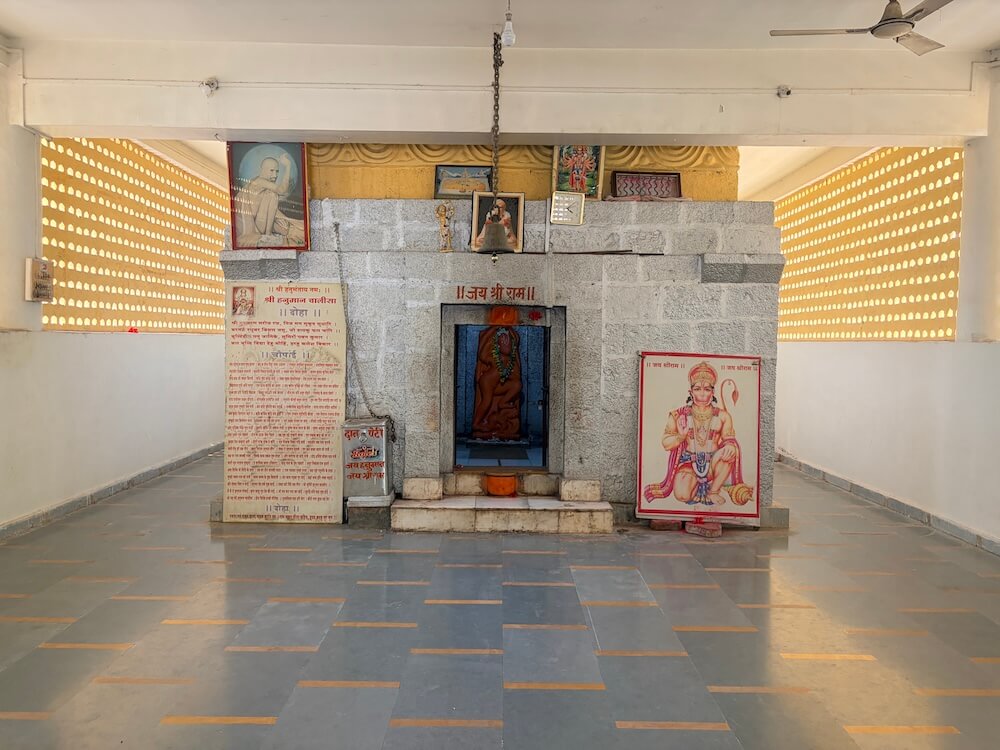
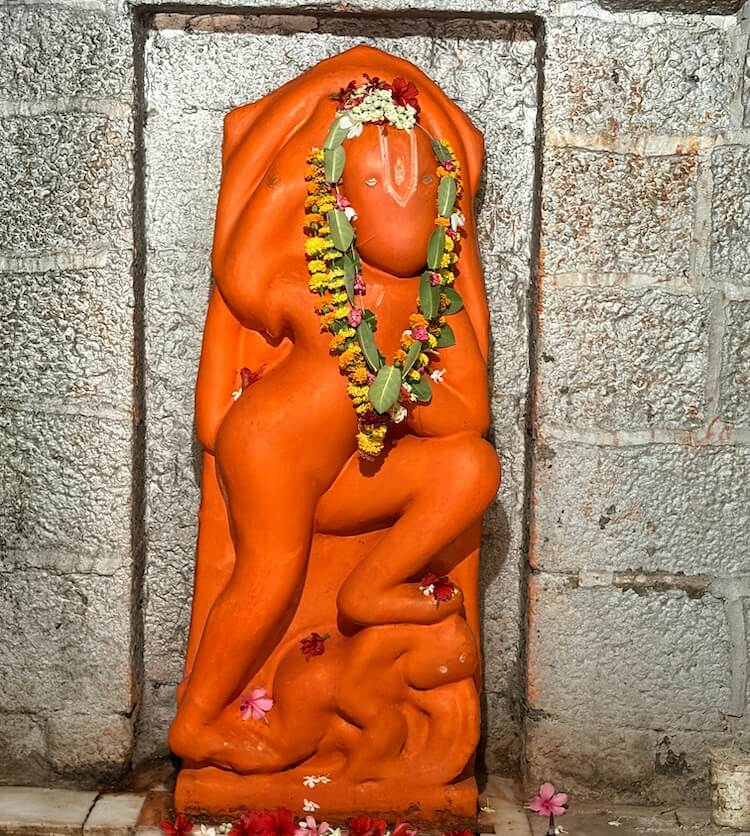
About one kilometer away from the Parth Temple, there is a separate temple dedicated to Hanuman, or Maruti. In front of this Maruti temple, which has a courtyard, two deep, parallel grooves or lines can be seen imprinted on a stone. It is said that these grooves are the marks of the wheels of Arjuna’s chariot, which was pushed back by the arrow of Queen Champavati. A legend is prevalent here that when Arjuna’s chariot was thrown back sixteen yojanas due to the arrow released by Queen Champavati, it was Hanuman who stopped and steadied it at this very spot.
This sacred temple stands as a testament to deep spiritual devotion, ancient architectural grandeur, and rich local cultural traditions.
The sanctum sanctorum houses the divine idol consecrated according to ancient Vedic traditions, surrounded by serene courtyards and traditional temple architecture.
Navratri, Maha Shivratri, Annual Temple Jatra & Deepotsav
Compare and book flights, secure top-rated local hotels near the temple, hire reliable guides, and rent cars instantly.
Extend your pilgrimage by visiting other highly sacred temples located nearby.


Add ₹999 more to unlock FREE SHIPPING!
Your sacred cart is currently empty.
Shop Photo FramesFill in your delivery details below to place your order.
Add comment