
Add ₹999 more to unlock FREE SHIPPING!
Your sacred cart is currently empty.
Shop Photo FramesMany legends are prevalent among the people, offering evidence that Prabhu Shri Rama was a most devout worshipper of Bhagwan Shiva. Numerous ancient temples associated with these legends can be found across the nation. While Shri Rama, Lakshmana, and Sita were in exile, they journeyed together from Ayodhya to Panchavati in Nashik, Maharashtra. After Ravana abducted Sita from Panchavati, Shri Rama and Lakshmana travelled all the way to Lanka in search of Her. During that journey, Shri Rama established Shiva-lingams and built temples in many places. The Chintamaneshwar Temple in Georai city is one such sacred site. Devotees believe that by having darshan of the awakened Mahadev here, they become free from all worries.
The legend associated with this temple recounts that after Rāvaṇa abducted Sītā Mātā, Śrī Rāma, while searching for Her, arrived at this very spot. There, He met Pārvatī Devī, also known as Gaurāī. Gaurāī informed Śrī Rāma that Rāvaṇa had indeed abducted Sītā Mātā. Upon learning Sītā Mātā’s whereabouts and that She was safe from Gaurāī, Śrī Rāma felt somewhat relieved of His worries and established a Śivaliṅgam here. Thus, this Mahādeva came to be known as Chintāmaṇeśvara. Furthermore, because Śrī Rāma met Gaurāī here, the town was named Gaurāī, which later, through linguistic corruption, became the prevalent name Gevrāī.
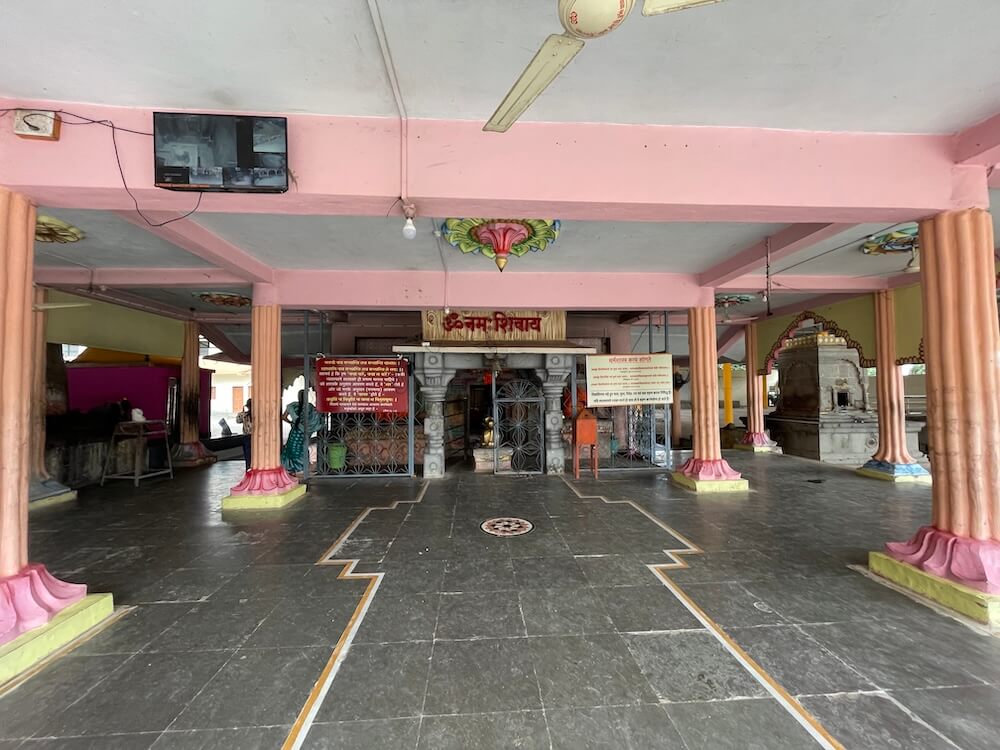
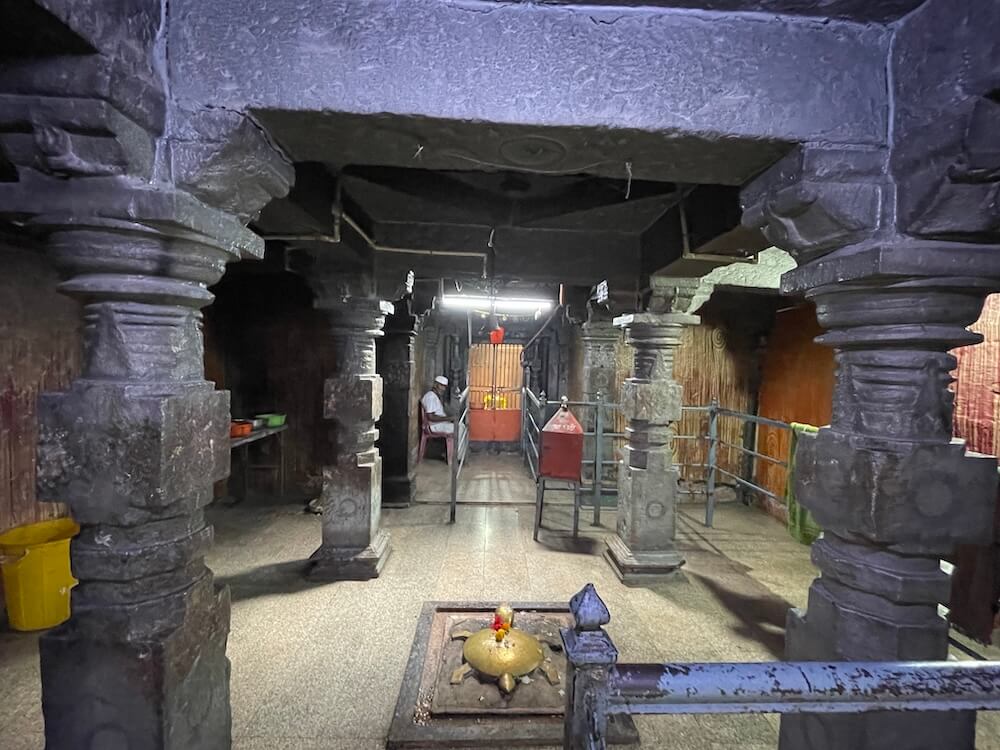
The priests here share that this temple, built in the Hemadpanti style with stone masonry, is approximately four hundred to five hundred years old. However, scholars believe that the temple is even more ancient, considering its architectural style and the intricate carvings on its stone pillars. The priests further state that the Darshan Mandap (hall for devotees to behold the deity) and other structures within the temple complex have been rebuilt over time. This sacred temple is nestled on the banks of the Vidrupa River in the town of Gevrai. The temple is fortified by a strong rampart, within which lies its entrance. In the temple’s paved courtyard, there is a roof shaped like an elephant’s back, supported by iron pillars. Beneath this roof are the samadhis (tombs) of the revered late priests, Kesinath Maharaj and Shankar Maharaj. Within the temple courtyard itself, parking facilities are available for the convenience of devotees.
Within the temple courtyard, beside the Darshan Mandapa, there is a raised platform upon which stands a tapering Deepamaal. On this platform, adjacent to the Deepamaal, is a sculpture of Nandi. Here too, there is a small shrine housing an idol of a local deity. In front of the main temple, within the courtyard, is an ancient stepwell constructed from carved stone. It is noteworthy that the water in this stepwell is said to never dry up. In front of the Mandir is a Darshan Mandap, which is semi-open. As it is somewhat elevated above the courtyard, this Mandap has two crescent-shaped steps each on its front and right sides. Within the Darshan Mandap, there are four rows, each with four intricately carved pillars. All the pillars stand upon square bases. This Darshan Mandap was built approximately one hundred years ago by the late Pujari, Shri Keshinath Maharaj, of this very place.
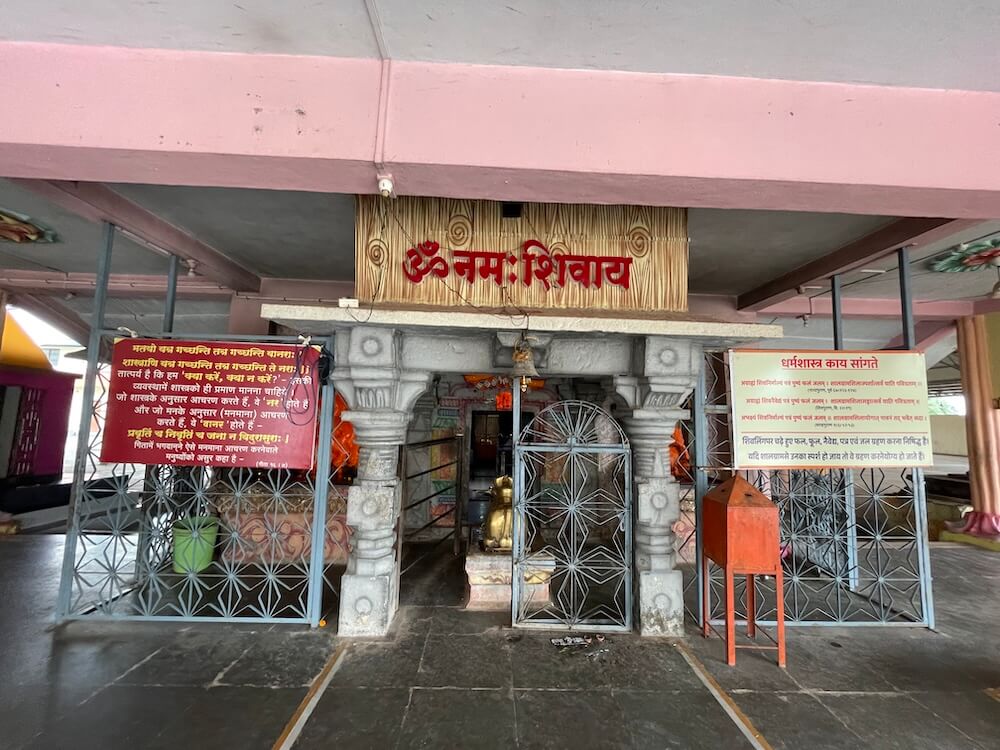
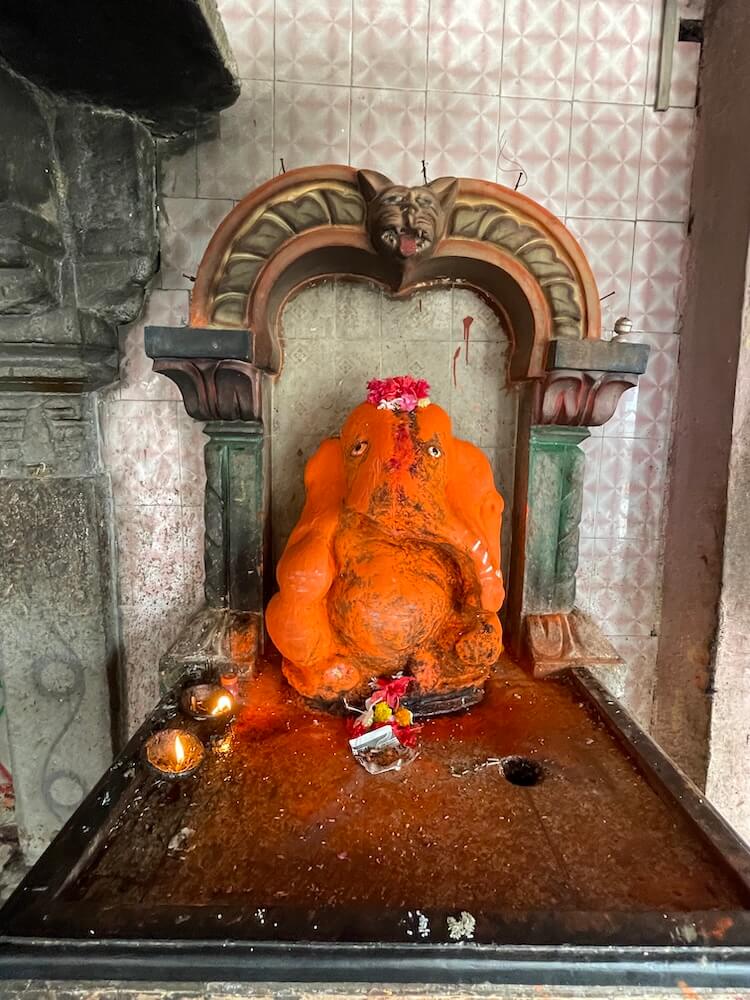
Further ahead is the ancient stone temple, originally constructed with a mukhamandapa, sabhamandapa, antarala, and garbhagriha. In the mukhamandapa stand two ornate pillars, resting on their padas. The lower approximately two feet of these pillars are square, while the upper sections feature various geometric shapes such as hexagons, octagons, and circles. Here, upon a vajra-pitha, is a black stone murti of Nandi. Flanking the entrance on the front wall of the sabhamandapa are two platforms. On the right-hand platform is a murti of Ganapati, and to the left, one of Maruti.
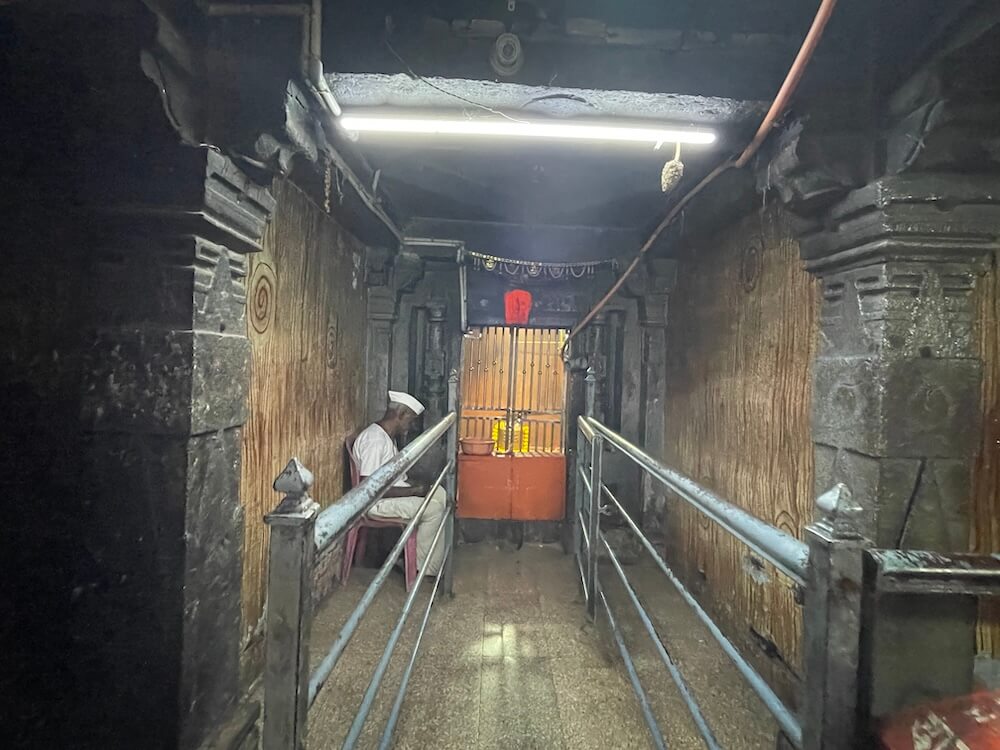
The ornate doorframes of the sabhamandapa are adorned with carvings of leaves and flowers, and a sculpture of Shri Ganapati graces the lalāṭabimba. The entrance features beautifully carved wooden doors. Within the assembly hall, there are four rows, each with four intricately carved pillars. All the pillars stand on square bases. Their shafts display various geometric shapes, including squares, hexagons, octagons, and circles. In the centre of the assembly hall floor, there is a tortoise sculpture. Along both walls of the assembly hall, stainless steel railings have been installed to manage the queues of devotees.
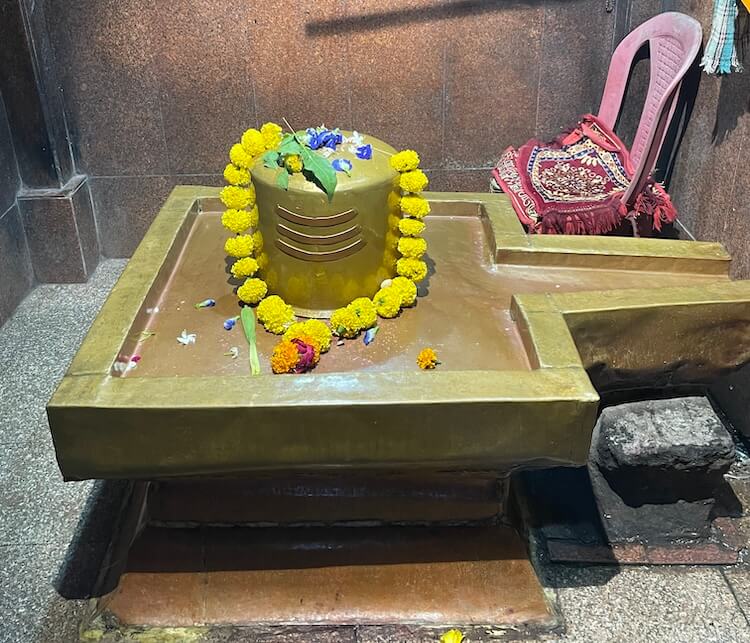
Ahead is a narrow antechamber, and beyond that, the entrance to the Garbhagriha. The doorframes of the Garbhagriha are adorned with creeper motifs, while the Lalatabimba features a sculpture of Ganapati. Inside the Garbhagriha, at the centre of the floor, rests a large Shivapindi with a tall, square Shalunka. A brass Naga with a canopy is placed upon the Shivapindi, and a copper Abhisheka Patra, holding a stream of water, hangs from the ceiling. On the outer rear side of the Garbhagriha, there is a Gomukha Pranal, and in front of it, a Nirmalya Kunda. The Mukhamandapa, Sabhamandapa, and Garbhagriha of the temple all have Shikhara (spires) on their roofs. The circular Shikhara on the Mukhamandapa is small. The Sabhamandapa has a medium-sized dome-shaped Shikhara, adorned with animal sculptures on all four sides. The Garbhagriha’s roof bears the tallest Shikhara. It features Devakoshthakas (niches for deities) on all four sides, each containing a deity’s idol. The roofs of these Devakoshthakas also display animal sculptures. At the very top of this Shikhara, there are two Amalakas placed one above the other, while the other two Shikharas each have a single Amalaka at their apex. All the Amalakas on the Shikharas are crowned with Kalashas and Dhwajapatakas (sacred flags).
Mahashivaratri is the main annual festival here. During this time, a continuous Harinam Saptah is organised for seven days. For seven consecutive days, the temple hosts programs such as bhajan, kirtan, pravachan, and mahaprasad. In the month of Shravan, for the entire month, devotees throng in immense numbers for darshan of the Lord and to fulfil their vows. Festivals and celebrations such as Chaitra Padwa, Dussehra, and Diwali are observed in the temple.
This sacred temple stands as a testament to deep spiritual devotion, ancient architectural grandeur, and rich local cultural traditions.
The sanctum sanctorum houses the divine idol consecrated according to ancient Vedic traditions, surrounded by serene courtyards and traditional temple architecture.
Navratri, Maha Shivratri, Annual Temple Jatra & Deepotsav
Compare and book flights, secure top-rated local hotels near the temple, hire reliable guides, and rent cars instantly.
Extend your pilgrimage by visiting other highly sacred temples located nearby.


Add ₹999 more to unlock FREE SHIPPING!
Your sacred cart is currently empty.
Shop Photo FramesFill in your delivery details below to place your order.
Add comment