
Add ₹999 more to unlock FREE SHIPPING!
Your sacred cart is currently empty.
Shop Photo FramesA famous shrine of Jotiba, the ‘King of the Deccan’ and the family deity (Kuldaivat) of various castes and communities in Maharashtra, is located at Girjawade in Shirala taluka. It is said that with the help of Goddess Chopdai, Jotiba slew the demon Girijasur at this very place. Later, after being summoned by devotees from the Kolhapur region to curb the menace of Ratnasur, Jotiba proceeded there. Because of this, this original abode of Jotiba holds special significance. Every day, hundreds of devotees arrive here for darshan, chanting ‘Changbhala’ and showering gulal and dry coconut.
The ‘Kedarvijay’ scripture narrates the glory of Jotiba. It is said that this was originally a Sanskrit text, which was brought into Marathi by a devotee of Jotiba named Hari Angapurkar. This text, consisting of 36 chapters, was published in the year 1779 CE. The legend described in this scripture states that at the Badri-Kedar region, the sage Pouganda and his wife Vilambuja were performing penance to be blessed with a son. On the day of Chaitra Shuddha Saptami, coinciding with Shashthi at sunrise on a Sunday, they were blessed with a son. He became famous as ‘Kedar Ravaleshwar’. He is considered an incarnation of Kedarnath from the Himalayas. Consequently, he came to be known by names such as Kedar, Kedareshwar, or Kedarling. Since Kedarnath is one of the Jyotirlingas, Kedarling also began to be referred to simply as Jyotirlinga. The author of ‘Kedarvijay’ asserts that the name ‘Jotiba’ became prevalent from this very name.
According to the Sthala Mahatmya (local legend) of this place, when the Pandavas were in exile, the flow of the holy river Ganga Bhagirathi (Bhogavati) at the site of Gaymukh in Girijapuri Upon arriving for a visit, he had consecrated the Mahadeva Pindi at this site. He resided on the local hills for some time. During that period, he liberated the citizens of this region from the torment of a demon. Furthermore, Dharmaraja advised the people here to follow the path of truth and righteousness. For this reason, Girjawade is also known as the ‘Dharmachi Pandhar’.
According to a legend, Jotiba slew the demon Girija in this region. The village where the demon’s torso fell was named Dhamwade, while the villages where his head and intestines fell were named Shirsi and Antri, respectively. The Atmanlinga from the deity’s neck fell at Chincholi, where a temple also stands. All these villages are located in the Girjawade area. For families such as the Mane and Nikam in this region, Khandoba of Girjawade is the family deity (Kuldaivat).
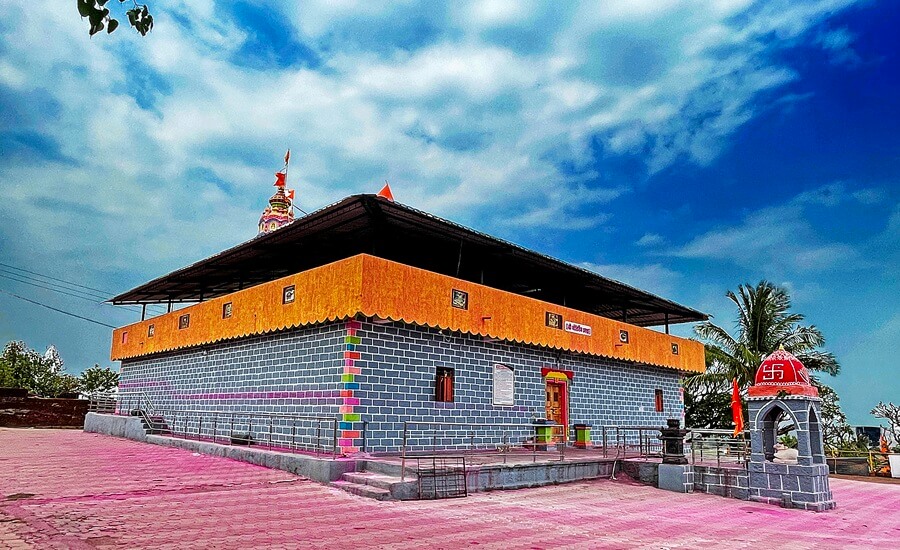
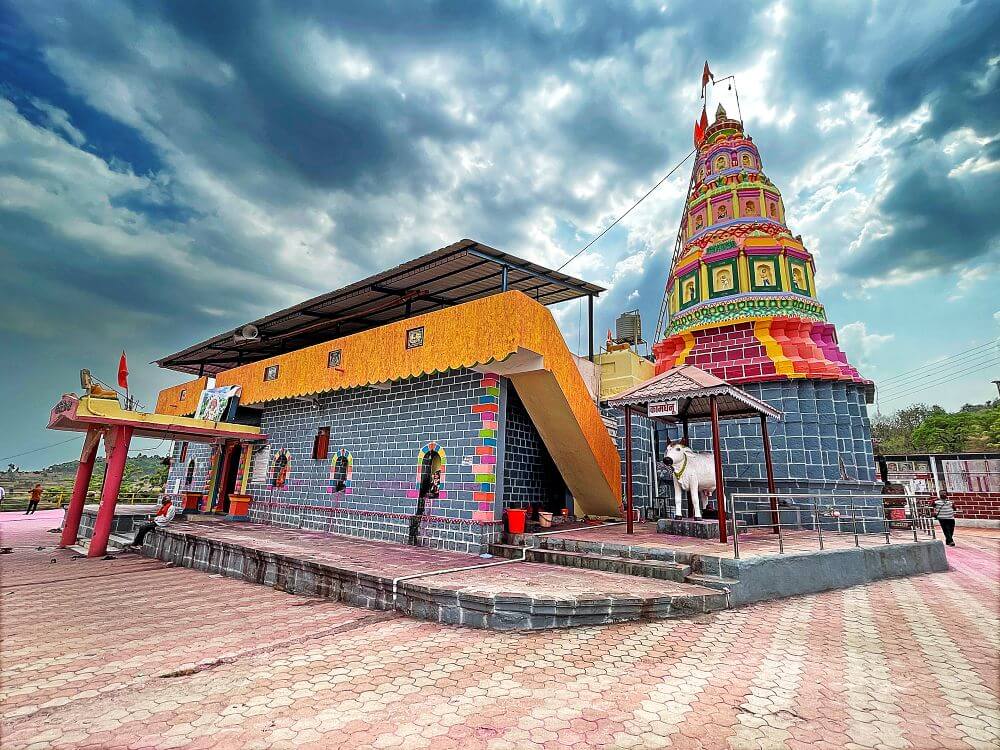
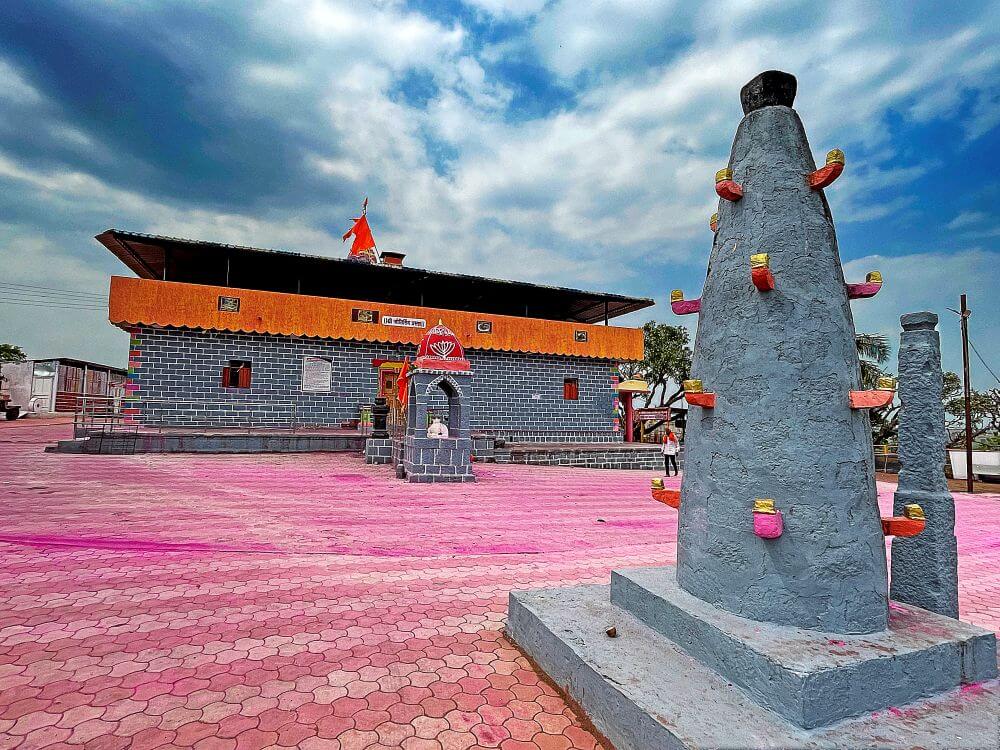
Girjawade, located on the border of the Karad taluka in Satara district, is the last village of the Shirala taluka. Beyond this lies a completely hilly region. On one of these mountain slopes is the sacred abode of Jotiba. One enters the temple courtyard after climbing about 25 to 30 steps. A few years ago, a motorable road was also constructed here to allow vehicles to reach the site. The temple premises look beautiful as the spacious courtyard is paved with paver blocks throughout. In this courtyard stands an ancient Deepmal (lamp tower) and a Deepstambh (pillar of lights). In front of the main temple is the Nandi Mandapa. Both the Nandi Mandapa and the main temple stand on a high plinth (jagati). There is a stone pathway about three feet high to enter the temple from the Nandi Mandapa. The temple and the Nandi Mandapa are connected by this pathway. In this Nandi Mandapa, there is a large stone idol of Nandi. Beside the Nandi Mandapa, there is a Tulsi Vrindavan made of black stone.
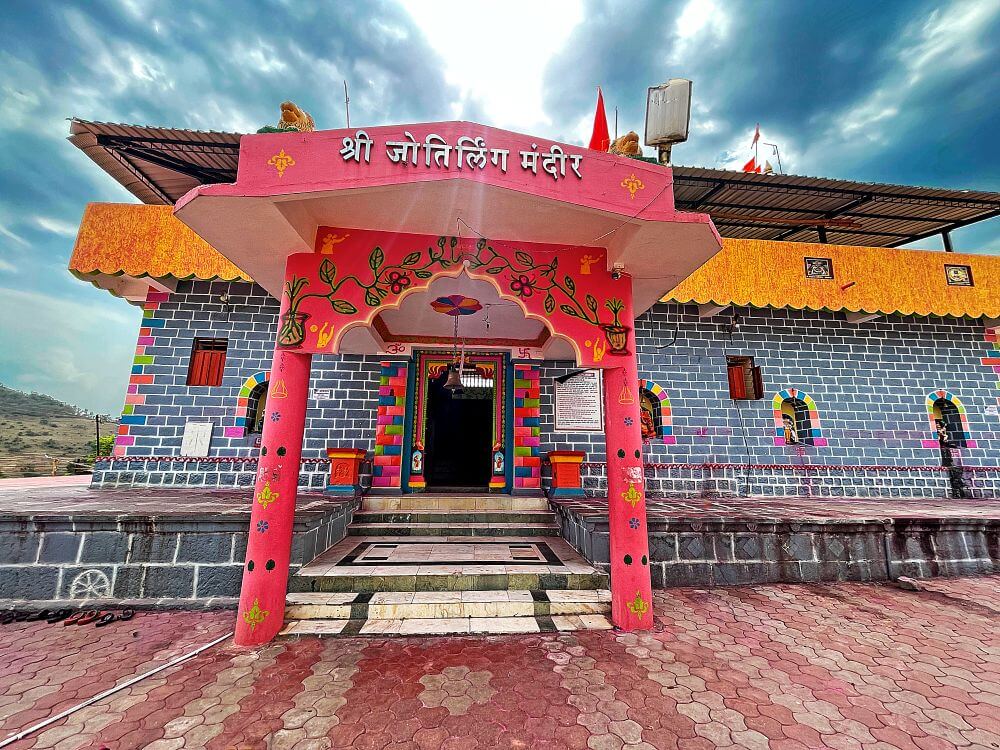
The structure of this two-story temple consists of a Mukhamandapa (front pavilion), Sabhamandapa (main assembly hall), Antarala (vestibule), and Garbhagriha (sanctum sanctorum). One enters the temple’s Sabhamandapa through the arched entrance of the Mukhamandapa. In the niches on the front wall of the Sabhamandapa, there is an idol of Ganapati on the right and Saraswati on the left. The door frames of the Sabhamandapa are adorned with intricate carvings, with welcoming figures (swagatika) at the base. In a niche on the left side of the Sabhamandapa stands a seven-foot-tall idol of Bhimabhairava, facing the Garbhagriha of Jotiba. The idol wears a turban on its head, and the staff held in the right hand is positioned over the head like a sword. With the left hand, the fallen He is holding the demon’s hand, and one foot is placed upon its chest.
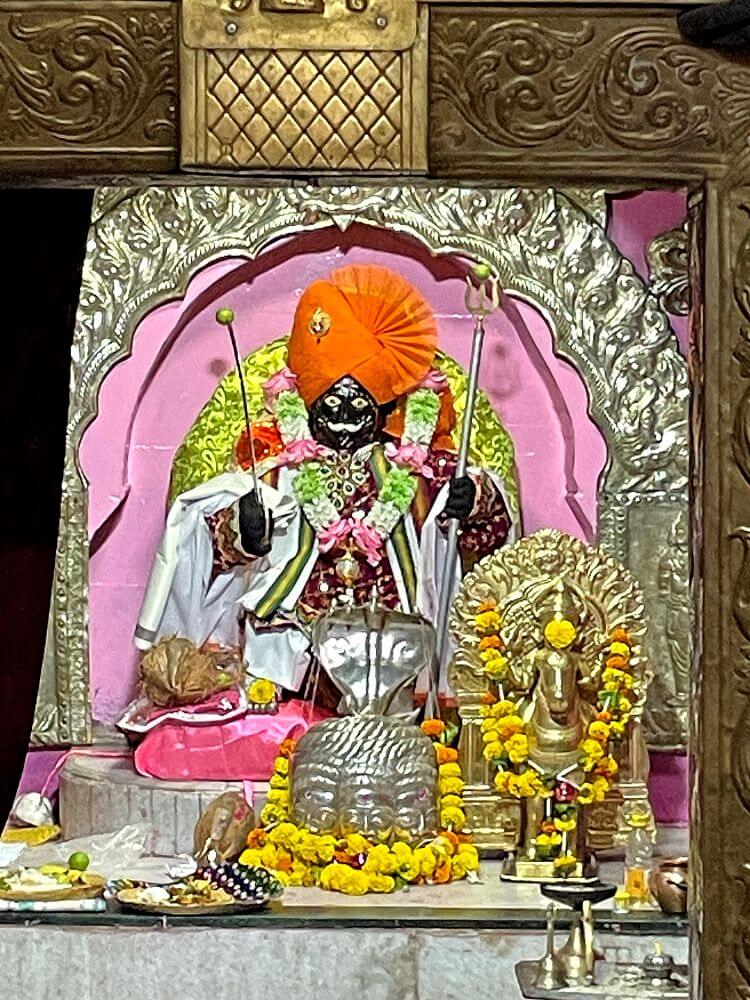
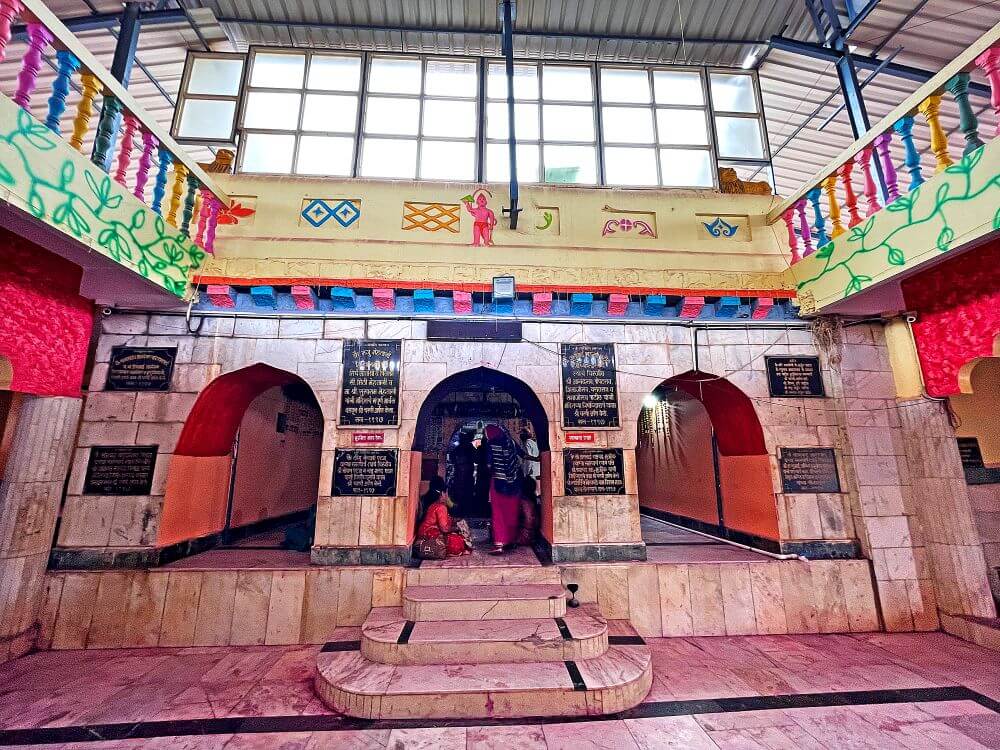
In front of Bhim-Bhairav, there is an antarala (vestibule) with three arches. To reach this slightly elevated antarala, there are four steps. The door frames of the sanctum sanctorum (garbhagriha) are covered with brass sheets, which are adorned with intricate vine carvings. On the lalata-bimba (lintel) of the sanctum entrance, there is an idol of Lord Ganesha. Inside the sanctum, on a vajrapitha (pedestal), stands the four-armed idol of Jotiba carved in black stone. With a turban on the head, large eyes, and a majestic mustache, the idol appears truly regal. The idol is adorned with various ornaments around the neck, and the hands hold a sword, a drinking vessel (panpatra), a damaru, and a trident. Jotiba is considered a manifestation of Brahma, Vishnu, and Mahesh. Therefore, in front of the idol of Jotiba, there is a three-faced silver pindi, over which a silver serpent holds a canopy. Near the feet of Jotiba, there is a brass utsavamurti (processional idol) depicting the deity mounted on a horse.
On the circumambulation path (pradakshina marga) of the sanctum sanctorum (garbhagriha) are the distinctive black stone idols of Kuntimata, Dharmaraj, Bhima, Arjuna, Nakula, Sahadeva, and Draupadi. In addition to these, there are also idols of Mangaladevi, Tukai, Kalammadevi, Vitthalai, Waghjaidevi, Ninaidevi, Shri Krishna, Ambamata, Yamaidevi, Mahakali, Saint Dnyaneshwar, Vitthal-Rukhumai, and Saint Tukaram. Furthermore, there is also a Nandi and a Shivlinga here.
On the outer circumambulation path (pradakshina marga) of the temple, there are idols of Ganpati, Saraswati, Dattatreya, and Hanuman. On the outer walls of the temple, there are images of the Jyotirlingas. On the same circumambulation path, there is a sculpture of a cow performing milk abhishek (dugdhabhishek) on a Shiva Linga. The temple spire (shikhara) consists of three tiers. The niches in the first tier contain images of common citizens, the second tier contains images of sages and saints (sadhu-muni), and the third tier contains images of deities. Above this section are the amalaka and the pinnacle (shikhara).
A fair is held here on Hanuman Jayanti. At that time, a large crowd of devotees gathers here. It is said that during this fair, the fragrance of Davana (Artemisia) permeates the sanctum sanctorum. Davana is considered to be the favorite plant of Lord Jyotiba. Traditional cultivation of Davana takes place in Kekhale village, situated at the foothills of the Jyotiba mountain in Panhala taluka. It is said that apart from this village, Davana is not grown anywhere else in the Kolhapur district. Although the fragrance of Davana fills the sanctum during the fair, the plant itself is not physically present there. It is the firm belief of the devotees that it arrives here secretly from the Mahadeva of Shikhar Shingnapur. Only when the fragrance of this Davana fills the sanctum is the deity’s palanquin procession taken out. The enthusiasm of the devotees reaches its peak at that moment. For this fair, palanquins arrive from the surrounding villages of Dhamode, Pulambri, Shirsi, Wakurde, Antri, Yenpe, and Yelgaon (Taluka Karad). There is a large pond on the mountain here. On the last Monday of Shravan, the deity goes there for a ritual bath.
This sacred temple stands as a testament to deep spiritual devotion, ancient architectural grandeur, and rich local cultural traditions.
The sanctum sanctorum houses the divine idol consecrated according to ancient Vedic traditions, surrounded by serene courtyards and traditional temple architecture.
Navratri, Maha Shivratri, Annual Temple Jatra & Deepotsav
Compare and book flights, secure top-rated local hotels near the temple, hire reliable guides, and rent cars instantly.
Extend your pilgrimage by visiting other highly sacred temples located nearby.


Add ₹999 more to unlock FREE SHIPPING!
Your sacred cart is currently empty.
Shop Photo FramesFill in your delivery details below to place your order.
Add comment