
Add ₹999 more to unlock FREE SHIPPING!
Your sacred cart is currently empty.
Shop Photo FramesThe city of Miraj, which possesses a rich historical, cultural, and spiritual heritage dating from the Shilahara dynasty through the Adil Shahi, Shivshahi, and Peshwa eras, is home to many ancient temples. One such renowned temple is the Khandoba Temple. It is said that the masks (mukhvates) of Khandoba and Mhalasai in this temple originated from the Khandoba temple in Pali, Satara district. These silver masks, along with the annual fair held in the month of Paush and the accompanying wedding ceremony of Khandoba and Mhalasai, are the main attractions of this temple.
In the research treatise ‘Dakshinecha Lokadev Shrikhandoba’ by the great scholar R. C. Dhere, it is stated that this folk deity is known as Khandoba in Maharashtra and Mailar in Karnataka. Mhalasa is the consort of Mallari Martand Bhairav, that is, Khandoba. For this reason, he is addressed as Mhalasakant. Mhalasa is considered an incarnation of Mohini. According to mythological legend, Mhalasa incarnated at the home of the merchant Timmashat Vani in Nevase. Subsequently, following the divine command received in a dream by Martand Bhairav, the marriage of Martand Bhairav and Mhalasa took place at Pali on Paush Shuddha 15. In the sanctum sanctorum of the temple at Pali, there are self-manifested (Swayambhu) lingas and masks of Khandoba and Mhalasa. One of their shrines is the Khandoba temple in Miraj.
A part of the city of Miraj, which has been a major grain market since historical times, is known as Magdum Galli. The word Magdum is derived from ‘Makdumi’, meaning the position of a Patil (village head). In this Magdum Galli, there is a temple of Khandoba. It is said that the Magdum people here were great devotees of Khandoba. They used to travel to Pali to seek the blessings of their family deity, Khandoba. Once, they brought the masks (mukhwate) of the deity from the Khandoba temple in Pali here in a palanquin. brought it. It was installed under a large Peepal tree. Later, a Magdum devotee from this place offered a mansion (wada) for the deity, and the masks were installed in this mansion. Over time, this mansion, located in a bustling settlement, transformed into a temple.
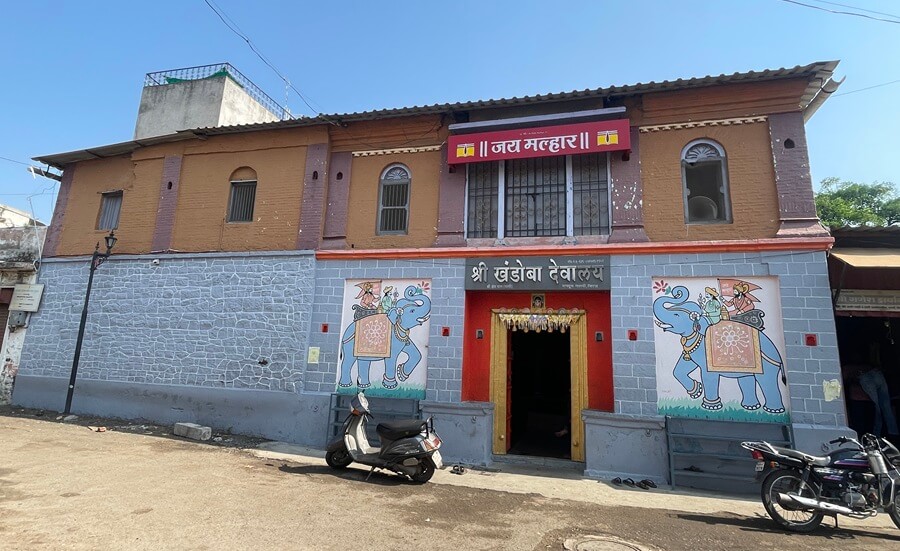
It is said that this wada is approximately 150 to 200 years old. The lower structure of this two-storey temple-like wada is made of stone, while the upper portion is built of bricks. On the front walls of the temple, one can see paintings of decorated elephants on both sides, with a mahout and a person holding the ‘Malhar’ flag sitting atop them. Above the temple entrance, there is a plaque that reads: ‘Khandoba Devalaya, Shri Kshetra Pal (Pali), Magdum Galli, Miraj’. As this is the temple of Khandoba in Pali, it has been mentioned accordingly.
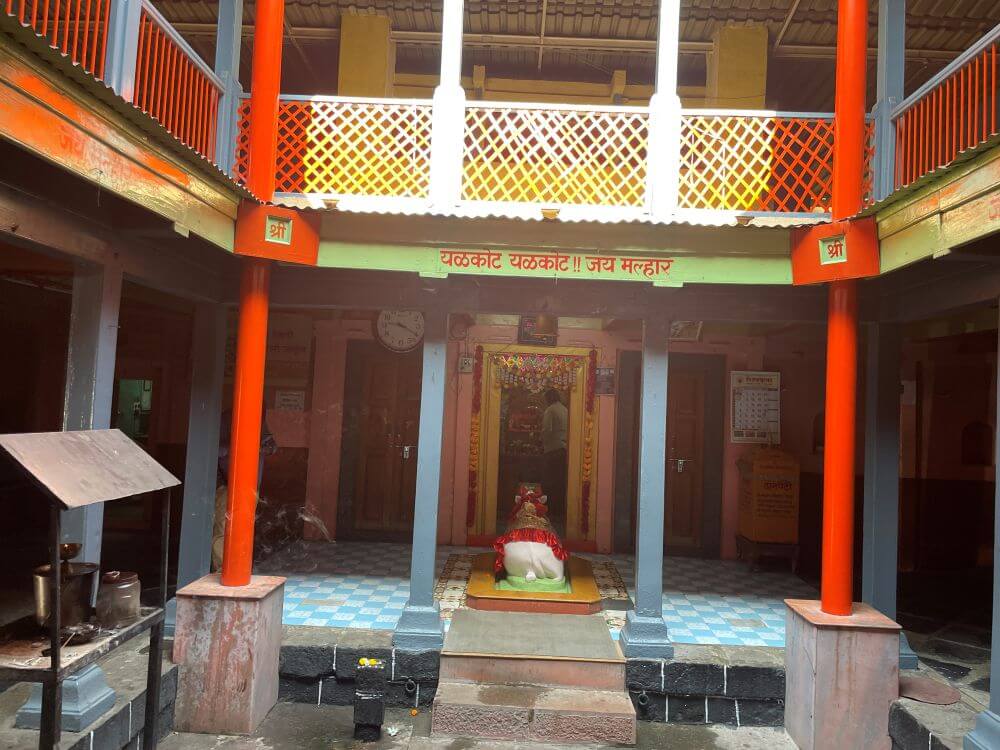
The doorframe of the entrance is covered with gold plating, featuring intricate floral and leaf carvings. Above the doorframe, there are carvings of the Shivling, the Sun, and Nandi. There are relief sculptures, on which a depiction of Ganapati is visible. Upon entering the temple, one can see the architectural style of traditional mansions (wadas). The structure features stone masonry, wooden pillars, and a wooden ceiling. It is said that the roof was originally tiled, but corrugated sheets were installed in later times. There is a large, open space here known as the padvi, which resembles a sabhamandapa (assembly hall). A raised platform (ota) is built on all four sides, with a large, open square area in the center. This central square is open all the way up to the ceiling, allowing sunlight to stream in from above and illuminate the temple. In the very center of this space lies a silver tortoise. The temple’s structure consists of a closed sabhamandapa, an antarala (vestibule), and the garbhagriha (sanctum sanctorum).
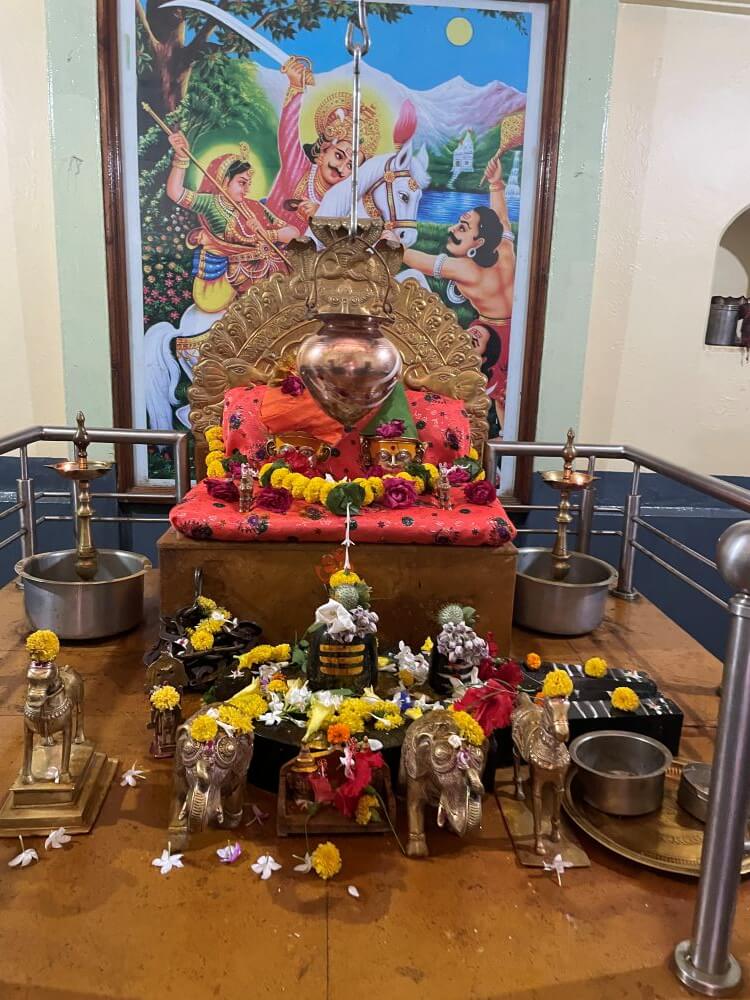
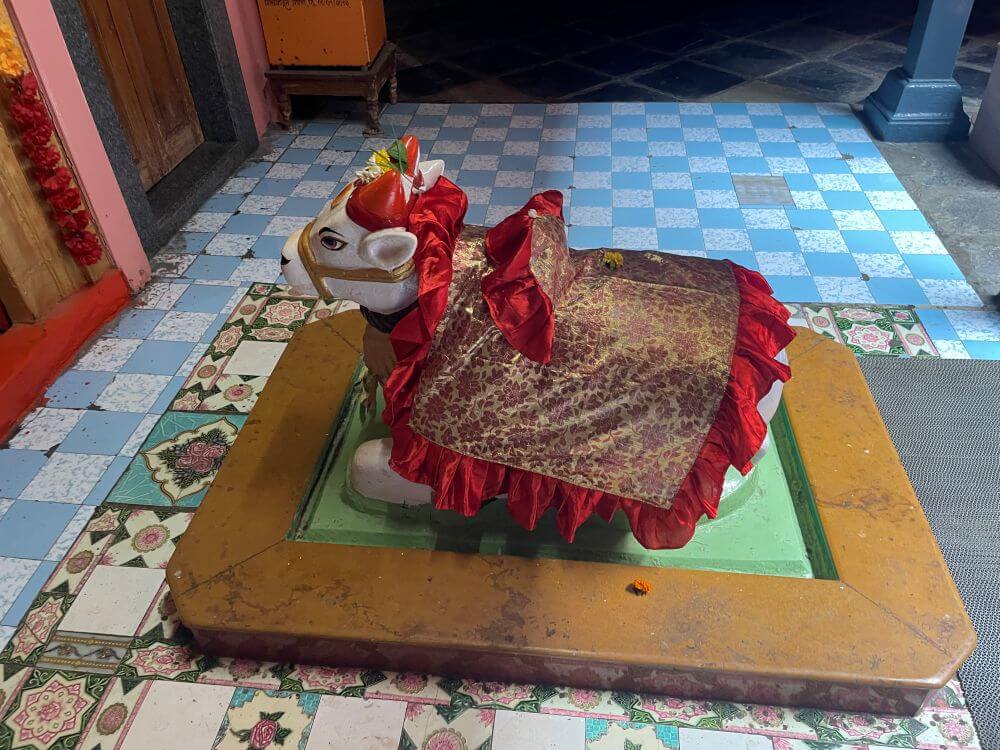
While moving towards the Antaral, there is a stone on the left used for breaking a langar (iron chain). There is a tradition of tying this langar to this stone and breaking it during the yatra. Further ahead in the Antaral, there is an idol of Nandi. The doorframes of the sanctum sanctorum (Garbhagriha) are covered with gold plating. Inside the Garbhagriha, the silver masks of Khandoba and Mhalsa are placed on a throne atop a large Vajrapitha, resting on a cushion of silk garments. These masks are exquisitely crafted. A *bhandara* (turmeric powder) mark is applied to their foreheads. Khandoba is adorned with a *pheta* (turban), and Mhal-sai is adorned with a *khana* (traditional fabric) crown. In front of them are two small silver horses, which are the *vahana* (mounts) of Lord Khandoba. Behind the throne, one can see intricate carvings of the five-headed Sheshnag, two elephants, a *kirtimukh*, and serpents beside them. In front of the throne is a *dwilingi pindi* (a dual-lingam structure); it is said that one represents Khandoba and the other represents Goddess Mhal-sai. Placed in front are their mounts—two silver horses—along with two elephants and small replicas of the masks of Khandoba and Mhal-sai. Also kept here is the *langar*, a thick iron chain that is broken during the *yatra* (pilgrimage festival). At the bottom is the mask of a *Waghya*, a devotee of the deity. There are some niches on the walls of the *garbhagriha* (sanctum sanctorum). In the niche on the left side, there is a brass mask of Banai, the second wife of Khandoba. Next to it is the mask of Hegade Pradhanji, who is believed to be an incarnation of Lord Vishnu.
Outside the sanctum sanctorum, in a room on the right side, is the bedchamber of Khandoba. It contains a cot and the deity’s bedding. Behind the temple, there is a large Bael tree, beneath which sits a Nandi. Additionally, there is an ancient tortoise carved from black stone. On one side of the ceiling, the temple’s palanquin is mounted. This palanquin is taken out during the month of Shravan and at the time of the fair. Devotees can have darshan of Khandoba and Mhalasai in this temple daily from 5:30 AM to 8:00 PM. Every Purnima, Amavasya, Champashasthi, and during Shravan, devotees visit in large numbers for darshan. The fair is held here in January, which is the month of Paush, coinciding with the Khandoba fair at Pali. During this fair, the wedding ceremony of Khandoba and Goddess Mhalasa takes place. Devotees gather in large numbers to witness this event. On that occasion, Mahaprasad is also organized for the devotees. On the first and last Mondays of Shravan, these masks from the sanctum sanctorum are taken in a palanquin to the Krishna River for a holy bath.
Along with its religious significance, the city of Miraj is also renowned for its cultural heritage. It is known worldwide as the home of Ustad Abdul Karim Khan, a legendary figure in Hindustani classical music. It was in this city that the Bhagavad Gita was first published in printed form in the country. The nation’s first-ever live radio broadcast also took place in this city.
This sacred temple stands as a testament to deep spiritual devotion, ancient architectural grandeur, and rich local cultural traditions.
The sanctum sanctorum houses the divine idol consecrated according to ancient Vedic traditions, surrounded by serene courtyards and traditional temple architecture.
Navratri, Maha Shivratri, Annual Temple Jatra & Deepotsav
Compare and book flights, secure top-rated local hotels near the temple, hire reliable guides, and rent cars instantly.
Extend your pilgrimage by visiting other highly sacred temples located nearby.


Add ₹999 more to unlock FREE SHIPPING!
Your sacred cart is currently empty.
Shop Photo FramesFill in your delivery details below to place your order.
Add comment